1 Corinthians 1:3-17 – Proclaim Good News

Jesus de Greatest, statue in Nigeria

Grace and peace to you from God our Father and the Lord Jesus Christ.

I always thank my God for you because of his grace given you in Christ Jesus. For in him you have been enriched in every way—with all kinds of speech and with all knowledge— God thus confirming our testimony about Christ among you. Therefore, you do not lack any spiritual gift as you eagerly wait for our Lord Jesus Christ to be revealed.He will also keep you firm to the end, so that you will be blameless on the day of our Lord Jesus Christ. God is faithful, who has called you into fellowship with his Son, Jesus Christ our Lord.

I appeal to you, brothers and sisters, in the name of our Lord Jesus Christ, that all of you agree with one another in what you say and that there be no divisions among you, but that you be perfectly united in mind and thought. My brothers and sisters, some from Chloe’s household have informed me that there are quarrels among you. What I mean is this: One of you says, “I follow Paul”; another, “I follow Apollos”; another, “I follow Cephas”; still another, “I follow Christ.”

Is Christ divided? Was Paul crucified for you? Were you baptized in the name of Paul? I thank God that I did not baptize any of you except Crispus and Gaius, so no one can say that you were baptized in my name. (Yes, I also baptized the household of Stephanas; beyond that, I don’t remember if I baptized anyone else.) For Christ did not send me to baptize, but to preach the gospel—not with wisdom and eloquence, lest the cross of Christ be emptied of its power. (New International Version)

The Apostle Paul clarified the foremost mission of Christianity to the Corinthian church: Preach the gospel. 

Everything else Paul did – from healing people to gathering offerings for others, and from making tents to journeying around the Mediterranean world – he did with the central focus and aim of proclaiming the good news of God’s grace in Christ.

Unfortunately, the Corinthian believers had lost sight of this urgent and needed imperative of proclaiming the good news of Jesus. Instead, they hardened into opinionated groups. Disunity amongst them was rampant and rancid. In short, the church made secondary matters of first importance. So, Paul wrote to correct this situation, which had gotten completely out of hand.

The proclamation of the gospel in Word and Sacrament needs to be at the core of every church and every believer’s life. When it isn’t, there are factions, special-interest groups, and condescending attitudes which fill the vacuum left in the center.

There are some things, maybe most things, we can agree to disagree with. Yet, when it comes to the good news of forgiveness and grace in Christ, we are to be of one mind. It is imperative we agree together that the heart of Christian mission is the gospel.

Unity around the gospel won’t happen if everyone is listening to competing voices.

Some believers have their favorite pet preachers. They follow that person and listen to them. That’s fine – to a degree. Yet, problems will inevitably arise because some practices happening within a particular church or faith community may not sync with the pet preacher or teaching. And if several individuals have different folks they follow, it can get messy in a hurry.

Following one person over another, Paul insists, is not the real issue in Christianity. Rather, it’s proclaiming the gospel – and not some person or their ideas. Believers need to put a whole lot more energy into using their spiritual gifts, rather than putting a crown on some worm of a preacher.

People can disagree on a lot of things, and that’s okay. But, in the church, there ought always be agreement and unity in building ministry around the person and work of Jesus Christ.

Everyone in the church, without exception, has a role to fulfill, a gift to exercise, in proclaiming good news. For me, I enjoy teaching Scripture to unbelievers and answering their questions, as well as mentoring believers in the cardinal doctrines of faith and practice. 

Others proclaim the gospel through hospitality, or partnering with others, or even inviting people to events and bible studies. In all the myriad ways God has gifted us, whether it is in serving or speaking, we are to use that gift not to advance a personal agenda, but to preach the gospel.

In this season of the Epiphany, Christians celebrate that the gospel has come to Gentiles and not only Jews. The light shines on all people, not just some. Therefore, followers of Jesus are to let their light shine, as our Lord exhorted us:

“You are the light that shines for the world to see. You are like a city built on a hill that cannot be hidden. People don’t hide a lamp under a bowl. They put it on a lampstand. Then the light shines for everyone in the house. In the same way, you should be a light for other people. Live so that they will see the good things you do and praise your Father in heaven.” (Matthew 5:14-16, ERV)

Blessed Father, Son, and Spirit, you are One God, perfectly united and in continual harmony. You have loved humanity to such a degree that you orchestrated a great deliverance from sin, death, and hell. Help your entire church to resolve petty differences and fix a gaze firmly and graciously on proclaiming the good news of salvation in Jesus, our Lord. Amen.

Why Is Our Ministry Important?

Welcome, friends! Luke 4:14-30 is the account of Jesus reading the words of Isaiah the prophet to proclaim good news to the poor, freedom for prisoners, recovery of sight for the blind, and release for prisoners. How Christ used those words caused a huge commotion, and still does. Let’s find out together what happened. Click the videos below and let us consider Jesus….

Pastor Tim Ehrhardt, Luke 4:14-30

Gracious God, you bring glad tidings to the poor, heal the brokenhearted and free prisoners from jails. Please come to us and send us out, as forgiven people, to the poor, the brokenhearted, and the imprisoned. Amen.

Matthew 2:1-12 – Epiphany of the Lord

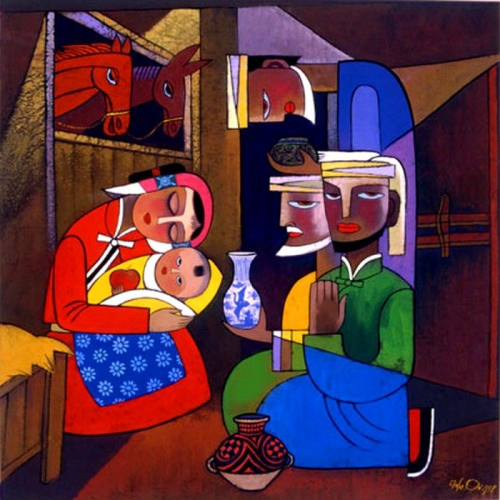
The Three Wise Men by He Qi

In the time of King Herod, after Jesus was born in Bethlehem of Judea, wise men from the East came to Jerusalem, asking, “Where is the child who has been born king of the Jews? For we observed his star at its rising and have come to pay him homage.” When King Herod heard this, he was frightened, and all Jerusalem with him; and calling together all the chief priests and scribes of the people, he inquired of them where the Messiah was to be born. They told him, “In Bethlehem of Judea; for so it has been written by the prophet:

‘And you, Bethlehem, in the land of Judah,
    are by no means least among the rulers of Judah;
for from you shall come a ruler
    who is to shepherd my people Israel.’”

Then Herod secretly called for the wise men and learned from them the exact time when the star had appeared. Then he sent them to Bethlehem, saying, “Go and search diligently for the child; and when you have found him, bring me word so that I may also go and pay him homage.” When they had heard the king, they set out; and there, ahead of them, went the star that they had seen at its rising, until it stopped over the place where the child was. When they saw that the star had stopped, they were overwhelmed with joy. On entering the house, they saw the child with Mary his mother; and they knelt down and paid him homage. Then, opening their treasure chests, they offered him gifts of gold, frankincense, and myrrh. And having been warned in a dream not to return to Herod, they left for their own country by another road. (New Revised Standard Version)

“Truth, by which the world is held together, has sprung from the earth, in order to be carried in a woman’s arms.”

St. Augustine

Each year on January 6 in the Church Calendar, after the twelve days of Christmas, is the celebration of Epiphany. Christ’s coming to this earth as a child and becoming like us is much more than a baby in a manger.  Epiphany helps to bring a vision and understanding of God’s glory to all kinds of people of the world.

Epiphany means “manifestation” or “appearance.”

The event associated with this season is the visit of the Magi to Jesus. The season of Epiphany has a special emphasis on the teaching and healing ministry of Jesus. The great celebration and focus of these weeks is that salvation is not limited to Israel but extends to the Gentiles, as well.

Every season in the Christian Year has its unique angle of grace. With Epiphany, we see that one of the most scandalous truths of Christianity is that God graces common ordinary people who seem far from God with the gift of Jesus. 

God grants repentance that leads to life for all kinds of people no matter their race, ethnicity, gender, class, or background. It is a wondrous and astounding spiritual truth that God’s gracious concern is not limited to a certain type of person or a particular group of people.

Grace is and ought to be the guiding factor in how we interact with people. 

Losing sight of grace leads to being critical and defensive. Like King Herod of old, a graceless person becomes enamored with earthly power and control. But embracing grace leads to the humility of seeing the image of God in people quite different from ourselves. 

Like the Apostle Peter, who learned in a vision to bring the gospel to non-Jews, old legalisms begin to wear away so that people from all walks of life can have access to Jesus and his gracious saving and healing ministry. (Acts 10-11:18)

Grace brings down barriers and causes us to do away with unnecessary distinctions between others. Our appropriate response to such a grace is to glorify God for his marvelous and amazing work.

It is a merciful reality that the Magi, or Wise Men, pagan astrologers, were directed to the Messiah. A light was provided to lead them to Jesus. Apart from God’s care and intervention they would have remained in darkness. 

Adoration of the Magi by He Qi

It is still true for people today. This old broken world is wrapped in darkness. All kinds of people have no light at the end of the tunnel of their lives for hope and new life. The gospel of Jesus Christ brings that light to those unable to see. Jesus, in his teaching ministry, exhorted his followers not to hide their light but to let it shine for all to see. (Matthew 5:14-16)

Sometimes, maybe oftentimes, the best way to bring resolution to our own troubles and problems is through helping others make sense of their lives through the gracious light of Christ. Then, they can see an appearance, an epiphany, of what their lives could be in the gracious rule of the kingdom of God. 

As we celebrate Epiphany and journey with Jesus through his earthly upbringing and into his gracious ministry to people, let us keep vigilance to not let our light grow dim. Instead, let us hunger and thirst after Christ’s righteousness so that our joy is full, and our light is bright.

God of mercy, Lord of all, you have gifted the Church through the goodness of your grace to be your hands and do your work, to be your voice and share your words, to bring healing to broken lives. You have graciously gifted your people with the blessings of your Spirit, the power to transform lives and make all things new.

Now may our hearts receive, our mouths proclaim, our hands prepare for compassionate service so that the love we have may overflow into the hearts of others. May they receive your grace, your renewing Spirit, and your love, through Jesus Christ our Savior. Amen.

Luke 1:46b-55 – Mary’s Magnificat

Mary’s Magnificat by Br. Mickey McGrath

Mary responded,

“Oh, how my soul praises the Lord.
    How my spirit rejoices in God my Savior!
For he took notice of his lowly servant girl,
    and from now on all generations will call me blessed.
For the Mighty One is holy,
    and he has done great things for me.
He shows mercy from generation to generation
    to all who fear him.
His mighty arm has done tremendous things!
    He has scattered the proud and haughty ones.
He has brought down princes from their thrones
    and exalted the humble.
He has filled the hungry with good things
    and sent the rich away with empty hands.
He has helped his servant Israel
    and remembered to be merciful.
For he made this promise to our ancestors,
    to Abraham and his children forever.” (New Living Translation)

Mary’s great song of praise grasps the reality of being pregnant with the Messiah. Mary affirmed that the all-powerful God “has done great things for me.” Indeed, the Lord shows mercy to everyone who worships and adores such mighty acts.

It strikes me that Mary, instead of being full of worry and afraid of the future, and as an unmarried teen with child, is full of the Spirit and faith. Mary neither complained nor fretted for the nine months of her pregnancy; she praised God and was clear-headed about the grace shown to her.

Mary’s canticle gives us insight into the mystery of the incarnation: God chooses the weak, those of low esteem, and the powerless.

Mary was rather ordinary. She had no wealth. She possessed nothing which would cause anyone to pick her out of a crowd. Yet, she is the one chosen by God. And her wonderful response to grace demonstrated that there is so much more to any person than what we can see with our eyes and perceive through our earthly glasses of high positions and strength of personalities.

The mother of Jesus had the wisdom to discern that her situation typified the Lord’s egalitarian work of leveling the field. Mary’s pregnancy normalized the needs of all people. Her son, the Deliverer, would carry this understanding into his own life and ministry – declaring good news to the poor, comforting the brokenhearted, proclaiming freedom for captives, telling those who mourn that the time of the Lord’s favor has come.

God is full of grace, mercy, and power to the powerless and the needy. The Lord has our backs. Perhaps if we all, both individually and corporately, continually used our words to identify and declare the great things God has done we would realize the consistent blessing of the Lord. 

As we near the night of our Lord’s birth, take some time to reflect on the ways God has been good to you in this Advent season, and like Mary, offer praise for each act of mercy. Mary exhibited no helplessness but had her heart calibrated to detect the grace of God when it was present.

Great and mighty God, I will praise you with all my heart.  You care for me and always show mercy to those who worship you.  Fulfill all your good promises in me, and in all your people, for the sake of your Son, the Lord Jesus.  Amen.