The Parable of the Sower

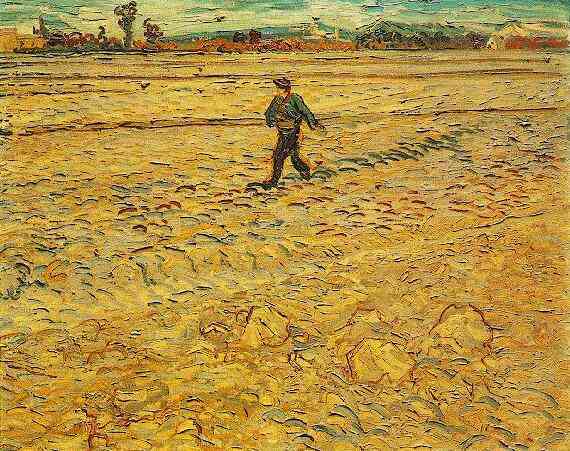
The Sower by Van Gogh 1881
“The Sower” by Vincent Van Gogh, 1881

“A farmer went out to sow his seed. As he was scattering the seed, some fell along the path, and the birds came and ate it up. Some fell on rocky places, where it did not have much soil. It sprang up quickly because the soil was shallow. But when the sun came up, the plants were scorched, and they withered because they had no root. Other seed fell among thorns, which grew up and choked the plants. Still other seed fell on good soil, where it produced a crop—a hundred, sixty or thirty times what was sown. Whoever has ears, let them hear.” (Matthew 13:3-9, NIV)

Introducing the Parable

I have been preaching sermons for over thirty-five years, so I have seen my share of people falling asleep in church.  The most common ways of drifting off during a sermon are, what I call, the “Snapback” in which the head dramatically snaps back from its gradual descent backward; the “Pious Nod” where it might appear the person is praying until the head either hits the pew in front of it or snaps up, as in the snapback; and, the “Cozy-Sweet” where the head goes to the side and eventually lands on its neighbor’s shoulder for a bit of a nap.

I tend to believe if you need to sleep, you need to sleep – and I find the nodding-off antics of parishioners as bringing some light-hearted levity to my life. That said, for the Christian, it is important to listen to the Word of God.  We need, first and foremost, to take a posture of listening, really hearing what Jesus has to say so that we can do the will of God.

The Parable

“Whoever has ears, let them hear,” said Jesus.  Truly hearing Jesus’ words and listening with focused attention is the key to life.  Our ears are the soil of our lives.  Ears that are attentive and devoted to listening to Jesus are good soil; ears that are distracted and inattentive and stopped up with ear wax are the bad soil.  Receptive listening to the Word of God brings a fruitful harvest of righteousness, peace, and joy in the Holy Spirit.  The Parable of the Sower (or Soils) lets us know that sowing (planting) the Word is important.   It is sown on four different soils….

  1. The seed on the path. A path is for walking, which is why the seed never takes root.  Here there is no listening. When we act without listening, our actions will be misguided.
  2. The seed on rocky soil. Here there is no deep listening.  A lack of attentive hearing results in a shallow person who perhaps relies more on Christian clichés or on his/her personality or abilities instead of the sown Word.
  3. The seed on the thorny soil. Here there is significant listening. However, there is too much listening to a cacophony of voices and not enough singular listening to the sown Word.  Listening to the wrong voices will cause an unfruitful life, so we must be careful to the kind of preaching and type of preachers we hear!
  4. The seed on good soil. A devoted listening to the Word without distraction leads to a productive, fruitful believer.

The Nature of Parables

A parable is a genre of biblical literature.  Parables are as much about concealing truth as they are conveying truth.  A person needs to give focused attention to the story to learn from it, much like a good novel conveys truth about the human condition without being preachy or outright saying the truth; or, much like a good movie that relies on character development and the power of story for its message instead of being a straightforward documentary.

Jesus neither strong-arms people into the kingdom nor puts a person in a full nelson to force them to do God’s will.  We will miss the kingdom if we are looking for a big dramatic hoo-ha of an event, because it comes as an awareness within people and works its way out. For the person who has no intention of changing, they will find Christ’s words confusing.  They might “hear” Jesus yet fail to really listen since they have their own ideas about how the kingdom ought to operate.

Yet, grace is present.  The very fact that Jesus addressed the crowd of people demonstrates he cared enough to communicate.  He could have said, “Hey, you guys, get lost, I’m just going to interact with people who really listen to me.”  Jesus, however, is full of mercy.  Instead of coming at the crowd and bursting through the front door, he came at them through the side door so that they would be able to receive the message well.

When I was a young Christian, I had a habit of puking the good news of Jesus all over people without really listening to them.  Being blunt without being attentive is not the best approach; neither is being worried about saying something offensive, so nothing is said at all.  Others cannot listen if we are either obnoxious or silent. A better approach is to ask permission to tell your story of what Jesus means to you, or what you have learned from God’s Word.

The Sower by Van Gogh 1888
“The Sower” by Vincent Van Gogh, 1888

The Parable Interpreted

“Listen then to what the parable of the sower means: When anyone hears the message about the kingdom and does not understand it, the evil one comes and snatches away what was sown in their heart. This is the seed sown along the path. The seed falling on rocky ground refers to someone who hears the word and at once receives it with joy. But since they have no root, they last only a short time. When trouble or persecution comes because of the word, they quickly fall away. The seed falling among the thorns refers to someone who hears the word, but the worries of this life and the deceitfulness of wealth choke the word, making it unfruitful. But the seed falling on good soil refers to someone who hears the word and understands it. This is the one who produces a crop, yielding a hundred, sixty or thirty times what was sown.” (Matthew 13:18-23, NIV)

The focus of the interpretation Jesus gave is the experience of the seed in a variety of soils.  The outside powers that act on the Word – devouring birds, rocks, the burning sun, choking thorn-bushes – demonstrate that the Word is central and needs to be received well:

  1. The soil on the path is the person who hears the message yet is unable to hear God’s Word because their heart is hard. The devil snatches it before any real understanding can take place.  We see that the devil is real and has ability to influence people who have listening issues.
  2. The rocky soil is the person who hears just enough to respond with joy but drops out when hard circumstances come around. “I didn’t sign up for this!” is their cry.  They needed to count the cost of discipleship before responding to the message.  This is merely a professing Christian, nothing more.  Rather than listening and internalizing the Word, there is only positive affirmation without any action or practice. So, tomorrow the message is gone and forgotten.  When difficulty comes, there are no supporting words to draw from, so the person fades away, unable to navigate life successfully.
  3. The thorny soil also hears and responds to the message. This person is also a professing Christian, nothing more.  The issue with such a person is that he/she also listens to the voices of worry and wealth.  Like some sort of spiritual attention-deficit-disorder, there is no ability to filter all the voices calling out, and so there is no growth.  The Word of God must reign supreme; there cannot be two thrones of Wealth and Word and two Masters of God and Money.
  4. The good soil is listening with the intention of understanding and putting into practice the message heard is what brings about fruit. Receiving the Word through careful listening brings about spiritual growth.  God brings the growth when we focus on the Word.  So, priority must be to listening well to the Word of God.  When a whole group does this, then it creates a greenhouse effect in which people cannot help but grow in the Lord!

Conclusion on the Parable

The simple reception of God’s Word makes a person fruitful.  The first soil did not receive the Word at all, though it listened to it; the second received it with joy but under pressure let it go; the third received it with only one hand because the other hand was busy; only the fourth soil received the seed of the Word with both hands.

Blessed is the one who does not walk in step with the wicked or stand in the way that sinners take or sit in the company of mockers, but whose delight is in the law of the Lord, and who meditates on his law day and night. That person is like a tree planted by streams of water, which yields its fruit in season and whose leaf does not wither—whatever they do prospers. (Psalm 1:1-3, NIV)

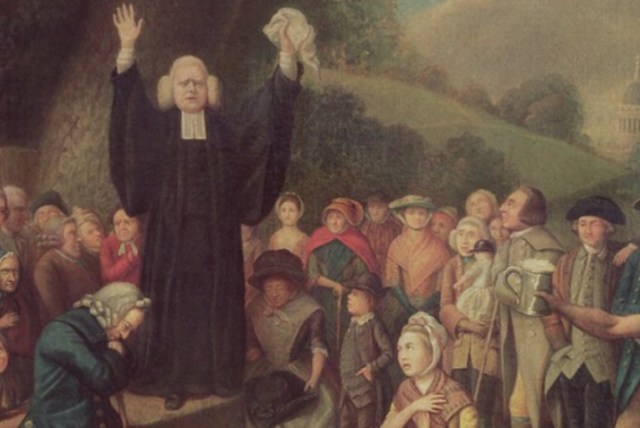
George-Whitefield
George Whitefield (1714-1770) preaching outdoors by English artist John Collet (c.1720-1780)

George Whitefield, arguably the greatest of all revivalists, addressed the topic of listening in a mid-eighteenth- century sermon based on the words of Jesus in Luke 8:18, “Take care how you hear:”

  1. Come to church out of a sincere desire to know what God has to say to you. Sermons are not for entertainment. They are to reform our hearts and teach us our duty towards God and men.
  2. Give focused attention to the things that are spoken. Listen as you would to the voice of someone you respect; the King of Kings demands even more respect! The stuff of sermons concerns eternal matters and not just the things of this world.
  3. Guard you heart against prejudice to the minister. Even when ministers urge us in the ways they themselves have trouble with, don’t refuse the urging on that account. If what they urge is biblical, receive as though Jesus were the one who spoke.
  4. Guard your heart at thinking more highly of a minister than you ought.It was the Corinthian evil that they began to prefer one preacher to another openly with terrible consequences for the body of Christ. Though one may minister to you more than another, respect both for what God does through them to the body of Christ and remember they are people just like you.
  5. Make application to your own heart of everything that is said.  Beware of that roving eye that says in a sermon, “That was meant for him” or “I sure hope she heard that!”
  6. Pray to the Lord, before, during, and after the sermon. Pray that the minister might be endued with power and boldness to declare the whole counsel of God and not be intimidated by anyone. Pray that God would apply the words to your own heart.

Whitefield concludes: “If only all who hear me this day would seriously apply their hearts to practice what has now been told them! How ministers would see Satan, like lightning, fall from heaven, and people find the Word preached sharper than a two-edged sword and mighty, through God, to the pulling down of the devil’s strongholds!”

May it be so, to the glory of God.

Matthew 11:16-19, 20-25 – Following Jesus

Welcome, friends! Click the video below and let us consider the words of Jesus together.

You may also view this video on TimEhrhardtYouTube

Click Behold the Lamb (Communion Hymn) by Keith and Kristyn Getty, the song mentioned in the video.

May the grace of the Lord Jesus, the love of God the Father, and the fellowship of the Holy Spirit be with you, today and always. Amen.

Following Jesus

Walking with Jesus

The disciple and evangelist Matthew, the former tax collector, purposefully arranged his Gospel of Jesus to emphasize what it means to truly follow Christ. Matthew knew a thing or two about discipleship and following Jesus, having walked away from a lucrative business because Jesus called him. However, the hardest thing for Matthew was likely not giving up the money, as it was daily facing people who knew his past and many who held it over his head – except Jesus. Only grace has the power to change our lives and make us willing to face anything, for good or for ill.

For Matthew, the first sermon of Jesus, The Sermon on the Mount (Matthew 5-7), was meant to move the massive crowd of people physically following Christ to spiritually, ethically, and with heartfelt devotion following Jesus as committed disciples embracing the true way of righteousness – mercy, purity, and peacemaking.

In chapters 8-10 of his Gospel, Matthew narrates amazing events of miracles and healing including: the blind receiving sight; the lame getting on their own two feet and walking; those with leprosy being cured; the deaf hearing; the dead raised to life; and, the good news of God’s benevolent reign preached to the poor. Jesus was not only inviting people to be disciples; he was developing disciples through the sheer force of mercy. This was no sign-up sheet Christianity. This was deliverance from physical and spiritual oppression to a life of walking in the gracious way of Christ, no matter what the cost.

This was beautiful and wonderful ministry. It was life-changing and earth-shattering. However, most of the crowd who followed Jesus around observing the divine interventions were unfazed. In my mind, I picture the crowd like a bunch of social media followers who troll through others stuff and offer little except criticism when they see something that they do not like or agree with.

Jesus had his own comparison. He asked the crowd: To what can I compare this generation? Christ was angling for his listeners to consider the current state of the people and the society. He answered his own question with a saying that the people were familiar with: “We played the flute for you, and you did not dance; we sang a dirge, and you did not mourn.” (Matthew 11:17)

The saying Jesus quoted pertains to weddings and funerals. He was saying that the crowd standing right in front of him, seeing him and seeing his works up close and personal, are like people who have their backs against the wall during a celebration dance at weddings. They are also like people who show no grief and don’t cry at funerals.  In other words, they are dull. They have Jesus right in front of their faces, and they do not see him because they are expecting someone else.

Most of the people could not get over the fact that Jesus hung-out with people who were not like them and kept focusing his ministry on folks who need it the most. Jesus was giving a stinging rebuke – and they knew it. Jesus was essentially calling the unmoved crowd a bunch of bratty little kids who sit around waiting for their idea of Messiah to come along.

Bottom line: Jesus had no acceptance for them simply because they were not willing to accept him on his terms and in his way. So, Jesus then clearly communicated who is accepted with him: Those who need him. They are accepted because the Father has revealed Jesus and truth to the least and the lost. Little children were always overlooked and forgotten people in the ancient world – low on the totem pole of human hierarchy and viewed mostly as potential adults who would someday contribute to society.

Kids need to be cared for. And that is the key to why Jesus spoke of becoming like little children: kids need the care of others or they will not make it. They know it. The plan of God is to bless those who are poor in spirit, not those who think they “already know all that stuff” and have no need for a Messiah who only meets the needs of immigrants, people of color, the aged and the infirm. Those who know their need for a Savior come to Jesus asking for help and find the open arms of God. Those who only know their spiritual pedigree and how much others need them, are glad they are not like people beneath them, and ask for nothing – these are the people who will find themselves looking at God’s back.

The needy are accepted because they humble themselves and come to Jesus and exchange their yokes. Christ’s invitation goes out to all those for whom religion and church has become a grind, for whom trying to always be a good Christian is like carrying a heavy burden. We are invited to replace our heavy yoke with the yoke of Jesus.

Simon and Jesus by Nicholas Mynheer
Jesus and Simon by Nicholas Mynheer

A “yoke” was a rabbi’s set of rules based in his interpretation of the Law. The disciples of a rabbi would follow him around everywhere and continually listen to his view of how to live the Scripture in everyday life. There were rabbis whose yoke weighed people down with endless rules on every detail of life. Jesus would later say about such teachers:

“They tell you to do things, but they themselves don’t do them. They make strict rules and try to force people to obey them, but they are unwilling to help those who struggle under the weight of their rules. They do good things so that other people will see them.” (Matthew 23:3-5)

Jesus, contrary to other rabbis, taught the Beatitudes and Sermon on the Mount as his yoke, which was a form of living from the heart, and not just to put on a good show for others.

Jesus said “learn from me” because he is gentle and humble in heart. Jesus is not going to turn us away when we sincerely and humbly come to him; in fact, he invites us to come so we might bask in God’s acceptance:

“Come to me, all of you who are tired and have heavy loads, and I will give you rest. Accept my teachings and learn from me, because I am gentle and humble in spirit, and you will find rest for your lives. The burden that I ask you to accept is easy; the load I give you to carry is light.” (Matthew 11:28-30, NCV)

If faith has become all too familiar, if you have lost your sense of awe and wonder about God, if you desire something more than just keeping up with the Christian Jones’s and fulfilling a checklist of Christian duty, then there is an invitation for you to come to Jesus – offered by Christ himself. We get to walk with Jesus.

3374b-thetable

For Christians everywhere throughout the world for two millennia the Table is the place to come in remembrance, communion, and hope. We remember the once for all sacrifice of Christ which unburdened us of our heavy load of sin. We commune with this same Christ now in the present. We anticipate our future hope with confident expectation that Christ is coming again. The Table is an invitation for us to eat and drink of Christ. The words of Keith and Kristyn Getty and Stuart Townsend’s “Communion Hymn” capture Christ’s acceptance of us and our need to receive such grace:

Behold the Lamb who bears our sins away,
Slain for us – and we remember
The promise made that all who come in faith
Find forgiveness at the cross.
So we share in this bread of life,
And we drink of His sacrifice
As a sign of our bonds of peace
Around the table of the King.

The body of our Savior Jesus Christ,
Torn for you – eat and remember
The wounds that heal, the death that brings us life
Paid the price to make us one.
So we share in this bread of life,
And we drink of His sacrifice
As a sign of our bonds of love
Around the table of the King.

The blood that cleanses every stain of sin,
Shed for you – drink and remember
He drained death’s cup that all may enter in
To receive the life of God.
So we share in this bread of life,
And we drink of His sacrifice
As a sign of our bonds of grace
Around the table of the King.

And so with thankfulness and faith we rise
To respond, – and to remember
Our call to follow in the steps of Christ
As His body here on earth.
As we share in His suffering
We proclaim Christ will come again!
And we’ll join in the feast of heaven
Around the table of the King.

Amen.

Matthew 11:20-24 – “C’mon, Man!”

Jesus angry
“Christ in Majesty” by Polish artist Jan Henryk de Rosen at the National Shrine of the Immaculate Conception

Then Jesus began to denounce the towns in which most of his miracles had been performed, because they did not repent. “Woe to you, Chorazin! Woe to you, Bethsaida! For if the miracles that were performed in you had been performed in Tyre and Sidon, they would have repented long ago in sackcloth and ashes. But I tell you, it will be more bearable for Tyre and Sidon on the day of judgment than for you. And you, Capernaum, will you be lifted to the heavens? No, you will go down to Hades. For if the miracles that were performed in you had been performed in Sodom, it would have remained to this day. But I tell you that it will be more bearable for Sodom on the day of judgment than for you.” (NIV)

Today’s New Testament lesson from the Gospel of Matthew, recounting the words of Jesus, are not filled with unicorns and butterflies, to say the least. We might be somewhat unfamiliar with these not so famous, maybe even infamous, words from our Lord. Before Jesus tells who is accepted in the kingdom of God (Matthew 11:28-30) he tells us who is not accepted. These scathing words are specifically leveled to the towns in which Christ had performed his ministry of healing and miracles.

We need to hear the hard words of Jesus. Up to this point in Matthew’s Gospel, he has laid out the birth narrative of incarnation in chapters 1-2; the preparation for Christ’s ministry in baptism and being sent to the desert in chapters 3-4; Christ’s teaching on what constitutes a genuine follower of God, the Sermon on the Mount, chapters 5-7; and, chapters 8-10, recording ten miracles which were meant to demonstrate that the kingdom of God has broken into history in the person of Jesus Christ. In chapter 11, Jesus begins leveling a rebuke to the crowd who had observed his ministry and did nothing in response to his works.

For Jesus, the height of hubris was to simply ignore his righteous works of gracious teaching and benevolent healing.

If you are not a fan of Monday Night Football, let me explain a pre-game segment each week during the season called, “C’mon, man!” Each commentator picks out a bonehead play from the previous week that would cause someone to shake their head in dismay and say “c’mon, man!” They are typically situations where the player’s head just was not in the game and they ended up, in some cases, costing their team points or even the game.

Cmon man

Reading Christ’s words sounds a lot like Jesus picking out the towns in which he performed his miracles, and saying to them: “C’mon, man!”  “You saw me cleanse a man from leprosy, heal paralyzed people and a woman with a chronic disease, calm a great storm, exorcise demons from people, give sight to the blind and speech to the mute. You saw all of this, but it has not changed you one bit. You still live the same way you always have and have not come to me as the source of your deliverance… “C’mon, man!”

Notice that Jesus’ denunciation comes not because he was experiencing opposition or persecution; he was denouncing them for their bonehead lack of response and refusal to change their lives to conform to what they were seeing right in front of their faces. The crowd heard his teaching and saw his miracles, and it had no effect on them. So, Jesus gave them a great big “C’mon, man!” Judgment becomes the lot of someone who is unaffected and unresponsive to the vast sea of human need around them, viewing Jesus as just another voice, and living a life of mediocrity in the face of opportunity.

So, what would the segment “C’mon, man!” look like today? What would Jesus say to us? Keep in mind we are people with access to Christ’s teaching. We have the Sermon on the Mount to read, study, meditate upon, and live by – yet, too many [Christians] don’t take the time to examine it with the intent of seeing Jesus and allowing him to change their lives… “C’mon, man!”

The Holy Spirit has been provided, who is the power source of the Christian life. We possess all the resources of grace necessary to step into this world and make a difference, yet so many do nothing but occupy a place in the pew [or couch] because they are too afraid to sacrifice their time in meaningful ministry… “C’mon, man!”

There are neighbors, relatives, and co-workers who are lost and lonely, in need of the kind of grace Jesus gives, yet too many of us are oblivious to them and instead are constantly worried about things that, in the end, don’t really matter at all… “C’mon, man!”

We have opportunities to grow in the grace and knowledge of Jesus Christ through a vast array of available ministries, yet many do not take the chance to change and be spiritually stretched… “C’mon, man!”

Today the words of Jesus are right in front of our faces, and some of us will have the audacity to read them and remain unchanged, unchallenged, and unresponsive… “C’mon, man!”

If our highest values in life are sameness, stability, and security, we may very well, at the least, miss Jesus altogether, and, at worst, find ourselves under his condemnation. These verses are for those whom Jesus has become all too familiar, as if he is just another piece of furniture in the living room – the coffee table with a dusty Bible resting on it.

Perhaps this post may seem a bit out of place on a website which promotes itself as caring. I would like to think of it as obnoxiously caring. I trust you will accept today’s writing and the words of Jesus as caring enough to confront. There are times when Mid-West nice gets us nowhere and we must have hard conversations. Yes, conversations, and not verbal rockets launched from one group to another. Jesus did not denounce from a distance; he did it up close and personal. Furthermore, he was specific and not generic about why he was speaking in the way he did.

So, may you be able to pray this prayer of repentance today with heartfelt conviction:

Almighty God, Father of our Lord Jesus Christ, Sovereign Lord of the universe, Creator of humanity, we, your unfaithful children, are sorry for our sins and the lives that we have lived apart from your grace. We sincerely believe and confess in our hearts that only through the precious blood of our Lord Jesus Christ on the cross, can we obtain your forgiveness.

We repent that: in thought, word, and deed, we have committed serious offences against you and our neighbors. Through spiritual laziness and prideful lust for power, we have provoked hatred, division, despair, and hurt within our communities.

Through our greed, deceit, and indifference, we have inflicted serious damage, unnecessary conflict, and aggravated destruction to those different than us.

Through our selfishness, insensitivity, and bias (both conscious and unconscious) we have encouraged and emboldened those who inflict hurt, pain, and sorrow on those who are already oppressed and poor.

In the name of religion, doctrine, and even of Christ himself, we have wounded fellow believers and those who genuinely pursue a faith different than ours. In stubbornness, pride, and arrogance, we have caused division and strife within your church and among your people.

Mercifully send your Holy Spirit, the Spirit of order and comfort, to cleanse us from all unrighteousness; to restore in us true faith in Christ which brings truth, peace and harmony; and, to help us walk together with our brothers and sisters in the peace of our Lord Jesus Christ, to the glory of your name. Amen.