While Jesus was in Bethany in the home of Simon the Leper, a woman came to him with an alabaster jar of very expensive perfume, which she poured on his head as he was reclining at the table.
When the disciples saw this, they were indignant. “Why this waste?” they asked. “This perfume could have been sold at a high price and the money given to the poor.”
Aware of this, Jesus said to them, “Why are you bothering this woman? She has done a beautiful thing to me. The poor you will always have with you, but you will not always have me. When she poured this perfume on my body, she did it to prepare me for burial. Truly I tell you, wherever this gospel is preached throughout the world, what she has done will also be told, in memory of her.” (NIV)
When I was a teenager there was a show on TV called “Quincy.” Quincy was a coroner. Every episode was him performing an autopsy on someone who appeared to have a rather normal death. But Quincy always found something suspicious and spent his time prying into people’s lives to confirm his investigation. His boss and the police chief would chide and warn him saying, “Leave it alone, Quincy.” Quincy’s typical response was: “But I can’t leave it alone. There’s more here than what meets the eye!”
Indeed, there is more going on in today’s Gospel lesson than what meets the eye. The Apostle John identifies the woman as Mary (John 12:1-11), a woman with a sordid background who had her life transformed through meeting Jesus. Now, near the end of Christ’s life as he was about to enter Jerusalem and be arrested, tried, tortured, and killed, this woman, Mary, is aware of what is happening when others are not. Her own brokenness cracked open to her the true reality of life.
The surface event itself is a touching and tender moment in history. This woman, whom everyone knew was a damaged person, took a high-end perfume and broke the entire thing open. She then proceeded to anoint Christ’s feet with it. You can imagine the aroma which filled the entire house with expensive perfume for all to smell. Giving what she had to Jesus, Mary demonstrated the path of true discipleship.
Yet, that is not all, because there is more here than what meets the eye:
The broken jar of perfume shows us the brokenness of the woman and our need to be broken (Matthew 5:3-4).
The woman used an extraordinary and extravagant amount of perfume, picturing her overflowing love for Jesus (John 20:1-18).
The woman poured the perfume on the head of Jesus, and she herself used her hair as the application (according to John); hair is a rich cultural symbol for submission and respect (1 Corinthians 11:14).
The perfume directs us to the death of Jesus (John 19:38-42).
The perfume highlights for us the aroma of Christ to the world (2 Corinthians 2:15-17).
There is more to the disciples’ response than mere words about perfume; the Apostle John specifically names Judas as questioning this action – the one who is not actually concerned for the poor (Matthew 26:15).
The woman and the disciples, or Judas and Mary, serve as spiritual contrasts: Mary opens herself to the sweet aroma of Christ; Judas plain stinks.
The perfume presents a powerful picture of the upcoming death of Christ, for those with eyes to see; he was broken and poured out for our salvation (Luke 23:26-27:12).
Christianity was never meant to be a surface religion which only runs skin deep. The follower of Christ is meant to be profoundly transformed, inside and out, so that there is genuine healing, spiritual health, and authentic concern for the poor and needy. Keeping up appearances is what the Judas’s of this world do. But the Mary’s among us dramatically point us to Jesus with their tears, their humility, their openness, and their love.
In this contemporary environment of fragmented human ecology, our first step toward wholeness and integrity begins with a posture of giving everything we have – body, soul, and spirit – to the Lord Jesus. Methinks Quincy was on to something.
Loving Lord Jesus, my Savior, and my friend, you have gone before us and pioneered deliverance from an empty way of life and into a life of grace and gratitude. May I and all your followers, emulate the path of the woman Mary and realize the true freedom which comes from emptying oneself out for you. Amen.
“Don’t be deceived, bad company corrupts good character.” (1 Corinthians 15:33)
When they went across the lake, the disciples forgot to take bread. “Be careful,” Jesus said to them. “Be on your guard against the yeast of the Pharisees and Sadducees.”
They discussed this among themselves and said, “It is because we didn’t bring any bread.”
Aware of their discussion, Jesus asked, “You of little faith, why are you talking among yourselves about having no bread? Do you still not understand? Don’t you remember the five loaves for the five thousand, and how many basketfuls you gathered? Or the seven loaves for the four thousand, and how many basketfuls you gathered? How is it you do not understand that I was not talking to you about bread? But be on your guard against the yeast of the Pharisees and Sadducees.” Then they understood that he was not telling them to guard against the yeast used in bread, but against the teaching of the Pharisees and Sadducees. (NIV)
I tend to think in metaphors, which is probably one reason I like the teaching of Jesus so much. While on this earth, he used a range of metaphors from common everyday life to communicate his point. Seems as though the disciples were more concrete thinkers.
Yeast was a common symbol for evil, which is why the Jews ate unleavened bread. Jesus was trying to get the point across to his disciples that, like yeast, even just a little bit of unhealthy teaching can have far-reaching effects. Partaking of bad teaching works through the whole batch of dough and ruins the spiritual life.
We might think that after seeing Jesus heal the sick, raise a paralyzed man, cure the blind, restore the demon-possessed, walk on water, and feed the masses with only a few loaves of bread that his disciples would be clamoring with praise and responding with a big “Wow! Look at what Jesus did! Tell us what to do next!” Instead, they stood around mumbling about how to interpret the great feeding of the four thousand.
The math lesson Jesus explained to the disciples about the baskets of food that they had gathered was that the less the disciples had and the bigger their problem, the more Jesus did. Jesus Math adds up to grace. And grace means that who we are, or are not, and what we have, or do not have, is immaterial; what matters is that we have Jesus. We give him what little we have, along with ourselves, and let him do the work.
We must avoid the trap and the temptation of thinking, “If only I had ___; If only I were ___.” This is unsound doctrine because it denigrates the image of God within us and the good gifts God has already given to us, as if we ourselves are not enough. Yet, even if we have next to nothing, with few abilities, when offering it to Jesus, he turns it into a miraculous bounty of blessing for the world.
Seeing ourselves, our relationships, our stuff, and our world through the person and work of Jesus Christ is our task. It does not take great powers of interpretation to see that the times are evil and bad information gets disseminated and spread. What is more difficult for us is discerning that there is a great opportunity for mission and service amid this decaying world.
We will miss that wonderful opportunity if we partake of bad teaching. It is imperative that we feed upon sound teaching and be very discerning about who we listen to and what they are really saying to us. Words which are heavy with judgment and light on grace are to be suspect because such teaching is antithetical to the gospel. Instruction which sets apart and demonizes groups of people or characterizes certain individuals as monsters or animals is completely out of step with the way of Jesus Christ.
We are to be on our guard against any teaching which places an unrealistic and dispassionate heavy load of guilt and shame upon people. We must be vigilant to not accept teaching that plays upon people’s fear and twists reality, making groundless and unsubstantiated claims without evidence. In short, the Holy Scriptures are not to be used as a club to beat people into submission toward our way of thinking and acting.
The spiritual abuse and objectification of others by using the Bible is a terrible condition which unfortunately exists in today’s world. The sad reality is that there are people who engage in harassing others by using God’s Holy Word. People have been created in the image and likeness of God, and therefore deserve to be treated with respect and civility, regardless of their creed, color, or condition.
So, let me be clear and deliberate about the use and abuse of God’s revelation to us:
I do not condone any use of the Bible which seeks to intimidate, bully, impede, or affect any person’s ability: to work effectively at their jobs, to worship joyfully at their church, or to live without fear of being blacklisted or red-lined to the periphery of society.
I do not condone any use of the Bible which intends to control either by threat or by use of physical force any person, their family, and/or their property through inducing fear.
I do not condone any use of the Bible which justifies touching any person without their consent, or coerces, or physically forces another person to engage in a sexual act against their will.
I reject any use of the Bible which encourages any sort of hate crime, act of violence, or hate speech against any person regardless of their gender, sexual orientation, race, ethnicity, class, or religion.
I reject any use of the Bible by any clergy and/or church leadership which demeans and marginalizes women in their basic humanity, role, function, or leadership.
I reject any use of the Bible by any church member and/or attender which demeans and discounts the worldwide Christian community.
I uphold any use of the Bible which seeks to communicate its theology and message gently, carefully, graciously, and lovingly for the spiritual edification and healing of all people.
I uphold any use of the Bible which intends to cultivate one’s own soul and develop a teachable spirit.
I uphold any use of the Bible which looks for truth, wisdom, beauty, and humility.
I champion use of the Bible for both personal and corporate encouragement.
I champion use of the Bible for critical inquiry, scrutiny, and learning.
I champion use of the Bible for all people, regardless of age, including genuine seekers and spiritual misfits, as well as the hurt, abused, lonely, lost, confused, and concerned.
Jesus touches the leper, a mosaic from an early Byzantine Church
When Jesus came down from the mountainside, large crowds followed him. A man with leprosy came and knelt before him and said, “Lord, if you are willing, you can make me clean.”
Jesus reached out his hand and touched the man. “I am willing,” he said. “Be clean!” Immediately he was cleansed of his leprosy. Then Jesus said to him, “See that you don’t tell anyone. But go, show yourself to the priest and offer the gift Moses commanded, as a testimony to them.”
When Jesus had entered Capernaum, a centurion came to him, asking for help.“Lord,” he said, “my servant lies at home paralyzed, suffering terribly.”
Jesus said to him, “Shall I come and heal him?”
The centurion replied, “Lord, I do not deserve to have you come under my roof. But just say the word, and my servant will be healed. For I am also a man under authority, with soldiers under me. I tell this one, ‘Go,’ and he goes; and that one, ‘Come,’ and he comes. I say to my servant, ‘Do this,’ and he does it.”
When Jesus heard this, he was amazed and said to those following him, “Truly I tell you: I have not found anyone in Israel with such great faith. I say to you that many will come from the east and the west and will take their places at the feast with Abraham, Isaac, and Jacob in the kingdom of heaven. But the subjects of the kingdom will be thrown outside, into the darkness, where there will be weeping and gnashing of teeth.”
Then Jesus said to the centurion, “Go! Let it be done just as you believed it would.” And his servant was healed at that moment. (NIV)
Maybe you, like me, have had your computer pick up a nasty virus that hijacks every file and function you possess. For me, the most frustrating thing about those events is that there is nothing I can do by myself to fix it or make it better. I must humble myself and ask some computer geek to get into my system and take care of the problem. It feels weird looking at my screen and having somebody I do not know working inside my personal computer. But if I fail to get help, my computer would be worthless – unless I let someone with authority fix the blasted thing.
Jesus Christ is Lord of all. Since he has authority over everything, we must live our lives in submission to his will and way. Only through humble resignation to Christ will we experience the healing and deliverance we seek.
Jesus preached his famous Sermon on the Mount (Matthew 5-7) and taught the people as one who had authority. In that Sermon, Jesus laid out the values of God’s kingdom: humility, sorrow over sin, meekness, purity, mercy, and peacemaking. Now, in today’s Gospel lesson, we see the power and values of God’s kingdom evidenced and expressed in two stories of healing and deliverance.
The world needs saving, and that is exactly what Jesus is up to. Jesus Christ’s authority is total, and comes from his moral authority, as the very embodiment of the Beatitudes he taught. Grace always gets the last word, as Jesus healed without showing favoritism nor discrimination.
In the first story, Jesus used his authority to heal and transform a leper. Leprosy was a feared disease in the ancient world. There was no known cure, and lepers were forced to live apart from everyone else. The Old Testament book of Leviticus says that a leper must wear torn clothes, let his hair be unkempt, cover the lower part of his face and cry out “unclean! unclean!” (Leviticus 13:45-46). Lepers were the ultimate outsiders.
A leper came to Jesus with a humble profession of faith: “Lord, if you want to, you can make me clean.” It was a clear case of genuine need, and poverty of spirit. Jesus responded by doing the unthinkable: He touched him. In a great and wonderful reversal, Jesus did not become unclean by touching the leper but instead the leper was made clean.
If we want the world to be saved and to follow the way of Jesus, then we will emulate our Lord by touching the world. It will not do for us to stand afar off from the outsiders of our community and avoid marginalized people. It will not do for us just to provide a service without having to touch someone. Authentic Christian ministry communicates love through contact and identification with others.
Eleven centuries after Jesus walked the earth, another man, Francis, met a leper on the road as he journeyed toward Assisi. “Though the leper caused him no small disgust and horror, he nonetheless, got off the horse and prepared to kiss the leper. But when the leper put out his hand as though to receive something, he received money along with a kiss” (Life of St. Francis by Thomas of Celano). Francis did what seemed humanly impossible because he was filled with the love and compassion of Christ. The love of Jesus allows us to touch others with compassionate care, especially to those who have been rejected and mistreated.
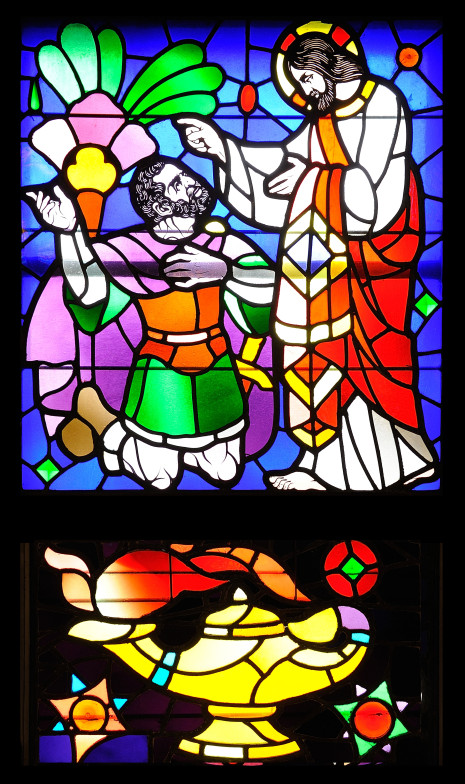
The Centurion Begs Jesus to Heal his Servant, and The Lamp of Faith, from St. Matthew Catholic Church in Detroit, Michigan.
The second story was equally eye-popping and unbelievable to the people in Christ’s day. Jesus used his authority to heal and transform a Gentile. Again, we see the Beatitudes expressed toward a Roman Centurion who felt unworthy to even have the Lord Jesus come into his house. Furthermore, the Centurion’s profession of faith amazed even Jesus: “Just say the word,” he said in recognition of Christ’s authority, which is big enough to heal without even being present. Centurions were the backbone of the Roman military machine and hated by the Jews. Yet, Jesus the Jew not only responded to the Centurion’s request, he affirmed this Gentile’s faith as greater than any Jew.
Grace answers to need, and not to smug self-confidence. The Roman Centurion did not ask for healing for himself but for his servant, and Jesus listened and answered. The Centurion neither demanded nor claimed healing but came in a spirit of humility and asked with confidence that Jesus could heal his servant if he wanted to. The Centurion simply threw himself on God’s mercy. So, Jesus upheld the Centurion as a model of faith for us all.
Not only did Jesus affirm the Centurion’s faith, he gave a solemn warning to the self-righteous: Their lack of humility and genuine faith would land them outside the kingdom. In another great reversal, the insiders will become the outsiders, and the outsiders become the insiders. The independently proud did not experience healing and transformation because they did not even know they were sin sick. They saw no need for an intervention by Jesus because they already had their righteous deeds to boast about. They were more concerned about looking good and saving face and did not perceive their own unworthiness.
The self-righteous approach to handling problems and difficult situations is to come up with good ideas and clever strategies, relying on sheer personal effort and willpower. Prayer may or may not happen after the plans are laid, and there is no sense of beginning with beseeching God. Our delusional thoughts of personal autonomy only separate us from the grace of God we so desperately need.
There is a spiritual dimension to every situation and trouble we face – including sickness. If we only examine the medical end of physical problems, we may be dealing with symptoms instead of the root issue that plagues us. The Apostle James said:
Are you hurting? Pray. Do you feel great? Sing. Are you sick? Call the church leaders together to pray and anoint you with oil in the name of the Master. Believing-prayer will heal you, and Jesus will put you on your feet. And if you have sinned, you will be forgiven—healed inside and out. Make this your common practice: Confess your sins to each other and pray for each other so that you can live together whole and healed. (James 5:13-16, MSG)
Jesus healed and transformed outsiders. The followers of Christ must constantly ask: Who are the outsiders among us? Do we care about strangers? Are we willing to touch aliens and immigrants? Will we intercede in prayer for those who are foreign to us? Will we search for and pursue those on the periphery of society? Do we believe the risen and ascended Jesus can and will heal, deliver, and transform people?
Jesus cannot be domesticated into some figurehead that suits our desires and conforms to our ideas about how things ought to be. Jesus is portrayed in these stories as eager to heal, wanting to show grace to the least and the lowly among society. May we participate in word and deed the Lord’s Prayer:
Our Father in heaven,
may your name be kept holy.
May your Kingdom come soon.
May your will be done on earth,
as it is in heaven.
Give us today the food we need,
and forgive us our sins,
as we have forgiven those who sin against us.
And don’t let us yield to temptation,
but rescue us from the evil one. Amen. (Matthew 6:9-13, NLT)
Jesus called his disciples to him and said, “I have compassion for these people; they have already been with me three days and have nothing to eat. I do not want to send them away hungry, or they may collapse on the way.”
His disciples answered, “Where could we get enough bread in this remote place to feed such a crowd?”
“How many loaves do you have?” Jesus asked.
“Seven,” they replied, “and a few small fish.”
He told the crowd to sit down on the ground. Then he took the seven loaves and the fish, and when he had given thanks, he broke them and gave them to the disciples, and they in turn to the people. They all ate and were satisfied. Afterward the disciples picked up seven basketfuls of broken pieces that were left over. The number of those who ate was four thousand men, besides women and children. After Jesus had sent the crowd away, he got into the boat and went to the vicinity of Magadan. (NIV)
Through the event of Christ miraculously feeding more than four-thousand people, the Christian tradition embraces a living, ascended, and glorified Jesus who still looks to feed those in need. Furthermore, just as Christ had his disciples participate in the miracle, so he still wants to use us today in feeding the world. It is therefore necessary that we work on aligning our resources – our emotional energy, our money, our service – toward reaching out to people who are hungry, both physically and spiritually.
Jesus did just that in feeding thousands of people. He organized his disciples for a miracle even though they failed to understand what he was doing until he did it. The disciples, bless their head scratching, wondered how the vast throng of people were going to be fed, even though they had already participated in the feeding of the five thousand (Matthew 14:13-21). The disciples sarcastically responded to Jesus, “Where could we get enough bread in this remote place to feed such a crowd?” Maybe they were less thick-headed and more hard-hearted. You see, unlike the previous feeding miracle, this one took place in the Gentile territory of Tyre and Sidon.
It appears the disciples were having a hard time with Jesus using his efforts, compassion, and miracles for Gentiles (non-Jewish people) instead of Jews. It could be that they were thinking Jesus should stand for holiness by being as far apart from pagans as they can get. Besides, it wasn’t as if there weren’t any hungry people among their own Jewish people. Maybe they were thinking: “Shouldn’t the miraculous and divine resources be better utilized in keeping them within the Jewish community? After all, the gentile Romans oversee the land. Couldn’t they take care of the needy? Is this really our responsibility?”
Jesus would have none of that kind of thinking. Christ most certainly could have avoided the Gentiles if he wanted to; but he didn’t. Jesus could have fed the people and done a miracle without the involvement of his Jewish disciples, but he didn’t. Jesus wanted his disciples to be part of the miracle through distributing the bread and fish for the people to eat. Jesus would have nothing to do with his Jewish disciples avoiding the Gentile people. He wanted the disciples to meaningfully connect with the hungry people.
I wonder whom Jesus wants us to meaningfully connect with. I am curious if Christ is looking to align his divine resources for people in our lives – and to use us as the means of a miracle. Perhaps the people who are quite different from us are the ones we are to feed. I am wondering how we view such persons. If we tend to freight our language about them in sarcasm, perhaps that is a clue to our own implicit or unconscious bias.
Back in the 1980’s and 1990’s, I had many conversations and dialogues with Christians about AIDS and the gay community. I am saddened that the pervasive attitude I encountered at the time was how gays and lesbians were ruining our society (among other attitudes not worth repeating). Instead of seeing them through the eyes of the compassionate Jesus and seizing an opportunity to love an entire community of people, the discussions were more about how to keep “homosexuality” and the “gay disease” out of church. The hospitals at that time had wards of persons dying from HIV, and few Christians present to bring the compassionate resources of Jesus to them. Withholding spiritual or physical food from people in need, no matter who they are, is not the way of the Lord Jesus – the One who feeds and heals. However, giving the grace of food and fellowship to all in need emulates the compassion of Jesus. Indeed, there is always room at the Table.
“Table of Hope” by Joey Velasco
Jesus not only meets the needs of all kinds of people, he also gives lavishly so that the supply is more than enough. The resources of grace will never run out; there is always enough. I hope our legacy to the people of this earth is that there is always enough grace from us because we have ourselves received grace from the Lord Jesus.
Most folks, especially the poor, rarely have their needs met through rational ethereal arguments and pious pronouncements of truth. And their needs cannot be met if available resources are placed on the outside of their access to them due to existing attitudes about poverty and/or particular people groups. The needs of people are met through non-judgmental compassion which finds a way to connect them with food, both physical and spiritual, even if it takes a miracle to happen.
God Almighty, the One who sustains all, we ask you to pour your powerful Spirit into all who are empty this day. Fill the hearts of persons who are troubled. Fill the minds of people who are confused. Fill the stomachs of your children who are hungry. Fill the souls of people who are feeling lost. Fill the lives of all who need you, but do not know you. May your Spirit fill us all to overflowing, dear Lord, and may we be inspired to share our abundance with others so that there will be no more empty hearts and minds, stomachs, and souls. We pray all this in the name of Jesus Christ, who fills lives with your endless grace. Amen.