Love the Lord Your God

Jesus replied: “Love the Lord your God with all your heart and with all your soul and with all your mind. This is the first and greatest commandment.” (Matthew 22:37-40, NIV) 

One of the teachers of the law asked Jesus, “Of all the commandments, which is most important?” “The most important one,” answered Jesus, “is this: ‘Hear, O Israel: The Lord our God, the Lord is one. Love the Lord your God with all your heart and with all your soul and with all your mind and with all your strength.’” (Mark 12:28-30, NIV) 

I love my three daughters. I think God made them beautiful to compensate for all the ornery things they did as kids so I would not go crazy. Once the oldest was at the top of the stairs with the youngest (who was two years old at the time). She put her in a laundry basket and pushed her down with the middle kid at the bottom to catch her.   

I love my wife with all my heart and soul. Yet, she always thought it would be a good idea to have an open-door policy for the girls to come into our bed at night whenever they needed us. I have been puked on, peed on, kicked on and pushed out of bed. Sometimes it was like living with a bunch of drunks. Raising this girl version of “Malcom in the Middle” was often stressful. However, I gladly dealt with it all because I love my girls with all my heart, soul, mind, and strength.  

Love God with all your heart. 

God has children across planet earth, and he loves them all. To love God with all our heart is to begin seeing God’s big expansive heart for people all around the world. God’s compassionate heart is close to the broken-hearted, near to those in need. In fact, God’s wrath is a response of love to make things right in this fallen world. As early as the book of Genesis, just a few chapters in, it says: 

The Lord saw that the human beings on the earth were very wicked and that everything they thought about was evil. He was sorry he had made human beings on the earth, and his heart was filled with pain. (Genesis 6:5-6, NCV) 

God is disturbed with violent and evil hearts. God is heartbroken about the dark places within the human heart. God is deeply concerned for suffering, injustice, oppression, and death. Every year fifteen-million children die of starvation. Human trafficking of women and girls has increased six-fold over the past five years resulting in forty-million victims of forced sex worldwide. We recently hit a grim milestone of one-million deaths across the world to COVID-19. Hundreds of millions are locked in grinding poverty, have no clean water to drink, and face a lifetime of illiteracy and poor wages. On and on it goes…. 

This is just a small glimpse of what God sees every day. And God knows each one of their names. For us, people need to move from being numbers to being names. God wants us to champion vital causes and aim our collective love toward people in need of Christ’s compassion and deliverance. 

Love is a deliberate decision to meet a need in another person. One who fails to see the needs of others will suffer a shrinking heart. But the one close to God’s heart and aware of another’s need will gain an expansive heart. God also sees the good and the beautiful: every obedient act done in secret, each prayer uttered in the privacy of our closet, and all the places of selfless love toward another.  

Love God with all your soul. 

We need a newfound sense of God’s wonder and beauty to reclaim the soul of Christianity. If loving God with all my heart means my heart breaks for the things that break God’s heart, then loving God with all my soul has my life flooded with God’s glory – awed by Divine majesty, mystery, and beauty. Loving God with all my soul is to perceive the glory and wonder of God all around me. It is to be profoundly grateful for everything – even and especially for the lessons learned from personal hardship and suffering.  

Without a divine perspective, we only see the world as we are and not as it is. The ways to cultivate a beautiful love for God with all my soul is to meditate on Scripture and creation. Literally take time to smell the roses. If we walk or drive the same route every day, be mindful to observe one thing you have never seen before. Then, praise God for it. Each time Holy Scripture is read, do it slowly and carefully, noticing one thing you have never seen before. Then, praise God for that perception. 

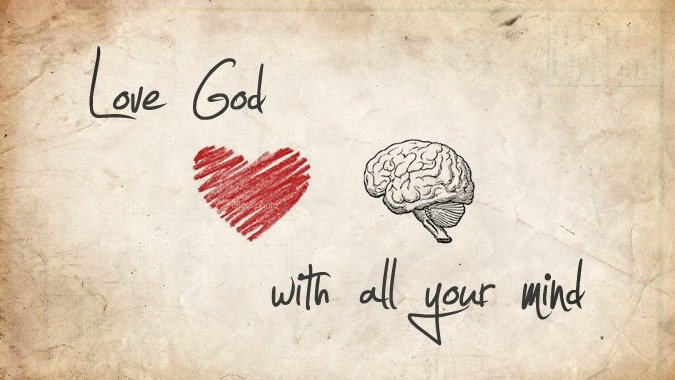
Love God with all your mind. 

True love has an insatiable desire to know more and more about the object of its affection. To love God with all our minds is a desire to learn and experientially know more about the Lord. It is to have a constant curiosity about God.  

We must love God with full faculties and not with half a brain. Left-brain dominant people rely on the logical, analytical, practical, and think chiefly in concrete ways. Right-brain dominant folks are artistic, intuitive, creative, imaginative, humorous, even sarcastic, often speaking poetically and with satire or metaphor. Loving God with all our minds means we will use all our brains, both the right and the left hemispheres. 

One obstacle to loving God with our brains is that the mind of sinful humanity is death (Romans 8:6). A sinful mind is a small brain; it is not interested in genuine critical thinking – only in stubbornly expressing opinions. Such individuals are merely using a ridiculously small part of their brains. God, however, wants to sanctify our whole brains, to transform us by the renewing of our minds (Romans 12:2).   

We are to use our full cognitive capacities to love God – meaning we will value the left brain orientation of  embracing order and discipline, using all the tools of reason and logic, learning critical thinking skills, and pursuing the life of the mind. We will also value the right brain orientation of embracing mystery, paradox, and gray areas, enjoying the process of discovery, and probing the deepest issues of divinity and humanity – being comfortable with asking questions and not always having the answers. 

Love God with all your strength. 

God loves the smell of your sweat. You might stink to high heaven from hard work but for God it is a sweet aroma and sacred incense. Love is measured not only by words spoken but by calories burned. Using our hands and our effort is as valuable to God as using our brains.   

Feel free to go hard after God with all your strength – being mindful that we all have a finite amount of energy. Because of this, we need to ensure we do not inordinately waste our energy pursuing power and control. Pride, anger, and selfishness saps our strength. Guilt, shame, and regret follow it up by draining our spiritual stamina. So, we need to keep busy doing the right things. 

Loving God with all our strength requires respecting boundaries and implementing healthy rhythms of life. We might believe (wrongly) that the answer to most things is to work harder. Try doing that with your car when a red light comes on the dashboard and you will soon not have a car to drive.

Many persons are hellbent on working themselves into the ground. Feeling the pressure of responsibility, the fear of failure, the obsessive need for perfectionism, and the stress of dealing with difficult situations cause some folks to ignore their better judgment. Some individuals find the shame of failure too unbearable to let up on the gas pedal, and so keep going day after day worried that they might be letting someone down.    

Loving God with our strength means we will observe the Sabbath. God rested; therefore, we rest. Sabbath observance avoids loading up a day of “rest” with all kinds of work. We are to use our time to restfully connect with God, take leisurely walks with family, enjoy good friends over a meal, and, of course, delight in a well-deserved nap. Wise and rightly ordered priorities come from well-rested people.  

Summary 

Love God from a large heart because God has a big heart. Love God with your soul through deep feelings because God created us as emotional creatures. Love God cerebrally with a curiosity to know humanity and divinity because God is infinitely interested in us. And love God through hard work done for the things God cares about, just as Christ loved us and gave himself for us.   

Matthew 17:22-27 – Because We Can

When they came together in Galilee, Jesus said to them, “The Son of Man is going to be delivered into the hands of men. They will kill him, and on the third day he will be raised to life.” And the disciples were filled with grief.

After Jesus and his disciples arrived in Capernaum, the collectors of the two-drachma temple tax came to Peter and asked, “Doesn’t your teacher pay the temple tax?”

“Yes, he does,” he replied.

When Peter came into the house, Jesus was the first to speak. “What do you think, Simon?” he asked. “From whom do the kings of the earth collect duty and taxes—from their own children or from others?”

“From others,” Peter answered.

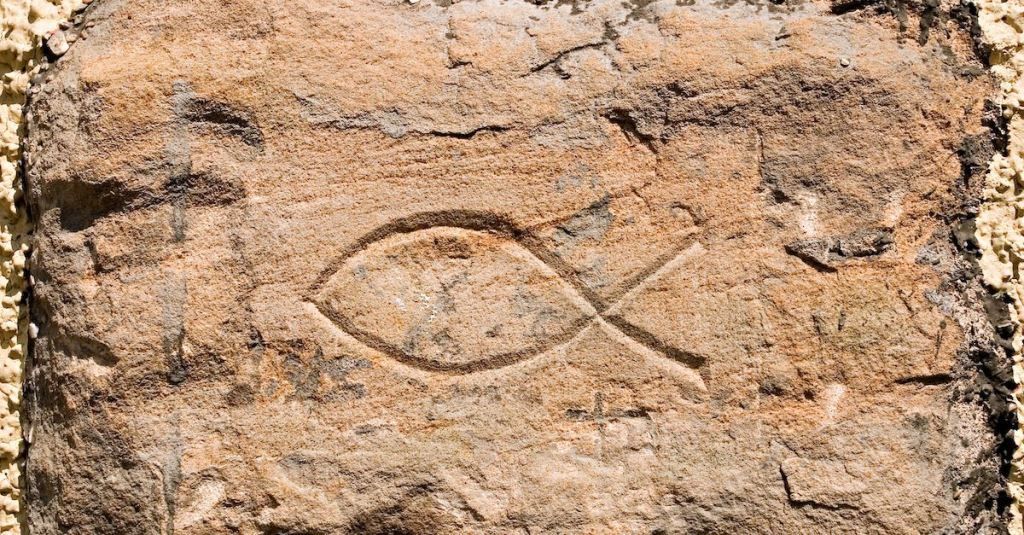
“Then the children are exempt,” Jesus said to him. “But so that we may not cause offense, go to the lake and throw out your line. Take the first fish you catch; open its mouth and you will find a four-drachma coin. Take it and give it to them for my tax and yours.” (NIV)

In ancient times, the Jerusalem Temple was designed to serve as the bridge between God and humanity. It was the place where God “came down” and accepted the offerings of the priests on behalf of the people. In Christian theology, Jesus came to this world to become the permanent bridge and the eternal temple.

Jesus saw himself as the ultimate connector who spans the great expanse between God and people. Christ ascended to heaven and gave the Spirit to his people, the Body of Christ. Basic Christian ecclesiology recognizes the Church (both individual Christians and the Church universal) as the Temple of the Holy Spirit. The Spirit is the continuing presence of Jesus on this earth. Jesus, Spirit, and Church are inextricably bonded with divine superglue to engage in the mission of being God’s Temple – the place of connection between the human and the divine.

Jesus used the situation of a question asked about taxes and the Temple to speak and illustrate the value and import of connecting with both God and others.

Why did Jesus pay the temple tax?

A “drachma” was about a day’s wage. In the time of Christ, there was a two-drachma tax which was levied by the Jewish authorities on every male Jew between the ages of 20-50. The tax was implemented to support the temple building and all the services that went into it.

The temple tax was not compulsory, so typically, the tax collectors did not impose it on the poor – which is why the collectors asked Peter whether Jesus pays the tax or not, because Jesus was poor. Jesus paid the temple tax out of humility, even though he was exempt, so to not offend and cause unnecessary scandal. Said another way, Jesus and his disciples did not have to pay the tax but instead chose to use their freedom for the benefit of others.

There is freedom in Christ. Yet, because of love, and a focus on need instead of rights, we can choose to use our freedom to serve larger purposes than just our own interests. The Apostle Paul later framed it this way:

It is necessary to submit to the authorities, not only because of possible punishment but also as a matter of conscience. This is also why you pay taxes, for the authorities are God’s servants, who give their full time to governing. Give to everyone what you owe them: If you owe taxes, pay taxes; if revenue, then revenue; if respect, then respect; if honor, then honor. (Romans 13:5-8, NIV)  

We exist to serve more than ourselves. God has purchased and adopted us through the death of Christ; we are now the Temple of the Spirit. We can emulate the Savior and choose humility to serve others. A logical question arises about all this: If I do this and focus on responsible service instead of rights, then how am I going to make ends meet?  Is any of this realistic or practical?

How did Jesus pay the temple tax?

Jesus cares about supplying needs. Jesus can and does take care of people who choose to give for the benefit of others. Jesus told Peter the fisherman to go out and fish. A crazy thing happened – Peter found not only a two-drachma coin to cover the annual tax but a four-drachma coin to cover both Jesus and Peter’s tax!  This was a powerful lesson about God’s abundant grace. 

As God’s people, we not only believe in the miraculous; we depend on miracles. We can bank on Jesus supplying our need. This is not a health and wealth gospel. Jesus was monetarily poor, so I am not sure how anyone can justify that God wants all believers to be financially rich.

There was once a man I knew who only had $100 to his name. He got to know another man who needed a suit for his job. The man with a $100 gave it all to the man who needed the suit. That man is alive and well today with all his needs met. He is not rich. However, he is quite happy. If we never need a miracle, we have never given of ourselves enough to need one.

Peter was a fisherman, so Jesus told him to fish and there was a miracle. Sometimes we might get the wrongheaded notion we must do something way outside of our given giftedness. God created each person with a unique intellect, abilities, and strengths and so, we are to use them to affect a miracle – just as Peter did.

We can have a big picture view of our shared humanity without narrow provincial views which are unable to see the vast scope of human need. And so, we can trust God to use us for divine purposes. We can exercise faith in the miraculous for both ourselves and others. We can embrace Christ’s mission in this world to such a degree that we would never consider living any other way. May we do it because we can.

God of all abundance and grace, help us to find firm ground in a shaky economy. Provide jobs for the unemployed; give us strength and peace when anxiety and worry come knocking; grant us patience when things look bleak; and, bring us the serenity of your presence so that we can do your will for the salvation of others through Jesus Christ our Lord in the power of your Holy Spirit. Amen.

Matthew 14:1-12 – Speaking Truth to Power

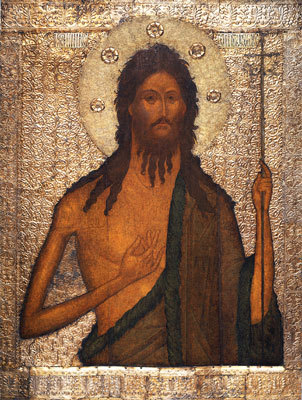
16th century Russian Orthodox icon of John the Baptist

At that time Herod the tetrarch heard the reports about Jesus, and he said to his attendants, “This is John the Baptist; he has risen from the dead! That is why miraculous powers are at work in him.”

Now Herod had arrested John and bound him and put him in prison because of Herodias, his brother Philip’s wife, for John had been saying to him: “It is not lawful for you to have her.” Herod wanted to kill John, but he was afraid of the people, because they considered John a prophet.

On Herod’s birthday the daughter of Herodias danced for the guests and pleased Herod so much that he promised with an oath to give her whatever she asked. Prompted by her mother, she said, “Give me here on a platter the head of John the Baptist.” The king was distressed, but because of his oaths and his dinner guests, he ordered that her request be granted and had John beheaded in the prison. His head was brought in on a platter and given to the girl, who carried it to her mother. John’s disciples came and took his body and buried it. Then they went and told Jesus. (NIV)

John’s murder is a story about our world – a world of power, sex, and intrigue. Times may change, but people across the ages do not change. Humanity is fundamentally the same in every century. And the world is still the world, no matter the historical time. 

The contrast between Herod and John supply us with two types of people who exist throughout every age of humankind, offering us the choice of which way we will go with our lives. The story illustrates for us the reality of living in a fallen world as a devout person.

The Herod in today’s Gospel lesson was a son of Herod the Great, the one who killed all the male babies when Jesus was born in order to try and get rid of any rival king (Matthew 2:1-18). King Herod is displayed in the narrative as a tragic and pathetic figure who is ruled by his own lusts. He seems too proud and wimpy to admit he made a rash promise and killed a man just to save face with his guests at a party.

Talk about a Jerry Springer worthy family drama, here it is: The Herod family was rich, proud, and downright violent. They tended to marry within their own clan to hold their power and possessions for themselves. Herodias married her uncle Herod Philip; Salome was their daughter. Later, Salome married Philip the tetrarch, half-brother to Herod Philip. Through marriage, Salome became both aunt and sister-in-law to her mother. Then the Herod in our story married Herodias, who had been married to Herod’s half-brother, Herod Philip. Having fallen in love with Herod Antipas, Herodias divorced Herod Philip to marry Herod Antipas. Sheesh, nothing like complicated family drama.

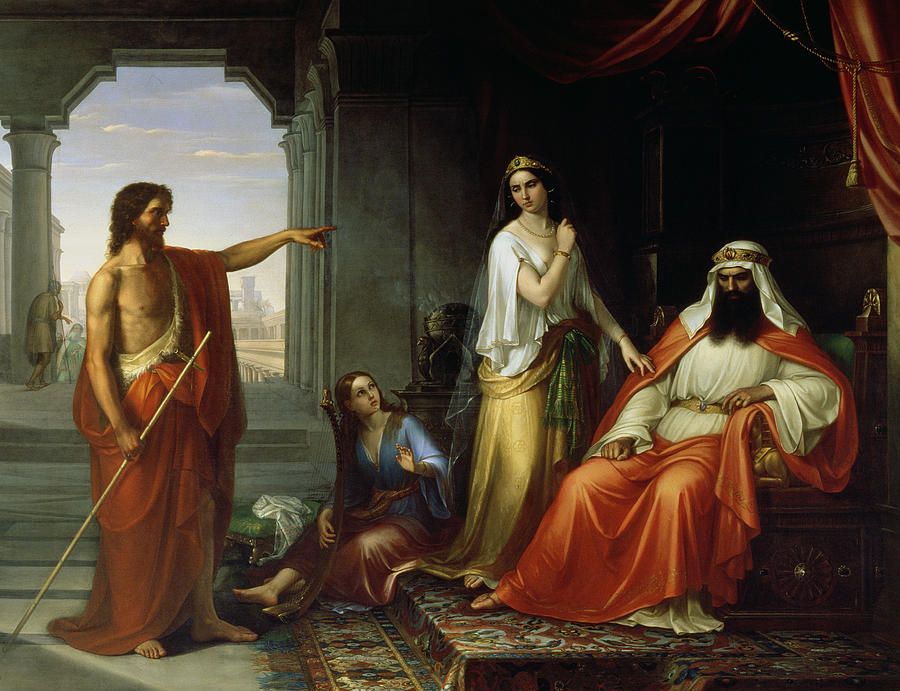
St. John the Baptist Rebuking Herod by Italian artist Giovanni Fattori (1825-1908)

Into this violation of Old Testament marriage laws (the Herod’s were Jewish) came John who made no bones about the fact this was not right (Leviticus 18:16, 20:21). Herodias nursed a grudge against John for speaking out against her and Herod’s choices. Hell, hath no fury like a woman’s scorn, and when Herodias found an opportunity to get rid of John, she coached her daughter into asking for John the Baptist’s head on a platter. Herod, too insecure to take back his ridiculous promise and look like a fool, consented to the execution of John.

In contrast to all this tragic theater is John the Baptist. John was a messenger of God and a preacher of repentance. As one who was preparing the way for Jesus, his message was simple and to the point: Repent, for the kingdom of God is near. John got into trouble and lost his life because he spoke truth to power by meddling in the life of King Herod and his family. The Herod’s were the political establishment of the day, and John did not temper his words when dealing with them.

There is a refreshing integrity about John. He was always the same no matter where he was, and no matter who the people were around him. In contrast to Herod, John was bold, courageous, confident, unafraid, and secure enough in his relationship with God to engage in ministry without thought to the consequences.  He was unconcerned for what others might think of him if he proclaimed truth in the public square, and it did end up costing him his life.

The story of John the Baptist’s death speaks about the hostility of this world. And it prefigured and foreshadowed the death of Jesus. Like John, Jesus was executed by the civil authorities. Herod, like Pilate after him, hesitated to execute and was swayed by the crowd. Herodias, like the chief priests toward Jesus, finally got her way through scheming and manipulation. John’s disciples came and took his body and buried it, just like Joseph of Arimathea and Nicodemus did for Jesus.

These stories, on the surface of things, appear to be only gloom and doom. Yet, there is a message of hope and joy. The absurd is working out itself in deliverance from sin, death, and hell. Through death, Jesus conquered death. We now have no fear of death; its sting has been taken away. Without fear of death, we have no reason to fear life with its troubles and tribulations.

The fork in the road is between the way of John or Herod. It is a values-based decision. If worth is derived from what we do, what we have, and/or other’s opinion of us, we will likely identify more with Herod and his choices. If there is a preoccupation with hoarding power and control, this is the path of Herod. 

Conversely, if the ultimate value is in knowing Christ crucified and the power of his resurrection, then we identify with John as our spiritual ancestor. If security and worth is derived from being in Christ, then there is boldness to speak truth to power and give grace to the powerless.

Herod saw no further than his immediate needs and safety; he failed to discern his own heart. Because of his spiritual blindness, Herod did not look away from himself and look to God. Faith in Jesus comes when persons look away from themselves and look to Christ who holds the power to free all from spiritual bondage.

Let us look to the example of John the Baptist who consistently sought to do the will of God as best as he understood it. Together with all God’s people past and present, we declare that God is with us, the kingdom of God is near, and the love of Christ brings faith and hope.

Almighty God, through your providence John the Baptist was wonderfully born and was sent to prepare the way of your Son, our Savior by the preaching of repentance. Lead us to repent according to his preaching and, after his example, constantly to speak the truth, boldly to rebuke vice, and patiently to suffer for truth’s sake; through Jesus Christ your Son, our Lord, who is alive and reigns with you, in the unity of the Holy Spirit, one God, now and forever. Amen.

Matthew 18:1-5 – On Humility

At that time, the disciples came to Jesus and asked, “Who, then, is the greatest in the kingdom of heaven?”He called a little child to him and placed the child among them. And he said: “Truly I tell you, unless you change and become like little children, you will never enter the kingdom of heaven. Therefore, whoever takes the lowly position of this child is the greatest in the kingdom of heaven. And whoever welcomes one such child in my name welcomes me. (NIV)

God’s benevolent, gracious, and ethical realm is accessed and rests upon humility. Wherever there are humble hearts, there is change, transformation, and new life. Where there is the presence of pride, there you will find posturing, positioning, and peacocking – nothing changes.

Humility enables a person to see beyond the end of their nose. A humble posture allows an individual to observe the wounds and pains of those with little power and low societal status. A preoccupation with being great and believing we are indispensable is to amble down a blind path.

In the ancient world, children were on the lowest rung of society’s ladder. They were mostly looked upon as potential adults – little people who would someday contribute to the welfare of the family business and the community. Until then, kids were expected to begin learning their future trade with full submission and obedience. They had no power or leverage over others.

So, when Jesus told his disciples to take the lowly position of a child, he was not talking about innocence or cuteness. Christ meant for his followers to divest themselves of prideful positioning for greatness and embrace the helplessness and vulnerability of children. For Jesus, a child was closer to God’s rule and reign because they existed in truly humble circumstances, whereas an adult had too much concern with looking good and seeking every advantage possible.

Life is more upside-down than we sometimes realize. Adults have more to learn from kids than kids do from adults. To listen to a child is about as near to hearing the voice of God as you will get.

Let us consider how pride and humility work out in our daily lives. For example, when down and hurting, maybe you have had the experience of another person trying to one-up your pain, as if what they experienced was worse than you. In their pride, they ignore that pain is personal, as if it’s a one-size-fits-all. 

Invalidating a person’s state of being or feelings does no one any good.  It happens because of pride and a lack of humility. Imagine going to see a doctor who turns out to be arrogant in his approach. He fails to really listen to you. He just gives a quick exam and offers his diagnosis with a regimen of more pills to take. You are left sitting there while he is off to another patient, colonizing another person’s mind and emotions with his expertise.

I am not giving doctors a hard knock. I work in a hospital and have great respect for medical professionals who provide wise care plans. Yet, it is likely that you, like me, have had that occasional experience of the doctor full of him/herself with all the right answers on your pain and situation.

You may have also had the unfortunate experience of having a pastor, therapist, or counselor assess your situation with little information and even smaller compassion.  Like writing a script for pills, they give you a few Bible verses and tell you to quit sinning and live obediently.

If pride and arrogance are the original sin, then the remedy to that malady is humility. No matter who we are – whether doctors, pastors, laypersons, patients, or whomever – we are meant and designed by our Creator God to live a humble life.  That means we are to both give and receive humility-based care.

Humility is the cornerstone to every good thing in this life.  Jesus said:

“Blessed are the poor in spirit, for theirs is the kingdom of heaven.” (Matthew 5:3, NIV)

The door of God’s kingdom swings-open on the hinges of humility.

The Apostle Paul, seeking to follow his Master Jesus in his teaching and humility said:

“Since God chose you to be the holy people he loves, you must clothe yourselves with tenderhearted mercy, kindness, humility, gentleness, and patience.” (Colossians 3:12, NLT)

Basic human interaction with one another is grounded in humility. The old prophet made his expectations clear:

“He has told you, O mortal, what is good; and what does the Lord require of you but to do justice, and to love kindness, and to walk humbly with your God?” (Micah 6:8, NRSV)

Life is truly life when it is humility-based.

Therefore, caring for another person is not a simple linear matter of offering your opinion or expertise; it is believing that the one needing care is the expert on herself.  The caregiver has as much to learn from the care-seeker. The beauty of humility-based care is that two people discover together how to grow, thrive, and flourish in a situation where it is not currently happening.

Breakthroughs occur in the soil of humility when the care-seeker comes out of the darkness and into the light through mutual discovery and insight.

We live with the confidence of the Psalmist:

“God leads humble people to do what is right and teaches them the way.” (Psalm 25:9, GW)

In the end, God saves and heals, not you or me.  That God chooses to use us to bring care to others ought to elicit the utmost of humility within us.

Lord God let me have too deep a sense of humor to be proud. Let me know my absurdity before I act absurdly. Let me realize that when I am humble, I am most human, most truthful, and most worthy of your serious consideration. Amen.