Matthew 21:28-32 – The Parable of the Two Sons

The Lord of the Parables by Argentine artist Jorge Cocco Santangelo

“What do you think? There was a man who had two sons. He went to the first and said, ‘Son, go and work today in the vineyard.’

“‘I will not,’ he answered, but later he changed his mind and went.

“Then the father went to the other son and said the same thing. He answered, ‘I will, sir,’ but he did not go.

“Which of the two did what his father wanted?”

“The first,” they answered.

Jesus said to them, “Truly, I tell you, the tax collectors and the prostitutes are entering the kingdom of God ahead of you. For John came to you to show you the way of righteousness, and you did not believe him, but the tax collectors and the prostitutes did. And even after you saw this, you did not repent and believe him. (NIV)

I once cheated on a college exam. It was a required class for which I was not much interested, so my grade was rather tenuous going into the final exam of the semester. When the professor stepped out of the classroom for a few minutes during the final, my fellow students began sharing answers. I gave in and went with the others.

I got an “A” on the exam and passed the class easily. However, I royally flunked God’s test. After a few days of misery, I went to the professor’s office and confessed what I had done. I was prepared to take a failing grade for both the exam and the class, yet I think the professor was so shocked that I would come and admit such a thing that he worked up my grade right there in front of me… I passed, but just barely.

I originally said “no” to what was right, but then said “yes” and made it right.  For those who practice repentance, there is a God of grace waiting for them. God also has no tolerance for those who profess truth with a big “yes” on the outside but are passive-aggressive on the inside and say “no,” undermining the truth by how they live. 

Today’s Gospel lesson highlights entrance into the kingdom of God – and the people entering might surprise us. Turns out, there are spiritual insiders on the outside of the kingdom, and spiritual outsiders end up as the ones who really inherit the kingdom.

Christ’s parable is a warning to all the spiritually serious: Beware, lest our insider energies be spent in correctness, conformity of belief, and cockiness rather than following Jesus.  At the same time, the parable encourages outsiders with the wonderful possibilities of a changed life. 

Christ was warning those who arrogantly assume they have the inside track by what they believe, and not by doing God’s will. It may be challenging for us to imagine how truly offensive this story was to the original hearers of the parable, so I restate it in a more contemporary form:

There was a man who was well respected in the community and had two sons. One son grew up and became a respectable member of the community, too. He was a successful businessman and gave lots of money to causes in his community, including new lights for the school football field – which was no small cost.  He only asked that appropriate and prominent recognition be given him with a plaque bearing his name on each of the light poles. 

The other son was not so successful.  He was the one in school who the teachers said, “Why can’t you be more like your brother?”  There was nothing spectacular about this son.  In fact, he lived an ‘alternate lifestyle’ and people murmured behind his back. 

One day the father said to this son: “Son, go and work at my place of business today; I am going away and need you to do some of the tedious paperwork I have gotten behind on.” “No way!” he answered, but later felt heartsick about the way he spoke to his father and decided to go and do all the grunt work his father needed done.

The father went to the well-respected son and said the same thing about needing him to do all the thankless paperwork that was piled up. That son answered, “Yes, sir, I will; anything you need I will do.”  But that son did not go. Instead, he chose to go golfing with some people whom he was trying to coy favor with.

After telling the story, Jesus asked all the upstanding faith leaders and the people listening: “Which of the two did what his father wanted?” “The first,” they answered.

Jesus said, “I tell you the truth, folks with different sexual orientations, unemployed persons on the low rung of society, and the religiously different with esoteric beliefs are entering the kingdom of God ahead of you. For you have had heard thousands of sermons about grace and the way of righteousness, yet you did not believe by putting God’s Word into practice; but the others did.  And even after you saw how God can change a person’s life from the inside-out, you yourselves did not repent and believe.

For Jesus to tell such a story was so incredibly scandalous that, frankly, it got him killed. Specifically, the scandal is this: Merely believing rightly and living as an upstanding citizen is not the way of salvation. Tax collectors and prostitutes were some of the most despised people in Christ’s time.  It was assumed they were outside of God.

Affirmation of Faith by Indian painter Jyoti Sahi, 1986

However, the proof of genuine belief is not lip service but actively obeying God when no one is looking:

My friends, what good is it to say you have faith, when you don’t do anything to show that you really do have faith? Can that kind of faith save you? If you know someone who doesn’t have any clothes or food, you shouldn’t just say, “I hope all goes well for you. I hope you will be warm and have plenty to eat.” What good is it to say this, unless you do something to help? Faith that doesn’t lead us to do good deeds is all alone and dead! Suppose someone disagrees and says, “It is possible to have faith without doing kind deeds.” I would answer, “Prove that you have faith without doing kind deeds, and I will prove that I have faith by doing them.” You surely believe there is only one God. That’s fine. Even demons believe this, and it makes them shake with fear. (James 2:14-19, CEV)

The Christian life comes down to obedience, not cheap talk. Jesus wants to bless a lost world in need of God’s love and grace.

If we have ears to listen, we can hear numerous lost souls crying in the dark. If we have eyes to see, there are people caught in addictions standing in front of us. If we have hands willing to labor, needy folks surround us who can neither help themselves nor ask for it.

Honestly, I am heartsick over the grinding loneliness of so many people; the boatloads of shame which thousands secretly carry; and the silent pain experienced by individuals everywhere. I feel this way because I genuinely believe my Lord feels the same. Jesus is looking to activate grace through his people to a world sinking in the depths of incredible human need.

Christ’s parable, however, is more than a warning; it is a story that opens the door of mercy for unlikely people seemingly far from God – people who ruined their lives by saying “no” to God. The parable is an invitation for all the screw-ups and those with little faith to come to Jesus.

There is a rather obscure Scripture reference, tucked away in the Old Testament. David was on the outside looking in. King Saul was on the inside trying to capture and kill him, even though David had done nothing wrong. Here is what happened:

David got away and escaped to the Cave of Adullam. When his brothers and others associated with his family heard where he was, they came down and joined him. Not only that, but all who were down on their luck came around—losers and vagrants and misfits of all sorts. David became their leader. There were about four hundred in all. (1 Samuel 22:1-2, MSG)

This rag-tag group of outsiders in Israel became Israel’s insiders as David eventually became king and these were the “mighty men,” the ones who helped bring Israel into prominence. 

Jesus Christ came into this world and identified himself as the Savior to the outsider when he quoted the prophet Isaiah:

Jesus went to the synagogue on the sabbath day, as was his custom. He stood up to read, and the scroll of the prophet Isaiah was given to him. He unrolled the scroll and found the place where it was written:

“The Spirit of the Lord is upon me,
    because he has anointed me
        to bring good news to the poor.
He has sent me to proclaim release to the captives
    and recovery of sight to the blind,
        to let the oppressed go free,
to proclaim the year of the Lord’s favor.”

And he rolled up the scroll, gave it back to the attendant, and sat down. The eyes of all in the synagogue were fixed on him. Then he began to say to them, “Today this scripture has been fulfilled in your hearing.” (Luke 4:16-21, NRSV)

In Christ, there are no lost causes and no persons too far on the outside to be redeemed. Therefore, now is the time to act on what we believe – to not only affirm right doctrine, but to live out that doctrine in obedience to God’s call.

Matthew 24:15-31 – Being Prepared

“So when you see standing in the holy place ‘the abomination that causes desolation,’ spoken of through the prophet Daniel—let the reader understand— then let those who are in Judea flee to the mountains. Let no one on the housetop go down to take anything out of the house. Let no one in the field go back to get their cloak. How dreadful it will be in those days for pregnant women and nursing mothers! Pray that your flight will not take place in winter or on the Sabbath. For then there will be great distress, unequaled from the beginning of the world until now—and never to be equaled again.

“If those days had not been cut short, no one would survive, but for the sake of the elect those days will be shortened. At that time if anyone says to you, ‘Look, here is the Messiah!’ or, ‘There he is!’ do not believe it. For false messiahs and false prophets will appear and perform great signs and wonders to deceive, if possible, even the elect. See, I have told you ahead of time.

“So, if anyone tells you, ‘There he is, out in the wilderness,’ do not go out; or, ‘Here he is, in the inner rooms,’ do not believe it. For as lightning that comes from the east is visible even in the west, so will be the coming of the Son of Man. Wherever there is a carcass, there the vultures will gather.

“Immediately after the distress of those days, the sun will be darkened,
    and the moon will not give its light;
the stars will fall from the sky,
    and the heavenly bodies will be shaken.

“Then will appear the sign of the Son of Man in heaven. And then all the peoples of the earth will mourn when they see the Son of Man coming on the clouds of heaven, with power and great glory. And he will send his angels with a loud trumpet call, and they will gather his elect from the four winds, from one end of the heavens to the other. (NIV)

I live in the upper Midwest of the United States. The summers can be brutally hot and humid. The winters can be incredibly frigid and full of snow. Having lived in various university towns and worked with many college students, every Fall there is always at least one international student, or a student from the American Deep South, that has never experienced a Midwest winter and snow. I could tell them repeatedly of the need for a sturdy winter coat before the snow flies. Yet, having never known sub-freezing, let alone sub-zero, temperatures it is difficult to imagine such cold when the weather is warm. At the coming of winter, I, or someone else, had to help ensure they had a suitable coat.  Even then, they usually shake all winter and never take their scarves off.

It might be difficult to imagine, because none of us have yet experienced it, that someday Christ will return to judge the living and the dead. Therefore, Jesus told his disciples about using discernment concerning a change of environment around them. Although it may seem improbable now, a time is coming which will be loaded with cosmic and cataclysmic changes. Sometimes, even for myself who has lived through many hard winters, it is incredible to know that the landscape as it is right now will be completely different.

The sky and the earth as we know it now will pass away; yet Christ’s words will endure for all time. If we are attentive and alert, we will be ready. We will have a warm winter parka on hand. And, for now, it means taking off the old clothes of fear, insecurity, hopelessness, and hate, and putting on the new clothes of righteousness, peace, and love in the Holy Spirit. Winter is nearly here. There is a chill in the air.

God Almighty, we long for the coming of your kingdom in Jesus Christ our Lord. We lament before you the signs that your kingdom has not yet come in its fullness. The signs of brokenness and divisions, oppression and abuse, poverty and loneliness, are everywhere present in the world. So, we cry out from the depths of our being, “O come, O come, Immanuel. Bring us comfort. Dispel the shadows of the night and turn our darkness into light.” Through Jesus Christ our Lord. Amen.

Matthew 12:46-50 – Family

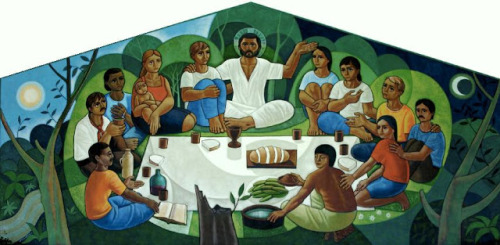
En la Cena ecológica del Reino (At the Ecological Kingdom Dinner) by Spanish artist Cerezo Barredo

While Jesus was still talking to the crowd, his mother and brothers stood outside, wanting to speak to him. Someone told him, “Your mother and brothers are standing outside, wanting to speak to you.”

He replied to him, “Who is my mother, and who are my brothers?” Pointing to his disciples, he said, “Here are my mother and my brothers. For whoever does the will of my Father in heaven is my brother and sister and mother.” (NIV)

Jesus obviously did not get the memo that blood is thicker than water. When his own blood family were waiting outside for him, Jesus used the occasion to speak of what makes up a true follower of God. Christ boldly asserted that his true family is made up of people who do God’s will.  By saying this, Jesus brought the point home that the kingdom of God turns on obedience.

Rather than solely confessing belief, or appealing to a family heritage of faith, Jesus said that a genuine believer in God is one who listens to God’s words and then promptly obeys them. Therefore, a Christian is defined by allegiance to Jesus, and not by having a certain bloodline. 

Identity determines activity. For example, if I identify myself primarily as a worker at my job, my activity will show it – I will spend long hours at my labor, and will do whatever it takes to please my boss and gain promotions. If I identify myself primarily as an athlete, I will spend long hours honing my skills, and do whatever it takes to please the coach and to win. If my identity is mostly wrapped around being a husband and father, I will focus most of my attention on my family and seek to please my spouse and children in all things. 

If my identity is first and foremost as a Christian, I will always seek to please Jesus. I will then view my job as an opportunity to express the ethics of God’s kingdom, as a calling from God, and as a means for God to transform me for his glory. I will view athletics as means to glorify God, and not as an end in and of itself but as a special gift for God to teach me about the importance of community and working together. 

If my identity is clearly in Christ, I will view my kids as belonging to God and I will steward the trust of children given me by doing whatever it takes to teach and train them in the way of Jesus. I will thank God for my family and not confuse them with being God by idolizing them.

In today’s Gospel lesson, Jesus was inside a house, with his family on the outside. So, why were the family members of Jesus not inside the house sitting at his feet, taking the posture of a disciple? The disciple Matthew wanted to communicate more than physical distance between Jesus and his physical family – being “outside” was meant to convey the posture of Christ’s family as spiritually distant, skeptical of him, and indecisive about who he was and what he was up to. In fact, the disciple Mark made this spiritual and emotional distance clear:

Jesus entered a house. A crowd gathered again so that it was impossible for him and his followers even to eat. When his family heard what was happening, they came to take control of him. They were saying, “He’s out of his mind!” (Mark 3:20-21, CEB)

Christ’s earthly family were not looking for Jesus to give them warm-fuzzies and have a family group hug. They were there to tell him: “Cut it out, Jesus, because you’re acting like a nut-cake and embarrassing us all!” The kid brothers of Jesus (James and Jude) would go on to become powerful Christian preachers and each pen a New Testament letter, but that does not happen till after Jesus’ resurrection.

Ethiopian Orthodox Church depiction of Christ and his disciples

Jesus was saying that identifying only with a biological family leads to only pleasing that family. However, identifying with Jesus leads to a radical form of following God that seeks to please him instead of submitting to family practices, mores, and beliefs which are inconsistent with the kingdom of God. 

For the follower of Christ, the church is the family of God, and we are to act consistent with being in such a family.  We are to go hard after God’s will, serve one another, and adopt outsiders into our family.  The church is a family, not a restaurant.  When we go to a restaurant, we either like the food and the service, or not. If the experience was unpleasant, we might complain to the waitress and may or may not come back.  Try doing that with your mother and see where it gets you!  As a biological family, we are committed to each other. There is no complaining about mom because of dad’s wrath. Instead, we are expected to clear our plates and put them in the dishwasher, to sweep the floor and clean the table, and to work together for the benefit of the entire family.  In the same way, following Jesus means being committed to his family, the church.

Priority is to be given in doing God’s will, regardless of blood, because obedience to Christ identifies us as being in the family of God.  Our actions and the way we live points to what we honestly believe and where our commitments truly lie. 

The first step of God’s desire for us is quality focused time in sitting at Christ’s feet and listening to him because this is at the heart of all Christian discipleship. We cannot do God’s will until we have clearly heard it; and we cannot hear God’s will unless we take the time to be at the feet of Jesus. 

Both listening and doing are necessary.  Listening without engaging the world is a failure of mission; and doing without first listening leads to misguided acts and eventual burn-out. Allow Jesus to call the shots and let him instruct us so that we can act wisely and obediently. 

Jesus did not devalue blood relatives as irrelevant. Rather, Christ emphasized that our primary allegiance is to him, and not to our biological family.  The kingdom of God seeks to restore and redeem all things, including family. Both church and family are important. The relationships within each are to be nurtured.

The family of Jesus, the church, is important because Christ suffered and died for her. So, we are to be committed to the church, love the church, and serve the church because we are family. If we have a good grasp of this, we will make decisions based in what we believe God’s will is, instead of whether a relative will get upset, or not. 

Our biological families are important.  Jesus never pitted one against the other, because he wants to see families redeemed and work together as the family of God. Every Christian family can do this:

  • Appoint a time to read Scripture together and listen to Jesus and discuss it.
  • Show hospitality so that we can eat and drink our way into the kingdom of God. 

We need to persistently pray for spiritually lost family members, and those whom we are estranged from. Most families have at least a few toxic persons in their orbit. Here is how we might pray for them:

  • That God will arrange divine appointments between them and other believers who love Jesus.
  • That God will draw them to the mercy of Christ.
  • That God will hinder the devil’s schemes against them.
  • That they will understand and respond to the good news of God’s grace.

Soli Deo Gloria

Matthew 24:45-51 – The Master is Coming

Expert explains about plagues, Armageddon and Jesus' return

Jesus said, “Who then is the faithful and wise servant, whom the master has put in charge of the servants in his household to give them their food at the proper time? It will be good for that servant whose master finds him doing so when he returns. Truly I tell you, he will put him in charge of all his possessions. But suppose that servant is wicked and says to himself, ‘My master is staying away a long time,’ and he then begins to beat his fellow servants and to eat and drink with drunkards. The master of that servant will come on a day when he does not expect him and at an hour he is not aware of. He will cut him to pieces and assign him a place with the hypocrites, where there will be weeping and gnashing of teeth.” (NIV)

Satan once called on some demons of hell and wanted to send one of them to earth to ruin some souls. One demon came forward and said, “I will go.” The devil said, “If I send you, what will you tell the humans?” He said, “I will tell those humans that there is no heaven.” Satan said, “They will not believe you, for there is a bit of heaven in every human heart. In the end everyone knows that right and good must have the victory. You may not go.” 

Then another demon came forward, darker and fouler than the first. The Accuser said, “If I send you, what will you tell humanity?” He said, “I will tell them there is no hell.” Satan looked at him and said, “Oh, no; they will not believe you, for in every human heart there’s a thing called a conscience, an inner voice which testifies to the truth that good will be triumphant and evil defeated. You may not go.” 

Then one last demon came forward, this one from the darkest place of all. The devil said to him, “And if I send you, what will you say to women and men to aid in the destruction of their souls?” The demon said, “I will tell them there is no hurry.” Satan said, “Go!”

Most people’s crime in not gross sin but in plain indifference, without much thought to a future judgment day. Jesus said that such persons will not know what hit them because the Day of the Lord is coming, and it may be soon. Therefore, the question for Christians is not “When will Christ return?” because no one knows the answer.  Rather, the question for us is:

Are you ready for Christ’s return?

Today’s Gospel lesson is part of what is known as the Olivet Discourse, Christ’s final sermon before he faced the cross. Jesus was looking for his disciples to keep watch, to stay alert, to be ready, like a watchman on a tower scanning the landscape for an invading army.  We are to remain vigilant and remember Jesus is coming again.  We are to live each moment considering the promise of Christ’s coming, not knowing the day when it will happen.

Keeping watch, being ready, and staying alert means being witnesses to a world going about their merry way unaware that there is a doomsday.  We are to be active, like Noah building the ark, anticipating the great flood of coming judgment. We are not to waste time creating prophecy charts and trying to connect current events to the Lord’s return. Instead, we are to prepare for the coming judgment through living godly, upright lives. (2 Peter 2:4-9)

We keep watch by being faithful stewards in God’s household. 

We are to avoid being like the unfaithful teenager who, when given the responsibility of watching over the house while his parents are gone for the weekend, has a big party and trashes the house.  The parents will come home at a time the teenager does not expect, and then there will certainly be weeping and gnashing of teeth! 

The faithful and wise steward is busy doing the master’s business – the mundane work of taking care of the master’s house. Preparing for Christ’s return leads to down-to-earth acts of love and care, without passively or nervously sitting around and waiting.  The unfaithful servant in Christ’s story is careless, cruel, and carouses because he pays no attention to the fact that the master could return at any moment.

When Christ returns, none of us knows who will be taken and who will be left – because people might look like the same on the outside, doing the same work side by side, but can be very different persons on the inside.

As believers wait for their Lord’s return, they may become impatient and get caught up in petty day to day problems, losing sight of what is tremendously important.  One day, a man named Denis Waitley, was trying to catch a flight but was running late. So, he ran through the airport terminal.  He got to the gate the split second the gate agent closed the door.  Denis explained his situation, that he had a speaking engagement to get to, but the agent did not budge. 

Denis’s frustration turned into fuming.  He stormed out of the boarding area and back to the ticket counter to register a complaint and reschedule his flight.  The anger intensified as he waited for more than twenty minutes in a line that barely moved.  Just before he got to the counter an announcement over the intercom changed his life.  The flight he missed, flight 191 from Chicago to Los Angeles, crashed on takeoff and killed every person on board the plane. 

Denis Waitley never registered his complaint.  In fact, he never returned his invalidated ticket.  He took it home and pinned it on a bulletin board in his office to remind him whenever he got frustrated or upset that life is more than day to day impatience, worry, and complaints.  It is about serving a lost world destined to slide away from God apart from the grace that can turn judgment into blessing.

We are to keep watch for the Lord’s return because it could be today. 

In the meantime, we are to be faithful by serving a world in tremendous need of getting on the ark and being saved from the coming judgment. Perhaps the best way to overcome our own chronic unhappiness and struggles is to serve the world and be the servant God wants us to be.

God Almighty, you are our hope in this life and the life to come, as we wait for Christ’s return, help us to work for the good, as if each day is our last; and let our hope for a new day shape how we live now. We look forward to the time when all will be made right. Even so, come Lord Jesus. Amen.