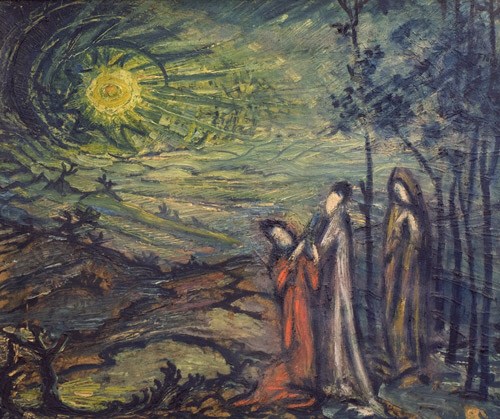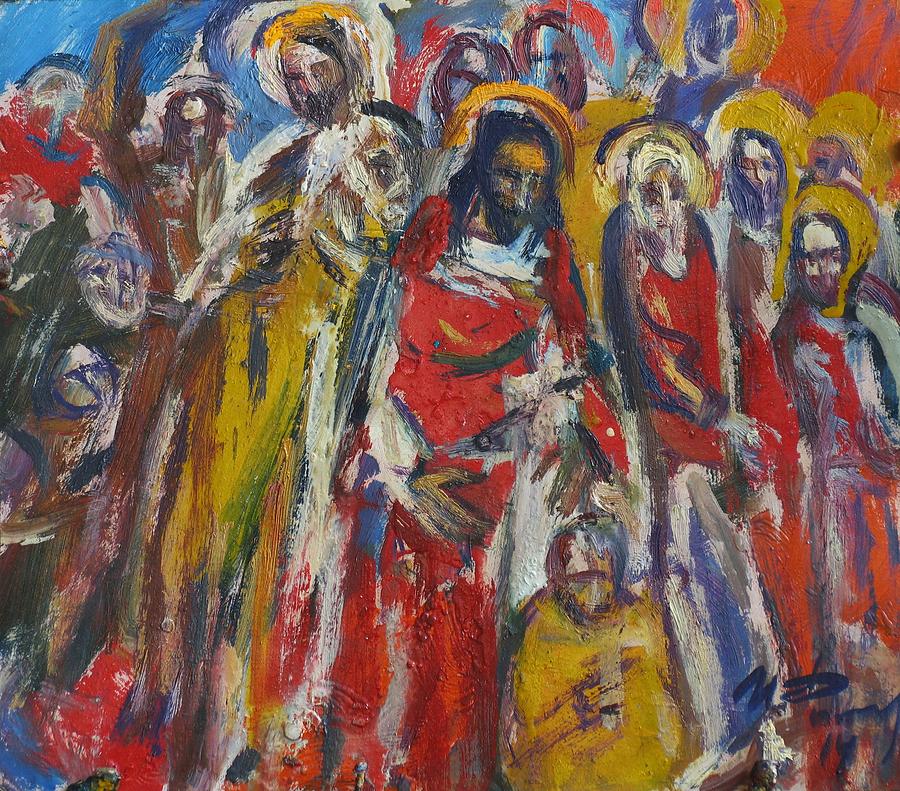
Matthew 9:2-13 – Why Jesus Came

Healing by Russian painter Ivan Filichev

Some men brought to Jesus a paralyzed man, lying on a mat. When he saw their faith, Jesus said to the man, “Take heart, son; your sins are forgiven.”

At this, some of the teachers of the law said to themselves, “This fellow is blaspheming!”

Knowing their thoughts, Jesus said, “Why do you entertain evil thoughts in your hearts? Which is easier: to say, ‘Your sins are forgiven,’ or to say, ‘Get up and walk’? But I want you to know that the Son of Man has authority on earth to forgive sins.” So, he said to the paralyzed man, “Get up, take your mat and go home.” Then the man got up and went home. When the crowd saw this, they were filled with awe; and they praised God, who had given such authority to man.

As Jesus went on from there, he saw a man named Matthew sitting at the tax collector’s booth. “Follow me,” he told him, and Matthew got up and followed him.

While Jesus was having dinner at Matthew’s house, many tax collectors and sinners came and ate with him and his disciples. When the Pharisees saw this, they asked his disciples, “Why does your teacher eat with tax collectors and sinners?”

On hearing this, Jesus said, “It is not the healthy who need a doctor, but the sick. But go and learn what this means: ‘I desire mercy, not sacrifice.’ For I have not come to call the righteous, but sinners.” (NIV)

The late Abigail Van Buren, better known as the newspaper columnist, “Dear Abby,” was the person who made famous the phrase: “The church is a hospital for sinners, not a museum of saints.” That quote is an accurate reflection of what Jesus was doing and saying. We occasionally need words like Dear Abby’s to remind and reorient us toward why the church exists.  

The church of the Lord Jesus does not remain on this earth solely for our benefit, any more than a hospital exists for the benefit of the doctors or insurance companies! Rather, the church lives to extend the mission of Jesus through proclamation of good news with the restorative touch of grace. The church’s calling is not to find others who can help them with their tithing and keep warm seats in the pew. Instead, the church is the community of the redeemed, gathered and sent to be the continuing presence of Jesus on this earth.

Some who are reading this are not healthy. Some are sick with sin; others are heart-sick; yet others are plain sick-and-tired of being sick-and-tired. Jesus came neither to condemn nor heap a pile of unrealistic expectations on us. Christ points us to the source of healing and change and invites us to admit our need and come to him. 

Conversely, many others today are healthy, spiritually alive, and well. It is our job to roll up our sleeves and serve, participating fully in the mission of Jesus to the world. The question I want us to grapple with is this: Why did Jesus come to this earth? The answer to that question is to also answer the question of our own purpose and existence as followers of Christ.

Jesus came to forgive sin and transform sinners.In today’s Gospel healing, it was a case where the person’s sin was connected to his paralysis – and the paralytic found in Jesus not only physical healing, but new spiritual life.

The religious insiders observed the healing. Yet there was no rejoicing by them about the transformation. Instead, they became hung up on Jesus claiming to be God. Granted, this was a hard truth for them to get a hold of. But Jesus labeled such thinking as evil – the inability to see and perceive the situation as a divine intervention, and that Jesus really is the Lord who graciously did it. Because they wrongly discerned who Jesus is, they wrongly interpreted the situation. 

Therefore, it is important to see Jesus as the Human One who extends compassion and forgiveness. If we fail to see this about Christ, we will get caught up in all kinds of silly matters of personal preference and ridiculous power plays, based in how we think things should go, rather than the gospel.

Jesus came to forgive sin. Healing the body is good but not enough. Just focusing on the physical well-being of individuals was not why Christ came. At the heart of the human condition is spiritual brokenness, and Jesus is all about taking away guilt and shame, creating a new person and a new community. It is a radical vision which seeks to encompass all persons – which means Jesus touched many people overlooked by others.

Jesus came to call the despised people of society, the “sinners.” He called Matthew, a tax collector. Tax collectors were hated. They were corrupt characters who extorted money from innocent people. Jesus not only called the despised Matthew but had dinner with him and all his unsavory buddies. This kind of behavior by Jesus was deeply offensive to upstanding citizens.

However, Jesus did not back down. He responded by saying that it is not the healthy who need a doctor, but the sick. And he backed up his social actions with Scripture by encouraging offended folks to meditate on what this biblical phrase means: “I desire mercy, not sacrifice.” (Hosea 6:6)

For I desire mercy, not sacrifice, and acknowledgment of God rather than burnt offerings.

hosea 6:6, niv

It is possible to engage in outward rituals of worship, do all the right things, fulfill our duty, yet still miss the heart of God wants for humanity. Mercy is what God wants. Jesus knew this. So, Christ entangled himself with sinners to bring spiritual healing and restoration.

When Corrie Ten Boom sought to bring deliverance of the Jews from the Nazis during World War II, she had to entangle herself with Jewish refugees. When Christian missionaries seek to be the light of Jesus to people, they must entangle themselves with the people’s culture. If we want to see God deliver people from their situations, we must entangle ourselves with them, into complicated lives that are not pretty, with persons who have been tainted by sin. 

Lots of people are in awful predicaments. Christians, like their Lord, will need to get their hands dirty and their feet wet to extend Christ’s ministry of mercy and forgiveness. The gospel was never intended to be proclaimed from afar, but up close and personal through entanglement in people’s lives. If the merciful mission of Jesus is to occur, it requires the following three activities:

  1. Intimacy with Jesus. Engaging in the spiritual disciplines of prayer, giving, fasting, reading, and meditating on Scripture are the activities which help us to know Christ better and know and how to respond with mercy.
  2. Intimacy with fellow believers. We are hard-wired by God for community. Superficial relationships can only provide superficial community. Christians need to help one another with spiritual growth. They must hold one another accountable for the mission of Christ.
  3. Intimacy with “sinners.” This world is filled with sick, needy, hurting, lonely, unhealthy people who are locked in unhealthy patterns of living. They need a merciful change of life that comes from the merciful Jesus acting through merciful Christians. 

Mercy, not judgment, is at the heart of all change. If we desire others to be different, we will need to be acquainted with the mercy of God.

Most merciful God, we confess we have sinned against you in thought, word, and deed, and by neglect. We have not held fast to your commandments and have strayed from your teachings. We turn from our self-centered actions and pride. For the sake of your Son, Jesus Christ, have mercy on us and forgive us so that we are released from anything that seeks to keep us from delighting in your presence. Empower us with your wisdom, revelation, and discernment so that we might be your merciful hands, feet, and words to one another and those who do not yet know you. Amen.

Matthew 8:28-9:1 – A Force to Be Reckoned With

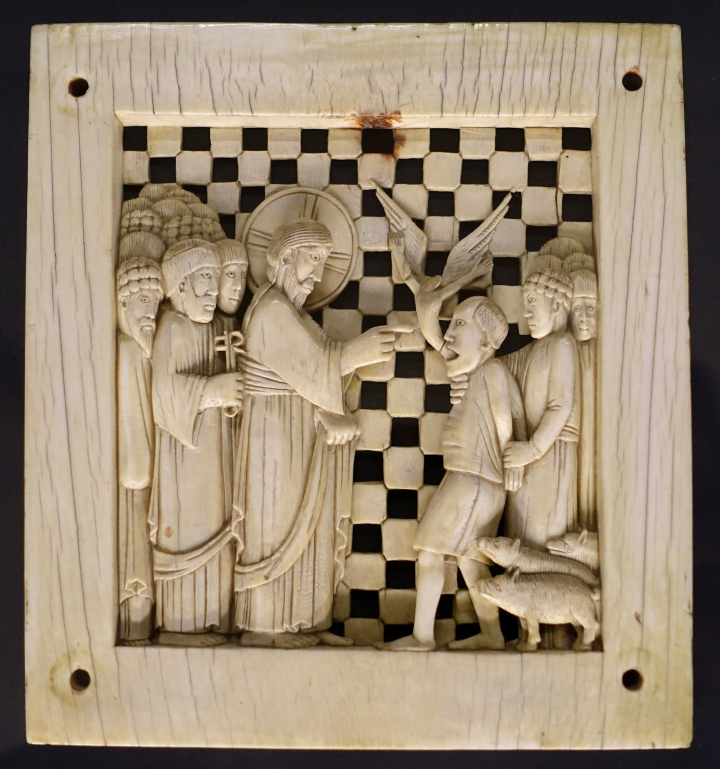
Christ healing the demoniac, ivory engraving, c.968 C.E.

When Jesus arrived at the other side in the region of the Gadarenes, two demon-possessed men coming from the tombs met him. They were so violent that no one could pass that way. “What do you want with us, Son of God?” they shouted. “Have you come here to torture us before the appointed time?”

Some distance from them a large herd of pigs was feeding. The demons begged Jesus, “If you drive us out, send us into the herd of pigs.”

He said to them, “Go!” So, they came out and went into the pigs, and the whole herd rushed down the steep bank into the lake and died in the water. Those tending the pigs ran off, went into the town, and reported all this, including what had happened to the demon-possessed men. Then the whole town went out to meet Jesus. And when they saw him, they pleaded with him to leave their region.

Jesus stepped into a boat, crossed over and came to his own town. (NIV)

At some point, everyone must deal with Jesus, simply because he is a force to be reckoned with. 

Eventually, we know that a storm will come. It may be sunny today, and the forecast might predict more sun or partly sunny for a while. Yet we know the weather will change. In the American Midwest state of Wisconsin where I live, we have not had as much snow this winter as we typically do. Oh, but all of us Wisconsinites know it is coming. It is not a question of “if” but “when.” It will not be here today or tomorrow, but it will come.

Jesus will come.  A person might not have to contend with him today, maybe not tomorrow. However, eventually, there will be a whopper of a storm and we will have to deal with it. In today’s Gospel lesson, two men described as being severely influenced by demons approached Jesus. Inside of them was such a terrible inner storm that they shouted at Jesus.

“Healing comes when our story is raw, bone-deep, and full of hunger for what only Jesus can offer.”

dan allender

Jesus, unfazed by the men’s inner violence and outer screams, uttered a command from a place of confidence. As fierce as the men were (the demons were so many that they were exorcised into a herd of pigs), Jesus had the authority to deal with the situation. As a result, the storm within the men subsided.

Yet, the storm was not over – it picked up momentum with the townsfolk. It seems they had been living their merry lives with no thought to Jesus. But he showed up. So, they had to contend with the authority right there in front of them. Unfortunately, they chose poorly. 

The Evangelist, Matthew, intends for us to see a connection in the story between the demons who begged Jesus, and the people of the town who begged Jesus. They did not humbly beg to follow him; they begged him to get away and leave them alone.

Jesus is an authoritative force to be reckoned with… and he is coming to your town.  Maybe not today, perhaps not tomorrow.  But things will not always be the way they are right now.  People will have to face Jesus.

Jesus Christ, Son of God, you are Lord over the wind, the waves, and the weather. You also command the unseen, and they obey. You are God with us. Oh, that all people would beg to follow you and not beg you to leave!  I am grateful for your power and authority over all things.  Amen.

Matthew 2:1-12 – Epiphany of the Lord

Star of Bethlehem by German painter Waldemar Flaig (1892-1932)

Jesus was born in Bethlehem in Judea, during the reign of King Herod. About that time some wise men from eastern lands arrived in Jerusalem, asking, “Where is the newborn king of the Jews? We saw his star as it rose, and we have come to worship him.”

King Herod was deeply disturbed when he heard this, as was everyone in Jerusalem. He called a meeting of the leading priests and teachers of religious law and asked, “Where is the Messiah supposed to be born?”

“In Bethlehem in Judea,” they said, “for this is what the prophet wrote:

‘And you, O Bethlehem in the land of Judah,
    are not least among the ruling cities of Judah,
for a ruler will come from you
    who will be the shepherd for my people Israel.’”

Then Herod called for a private meeting with the wise men, and he learned from them the time when the star first appeared. Then he told them, “Go to Bethlehem and search carefully for the child. And when you find him, come back, and tell me so that I can go and worship him, too!”

After this interview the wise men went their way. And the star they had seen in the east guided them to Bethlehem. It went ahead of them and stopped over the place where the child was. When they saw the star, they were filled with joy! They entered the house and saw the child with his mother, Mary, and they bowed down and worshiped him. Then they opened their treasure chests and gave him gifts of gold, frankincense, and myrrh.

When it was time to leave, they returned to their own country by another route, for God had warned them in a dream not to return to Herod. (NLT)

The Three Kings, Ethiopian Orthodox Church

Each year on January 6 in the Church Calendar, after the twelve days of Christmas, is the celebration of Epiphany. Christ’s coming to this earth as a child and becoming like us is much more than a baby in a manger.  Epiphany helps to bring a vision and understanding of God’s glory to all kinds of people in the world.

Epiphany means “manifestation” or “appearance.” The event which is associated with this season is the visit of the Magi to Jesus. Included in this time of the year between the seasons of Christmas and Lent is a special emphasis on the teaching and healing ministry of Jesus. The great celebration and focus of these weeks is that salvation is not limited to Israel but extends to the Gentiles, as well.

Every season in the Christian Year has its unique angle of grace. With Epiphany, we see that one of the most scandalous truths of Christianity is that God graces common ordinary people who seem far from God with the gift of Jesus. God grants repentance that leads to life for all kinds of people no matter their race, ethnicity, class, or background. It is a wondrous and astounding spiritual truth that God’s gracious concern is not limited to a certain type of person or a particular group of people.

Grace is and ought to be the guiding factor in how we interact with people. Losing sight of grace leads to being critical and defensive. Like King Herod of old, a graceless person becomes enamored with earthly power and control. But embracing grace leads to the humility of seeing the image of God in people quite different from ourselves. Like the Apostle Peter, who learned in a vision to bring the gospel to non-Jews, old legalisms begin to be worn away so that people from all walks of life can have access to Jesus and his gracious saving and healing ministry. (Acts 10-11:18)

Grace brings down barriers and does away with unnecessary distinctions between others. The appropriate response to mercy is to glorify God for such marvelous light and amazing work.

It is a merciful reality that the Magi, or Wise Men, pagan astrologers, were directed to the Messiah. A light was provided to lead them to Jesus. Apart from God’s care and intervention they would have remained in darkness.  And it is no less true for people today. This old broken world is wrapped in darkness. All kinds of people have no light at the end of the tunnel of their lives for hope and new life. The gospel of Jesus Christ brings that light to those walking around with no ability to see. Jesus, in his teaching ministry, exhorted his followers not to hide their light but to let it shine for all to see. (Matthew 5:14-16)

Sometimes, maybe oftentimes, the best way to bring resolution to our own troubles and problems is through helping others make sense of their lives through the gracious light of Christ so that they can see an appearance, an epiphany, of what their lives can be in the gracious rule of the kingdom of God. 

As we celebrate Epiphany and journey with Jesus through his earthly upbringing and into his gracious ministry to people, let us keep vigilance to not let our light grow dim. Instead, let us hunger and thirst after Christ’s righteousness so that our joy is full, and our light is bright.

God of mercy, Lord of all, you have gifted the Church through the goodness of your grace to be your hands and do your work, to be your voice and share your words, to bring healing to broken lives. You have graciously gifted your people with the blessings of your Spirit, the power to transform lives and make all things new. Now may our hearts receive, our mouths proclaim, our hands prepare for service so that the love that we have may overflow into the hearts of others, and receive your grace, your renewing Spirit, and your love, through Jesus Christ our Savior. Amen.

Matthew 2:13-18 – Flight into Egypt

The Flight into Egypt by Marc Chagall, 1980

When they had gone, an angel of the Lord appeared to Joseph in a dream. “Get up,” he said, “take the child and his mother and escape to Egypt. Stay there until I tell you, for Herod is going to search for the child to kill him.”

So, he got up, took the child and his mother during the night, and left for Egypt, where he stayed until the death of Herod. And so was fulfilled what the Lord had said through the prophet: “Out of Egypt I called my son.”

When Herod realized that he had been outwitted by the Magi, he was furious, and he gave orders to kill all the boys in Bethlehem and its vicinity who were two years old and under, in accordance with the time he had learned from the Magi. Then what was said through the prophet Jeremiah was fulfilled:

“A voice is heard in Ramah,
    weeping and great mourning,
Rachel weeping for her children
    and refusing to be comforted,
    because they are no more.” (NIV)

It can be easy to be diverted either by all the shiny things about the holiday season, or by all the sorrows which are stirred up for us in this time of year. I invite you to the very mundane and simple manger; the dull and unattractive place where God is found. Because it is here, we find the hope of the nations, and the true desire of our hearts.

Almighty God preserved and protected the child Jesus. Christ’s early life retraced the life of ancient Israel. Like the Jewish patriarchs, Jesus went down to Egypt (and would eventually go down and face hell for us in his crucifixion); and, like the ancient Israelites, Jesus was brought up out of Egypt (and would rise from the dead bringing freedom from sin and death once for all) in a New Exodus. By these Old Testament references, Matthew’s Gospel means to say: “Look, here is the Messiah, the coming King, the promised One of Israel and of all the nations. Jesus is our salvation, the fulfillment of all that we hope for.”

Jesus is the New Exodus

In the second of three dreams, Joseph is told to take Jesus to Egypt. Joseph obeyed the Lord and took the role of protecting Jesus, as contrasted with Herod’s role in attempting to murder Jesus.Yet, there is more to this story than Christ’s protection; this is the fulfillment of a biblical pattern, an identification of Jesus with the people of God. Matthew pulled forward the prophet Hosea to say that just as God brought the Israelites out of Egypt through a great deliverance, God brought up Jesus, the Great Deliverer, out of Egypt as the unique Son of God.  Jesus is God’s divine Son, and so is the rightful Ruler in God’s kingdom.

Just as God preserved Israel from Pharaoh’s wrath, the Lord protected Jesus from Herod’s wrath. God’s kindness and loyalty extends to us as covenant people and preserves us from the wrath of the devil who seeks to keep as many people as possible in the realm of darkness. Our hope is in the Lord Jesus who has conquered the devil by establishing a beachhead on this earth through incarnation as the Son of God.

Flight into Egypt by He Qi

Jesus Brought Us Out of Exile

The scoundrel King Herod massacred innocent toddlers to ensure the destruction of Jesus. Behind his atrocity was the devil himself who knew Jesus was the coming King who would one day bring salvation. Reflecting on a vision of Christ’s birth, the Apostle John identified the sinister plan and the divine deliverance:

The dragon stood in front of the woman who was about to give birth so that when she gave birth, he might devour her child. She gave birth to a son, a male child who is to rule all the nations with an iron rod. Her child was snatched up to God and his throne. (Revelation 12:4-5, CEB)

Satan wars against God’s Son and God’s people, whose roots go all the way back to the first prophecy of Christ after the Fall of humanity. God declared to Satan:

“And I will cause hostility between you and the woman,
    and between your offspring and her offspring.
He will strike your head,
    and you will strike his heel.” (Genesis 3:15, NLT)

There has been continual enmity ever since the Fall between the serpent and the seed of the woman, with the Israelites constantly being threatened with extermination and tempted to conform to pagan ways. King Herod was just another in a long line of demonically animated men trying to perpetuate the kingdom of darkness. We must take this threat seriously because the devil knows that his time is short. A second Advent is coming which will be the final judgment.

Satan’s most powerful weapon, death, has lost its sting because of Jesus. Christmas is a hard time of year for many people, filled with depression instead of joy, grieving over lost loved ones for whom we will not spend another Christmas with. Yet there is a reunion coming, the hope of a bodily resurrection in which we will be with Jesus and God’s people forever.  Be encouraged that there is no time in heaven; it will be only a moment and the people who have gone before us will turn around and see us; we will one day join them.

Matthew also used the prophet Jeremiah to communicate hope. Jeremiah’s prophecy dealt with children who were lost in war to the invading Babylonians.  The prophecy is a lament with the hope that captivity will not be forever. Matthew wanted us to see that the exile is over for us; Jesus has arrived, and the tears which were shed will shortly dry up. There may be a time of suffering which we must endure, yet there will be glory. Jesus is the Great Deliverer who brings us out of sin’s captivity and into the promises of God. He is our hope.

Jesus is the promised One who will deliver us from the tyranny of the devil. Christ is the hope of the nations, the Savior of the world. So, let us come back to the first Christmas which was the beginning of the end for evil on the earth. Believers in Jesus are part of God’s victory and overcome the evil one by the blood of the lamb, acknowledging that Christ’s incarnation was essential for us. 

Just as Jesus made a radical break with his former life in heaven through the incarnation, we, too, must break with our old way of life. God will save his people through this child Jesus. The greatest gift we can give in this season and throughout the year is the gift of grace, the presentation of the Christ child.

Loving God help us remember the birth of Jesus so that we may share in the song of the angels, the gladness of the shepherds, and the wisdom of the wise men. Close the door of hate and open the door of love across the world. Let kindness come with every gift and good desires with every greeting. Deliver us from evil through the blessing of the Christ child. Teach us to be happy with pure hearts. Grant us grateful thoughts, devoted hearts, and gracious hands, through Jesus our Savior in the might of the Holy Spirit. Amen.