“The prophet Daniel said that the disgusting thing that will cause destruction will stand in the holy place. When you see this (let the reader take note), those of you in Judea should flee to the mountains. Those who are on the roof should not come down to get anything out of their houses. Those who are in the field should not turn back to get their coats.
“How horrible it will be for the women who are pregnant or who are nursing babies in those days. Pray that it will not be winter or a day of rest, a holy day, when you flee. There will be a lot of misery at that time, a kind of misery that has not happened from the beginning of the world until now and will certainly never happen again. If God does not reduce the number of those days, no one will be saved. But those days will be reduced because of those whom God has chosen.
“At that time don’t believe anyone who tells you, ‘Here is the Messiah!’ or ‘There he is!’ False messiahs and false prophets will appear. They will work spectacular, miraculous signs and do wonderful things to deceive, if possible, even those whom God has chosen.Listen! I’ve told you this before it happens. So, if someone tells you, ‘He’s in the desert!’ don’t go out looking for him. And don’t believe anyone who says, ‘He’s in a secret place!’ The Son of Man will come again just as lightning flashes from east to west.” (God’s Word Translation)
Midwest American summers can be brutally hot and humid. And the winters can be terribly frigid and full of snow.
Having lived in various university towns and worked with many college students, every Fall there are always new international students, and students from the American Deep South, that have never experienced a Midwest winter and snow.
I might tell them, repeatedly, of the need for a sturdy winter coat before the snow flies. Yet, having never known sub-freezing, let alone sub-zero temperatures, it’s difficult to imagine such cold when the weather is warm.
There is little belief that everything around them will change in a few short months to the point that it will be felt down to the bone.
At the coming of winter, I, or someone else, helped ensure they had a suitable coat. Even then, those students often bodily shake all winter and never take their scarves off.
Since none of us have yet experienced it, it might be difficult to imagine that someday Christ will return to judge the living and the dead.
So, in order to help the disciples to grasp the coming future, Jesus told them to use discernment. Although it may seem improbable now, a time is coming which will be loaded with cosmic and cataclysmic changes.
Sometimes, even for myself who has lived through many hard winters, it’s incredible to know that the landscape, as it is right now, will be completely different in another six months.
Seasons come and go. Eventually, the sky and the earth as we know it now will pass away. However, the words and ways of Jesus Christ will endure for all time.
If we are attentive and alert, we will be ready. We will have a warm winter parka on hand.
For now, it means taking off the old clothes of fear, insecurity, hopelessness, and hate; and putting on the new clothes of righteousness, peace, and love in the Holy Spirit.
You may not think winter is coming. But it is. It may even be here sooner than you believe.
Do you feel that chill in the air?
Almighty and everlasting Father, we long for the coming of your kingdom in Jesus Christ our Lord. We lament before you the signs that your kingdom has not yet come in its fullness. The signs of brokenness and divisions, oppression and abuse, poverty and loneliness, are everywhere present in this present world.
So, we cry out from the depths of our being for you to come and bring us humility, wisdom, discernment, comfort, and hope. Dispel the shadows of the night and turn our darkness into light, through Jesus Christ, your Son, our Lord who with you and the Holy Spirit reign as one God, now and forevermore. Amen.
Jesus said, “Do not store up for yourselves treasures on earth, where moths and vermin destroy, and where thieves break in and steal. But store up for yourselves treasures in heaven, where moths and vermin do not destroy, and where thieves do not break in and steal. For where your treasure is, there your heart will be also.
“The eye is the lamp of the body. If your eyes are healthy, your whole body will be full of light. But if your eyes are unhealthy, your whole body will be full of darkness. If then the light within you is darkness, how great is that darkness!
“No one can serve two masters. Either you will hate the one and love the other, or you will be devoted to the one and despise the other. You cannot serve both God and money. (New International Version)
Nobody can pursue two diametrically opposed commitments.
Trying to live in both worlds of pursuing earthly treasure and heavenly treasure is not possible.
Jesus has no place for any of his followers to ride the fence between those two worlds.
We cannot practice God’s will, and at the same time have a moonlighting job with the world.
As followers of God, we must have a single-minded loyalty to kingdom values.
We are to do the will of God, from a right and sincere heart, and follow Christ’s teaching alone.
We may give of ourselves, and give of our money, with sincerity, but if we walk away from that and believe the rest of my money, time, talents, and resources are mine to use as I want (since I fulfilled my duty) then we have a divided loyalty between the kingdom of God and the domain of darkness.
Jesus, as he typically does in the Gospels, used metaphors to communicate that we must have an unswerving loyalty to God’s kingdom values.
The Treasure Metaphor
Do not store up for yourselves treasures on earth. So, what are earthly treasures?
Stuff, money, possessions, control, power, position, and recognition from others.
You may rightly ask in response, “Is any of that really, in and of itself, wrong?”
No. However, that’s not the real issue. The real question is this:
Do we use our earthly treasure to build heavenly treasure, or do we hoard earthly treasure for our own purposes apart from Christ’s kingdom values?
A man in a crowd said to Jesus, “Teacher, tell my brother to give me my share of what our father left us when he died.”
Jesus answered, “Who gave me the right to settle arguments between you and your brother?”
Then he said to the crowd, “Don’t be greedy! Owning a lot of things won’t make your life safe.”
So, Jesus told them this story:
A rich man’s farm produced a big crop, and he said to himself, “What can I do? I don’t have a place large enough to store everything.”
Later, he said, “Now I know what I’ll do. I’ll tear down my barns and build bigger ones, where I can store all my grain and other goods. Then I’ll say to myself, ‘You have stored up enough good things to last for years to come. Live it up! Eat, drink, and enjoy yourself.’ ”
But God said to him, “You fool! Tonight, you will die. Then who will get what you have stored up?”
“This is what happens to people who store up everything for themselves but are poor in the sight of God.” (Luke 12:13-21, CEV)
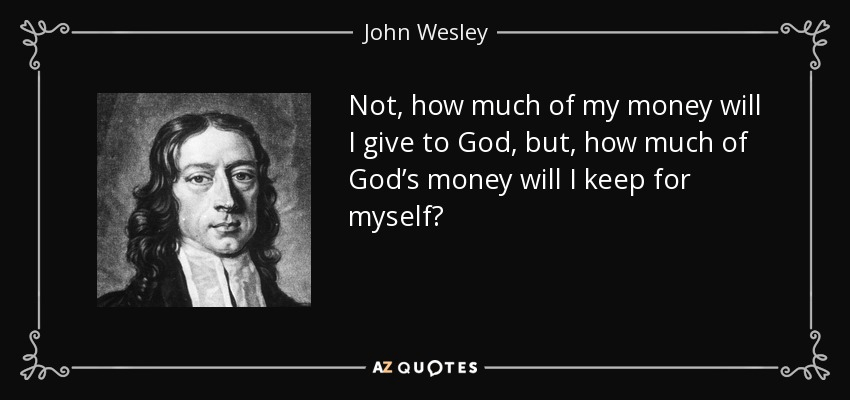
Earthly possessions are tools to be used. Jesus warns that we must not accumulate personal wealth, esteem, and success for the sake of placing ultimate security in money, but for advancing God’s kingdom values.
Why do that?
Because earthly treasure is temporary, and heavenly treasure is permanent.
Heavenly treasure is righteousness; it’s right and just relationships. Humility, peace, grace, mercy, purity, and forgiveness are all relational values. The only thing that we will take with us when we die is relationships; it’s the only thing that’s permanent.
If I am genuinely committed to God’s kingdom, my most cherished values will be established by God.
Whatever it is that we value, those values consume our thoughts and our efforts. In other words, what’s truly in our hearts directs our work.
And what we value derives from how we perceive our identity. For many Americans, we are defined primarily not as citizens or workers, but consumers. Jesus is neither advocating that we take vows of poverty, nor that we ought not to enjoy the good things in life. Rather, Jesus wants us to define where our loyalties truly lie.
The Light Metaphor
In the ancient world, the eye represented what you fixed your gaze on, or what your focus was. In our culture, we could replace the word “eye” with the word “goal.” The word “body” represents the entirety of one’s life. So, we may interpret Christ’s words in this way:
A goal is the focus of a life. If your goals are good, your whole life will be full of proper focus. But if your goals are bad, your whole life will be full of blindness. If then, the focus within you is only really blindness, how great is that darkness!
If the goals and dreams of life are toward earthly treasure, you will blindly move in that direction and your life will end up in disordered love and misplaced values. At death, you will have nothing to take with you because all the eggs have been put in the temporal basket.
The Slavery Metaphor
Jesus flatly stated that we cannot simultaneously serve God and money. Pick and choose. You must go one way or the other; there is no middle ground.
The question Jesus is posing is: “Who’s your Master?”
When deciding between two jobs, or two homes, or how to spend your time or your money, what set of values comes into play?… values that define me as a follower of Jesus?… or values that define me as an American consumer?
Will I be a bondservant of Jesus, or a slave to credit card debt?
Will I serve God, or serve the lifestyle that I believe I deserve?
Conclusion
None of us are immune from the temptations of all the world’s shiny things, of ambling into misdirected goals. If you find that you are slave to the wrong god, then there is good news: There is an infinite storehouse of grace that flows from the very heart of God through Jesus Christ.
If we confess our sins, he is faithful and just to forgive us our sins and cleanse us from everything we’ve done wrong. (1 John 1:9, CEB)
Choose this day whom you will serve.
Our Father in heaven, may your name always be kept holy. May your kingdom come and what you want, be done, here on earth as it is in heaven. Give us the food we need for each day. Forgive us for our sins, just as we have forgiven those who sinned against us. And do not cause us to be tempted, but save us from the Evil One.
The kingdom, the power, and the glory are yours forever. Amen. (Matthew 6:9-13, NCV)
“You have heard that it was said, You must love your neighbor and hate your enemy. But I say to you, love your enemies and pray for those who harass you so that you will be acting as children of your Father who is in heaven. He makes the sun rise on both the evil and the good and sends rain on both the righteous and the unrighteous. If you love only those who love you, what reward do you have? Don’t even the tax collectors do the same? And if you greet only your brothers and sisters, what more are you doing? Don’t even the Gentiles do the same? Therefore, just as your heavenly Father is complete in showing love to everyone, so also you must be complete. (Common English Bible)
A few rhetorical questions: Have you ever had someone not like you? Offend you? Purposely say or do things that upset you?
I once had a next door neighbor that was just plain mean. Once, when my dog accidentally strayed into her yard and left a package, she picked it up and placed the package directly in front of my backdoor.
When stuff happen, it’s easy to respond in kind. Many of us have sly passive aggressive tendencies toward people we don’t like. One of my professors once admitted that he responded to a woman who was bragging to him about how many children she had by saying, “Oh, we don’t place such an emphasis on sex in my house!”
That sort of stuff is rather benign. It’s altogether a different thing whenever someone has deeply hurt us with malicious words or actions. We naturally seek to defend and respond by hurting the other back.
So then, this is no trite saying of Jesus to proclaim that we are to love the enemy. It cannot be done apart from the God’s grace.
Jesus knows what he is asking of us. And he does not ask of us anything that he himself has not done.
We are often pleased with ourselves if we love our family and friends, because even that is a struggle, at times, for many people.
Yet, our love needs to expand much further than family. We must treat all people with respect and kindness, even active love, because this is what God does. And if followers of Jesus don’t do this, Christianity is shown, at best, to be just another religion out of many, and at worst, the Church is presented to the world as a fraud.
Those who are poor in spirit, mourn over sin, and display meekness, are those who understand they are no better than anyone else, including their enemies.
They seek to be right and to do right by:
Showing mercy instead of judgment
Displaying purity of heart instead of making plans to get back at others
Seeking peaceful solutions instead of looking to pick a fight
Accepting insults, persecution, instead of hating (Matthew 5:3-12)
With God’s righteousness as their breastplate, the Christian loves the enemy and prays for those who persecute them.
The Old Testament clearly says to love your neighbor (Leviticus 19:18). Yet, nowhere in the Bible does it say to hate your enemy.
Over the centuries, people began to draw the inference that if we are told to love our neighbor, that therefore, we must hate our enemy, who is not our neighbor.
From that popular understanding, it was inevitable that Jesus would get asked the question, “Who is my neighbor?” Christ’s answer to that question was to tell the parable of the Good Samaritan (Luke 10:25-37). The conclusion to that parable is that everyone I come into contact is my neighbor, and so must be shown mercy when they are in need.
It is not for us to judge whether someone is unlovable. It’s not our call to deem another person as unworthy of receiving love. Neither you nor I gets to decide if a person or group of people are too obnoxious or evil for any sort of love.
Nobody can love God by being hateful to another person. Love of God is not measured by zeal against God’s enemies; it is measured by treating all persons with respect and love.
Jesus clearly tells us how we can love our enemies: Pray for them. It is difficult to hate a group of people when we are devoted to praying for them. It’s really hard to call somebody a monster when you are using their name in prayer.
So, if you are struggling with a person or a group of people, pray! If someone is giving you a hard time and doesn’t like you, pray for them. Pray they will see the error of their ways. Pray the Spirit to open their eyes and grant them self-awareness. And, at all times, leave the judgment to God, for that is his business, not ours. (Romans 12:17-19)
Why love “those” people?… Because God loves them.
Loving those who offend us emulates God’s benevolence. Whenever we love our enemies, we are not expecting anything in return.
Since you are God’s dear children, you must try to be like him. Your life must be controlled by love, just as Christ loved us and gave his life for us as a sweet-smelling offering and sacrifice that pleases God. (Ephesians 5:1-2, GNT)
Love gives life meaning. And love always suffers. There isn’t any love apart from suffering. That’s because it requires a great deal of blood, sweat, and tears to love. Jesus is asking us to suffer for the enemy, just as we suffer for our children and our friends.
If Christians have no love for their enemies, then they are no different than the haters of this world. Followers of Jesus are distinctive because of the way we treat people. We are to model our lives after God’s love, not by the standard of niceness to those who are nice to us.
God doesn’t expect us to live only through reciprocity, that is, simply giving back to those who already have given something to us. Christians are to give even when persecuted. That’s because God shows no distinction in how he distributes the sun and the rain.
Showing basic respect and goodness to all people, no matter who they are, is God’s rain showers and sunshine toward others.
I have observed that every church believes they are friendly (even the cold ones) because the members are friendly with their friends. They greet everyone who greets them. This is neither spectacular nor noteworthy.
Genuine love keeps an eye open for the quiet, the awkward, and the friendless, and seeks them out.
“To return evil for good is devilish; to return good for good is human; to return good for evil is divine. To love as God loves is moral perfection.”
Alfred Plummer
Most English translations has Jesus saying to be “perfect,” because the heavenly Father is perfect. That is an unfortunate translation because a lot of people think “perfectionism.” But that’s not what Jesus was talking about. Christ was referring to being spiritually mature, morally sound, and personally whole and integrated.
“Maturity is looking at every person we meet and saying to yourself, ‘I will never, God helping me, do anything to harm you: not by angrily lashing out at you, lusting over you, faithlessly slipping away from you, verbally hitting back at you, or even justifiably disliking you.’”
Frederick Dale Bruner
So, how do you treat people, all people, even those you don’t like and have hurt you in some way?
The ability to love the enemy comes from God. Grace is not something we can just conjure up, as if we might will ourselves to love our enemies. It is not natural – it is supernatural, and so must come from a supernatural Being.
Human relationships easily become subject to verbal violence, bitterness, and destruction, whenever we treat our own life and the lives of other people as properties to be defended, instead of precious gifts to be received.
We have died to hate. So, how can we live in it any longer? Selfishness, pride, and seeking to control others has been crucified with Christ.
If we have nothing to defend, then we have no enemies who can harm us.
Jesus, Prince of Peace, you have asked us to love our enemies and pray for those who persecute us. With the help of the Holy Spirit, enable us to do just that. Give us the courage, strength, and grace to love those who harm us so that we may shine as beacons of Christian light in a world of revenge, retaliation, and darkness.
May all people learn to work together for the justice which brings true and lasting peace.
Let us pray for our enemies and persecutors:
We pray for those who have hurt us. Bless them always and in every way, Lord.
We pray for those who hate us. Bless them always and in every way, Lord.
We pray for those who insult us. Bless them always and in every way, Lord.
We pray for those who have stolen from us. Bless them always and in every way, Lord.
We pray for those who will not hear us. Bless them always and in every way, Lord. Amen.
On a bright Sunday morning, Lefty and his wife Goatrude were sitting at home enjoying a leisurely cup of coffee together. Lefty was slowly going through some of his emails.
And then, it happened.
“Oh, my goodness, look at this!” said Lefty to Goatrude. “I got an e-mail from Jesus! It says he will be here at 10am on Sunday. Egad! That’s any minute now!”
“The house is a mess! Hurry! Let’s get this all picked up.” said Goatrude. “And, for God’s sake, where is that big Bible? It needs to be here on the coffee table when Jesus gets here!”
“I think I know where that Bible is….” said Lefty. After rummaging around a junk closet, Lefty found the Bible dusted it off, and placed it prominently on the coffee table as the centerpiece of the living room.
As Goatrude and Lefty were hurriedly trying to make everything just right for Jesus, there was a knock at the door.
“That must be Jesus!” said Goatrude. “Answer it, Lefty. And, for goodness sake, stand up straight and be polite. We want Jesus to see us at our best.”
Lefty answered the door, surprised to see a ragged looking young man on the step.
“I’m sorry to bother you on a Sunday morning, but I haven’t had anything to eat all weekend. Might you have some food to spare?”
Perturbed with this interruption, Lefty answered the young man harshly. “No, I don’t. You need to go, right away. I have an important guest coming, and he’ll be here anytime now.” And he slammed the door shut.
Lefty had barely began getting back to tidying the living room when another knock came at the door.
“He’s here!” said Goatrude, moving quickly toward the door. But when she opened it, there stood a harried looking woman.
“Hello. My car broke down and I can’t get it started. And my cell phone died. Might I come in for just a few minutes so that I can get a bit warmed up and make a phone call?” said the woman.
Goatrude rudely responded, “We all have problems lady. I’ve got my own right now. You try and get ready for a visit from Jesus at the last minute. Try someone else.” And with that, Goatrude shut the door.
Lefty and Goatrude continued their hasty preparations for a visit from Jesus, when yet a third knock came at their door. This time, they answered it together, believing this to be Jesus for sure.
But when they opened the door, a frantic husband immediately said, “My wife just fell on the sidewalk. Please help me!”
“For God’s sake, man, we’re about to have Jesus here! We can’t be seen with a woman lying in front of our house! Get her up and go next door. And make it quick!”
Together, Goatrude and Lefty shut the door. Then, they sat down and anticipated Jesus to show.
Minutes pass… It’s now 10:15 and no Jesus. So, Goatrude, looking at Lefty, says, “I never figured Jesus to be somebody who is late. Maybe he got held up.”
“Hey, how about if I open this Bible and read something. When Jesus gets here, we’ll impress him with some knowledge. We’ll be the talk of the town, hosting Jesus.”
So, Lefty opened the big book, randomly turned to a page, and began reading….
“When the Son of Man comes in his glory, and all the angels with him, he will sit on his glorious throne. All the nations will be gathered before him, and he will separate the people one from another as a shepherd separates the sheep from the goats. He will put the sheep on his right and the goats on his left.
“Then the King will say to those on his right, ‘Come, you who are blessed by my Father; take your inheritance, the kingdom prepared for you since the creation of the world. For I was hungry, and you gave me something to eat, I was thirsty, and you gave me something to drink, I was a stranger and you invited me in, I needed clothes and you clothed me, I was sick, and you looked after me, I was in prison, and you came to visit me.’
“Then the righteous will answer him, ‘Lord, when did we see you hungry and feed you, or thirsty and give you something to drink? When did we see you a stranger and invite you in, or needing clothes and clothe you? When did we see you sick or in prison and go to visit you?’
“The King will reply, ‘Truly I tell you, whatever you did for one of the least of these brothers and sisters of mine, you did for me.’
“Then he will say to those on his left, ‘Depart from me, you who are cursed, into the eternal fire prepared for the devil and his angels. For I was hungry, and you gave me nothing to eat, I was thirsty, and you gave me nothing to drink, I was a stranger, and you did not invite me in, I needed clothes and you did not clothe me, I was sick and in prison and you did not look after me.’
“They also will answer, ‘Lord, when did we see you hungry or thirsty or a stranger or needing clothes or sick or in prison, and did not help you?’
“He will reply, ‘Truly I tell you, whatever you did not do for one of the least of these, you did not do for me.’
“Then they will go away to eternal punishment, but the righteous to eternal life.” (New International Version)








 Rev. Tim Ehrhardt