The Kingdom of God Is Here (Matthew 10:5-15)

Jesus sent his twelve harvest hands out with this charge:

“Don’t begin by traveling to some far-off place to convert unbelievers. And don’t try to be dramatic by tackling some public enemy. Go to the lost, confused people right here in the neighborhood. Tell them that the kingdom is here. Bring health to the sick. Raise the dead. Touch the untouchables. Kick out the demons. You have been treated generously, so live generously.

“Don’t think you have to put on a fund-raising campaign before you start. You don’t need a lot of equipment. You are the equipment, and all you need to keep that going is three meals a day. Travel light.

“When you enter a town or village, don’t insist on staying in a luxury inn. Get a modest place with some modest people and be content there until you leave.

“When you knock on a door, be courteous in your greeting. If they welcome you, be gentle in your conversation. If they don’t welcome you, quietly withdraw. Don’t make a scene. Shrug your shoulders and be on your way. You can be sure that on Judgment Day they’ll be mighty sorry—but it’s no concern of yours now. (The Message)

“People can’t observe the coming of God’s kingdom. They can’t say, ‘Here it is!’ or ‘There it is!’ You see, God’s kingdom is within  you.” Jesus, from Luke 17:20-21, GW

When Jesus told his followers that the kingdom of God is here, he didn’t simply mean that it all of a sudden showed up. No, it’s already here. It always has been. We just haven’t paid attention. And we haven’t noticed because we keep looking for a location, somewhere outside of ourselves. But, as it turns out, we already have what we’ve been searching for.

Christianity, at its core, is about following Christ. And that journey with Jesus is first and foremost a journey into oneself. This is why the Lord tells the disciples not to go first to outsiders. There’ll be a time for that. But now, the journey to their fellow Jews was to be an internal walk into the very depths of their own souls and the soul of a nation.

The singular message of this particular mission was to proclaim that the kingdom of God is near. It is here. In fact, it is so near and here that it is actually within you. But the disciples needed to discover this for themselves by going out and removing all obstacles to awareness of God’s light.

Jesus sent the disciples out and told them not to take anything with them because they already had what they needed. The kingdom of God is already within them.

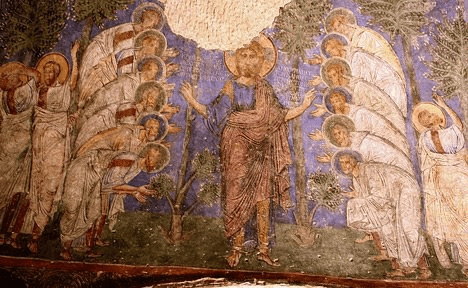
A Byzantine fresco of Jesus sending the disciples, 12th century

So, they were to leave all their baggage and their stuff behind. The disciples were to be stripped of all their trusted outer resources so that they had the ability to see themselves, to others, and human need – and then to be moved in their hearts with compassion, just as Jesus is. 

Whenever we take all our pre-packaged stuff with us into relationships and the doing of Christ’s mission, we already assume we know what other people need. If we have nothing with us, then we are able to see people for who they actually are; we can genuinely listen to what they are saying. 

You have freely received compassion from God, so freely give it away. Not everyone will respond, but that’s not your business; they will have to deal with God on that later.

Compassion is to be our response to human need. Yet, we don’t always respond with compassion because of the obstacles within our own hearts and lives prevent us from seeing others and their needs.

The following are a few of obstructions which hinder us from compassion and perceiving the kingdom of God within us, and how to deal with them:

  1. Contempt. Contempt breeds contempt. Unacknowledged and unresolved anger produces bitterness. Hatred feeds more hatred. Our environment makes a difference. For example, if you find you have to check your heart at the workplace in order to do your job, then you need to either you quit your, or bring forth the kingdom of God by tirelessly advocating for compassionate treatment of people.
  2. Busyness. I’m referring to an unhealthy pace of life. Many of us work too much and do too many things. We cannot have compassionate hearts by moving so fast that we fail to see other people’s needs. Slow down. No one is going to come to the end of their life and wished they had been workaholics. Make a thoughtful plan to slow down enough so you can tune into the needs of others and have emotional energy for them.
  3. Resentment. It’s possible to become coldhearted by excessive and unrelenting caregiving. This is the same sort of problem as an unhealthy pace of life; you give so much that you actually begin to resent the people you care for. Caregiving has to be meticulously balanced with self-care. There’s a time for everything, including rest and recuperation.
  4. Inaction. Only receiving and not giving is what I call “spiritual constipation.” It’s when a person listens to hundreds and thousands of sermons and podcasts but doesn’t listen to their neighbor. They have no intention of putting anything they hear into practice.

However, with nothing restricting or obstructing God’s kingdom within us, we can see the divine image within each person and within ourselves. We can begin to radiate that divine presence and be transformed by it’s inner light.

Like Jesus, transfigured before the disciples on Mount Tabor, we too, become transfigured by God’s energy of love touching our hidden divine energy as image-bearers. That energy now comes forth because we have left everything behind to follow Christ and experience the generosity which, ironically, only comes from having nothing.

This is a spiritual walk we cannot take alone. The road we travel is the way of community. Just as God is community – Father, Son, and Spirit – always in a unity of love, so we, as God’s image-bearers with the divine light within us, must strip ourselves of everything that hinders and the sin that so easily entangles and run with perseverance the race marked out for us.

We are to fix our eyes on Jesus and see him, the pioneer of our faith, the Light of the World, the Living Water, and Bread for the world, who endured all things for the redemption of humanity and all creation.

Almighty God, you sent your Son Jesus Christ to reconcile the world to yourself: We praise and bless you for those whom you have sent in the power of the Spirit to proclaim that the kingdom of God is near. We thank you that in all parts of the earth a community of love has been gathered together by their prayers and labors, and that in every place your servants call upon your Name; for the kingdom and the power and the glory are yours forever. Amen.

Matthew 10:34-42 – The Trouble with Jesus

Jesus teaching the disciples, from the Catacombs of Domitilla, Rome

Jesus said, “Do not suppose that I have come to bring peace to the earth. I did not come to bring peace, but a sword. For I have come to turn

‘a man against his father,
    a daughter against her mother,
a daughter-in-law against her mother-in-law—
    a man’s enemies will be the members of his own household.’

Anyone who loves their father or mother more than me is not worthy of me; anyone who loves their son or daughter more than me is not worthy of me. Whoever does not take up their cross and follow me is not worthy of me. Whoever finds their life will lose it, and whoever loses their life for my sake will find it.

Anyone who welcomes you welcomes me, and anyone who welcomes me welcomes the one who sent me. Whoever welcomes a prophet as a prophet will receive a prophet’s reward, and whoever welcomes a righteous person as a righteous person will receive a righteous person’s reward. And if anyone gives even a cup of cold water to one of these little ones who is my disciple, truly I tell you, that person will certainly not lose their reward.” (New International Version)

Jesus is the sort of guy that gets up in our grill and confronts us with this: All of life centers in him. That may sound incredibly narcissistic. For Christians, it isn’t, because we discern and confess along with the Apostle Paul:

“The Son is the image of the invisible God, the firstborn over all creation. For in him all things were created: things in heaven and on earth, visible and invisible, whether thrones or powers or rulers or authorities; all things have been created through him and for him. He is before all things, and in him all things hold together. And he is the head of the body, the church; he is the beginning and the firstborn from among the dead, so that in everything he might have the supremacy. For God was pleased to have all his fullness dwell in him, and through him to reconcile to himself all things, whether things on earth or things in heaven, by making peace through his blood, shed on the cross.” (Colossians 1:15-20, NIV)

The Christian’s confession of centrality in Christ means that we believe Jesus is the most important person there is. That confession often makes us troublemakers, as we follow in the footsteps of the Lord who was himself a troublemaker.

That may also sound like something that happens when a narcissist is in control. Again, for Christians, it isn’t, because we realize that trouble is central to Christian mission; the way of the resurrection comes through the cross; the way to succeed is to fail; and whoever loses their life will find it.

We Should Expect Opposition

We should not be obstinate, pigheaded, short-sighted, legalistic, or use the Bible as a brick to throw at people who disagree with us. That will certainly bring opposition and trouble. But this is not the kind of opposition we’re talking about. Being a jerk is antithetical to the gospel. Don’t be a jerk.

The opposition Jesus experienced came through being humble, meek, just, merciful, pure, and peace-loving. According to Christ’s Beatitudes, embracing these values will smack against their opposites. Pride, criticism, judgmentalism, and selfishness are ensconced everywhere throughout this fallen world.

The virtues of Jesus are counter-cultural; they’re different than how the world typically operates. 

As people who must live in this world, we need to avoid the extremes of simple assimilation into the culture, or an outright rejection of the culture. Blending into culture, and separating from it, are both ways of avoiding opposition and trouble. 

Instead, there is a third way that encompasses both shrewdness and innocence. And it is faithful to the way of Jesus. We need to interact with and engage the culture as salt and light. 

Assimilation means that we lose our saltiness. Isolation means that we hide our light.

But interaction means that we are discerning and seek to apply understanding and truth in the concrete situations of life in the world.

It means that we learn critical thinking skills. It involves listening to others and discovering their values. It requires speaking into another’s life with grace and truth. It is a matter of following the words and ways of Jesus, the center of all things.

Any fool can stand against something and complain about it – shouting from afar about what they don’t like. It’s also foolish to accept everything without question. As followers of Jesus, opposition and trouble is going to come when you rub shoulders with the world. If we never experience opposition, it’s probably because we have either succumbed to the culture or have removed ourselves from it.

We Will Inevitably Upset Our Family

Trouble will likely come from family. In many countries of this world, a family member who becomes a Christian has brought shame upon the entire family and, so, is in jeopardy of being shunned, rejected, or worse. That sort of trouble may be foreign to many, but family separations certainly occur in our own culture because of faith commitments to Jesus. 

Jesus stated that anyone who takes the easy way of loving family more than him is not worthy of him. Anyone who does not take up their cross and follow Jesus, even if it means trouble, is not worthy of following him. 

Each one must die to self. Let… it… go….

Die to the old life; take up a new life – a life dedicated wholeheartedly to Christ.

The old life involves holding onto a spirit of unforgiveness and bitterness; avoiding certain people; refusing to make things right with others. The new life entails keeping steadfast love, caring for others, embracing humility, being self-less, thinking the best of others, forgiving others, taking pleasure in truth, remaining patient, and always trusting God, no matter what.

We Are Going to Feel Afraid

Fear has to do with the unknown. If we expect opposition and trouble, then we won’t live in dread of what might happen. The early Christians even rejoiced in their suffering because they considered it a privilege to be walking in the way of Jesus. (Acts 5:41)

God has generously granted you the privilege, not only of believing in Christ but also of suffering for Christ’s sake. (Philippians 1:29, CEB)

We will receive special help in times of trouble and fear. We have the Holy Spirit, given to us to be our Helper for such a time as this. God is with us.

When you go through deep waters,
    I will be with you.
When you go through rivers of difficulty,
    you will not drown.
When you walk through the fire of oppression,
    you will not be burned up;
    the flames will not consume you. (Isaiah 43:2, NLT)

God sees everything and isn’t taken by surprise by your hardship; the Lord will eventually deal with all that is wrong in this world.

Jesus said, “In this world you will have trouble. But take heart! I have overcome the world.” (John 16:33, NIV)

It is a privilege to follow Jesus into trouble. This is “upside-down” theology. In giving my life away to Jesus, I find it. In getting into trouble, I find peace. In taking up my cross, I find purpose and joy. 

The flooding of thousands of square kilometers of rain forest in Brazil has given birth to an unusual industry – the extraction of underwater wood. Millions of tree trunks, below the waters of a lake formed by the 1980 construction of a hydro-electric dam, captured the entrepreneurial vision of Juarez Cristiano Gomes.

He invented an electric saw that works underwater and set up a company to extract this wood. Lumberjacks equipped with air tanks go down as far as 164 feet but are never in danger of being smashed by trees they cut since they “fall” upward to the surface.

The kingdom of God is upside-down. Facing trouble and opposition doesn’t make us fall; it actually lifts us up.

So, count the cost. Give your life away. In doing so, you will certainly not lose your reward from God.

Matthew 20:20-28 – Leadership as Service to Others

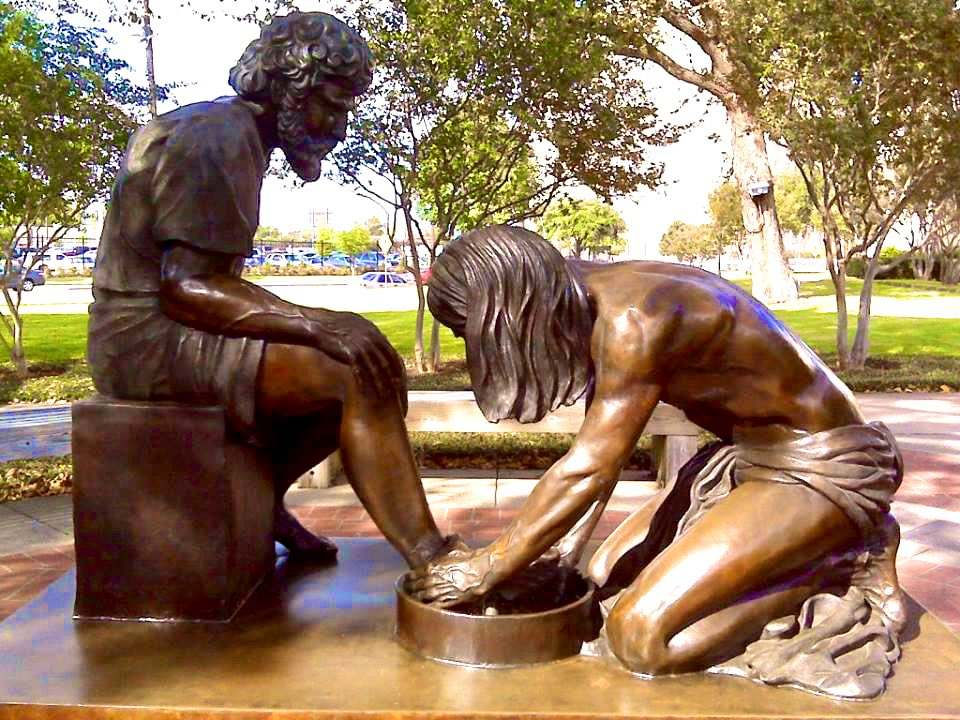
Statue of Jesus washing Peter’s feet, in Pittsburgh, Texas. Photo by Carol Highsmith

The mother of Zebedee’s sons came to Jesus with her sons and, kneeling down, asked a favor of him.

“What is it you want?” he asked.

She said, “Grant that one of these two sons of mine may sit at your right and the other at your left in your kingdom.”

“You don’t know what you are asking,” Jesus said to them. “Can you drink the cup I am going to drink?”

“We can,” they answered.

Jesus said to them, “You will indeed drink from my cup, but to sit at my right or left is not for me to grant. These places belong to those for whom they have been prepared by my Father.”

When the ten heard about this, they were indignant with the two brothers. Jesus called them together and said, “You know that the rulers of the Gentiles lord it over them, and their high officials exercise authority over them. Not so with you. Instead, whoever wants to become great among you must be your servant, and whoever wants to be first must be your slave—just as the Son of Man did not come to be served, but to serve, and to give his life as a ransom for many.” (New International Version)

Jesus and his disciples were not on the same page. That’s because they each had differing agendas.

Jesus was clear with the disciples about how things were going to shake out with him: torture, insults, crucifixion, and death was ahead. It seems the disciples and the mother of James and John missed the memo on this. Christ’s words went way over their heads.

It could be the disciples simply did not hear what Jesus was saying to them (repeatedly!). It’s more likely that the message of Jesus got filtered through an existing agenda of how they believed things ought to go.

The disciples, along with a lot of other Jewish folk in the first century, were looking for a Messiah in the mold of King David – a strong leader who would come and beat up the Romans, exert all kinds of power and influence, and establish an earthly rule over all the people they don’t like.

Submission to torture, humility before the very people they detested, and being killed by them were not factors into the disciples understanding of leadership and government.

Much like the powerful Aslan who had a thorough understanding of the world’s deep magic and submitted himself to the White Witch and death in C.S. Lewis’s The Lion, the Witch, and the Wardrobe – Jesus knew what he was doing, while everyone else seemed clueless about the true power which exists in the universe.

Let’s be clear about what that true power really is: grace. Yes, grace. Powerful, resplendent, subversive, scandalous, and radical grace.

Mercy was the missing factor in the disciples’ agenda. Jesus is not like other rulers. He does not operate by throwing his weight around to forcefully impose a crushing my-way-or-the-highway kind of rule (even though, ironically, he is The Way).

No, Jesus freely and unabashedly uses grace with its merciful tools of humility, gentleness, kindness, goodness, and love to introduce and establish a new kind of rule which is not posturing for self-serving authority.

Power, authority, and the positions which go with them are to be used for the common good of all persons. To be in any sort of leadership position is to be a servant of grace for the benefit of humanity and the world.

If Christ’s disciples had looked a bit closer into the Scriptures, they might have noticed, for all his power and authority, that King David trafficked in grace.

David, at the pinnacle of power, looked over the kingdom to see who from the family of his enemy, the former King Saul (who was into the power thing for himself) was around so he could show grace (2 Samuel 9). It was typical of ancient kings to secure their rule and power through killing-off rivals and family members of previous kings. Not so with David. And not so with Jesus.

Wherever there is posturing for position, preening for power, and a pestering for privilege – there you will find everything grace is not:

  • Reliance on making and calling-in favors
  • Arrogant and overinflated egos
  • Unrealistic expectations
  • Hatred and suspicion of others
  • Judgment and condemnation
  • An insistence on recognition
  • Compulsive manipulation and control over everything and everyone
  • Unilateral decision-making
  • Shaming of others
  • Hoarding resources
  • Coups and in-fighting
  • A demand of rights

We in the western world may not be in the habit of offing leaders and killing others to consolidate power, yet we still too often rely on violent speech and language, partisan policies, and good-old-boy systems which are foreign to the way of Christ.

In contrast to this, grace exists. It is the deep magic which resides within. Wherever grace operates, there you will find the heart of a servant:

Attending to the needs of all persons, especially the least, the last, and the lost

  • Freely consulting and collaborating with others
  • Focusing on responsibility
  • Loving discipline
  • Embracing accountability
  • Pursuing truth and integrity
  • Sharing power and resources
  • Encouraging feedback
  • Giving generously
  • Looking for ways to show mercy

This old world desperately needs leaders with a dutiful sense of public service which is compassionate and kind. Wielding authority is not about a show of strength; it is in the understanding that when I am weak, then I am strong.

Yes, this approach to leadership may bring some short-term suffering. Grace, however, results in longevity of righteousness and peace for those who have been trained by it. True service is being a servant of grace.

May it be so, to the glory of God, and for the blessing of the world. Amen.

Matthew 24:15-27 – Everything Will Change

“The prophet Daniel said that the disgusting thing that will cause destruction will stand in the holy place. When you see this (let the reader take note), those of you in Judea should flee to the mountains. Those who are on the roof should not come down to get anything out of their houses. Those who are in the field should not turn back to get their coats.

“How horrible it will be for the women who are pregnant or who are nursing babies in those days. Pray that it will not be winter or a day of rest, a holy day, when you flee. There will be a lot of misery at that time, a kind of misery that has not happened from the beginning of the world until now and will certainly never happen again. If God does not reduce the number of those days, no one will be saved. But those days will be reduced because of those whom God has chosen.

“At that time don’t believe anyone who tells you, ‘Here is the Messiah!’ or ‘There he is!’ False messiahs and false prophets will appear. They will work spectacular, miraculous signs and do wonderful things to deceive, if possible, even those whom God has chosen.Listen! I’ve told you this before it happens. So, if someone tells you, ‘He’s in the desert!’ don’t go out looking for him. And don’t believe anyone who says, ‘He’s in a secret place!’ The Son of Man will come again just as lightning flashes from east to west.” (God’s Word Translation)

Midwest American summers can be brutally hot and humid. And the winters can be terribly frigid and full of snow. 

Having lived in various university towns and worked with many college students, every Fall there are always new international students, and students from the American Deep South, that have never experienced a Midwest winter and snow. 

I might tell them, repeatedly, of the need for a sturdy winter coat before the snow flies. Yet, having never known sub-freezing, let alone sub-zero temperatures, it’s difficult to imagine such cold when the weather is warm. 

There is little belief that everything around them will change in a few short months to the point that it will be felt down to the bone.

At the coming of winter, I, or someone else, helped ensure they had a suitable coat. Even then, those students often bodily shake all winter and never take their scarves off.

Since none of us have yet experienced it, it might be difficult to imagine that someday Christ will return to judge the living and the dead. 

So, in order to help the disciples to grasp the coming future, Jesus told them to use discernment. Although it may seem improbable now, a time is coming which will be loaded with cosmic and cataclysmic changes. 

Sometimes, even for myself who has lived through many hard winters, it’s incredible to know that the landscape, as it is right now, will be completely different in another six months.

Seasons come and go. Eventually, the sky and the earth as we know it now will pass away. However, the words and ways of Jesus Christ will endure for all time. 

If we are attentive and alert, we will be ready. We will have a warm winter parka on hand.

For now, it means taking off the old clothes of fear, insecurity, hopelessness, and hate; and putting on the new clothes of righteousness, peace, and love in the Holy Spirit. 

You may not think winter is coming. But it is. It may even be here sooner than you believe.

Do you feel that chill in the air?

Almighty and everlasting Father, we long for the coming of your kingdom in Jesus Christ our Lord. We lament before you the signs that your kingdom has not yet come in its fullness. The signs of brokenness and divisions, oppression and abuse, poverty and loneliness, are everywhere present in this present world.

So, we cry out from the depths of our being for you to come and bring us humility, wisdom, discernment, comfort, and hope. Dispel the shadows of the night and turn our darkness into light, through Jesus Christ, your Son, our Lord who with you and the Holy Spirit reign as one God, now and forevermore. Amen.