
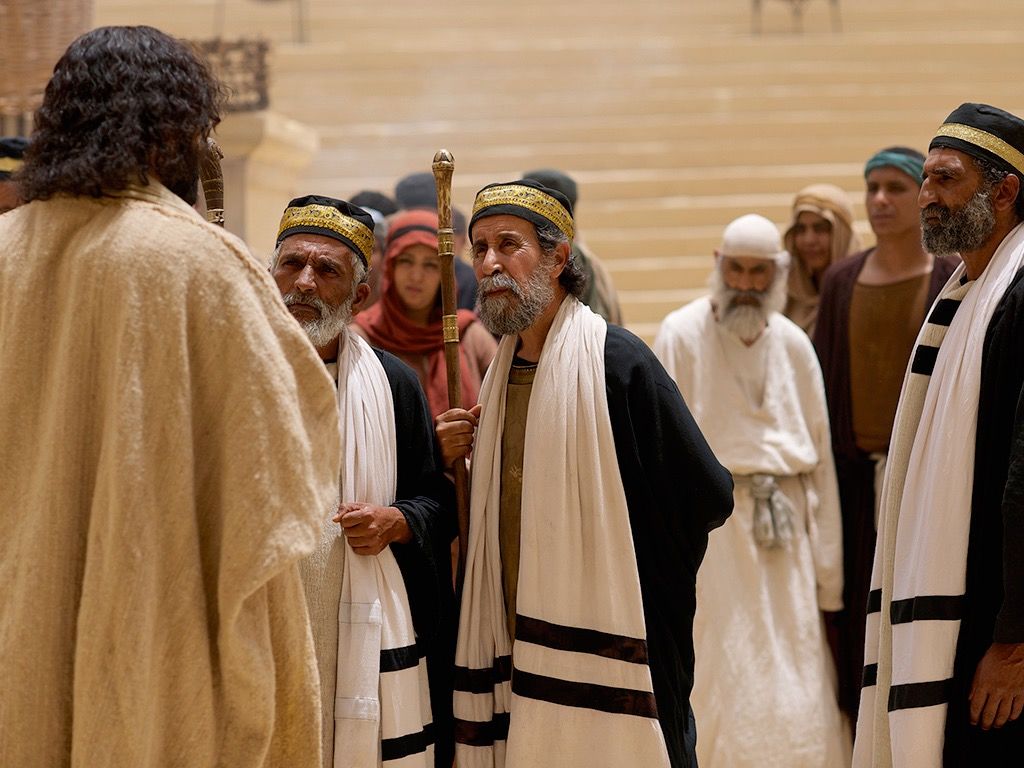
Mark 11:27-33 – Dueling Authorities

They arrived again in Jerusalem, and while Jesus was walking in the temple courts, the chief priests, the teachers of the law and the elders came to him. “By what authority are you doing these things?” they asked. “And who gave you authority to do this?”

Jesus replied, “I will ask you one question. Answer me, and I will tell you by what authority I am doing these things. John’s baptism—was it from heaven, or of human origin? Tell me!”

They discussed it among themselves and said, “If we say, ‘From heaven,’ he will ask, ‘Then why didn’t you believe him?’ But if we say, ‘Of human origin’ …” (They feared the people, for everyone held that John really was a prophet.)

So, they answered Jesus, “We don’t know.”

Jesus said, “Neither will I tell you by what authority I am doing these things.” (NIV)

Because Christ is Lord, we might overlook that Jesus, in his earthly ministry, was an outsider. Although a teacher, a rabbi, Jesus was neither a priest nor a member of any Jewish religious sect. He walked around as if he owned the place (which he did) and this gave no end of consternation from the established status quo religious leadership.

Jesus made significant inroads into people’s lives, especially with outsiders like himself, and this created anger and jealousy with many of the religious ruling class. Since Jesus was not a card-carrying member, the leaders wanted to hear from him why he kept acting confidently and deliberately on their religious turf, as if he had authority to do so.

The established authorities are depicted in today’s Gospel lesson as a craven bunch who did not want to alienate the crowds yet were eager to get the upstart Jesus out the way. This appears to be an age-old situation of leaders putting their fingers to the wind to go with whatever will keep them popular and in power. Since Jesus consistently refused to play such games, the authorities believed he needed to go. They, however, had no intention of risking an outright confrontation and showing their shadow motives.

Jesus clearly connected himself with John the Baptist, both coming from the same authority. John was yet another figure for whom the established leaders could not control. We ought never to underestimate that threats to status quo leadership who have no inkling of being public servants when true moral authority comes along. The lack of conformity from both John and Jesus would cost them their very lives.

Speaking truth to power while not becoming defensive is a tricky art. Yet, Jesus did it. Continual challenges to his authority left him unfazed as to his mission and purpose on this earth. Christ was assertive without becoming despotic; forward without taking the bait of useless arguments; confident with no hint of arrogance.

For me, the contrast between Jesus and the religious authorities is trenchant. The confident, wise, and calm authority of Christ is in direct opposition to the fear, anxiety, and worry of the ruling leaders. Whereas they kept anxiously ruminating about what to do about this threat to their established authority, Jesus exhibited a non-anxious presence which maintained a steadfast focus on God’s righteous, holy, and benevolent rule and reign.

Sometimes, continual fear is a clue that one is so worried about losing the person, place, or position they possess that the divine gets pushed aside.

Questioning Christ’s credentials was the giveaway that the existing religious authorities were concerned about their power and privilege, and not the people. The wise person will see such queries for what they are.

Wherever we observe those who refuse to share power, have a xenophobic bent toward outsiders, and will seem to do just about anything to maintain the status quo, there we will find the abuse of authority. Conversely, where we observe a deep concern for equity, justice, and the common good of all persons, there we see compassionate leadership who will champion ethical leadership and espouse moral authority.

In any democratic society, we must choose our leaders wisely.

Great God of hope, in these times of change and uncertainty, unite your people and guide our leaders with your wisdom. Give us courage to overcome our fears and help us to build a future in which all may prosper and share together through Jesus Christ our Lord in the strength of your Holy Spirit. Amen.


Mark 11:20-25 – Forgiveness

In the morning, as they went along, they saw the fig tree withered from the roots.Peter remembered and said to Jesus, “Rabbi, look! The fig tree you cursed has withered!”

“Have faith in God,” Jesus answered.“Truly I tell you, if anyone says to this mountain, ‘Go, throw yourself into the sea,’ and does not doubt in their heart but believes that what they say will happen, it will be done for them. Therefore, I tell you, whatever you ask for in prayer, believe that you have received it, and it will be yours. And when you stand praying, if you hold anything against anyone, forgive them, so that your Father in heaven may forgive you your sins.” (NIV)

Sometimes forgiveness seems about as possible as moving a mountain or withering a fig tree. Yet, it can be done. It needs to be done. An unforgiving spirit only causes gangrene of the soul and rots a person on the inside.

The heart of the good news in the Bible is forgiveness of sins. It comes through the person and work of Jesus Christ. Forgiveness is both an event, and a process. Forgiveness is to be a constant dynamic within our relationships because we live in a fallen world. People sin against us, and others hurt us. We sin against other people and hurt them, too. Relational pain is a reality this side of heaven. Revenge and/or passive-aggressive behavior are neither biblical nor healthy ways of handling our hurt. So, what is a person to do?

We practice forgiveness. The following is some biblical guidance as to what forgiveness is, and is not:

Forgiveness is hard work.

God did not promise forgiveness would be easy. He knows exactly the kind of cost it brings. Through the death of Jesus there can be and is forgiveness. The price of forgiveness for Jesus was not cheap.

“The blood of bulls and goats and the ashes of a heifer sprinkled on those who are ceremonially unclean sanctify them so that they are outwardly clean.  How much more, then, will the blood of Christ, who through the eternal Spirit offered himself unblemished to God, cleanse our consciences from acts that lead to death, so that we may serve the living God!” (Hebrews 9:13-14, NIV)

Forgiveness is a process.

Forgiveness is an ongoing process of putting off bad relational habits and putting on good ones. It takes time and cannot be hasty. Forgiveness must be deliberate with no shortcuts to it, otherwise it will not stick. 

“Get rid of all bitterness, rage and anger, brawling, and slander, along with every form of malice.  Be kind and compassionate to one another, forgiving each other, just as in Christ God forgave you.” (Ephesians 4:21-32, NIV)

Forgiveness does not mean we condone bad behavior.

Forgiveness is not blanket amnesty. It does not simply give another person a “pass” on their hurtful words or actions. Forgiveness means we do not hold the offense over the other person’s head.  Dr. Fred Luskin from Stanford University, an academic researcher of forgiveness, states, “Forgiveness is giving up all hope of a better past.”  We cannot undo the past. Yet, we have control of the present, and can choose to forgive. True forgiveness calls a spade a spade and names the specific offense in all its ugliness, and lets it go.

“You’re an evil man! When you begged for mercy, I said you did not have to pay back a cent.  Don’t you think you should show pity to someone else, as I did to you?” (Matthew 18:32-33, CEV)

Forgiveness does not always result in reconciliation.

It takes two to reconcile. It only takes one to forgive. I have often been told that it will not do any good to forgive another person because it would not change them. I respectfully retort: That is not the point. We forgive because it is our responsibility to work through our forgiveness issues and do it. We are not in control of whether another person will feel sorry for what they did, or not.  We regulate our own decision to forgive, no matter what the other person does or does not do, or whether they feel the gravity of their sin, or not.

“If possible, to the best of your ability, live at peace with all people.” (Romans 12:18, CEB)

“I [Jesus] say to you, love your enemies and pray for those who persecute you.” (Matthew 5:44, NRSV)

Jesus said [on the cross], “Father, forgive them, because they do not know what they are doing.” (Luke 23:34, CSB)

Forgiveness is primarily for our benefit.

If we hold on to bitterness toward another for their offense, we only hurt ourselves. Drinking the poison of bitterness will kill you, not the other person. Avoid the magical thinking that they are going to come to you all slobbery sorry for what they said or did. That often does not happen. When it does, it is a beautiful thing. Regardless, of another’s decisions, we are to forgive everyone who sins against us just as God has forgiven us.

“Forgive us our sins, as we have forgiven those who sin against us…. If you forgive those who sin against you, your heavenly Father will forgive you. But if you refuse to forgive others, your Father will not forgive your sins.” (Matthew 6:12, 14-15, NLT)

Forgiveness is to be frequent and generous.

The relational currency in God’s kingdom is forgiveness. Without it, we can neither operate well together, nor can we enjoy a satisfying life. However, with forgiveness, there is a demonstration of the practical effects of Christ’s crucifixion to life, not to mention a good witness to a watching world.  

“Peter got up the nerve to ask, ‘Master, how many times do I forgive a brother or sister who hurts me? Seven?’ Jesus replied, ‘Seven! Hardly. Try seventy times seven.’” (Matthew 18:21-22, MSG)

Forgiveness is an act of faith.

To forgive is risky business. If we have taken on a grudge like a warm security blanket, to toss aside the odd comfort of unforgiveness will seem strange, even fearful. When we are hunkered down in bitterness, we rarely see how it causes faith to weaken. The longer the lack of forgiving goes on, the harder it will be to give it up. Faith steps out and acts, believing that God is in it. On the other side is the hope of freedom and peace. Besides, the consequences of unforgiveness are downright unpleasant.

Keep us forgiven with you and forgiving others. Keep us safe from ourselves and the Devil. (Matthew 6:13-14, MSG)

Forgiveness is a blessing.

The end of the matter for many people comes down to the intensely practical. So, here it is: Do you want to be happy or miserable? I am not familiar with anyone who wakes up in the morning and says to themselves, “Mmm, I think I will be miserable today.” No, we want to be happy and blessed. Forgiving others is the path to blessing.

It is a great blessing when people are forgiven for the wrongs they have done, when their sins are erased. (Psalm 32:1, ERV)

May you know the blessing of being forgiven and forgiving others. May this freedom allow you to enjoy the peace of God the fellowship of others. Amen.

Mark 7:1-13 – Unmasking Hypocrisy

09781-mask2

One day some Pharisees and teachers of religious law arrived from Jerusalem to see Jesus. They noticed that some of his disciples failed to follow the Jewish ritual of hand washing before eating. (The Jews, especially the Pharisees, do not eat until they have poured water over their cupped hands, as required by their ancient traditions. Similarly, they don’t eat anything from the market until they immerse their hands in water. This is but one of many traditions they have clung to—such as their ceremonial washing of cups, pitchers, and kettles.)

So the Pharisees and teachers of religious law asked him, “Why don’t your disciples follow our age-old tradition? They eat without first performing the hand-washing ceremony.”

Jesus replied, “You hypocrites! Isaiah was right when he prophesied about you, for he wrote,

‘These people honor me with their lips,
but their hearts are far from me.
Their worship is a farce,
for they teach man-made ideas as commands from God.’

For you ignore God’s law and substitute your own tradition.”

Then he said, “You skillfully sidestep God’s law in order to hold on to your own tradition. For instance, Moses gave you this law from God: ‘Honor your father and mother,’ and ‘Anyone who speaks disrespectfully of father or mother must be put to death.’ But you say it is all right for people to say to their parents, ‘Sorry, I can’t help you. For I have vowed to give to God what I would have given to you. ’In this way, you let them disregard their needy parents. And so you cancel the word of God in order to hand down your own tradition. And this is only one example among many others.” (NLT)

As I read this Gospel text for today, I tried to imagine what emotions Jesus might have experienced when confronted about the lack of attention to tradition from his disciples concerning ritual hand washings – maybe frustration, anger, sadness, exasperation, disappointment, irritation, aggravation, or discouragement. Perhaps Christ felt all those emotions. Whatever Jesus was feeling at the time, I can easily see him taking a deep breath and exhaling a great big *sigh* over the religious leaders’ hypocrisy.

Hypocrisy is a disconnect between the values we espouse and our behavior. When there is incongruity between what we say is important and how we really live, this is being two-faced and duplicitous. The men who came to see Jesus were plain old insincere hacks who practiced religious quackery. And Jesus saw right through their fake pretension of righteousness.

First off, this narrative is not a dig on rituals themselves but on using ritual to leverage an appearance of religious superiority over others. This type of motivation for engaging ritual ignores the ethical and moral intention of those rituals.

Sometimes folks can get so doggone wrapped up in how faith is represented that they lose sight of the faith itself.

Hypocrisy has to do with our motives – not so much what we do but why we do it. Rituals are good. Why we do them or not, or how we go about doing them, gets at the heart of our objectives for engaging religious practices. Are they truly a worship offering to God, or are they merely mechanisms for keeping up appearances of holiness?

Hypocrisy is acting a part which is not truly us. It is to live from the false self through the attempt of providing an idealized perfect person to the public instead of embracing the true self and realizing our common humanity with one another in genuine devotion to God and service to others. Religious hypocrisy is particularly insidious because it uses what is sacred for selfish purposes. It damages the credibility of the religion, creates idolatry, and covers hate with a veneer of pretentious piety.

The hypocrite is one who is a bundle of disparate parts in massive need of integration to a whole and real self. The cost to facing this is vulnerably exposing oneself as flawed, imperfect, even ugly. Many persons have no willingness to be viewed by others as such, so they maintain their play-acting and continue to seek the attention and accolades as a model religious person.

We all must come to grips with the reality that God cares a whole lot about why we do what we do.

When the forms of faith become tools of oppression and crushing burdens upon others backs, then those forms have supplanted the faith itself. Out of the overflow of the heart the mouth speaks, and from the heart the hands and feet move. Whenever we care more about being and appearing right than getting it right and becoming better, then we have a heart problem. The heart of the issue is the heart itself. Clean up the heart, and everything else follows – not the other way around.

The probity of today’s Gospel lesson is that we might misinterpret what is important to God. We may be playing the hypocrite yet have the belief we are genuine. The capacity for our hearts to enlarge with love is in direct relation to an awareness of the hidden motives buried within those hearts. Evil intentions and motivations are what separate us from God – not our race, class, age, gender, religion, ethnicity, behavior, rituals, or anything else on the outside.


log
“You can see the speck in your friend’s eye, but you don’t notice the log in your own eye. How can you say, ‘My friend, let me take the speck out of your eye,’ when you don’t see the log in your own eye? You’re nothing but show-offs! First, take the log out of your own eye. Then you can see how to take the speck out of your friend’s eye.” –Jesus (Matthew 7:3-5)

If we find ourselves being nit-picky of others, this is usually a clue that the unconscious self is trying to protect us from facing the pain of our own sins by projecting and focusing on another’s supposed missteps with tradition or ritual.

Fortunately, Jesus came to this earth full of grace and truth. Christ sometimes, maybe oftentimes, set aside niceness and decorum to go for the heart. In shining light on the motives behind the deeds of people, some repented and received the good news of the kingdom of God; and, others resisted to maintain their illusion of control and superiority. None could ride the fence with Jesus around. You either loved him or hated him.

The beauty of grace is that when we squarely and uncompromisingly face our sins and let go of things we consider so important, and turn to God with authenticity, we are welcome at his Table.

Most holy and merciful Father, we acknowledge and confess before you our sinful nature, prone to evil and slow to do good, and all our shortcomings, offenses, and malevolent motives. You alone know how often we have sinned in wandering from Christ’s way of grace and truth, in wasting your gifts of compassion and justice, and in forgetting your love. O Lord have mercy on us. We are ashamed and sorry for all the ways we have displeased you. Teach us to hate our errors; cleanse us from our secret faults; and forgive us our sins; for the sake of your dear Son, our Lord. Most holy and loving God help us to live in your light and to walk in your ways according to the commandment of Jesus Christ, our Savior, in the enabling of your blessed Holy Spirit. Amen.