Mark 10:17-22 – Jesus Intervenes

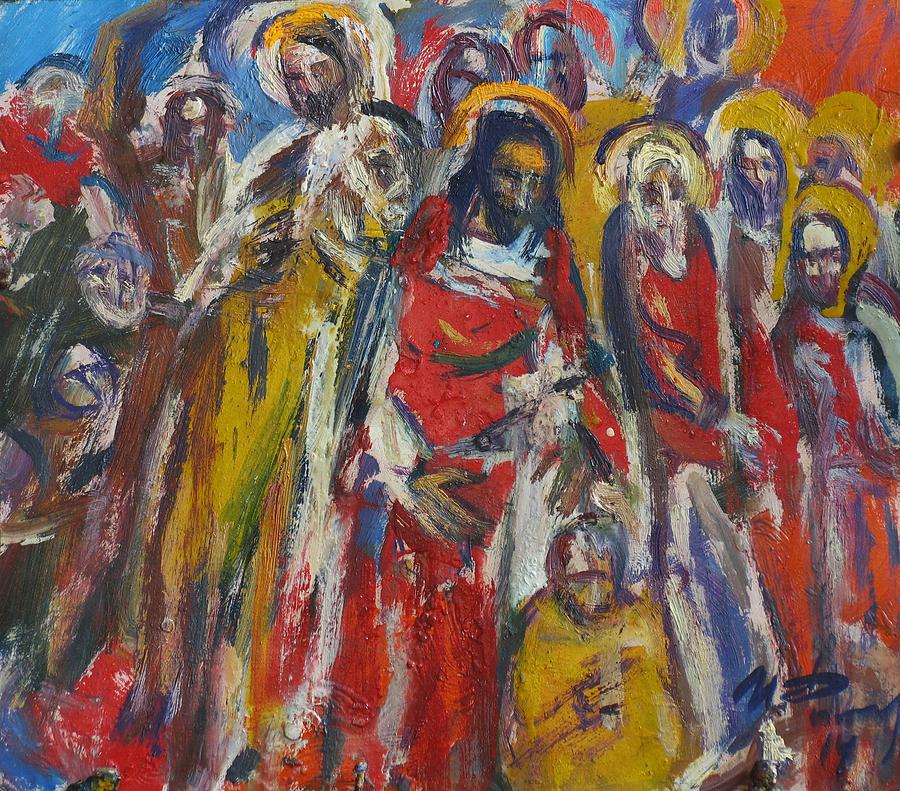
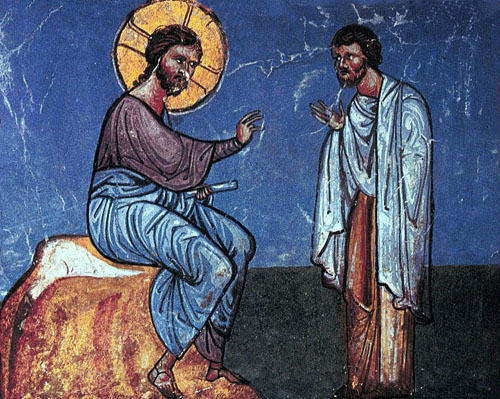
Eastern Orthodox mural of Jesus and the rich man

As Jesus started on his way, a man ran up to him and fell on his knees before him. “Good teacher,” he asked, “what must I do to inherit eternal life?”

“Why do you call me good?” Jesus answered. “No one is good—except God alone. You know the commandments: ‘You shall not murder, you shall not commit adultery, you shall not steal, you shall not give false testimony, you shall not defraud, honor your father and mother.’”

“Teacher,” he declared, “all these I have kept since I was a boy.”

Jesus looked at him and loved him. “One thing you lack,” he said. “Go, sell everything you have and give to the poor, and you will have treasure in heaven. Then come, follow me.”

At this the man’s face fell. He went away sad because he had great wealth. (New International Version)

We are all addicts. 

We all have our own sin addictions which keep us stuck in guilt and shame.

We may not all struggle with the same sin. Yet we all have some besetting sin(s) that we must be weaned off of. The most pervasive addiction found in Holy Scripture is neither substance abuse nor alcohol – it is the addiction to wealth and money.

Maybe your initial response was of someone else, besides yourself: “I don’t have as much money as____” or, “So-and-so has a real problem with that!” Those statements are what we call, in terms of addiction, denial. 

In truth, all of us are in some sort of denial about how much we really trust in paychecks, bank accounts, investments, and owning material stuff. I’m no exception. I own more books than I’ll be able to read in a lifetime, and yet, I tend to believe I don’t have enough of them.

Even the poor can have an addiction wealth and money by thinking about it and wishing for it to an unhealthy degree, as if wealth is the thing that will ultimately make them happy.

People in denial rarely have any idea how much they are hurting others, themselves, and God.  In fact, the consistent witness of the early church fathers is that the sheer accumulation of stuff is the same as stealing from the poor. 

Because of denial, people need an intervention. They need to be jolted back to their senses. Intervention is a gift. Someone cares enough about the person to intervene. Yet, interventions don’t always work. The person can choose to walk away and refuse to change.

Jesus did a gracious intervention with a rich young man. The man was addicted to wealth and money, but he didn’t see it. In fact, he thought he was quite godly and spiritual. It’s a sad story because the man walks away untransformed by his encounter with Jesus and did not accept the gracious invitation to follow the Lord. 

Chinese depiction of Jesus and the rich man, 1879

The man simply did not see himself as hopeless and desperately needing to change. He held to his denial.

The man approached Jesus with a question: “What must I do to inherit eternal life?” Whereas I would probably get all excited about being asked a question like this and launch into some long-winded gospel answer, Jesus immediately picked up on the attitude and the need behind the question. 

What must I do to get? It’s almost as if the man wants to acquire eternal life like he would acquire wealth. “I am a successful businessman with plenty of money, and a respected citizen with lots of wealth – now I want to be a success with God, as well.” 

The question may have been sincere, yet it was misguided. Eternal life is not spiritual real estate for an upwardly mobile person to acquire and possess. The man seems to believe he can purchase eternal life, as if everyone has their price, even God. “After all,” he may have been reasoning, “I have gotten everything else in life, so why not obtain eternal life?”

Jesus questioned the question. He went after the underlying assumption of doing something good to obtain eternal life. The fact of the matter is that the man cannot do anything. He can’t because only God is good. Jesus points him to God by changing the action from getting to entering. And he changed the language from a market acquisition to entering into a journey.

Jesus was inviting the man to walk with him.

Eternal life is a journey of faith in the God who is good, and not a transaction to get it. And, we too, must be careful not to treat eternal life as if it were a transaction, as if we must get a person to sign on the dotted line through a “sinner’s prayer” or some other formula that will seal the deal for eternal life. 

Instead, eternal life is a walk of obedience with God and his commands.

Jesus responded to the rich man with the Ten Commandments, specifically the ones which focus on human relationships. Jesus wanted him to realize that the path into the kingdom of God and eternal life goes through and not around how we treat our fellow human beings.

Christ and the Rich Young Ruler by Heinrich Hofmann, 1889

The Lord sought to expose the impossibility of continuing in life on the rich man’s terms. The guy just could not imagine what he might be lacking. So, Jesus helped him out. Christ gave him some major interventional language…. Sell. Give. Follow.

Sell everything. Give to the poor. Come, follow me.

One cannot simply add Jesus to their life, like adding a new car or a new fishing rod. Rather, one’s heart must change in order to accommodate real, genuine eternal life. 

Jesus offered the rich man someone to be, rather than something to get

It’s one thing to give from what you have; it’s another thing to surrender your life and all you have. 

In the New Testament Gospels, there are no easy conversations with Jesus. He gets personal in every encounter and gets under everybody’s skin. Christ doesn’t settle with superficial small talk when there are people whose hearts are little more than idol factories. 

Jesus never leaves us alone, because there is always the invitation to “Come, follow me.”

Christ exposed the wealthy man’s divided loyalties – he was trying to serve both God and money. But he would have to choose between the two. 

And that is our choice, as well. 

The question for us is not, “Am I completely devoted to money?” Instead, the question from our Gospel story today is, “Am I trying to serve God while maintaining a moonlighting job with the world?” 

God wants from us an undivided heart; the Lord desires absolute allegiance.

Jesus is looking for those who are poor in spirit, who recognize their great need for God – instead of believing that they are okay and just need to add a little Jesus to their lives. 

God is looking for spiritual beggars who understand their desperate situation and don’t practice denial by sugar-coating their actual spiritual state.

Like a drunkard who won’t give up his vodka; like a sex addict who won’t give up strip clubs or emotional affairs; or like a workaholic who just can’t come home; the rich man would not give up his disordered love for money and possessions. 

So, Jesus did an intervention. 

The Lord Jesus didn’t ask everybody to do exactly as he called the rich man to do. He didn’t ask the very wealthy Zacchaeus to do it, and he didn’t tell Peter to sell his fishing business. 

But Jesus does tell us to do something which seems impossible. Yet, where the impossible exists, so exists grace.

Blessed Lord, you have taught us that all our doings without loving generosity are worth nothing. Send your Holy Spirit and pour into our hearts your gift of love, the true bond of peace and of all virtues, without which whoever lives is counted dead before you. Grant this for the sake of your only Son Jesus Christ, who lives and reigns with you, in the unity of the Holy Spirit, one God, now and forever. Amen.

Mark 11:12-14, 20-24 – Believing Prayer

The next day, after leaving Bethany, Jesus was hungry. From far away, he noticed a fig tree in leaf, so he went to see if he could find anything on it. When he came to it, he found nothing except leaves, since it wasn’t the season for figs. So, he said to it, “No one will ever again eat your fruit!” His disciples heard this.

Early in the morning, as Jesus and his disciples were walking along, they saw the fig tree withered from the root up. Peter remembered and said to Jesus, “Rabbi, look how the fig tree you cursed has dried up.”

Jesus responded to them, “Have faith in God!I assure you that whoever says to this mountain, ‘Be lifted up and thrown into the sea’—and doesn’t waver but believes that what is said will really happen—it will happen. Therefore, I say to you, whatever you pray and ask for, believe that you will receive it, and it will be so for you. (Common English Bible)

A pastor once had a kitten stuck up in a tree, and it would not come down. The tree was not sturdy enough to climb, so the pastor decided that if he tied a rope to his car and drove until the tree bent down, he could then reach up and get the kitten. As he moved just a little too far, the rope broke. The tree snapped upright, and the kitten instantly sailed through the air and out of sight.

He felt just terrible and walked all over the neighborhood asking people if they had seen a little kitten. Nobody had and finally he prayed, “Lord, I commit this kitten to your keeping,” and then went about his business.

A few days later, he was at the grocery store and met one of his parishioners. In her shopping cart he was amazed to see cat food. The pastor knew the parishioner did not like cats, so he asked her why she was buying cat food.

She replied, “For years I have been refusing to buy my little girl a cat even though she has been begging for one. Finally, I told her that if God gives you a cat, I’ll let you keep it.  I watched my child go out into the yard, get on her knees and ask God for a cat. Then, a kitten suddenly came flying out of the blue sky with its paws spread out and landed right in front of her. Of course, I had to let her keep the kitten because it came from God!”

God wants us to pray! Yet, prayer does not happen apart from faith because to pray is to believe God is good and answers prayer. Prayerlessness is a sign of faithlessness. A person of little faith prays only a little. A person full of faith is always praying.

“God desires of us nothing more ardently than that we ask many and great things of him, and he is displeased of we do not confidently ask and entreat.”

Martin Luther

For Jesus, simply exhorting the disciples to pray was insufficient; they needed a deep change of heart. 

God calls us to transformation. Deep and lasting change must take place below the surface of our lives. Real change comes from the inside-out. It is the root of a person’s life, the heart, that must change – and not just the outward behavior.

In our Gospel lesson for today, Jesus got up early and was on his way to Jerusalem. He was hungry and wanted some breakfast, so he approached a fig tree. Figs were known back in Christ’s day as the poor man’s food. Fig trees were everywhere. Approaching a certain fig tree, Jesus found one that appeared leafy and well, yet had no figs. 

Jesus chose to use this tree as a teachable moment for his disciples. He cursed the tree and immediately the whole tree withered. So, why did Jesus curse the tree? Because it looked good on the outside but was really already dead on the inside. 

The tree had everything a tree needed: branches, leaves, and a trunk. Everything, that is, except fruit. The tree was to serve as an illustration for the disciples of believing prayer. The tree looked fine, and had the promise of fruit, but none was to be found. Jesus is looking for faith in his followers. 

In the prophet Jeremiah’s day, the nation of Judah had enjoyed a long stretch of prosperity and good circumstances. By all outward appearances they were doing fine. Temple attendance was at its peak and everyone was offering their sacrifices. Yet, something wasn’t right.

“I will take away their harvest,
declares the Lord.
    There will be no grapes on the vine.
There will be no figs on the tree,
    and their leaves will wither.
What I have given them
    will be taken from them.” (Jeremiah 8:13, NIV)

God pronounced a curse on Judah because, although conditions seemed fine on the outside, the people were trusting in their own abilities. But God was looking for fruit, not nice leaves. The Lord wants believing prayer, born of a faith that is confident in the goodness of God. 

God is looking for faith in us, as well. A faith not in paychecks, bank accounts, or the market economy, and not religiously in lots of outward forms of success, but a faith in God alone.

Jesus didn’t use the withering tree as an illustration of judgment but of believing prayer. Our words and prayers can have the immediate effect of changing the world. We can even speak to a mountain, and it will have to move, if we tell it to. 

Nobody probably goes around talking to mountains. Yet, all of us go around talking to ourselves about mountain-like problems. The power that levels mountains is prayer and words that speak confidence and boldness.  If you believe, you will receive whatever you ask for in prayer.

“Any concern too small to be turned into a prayer is too small to be made into a burden.”

Corrie Ten Boom

Doubt typically stands in the way of prayer – not doubt in yourself, because you don’t answer your own prayers. Doubt as an obstacles to faith is the questioning of God’s inherent goodness. We are not to have faith in faith itself, but in the actual person of God. (James 1:5-8) 

Everyone has made a difficult prayer request, mustering-up all the faith they can, and then are disappointed when it doesn’t happen. The unstable person vacillates when this happens, doubting whether God is really good or not. However, the person of faith believes God answers prayer, and if the prayer is not answered, we trust God knows the score and will answer according to gracious timing and good purposes.

Maybe you have even talked to yourself as a Job-like friend saying that you didn’t have enough faith and that is why your prayer was not answered. Yet, Christian faith isn’t a matter of being optimistic or of sending $19.95 to some hack preacher who promises to give you the secret of answered prayer, along with a free gold cross. 

We simply don’t know what God’s will is in every situation. However, we do know what God’s will is for a lot of things. For example, God is not willing that any should perish but all be brought to eternal life. So, we can pray with confidence for someone’s deliverance. And we can be bold about trusting in God’s promises.

We have every right, based in our union with Jesus Christ as redeemed persons, to ask God confidently and boldly for the removal of mountains. We possess authority in Christ to do so. Therefore, we do not need to offer tepid, milquetoast, mumbling prayers with sighs and hunched shoulders. 

Who knows? Maybe a kitten will show up.

Almighty and everlasting God, you made the universe with all its marvelous order, its atoms, worlds, and galaxies, and the infinite complexity of living creatures: Grant that, as we probe the mysteries of your creation, we may come to know you more truly, and more surely fulfill our role in your eternal purpose; in the name of Jesus Christ our Lord. Amen.

Mark 8:22-26 – A Ministry of Touch

“Healing” by Ivan Filichev

They [Jesus and his disciples] came to Bethsaida, and some people brought a blind man and begged Jesus to touch him. He took the blind man by the hand and led him outside the village. When he had spit on the man’s eyes and put his hands on him, Jesus asked, “Do you see anything?”

He looked up and said, “I see people; they look like trees walking around.”

Once more Jesus put his hands on the man’s eyes. Then his eyes were opened, his sight was restored, and he saw everything clearly. Jesus sent him home, saying, “Don’t even go into the village.” (New International Version)

Spirituality is, of course, a matter of the spirit. It is also a matter of the body. It may be lost on us that the way our spirituality is expressed is through our very real physical selves. A disembodied spirituality is really no spirituality, at all.

Christianity is profoundly physical. A core doctrine of the Church is the incarnation of Christ, God becoming man. Jesus has a real flesh and blood body. His physical body was the vehicle by which he did the will of God. Christ’s earthly ministry directed attention to people’s holistic needs – including the physical body.

So, perhaps it ought not surprise us when Jesus intentionally and literally touches people. From one person to another, Jesus was attentive to the power of compassionate and healing physical touch. For healing does not happen from afar; it is close enough to be personal, touching the spirit, the emotions, the mind, and the body.

In today’s Gospel lesson, some folks came to Jesus with a blind man in tow. They were evidently concerned and close enough to the man to beg Jesus to touch him. Yes, touch him. The small group of people were looking for a tangible reach from Jesus.

Just the other day, I visited a dear lady in the hospital for which I’m a Chaplain. As I began to speak with her, she reached out her hand, and I took it. I then realized that she was blind. This patient, in the dark because of her eyes, and in a strange unfamiliar place, needed more than a verbalized healing prayer from me. She needed a very real physical connection. The ability to compassionately touch another person has tremendous power.

“To touch is to give life.”

Michelangelo

Skin-to-skin contact is vital for our mental, emotional, spiritual, and physical health. Sensory deprivation is a real thing, and it’s a pervasive problem, especially during a pandemic.

We now know that whenever we feel unusual stress and pressure in our lives that the body releases the stress hormone cortisol. One of the biggest things actual physical touch can do is reduce the abnormal stress, allowing the immune system to work the way it should. What’s more, touch helps calm our heart rate and blood pressure, enabling us to have a more regulated way of life.

Jesus took the blind man by the hand and walked him outside the village. Let’s pause on that factoid for a moment. There was a man who literally walked with Jesus, hand-in-hand, for perhaps a few miles. I wonder what he experienced, just in that walk. What seems clear to me is that this event of walking was part of the man’s healing. He quite simply needed this bodily experience with Jesus.

I find it a bit humorous that some commentators struggle with the process of Christ’s healing the blind man, as if Jesus himself was struggling with trying to heal the guy. However, by taking the approach of an embodied spirituality, we can discern that this man required a great deal of touch from Jesus. The spitting, the putting the hands on the eyes, and then doing it again, was all deliberately tactile and just what the man needed for his healing of both body and soul.

Christ’s physical body was an instrument of grace. And our own bodies are meant to bless others with appropriate and compassionate touch. I realize this gets complicated with social distancing practices and concerns with health during a pandemic, yet we can still be agents of healing through simple acts of touch, including the following:

  1. Hug others. Hugs are healthy. I completely understand that some people aren’t huggers, and we ought to be guarded hugging others we don’t know very well. I usually ask before I hug someone outside of my family or church. Unfortunately, many people have had bad experiences being touched, and my heart goes out to them. Yet, the need for meaningful and positive touch still remains both for us and for others.
  2. Pet the dog. My wife’s little dog is a prima donna. He drives me nuts sometimes (maybe most of the time). Yet, because of his disposition, he is the perfect little gentleman when in a care facility or in public. He likes the attention. If you have a pet, let other folks pet them. I’m a busy guy, but when it comes to taking time for neighborhood kids to pet the dog while I’m walking him, I’m all in. It is a simple ministry that anyone can do.
  3. Hold hands or offer light touch. This can and perhaps should be a liberal activity within most families. It can also be done with others. It’s not weird to do this, even in some contexts with strangers. For example, when leading someone in the hospital to their appointed place, depending on the circumstance, I place a light hand on the back or shoulder. Hospitals aren’t exactly destination vacation spots, so folks can be nervous when in them. Simple ways of appropriate touch help calm the anxiety.
  4. Fist pumps and elbow bumps have replaced handshakes, and that’s a good thing. Fist and elbows just aren’t the same thing as a good old fashioned tight handshake, yet it is still an opportunity to touch. Some touch is better than no touch. Don’t give up on practicing ways to physically connect, even if those ways aren’t ideal.
  5. Use your eyes. There are just going to be some circumstances and places where you cannot offer an actual physical ministry of touch. So, use your eyes. Imagine in your mind offering a hug or a handshake to the person and intentionally focus that picture to your eyes. Since our physical eyes communicate a lot, the other person will pick it up.

Every day is an opportunity, for the believer, to walk with Jesus along our life’s journey. As we allow Christ to touch our lives, we, in turn, are able to touch others both spiritually and sometimes even physically through compassionate ministry.

May you know the grace of being touched by Jesus, and the blessing of touching others with the love of God.

Mark 8:14-21 – Adventures in Missing the Point

The disciples had forgotten to bring bread, except for one loaf they had with them in the boat.“Be careful,” Jesus warned them. “Watch out for the yeast of the Pharisees and that of Herod.”

They discussed this with one another and said, “It is because we have no bread.”

Aware of their discussion, Jesus asked them: “Why are you talking about having no bread? Do you still not see or understand? Are your hearts hardened? Do you have eyes but fail to see, and ears but fail to hear? And don’t you remember? When I broke the five loaves for the five thousand, how many basketfuls of pieces did you pick up?”

“Twelve,” they replied.

“And when I broke the seven loaves for the four thousand, how many basketfuls of pieces did you pick up?”

They answered, “Seven.”

He said to them, “Do you still not understand?” (New International Version)

In today’s Gospel lesson, Jesus uses yeast as a metaphor for corrupting influences. It only takes a little bit of yeast to work through the whole batch of dough. Christ, upholding the teachings of Old Testament law, didn’t just want people to avoid eating actual unleavened bread. He desired his disciples to be unleavened themselves, a holy people, free of all crookedness and malevolent motives.

Christ’s disciples, bless their pea-pickin’ literal interpreting hearts, were too dense to pick up on the metaphor. They began anxiously chattering about how Jesus might be disappointed with them in having no actual bread to eat. Although they had just witnessed an amazing miracle of literally feeding thousands of people, the disciples did not discern what that miracle meant beyond just filling bodily stomachs.

Had Christ’s disciples been able to see beyond the literal to the metaphorical, they would have likely understood several lessons Rabbi Jesus was teaching them:

  • The provision of bread pointed to who Jesus truly is: Living Bread from heaven. Just like the miraculous provision of manna in the desert to the ancient Israelites, so God was graciously meeting the total needs of people through Jesus. Conversely, the yeast of corruption saps the life out of people.
  • The presence of bread doesn’t necessarily mean it’s all good. There’s leavened bread and unleavened bread. That is, there is the healthy bread of God’s Word to eat, and there are other words to eat which is unhealthy bread. A life set apart for goodness and mercy in the world brings life to others. A person with mixed motives and personal agendas of power and privilege brings no nourishment to others – only inedible bread.
  • The puny amount of bread became a huge feast. A little bit of Jesus is enough to feed thousands and satisfy empty stomachs. A little bit of false teaching and hypocrisy is enough to corrupt thousands of people and make them sick.
  • The prosperity of bread multiplied by Jesus was so much that there were leftovers. In the kingdom of God, there is abundance. The disciples served the bread to the throng of people, and they received bread for themselves with twelve basketfuls of bread pieces – enough bread to feed their families, as well. The leavened bread of corruption doesn’t satisfy; it only decreases health.

But the disciples didn’t get it. So, Jesus chided them for their profound lack of spiritual awareness. By this time, the disciples had been following Jesus for a while – watching him do miraculous works of healing and meeting people’s needs, as well as being on the inside track of receiving his gracious teaching. If anyone ought to get what’s going on, it was them.

If we continually possess only a one-dimensional interpretation of Holy Scripture, a literal one, we are most certainly going to miss most of what’s really happening with Jesus. Rigid and narrow hermeneutical approaches aren’t just inadequate; they’re a corrupting influence. It is an adventure in missing the point because there is only a dim awareness of self, others, God, and God’s Word. It doesn’t nourish anybody. In fact, it makes people sick.

That sad situation makes such people, along with disciples at the time, no better than those on the outside of God’s kingdom.

“You will listen and listen,
    but never understand.
You will look and look,
    but never see.” (Isaiah 6:9, CEV)

Spiritual blindness and deafness are the symptoms of an unexamined and unaware life. And the lack of awareness is a malady from the bread of corruption.

Jesus Christ has a mission, along with the authority to make it happen. He was hoping for a more adequate understanding of this from his disciples, instead of getting the obtuse deer-in-the-headlights response.

Although, in some ways, today’s Gospel story is downer, it is also hopeful. The disciples ultimately do not remain stuck. They illustrate for us the nature of faith. Faith is not a one and done event of praying a sinner’s prayer or accepting Jesus. Rather, faith is an unfolding drama of redemption.

We grow in and into faith. Faith is much more a gradual awareness of God’s character and working in the world, with maybe a few dramatic epiphanies along the way. It is piecemeal, rather than wholesale. It’s more like taking small bites of delicious bread and savoring it with friends, instead of ravenously devouring an entire loaf alone.

“I am the living bread which came down from heaven. If anyone eats of this bread, he will live forever; and the bread that I shall give is My flesh, which I shall give for the life of the world.” (John 6:51, NKJV)

Lord Jesus, as you came to serve us living bread, fill us with the compassion and insight to respond to human need by loving service. Let the fire of your goodness and justice burn into us and through us, that we may seek to transform the unjust structures of society. As you come into our lives to redeem all that is good, guide to renew and sustain the life of your creation. Let your glory fill our lives. Let your glory fill this world. Amen.