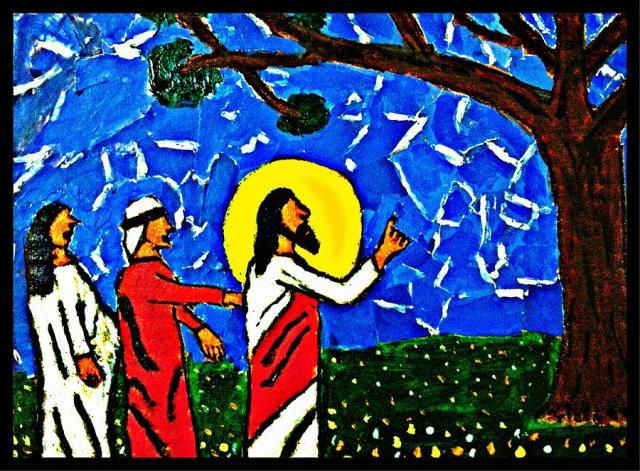
Prepare the Way (Mark 1:1-8)

The beginning of the good news about Jesus the Messiah, the Son of God,as it is written in Isaiah the prophet:

“I will send my messenger ahead of you,
    who will prepare your way”—
“a voice of one calling in the wilderness,
‘Prepare the way for the Lord,
    make straight paths for him.’”

And so John the Baptist appeared in the wilderness, preaching a baptism of repentance for the forgiveness of sins. The whole Judean countryside and all the people of Jerusalem went out to him. Confessing their sins, they were baptized by him in the Jordan River. John wore clothing made of camel’s hair, with a leather belt around his waist, and he ate locusts and wild honey. And this was his message:

“After me comes the one more powerful than I, the straps of whose sandals I am not worthy to stoop down and untie. I baptize you with water, but he will baptize you with the Holy Spirit.” (New International Version)

The beginning of Mark’s Gospel lets us know what the entire account is all about: The good news of Jesus Christ, the Son of God. And, from the get-go, Mark embeds this beginning in a much older beginning, from the prophet Isaiah. None of this stuff was made up; it’s been there all along, for those with the spiritual eyes to see it.

It could be that it seems you aren’t seeing anything happen in your life that’s good right now. You know you’re now into this Christian Advent season, but not feeling at all as if it’s a time of good news – because all you have been hearing is bad news stacked on top of bad news. Devastation and despair, destruction and depression, are not only with those experiencing the harrowing circumstances of war or disease, but perhaps with you, as well.

Just because you can always point to someone else, or some other people group around the world, that has it worse than you, doesn’t mean that your own situation is necessarily good. The worst sort of grief is the grief that you yourself are experiencing. It’s likely that you may have your own unique brand of hopelessness, and might feel guilty for not being more happy or grateful in this time of year.

We all need good news – not just the ones with daily terrible and traumatic encounters. Maybe we could all tap into our collective humanity and realize our spiritual connection with everyone else in this topsy-turvy world. If we share bad news together, then it seems to me that we can also share the good news with one another, as well.

And there is always good news, if we have the spiritual ears to hear it: God is here. God knows. God cares. God loves. God is the Victor. Specifically, for Mark and for Christians everywhere, the incarnation, life, death, resurrection, and ascension of Jesus the Messiah is the dynamic proclamation of deliverance from all the guilt, shame, anxiety, and devastation that happens around us and even to us.

The consistent witness of the New Testament Gospels is nothing less than the Evangelists saying to us, “Look! God is here in the person of Jesus.”

Christ did not come to this earth in order to bring us some nice distractions from the crap we are enduring; but instead turns toward the crud and faces it down with divine power.

John the Baptist, by Anikitos Giannoudes

We possess good news of great joy for all the nations. And there is, I believe, no better messenger to let us know this than John the Baptist – a quirky man whose clothes look like they don’t fit right (or are even fit for a person to wear) and whose daily lunch makes all the girls squeal.

If a guy like John – on the margins of society – can help point us to good news, then we, too, have an important place in this world of making a difference with our own social eccentricities, spiritual foibles, mental disorders, and funny looks.

It appears obvious that John only cared about one thing: making sure everyone knew who the true and ultimate Messenger was, because this Messenger Messiah had the true message of good news that the whole world desperately needs.

The good news of God brings hope to those who find themselves in dire straits, on the peripheries of our world, and of wondering if things will ever get better, or not. God’s good news of grace announces God’s presence in all of our wonderings, in every place, and with each situation we find ourselves in.

God’s love goes wherever we are. Jesus is our Immanuel, God with us. In the person of Christ, we discover that God is for us; and if everyone else is against us, the Lord’s divine presence is enough for us. Thanks be to God!

The Question of Authority (Mark 11:27-33)

The Pharisees Question Jesus, by James Tissot (1836-1902)

Again they entered Jerusalem. As Jesus was walking through the Temple area, the leading priests, the teachers of religious law, and the elders came up to him. They demanded, “By what authority are you doing all these things? Who gave you the right to do them?”

“I’ll tell you by what authority I do these things if you answer one question,” Jesus replied. “Did John’s authority to baptize come from heaven, or was it merely human? Answer me!”

They talked it over among themselves. “If we say it was from heaven, he will ask why we didn’t believe John. But do we dare say it was merely human?” For they were afraid of what the people would do because everyone believed that John was a prophet. So they finally replied, “We don’t know.”

And Jesus responded, “Then I won’t tell you by what authority I do these things.” (New Living Translation)

Jesus was an outsider. During his earthly ministry, he was viewed, at best, as an avant-garde leader; and, at worst, a flat out heretic. It may be easy to overlook that reality, because we typically think of Christ as Lord and always on the inside of things.

Although Jesus was a teacher and a rabbi – and was neither a priest nor a member of any Jewish religious sect – he nevertheless walked around as if he owned the place (which he did). That gave the established religious leadership of the day no end of consternation and frustration.

Jesus made significant inroads into people’s lives, especially with outsiders like himself. And this situation created anger and jealousy with many of the religious ruling class. Since Jesus was not a card-carrying member, the leaders wanted to hear from him why he kept acting confidently and deliberately on their religious turf.

“What gives you the right? Who authorized you to act this way?” was their cry.

The established authorities are depicted in today’s Gospel lesson as a craven bunch who did not want to alienate the crowds, and yet were eager to get the upstart Jesus out the way. This appears to be an age-old situation of leaders putting their fingers to the wind to go with whatever will keep them popular and in power.

Since Jesus consistently refused to play such games, the authorities believed he needed to go. They, however, had no intention of risking an outright confrontation and showing their shadow motives.

Jesus clearly connected himself with John the Baptist, as both coming from the same authority. John was yet another figure for whom the established leaders could not control.

We ought never to underestimate both perceived and actual threats to status quo leadership. Such leaders have no inkling of being public servants when true moral authority comes along. The lack of conformity from John and Jesus would cost them both their very lives.

Speaking truth to power while not becoming defensive doing so is a tricky art. Yet, Jesus did it. Continual challenges to his authority left him unfazed as to his mission and purpose on this earth. Christ was assertive without becoming despotic; forward without taking the bait of useless arguments; confident with no hint of arrogance.

For me, the contrast between Jesus and the religious authorities is trenchant. The confident, wise, and calm authority of Christ is in direct opposition to the fear, anxiety, and worry of the ruling leaders. Whereas they kept anxiously ruminating about what to do about this threat to their established authority, Jesus exhibited a non-anxious presence which maintained a steadfast focus on God’s righteous, holy, and benevolent rule and reign.

Sometimes, continual fear is a big red flag that the leader is so worried about losing their place or position, that the will of God gets pushed aside as merely a secondary concern.

Questioning Christ’s credentials was the giveaway that the existing religious authorities were concerned about their power and privilege, and not the people. The wise person will see such queries for what they are.

Wherever we observe those who refuse to share power, have a xenophobic bent toward outsiders, and seem to do just about anything to maintain the status quo, there we will find the abuse of authority.

Conversely, where we observe a deep concern for equity, justice, and the common good of all persons, there we see compassionate leadership who will champion ethical leadership and espouse moral authority.

In any democratic society, we must choose our leaders wisely.

Great God of hope, in these times of change and uncertainty, unite your people and guide our leaders with your wisdom. Give us courage to overcome our fears and help us to build a future in which all may prosper and share together through Jesus Christ our Lord in the strength of your Holy Spirit. Amen.

Forgive (Mark 11:20-25)

Jesus Cursing the Fig Tree by Ganosh Kelagina Beedu Shenay, 2016

In the morning as they passed by, they saw the fig tree withered away to its roots. Then Peter remembered and said to him, “Rabbi, look! The fig tree that you cursed has withered.” Jesus answered them, “Have faith in God. Truly I tell you, if you say to this mountain, ‘Be taken up and thrown into the sea,’ and if you do not doubt in your heart but believe that what you say will come to pass, it will be done for you. So I tell you, whatever you ask for in prayer, believe that you have received it, and it will be yours.

“Whenever you stand praying, forgive, if you have anything against anyone, so that your Father in heaven may also forgive you your trespasses.” (New Revised Standard Version)

Sometimes forgiveness seems about as possible as moving a mountain or withering a fig tree. Yet, it can be done. It needs to be done. An unforgiving spirit withers a person from the inside-out.

The heart of the good news in the Bible is forgiveness of sins. It comes through the person and work of Jesus Christ. Forgiveness is both an event, and a process. Forgiveness is to be a constant dynamic within our relationships because we live in a fallen world. 

People sin against us, and others hurt us. We sin against other people and hurt them, too. Relational pain is a reality this side of heaven. Revenge and/or passive-aggressive behavior are neither biblical nor healthy ways of handling our hurt. So, what is a person to do?

We practice forgiveness. The following is some biblical guidance as to what forgiveness is, and is not:

God did not promise forgiveness would be easy. He knows exactly the kind of cost it brings. Through the death of Jesus there can be and is forgiveness. The price of forgiveness for Jesus was not cheap.

The blood of bulls and goats and the ashes of a heifer sprinkled on those who are ceremonially unclean sanctify them so that they are outwardly clean.  How much more, then, will the blood of Christ, who through the eternal Spirit offered himself unblemished to God, cleanse our consciences from acts that lead to death, so that we may serve the living God! (Hebrews 9:13-14, NIV)

Forgiveness is an ongoing process of putting off bad relational habits and putting on good ones. It takes time and cannot be hasty. Forgiveness must be deliberate with no shortcuts to it, otherwise it will not stick. 

Get rid of all bitterness, rage and anger, brawling, and slander, along with every form of malice.  Be kind and compassionate to one another, forgiving each other, just as in Christ God forgave you. (Ephesians 4:21-32, NIV)

Forgiveness is not blanket amnesty. It does not simply give another person a “pass” on their hurtful words or actions. Forgiveness means we do not hold the offense over the other person’s head. 

“Forgiveness is giving up all hope of a better past.”

Fred Luskin, Stanford University

We cannot undo the past. Yet, we have control of the present, and can choose to forgive. True forgiveness calls a spade a spade and names the specific offense in all its ugliness, and lets it go.

You’re an evil man! When you begged for mercy, I said you did not have to pay back a cent.  Don’t you think you should show pity to someone else, as I did to you? (Matthew 18:32-33, CEV)

It takes two to reconcile. It only takes one to forgive.

I have often been told that it will not do any good to forgive another person because it would not change them. I respectfully retort: That is not the point. We forgive because it is our responsibility to work through our forgiveness issues and do it. We are not in control of whether another person will feel sorry for what they did, or not.  We regulate our own decision to forgive, no matter what the other person does or does not do, or whether they feel the gravity of their sin, or not.

If possible, to the best of your ability, live at peace with all people. (Romans 12:18, CEB)

I [Jesus] say to you, love your enemies and pray for those who persecute you. (Matthew 5:44, NRSV)

Jesus said [on the cross], “Father, forgive them, because they do not know what they are doing.” (Luke 23:34, CSB)

If we hold on to bitterness toward another for their offense, we only hurt ourselves. Drinking the poison of bitterness will kill you, not the other person. Avoid the magical thinking that they are going to come to you all slobbery sorry for what they said or did. That often does not happen. When it does, it is a beautiful thing. 

Regardless, of another’s decisions, we are to forgive everyone who sins against us just as God has forgiven us.

Forgive us our sins, as we have forgiven those who sin against us…. If you forgive those who sin against you, your heavenly Father will forgive you. But if you refuse to forgive others, your Father will not forgive your sins. (Matthew 6:12, 14-15, NLT)

The relational currency in God’s kingdom is forgiveness. Without it, we can neither operate well together, nor can we enjoy a satisfying life. However, with forgiveness, there is a demonstration of the practical effects of Christ’s crucifixion to life, not to mention a good witness to a watching world.  

Peter got up the nerve to ask, “Master, how many times do I forgive a brother or sister who hurts me? Seven?” Jesus replied, “Seven! Hardly. Try seventy times seven.” (Matthew 18:21-22, MSG)

To forgive is risky business. If we hold a grudge like a warm security blanket, to toss aside the odd comfort of unforgiveness will seem strange, even fearful. When we are hunkered down in bitterness, we rarely see how it causes faith to weaken.

The longer the lack of forgiving goes on, the harder it will be to give it up. Faith steps out and acts, believing that God is in it. On the other side is the hope of freedom and peace. Besides, the consequences of unforgiveness are downright unpleasant.

Keep us forgiven with you and forgiving others. Keep us safe from ourselves and the Devil. (Matthew 6:13-14, MSG)

The end of the matter for many people comes down to the intensely practical. So, here it is: Do you want to be happy or miserable? I am not familiar with anyone who wakes up in the morning and says to themselves, “Well, I think I’ll be miserable today.” No, we want to be happy and blessed. Forgiving others is the path to blessing.

It is a great blessing when people are forgiven for the wrongs they have done, when their sins are erased. (Psalm 32:1, ERV)

May you know the blessing of being forgiven and forgiving others. May this freedom allow you to enjoy the peace of God the encouragement of others. Amen.

The Parable of the Mustard Seed (Mark 4:30-34)

Again he [Jesus] said, “What shall we say the kingdom of God is like, or what parable shall we use to describe it?It is like a mustard seed, which is the smallest of all seeds on earth. Yet when planted, it grows and becomes the largest of all garden plants, with such big branches that the birds can perch in its shade.”

With many similar parables Jesus spoke the word to them, as much as they could understand. He did not say anything to them without using a parable. But when he was alone with his own disciples, he explained everything. (New International Version)

Working with Seeds

I grew up on a rural Mid-West America farm. Working with seeds was our livelihood. Even though my farming father worried incessantly about the weather, there was one thing he was never anxious about: seeds.

My dad knew that when we planted seeds in the Spring, there would be a harvest in the Fall. That’s because he knew the seed already has within itself everything it needs to germinate, take root, grow, and produce a harvest. His role was simply to tend to it all by keeping the fields free of weeds, worms, and critters.

Since I was the youngest, I typically got the grunt work of our massive family garden. I was always excited when we planted things because I knew what was coming in a few months: some delicious veggies on my dinner plate which were fresh from the garden that I myself tended. I never wondered whether there would be food on the table, or not.

Seeds are, of course, small. If you think about it, they appear quite unimpressive. Yet, we know better. We understand that when planted, watered, and cultivated, those seeds turn into amazing plants. 

But it takes time. Even as dumb little kid, I clearly knew that my planting seeds would not result in seeing anything above ground the next day. I understood it would take a few weeks before new growth would break the ground.

Seeds and the Kingdom of God

The kingdom of God, Jesus told us, is like a mustard seed – a very small seed which can grow into a tree big enough for birds to nest. Unlike the mighty Roman Empire, or contemporary powerful national governments, the kingdom of God had humble beginnings. It grows, over a long period of time, to become a force greater than anything the world can produce.

While our world races forcefully on with the speed of the hare, Jesus is carefully and patiently building his Church at the pace of a tortoise. In the end, the kingdom of God will rule over all creation, while the kingdoms of this world shall no longer exist. 

Even though many of us now live in a society where quicker, faster, better, and stronger dominate everything, still the best things in life come as a result of tedious perseverance over an extended period of time. 

We are in such a hurry to accomplish our goals, make as much money as we can, and keep constant vigilance over our work. And for what purpose?

When we forget to slow down, or worse yet, believe slowness to be laziness and/or stupidity, there is a price to pay.

Lessons of the Seed

In graduate school, I typically read an average of 200 books per semester. Yes, you read that right. I had to keep up. I was on the clock with deadlines for papers and projects. In the factory, where I did a stent as a worker, I did piece work at the rate of 100 per hour for 8-10 hours. I had to go fast to survive and keep my job, let alone thrive. All of this, of course, impacted my mind, body, and emotions – in very uncaring ways. It was all done at the cost of my physical and mental health.

Indeed, our modern capitalist societies generate an unparalleled level of wealth and standard of living. But this has been achieved at the cost of devouring our planet faster than she can replenish herself. The stress we have put on mother earth we would never think of putting on our own mothers.

Even our attempts at leisure and self-care are anything but. We often end up racing to have as much fun and relaxation as we can cram into a few days or weeks of our “time off.” A return to the normal rat race has us telling each other, “I need a vacation from my vacation.”

There is such a thing as death by overwork. So, we desperately need to come back to the words and ways of Christ – to embrace the slow developing rhythms of grace. We need to age like a fine wine or an expensive bourbon, getting wiser as we get older.

Time is a precious gift given to us by a good and wise God. And that gift must be stewarded well. All the things that bind people together and make our lives worth living – family, faith, friendship, and community – all thrive on having copious amounts of time with each other (and God) in relational connection.

We are, I believe, in a pandemic of having no one to listen, of profound loneliness, and of incredible lostness of soul. The only real prescription for these debilitating maladies is slowing down and taking the time to be, and to be with each other.

Seeds are Slow

Instant gratification will not do the trick. We need to plant small seeds, and then take the time to nurture them and watch over them. While the rest of the world rages and roars on with their disease of speed, believers must carefully cultivate spiritual practices which foster healthy growth and development.

Whether we like it, or not, we serve a slow God. And what’s more, because slowness is built into the very nature of the world, decelerating our lives actually works. Life eventually becomes better, not worse.

You and I have the God-given right to determine our own pace and tempo – without anxious systems of power squeezing every ounce of speed and activity out of us, sucking our souls to serve a worthless idol.

I, for one, would not be opposed to creating a society known as “The Royal Order of Sloths,” or joining a group of slow walkers who label themselves as “Sauntering for Sanity,” or simply be straightforward with an organization known as “The Society for the Propagation of Slowness.”

That’s because the best things in life take time; and those things need us to slow ourselves enough to notice and enjoy them. Eventually, we shall find that the world is blessed because of our commitment to embracing the small and the slow.

Let us pray for all the world, and also for ourselves, knowing that what we ask in the name of the Lord, will be heard according to God’s mercy and patience.

Almighty God, we pray for faith, even as small as a mustard-seed, and for the love to nourish and nurture it, so that it may grow and flourish. We pray for the church throughout the world – that people of faith may work together in unity and in prayer to overcome evil and to promote true love among all people.

O Lord, you are the beginning of all our good, the wellspring of all our love and the source of all our freedom. Let your grace continue to work in us, that your will may be done through us, and that we may always rejoice in your presence. Lord, in your mercy, hear our prayer. Amen.