John’s disciples told him about all these things. Calling two of them, he sent them to the Lord to ask, “Are you the one who is to come, or should we expect someone else?”
When the men came to Jesus, they said, “John the Baptist sent us to you to ask, ‘Are you the one who is to come, or should we expect someone else?’”
At that very time Jesus cured many who had diseases, sicknesses and evil spirits, and gave sight to many who were blind. So, he replied to the messengers, “Go back and report to John what you have seen and heard: The blind receive sight, the lame walk, those who have leprosy are cleansed, the deaf hear, the dead are raised, and the good news is proclaimed to the poor. Blessed is anyone who does not stumble on account of me.”
After John’s messengers left, Jesus began to speak to the crowd about John: “What did you go out into the wilderness to see? A reed swayed by the wind? If not, what did you go out to see? A man dressed in fine clothes? No, those who wear expensive clothes and indulge in luxury are in palaces. But what did you go out to see? A prophet? Yes, I tell you, and more than a prophet. This is the one about whom it is written:
“‘I will send my messenger ahead of you, who will prepare your way before you.’
I tell you, among those born of women there is no one greater than John; yet the one who is least in the kingdom of God is greater than he.”
(All the people, even the tax collectors, when they heard Jesus’ words, acknowledged that God’s way was right, because they had been baptized by John. But the Pharisees and the experts in the law rejected God’s purpose for themselves, because they had not been baptized by John.) (New International Version)
For a short time in my life, I had a side business doing some painting. I once painted an interior apartment in a large beautiful Victorian house. When I was done, it looked great. However, there was a bit of a problem. The owner came to check on my progress only to find that I had painted with the wrong color! I was certain I had it right, but, alas, the job ended up taking twice as long as anticipated.
Sometimes, we can be so sure about our plans, only to discover our expectations were off. John the Baptist was sitting in jail, not for any crime other than offending the king. As he sat there, John began to doubt. He started wondering about Jesus. Maybe he had been wrong about him. Perhaps he was not the Messiah, after all.
John had been doing ministry with the expectation that Jesus would beat up the Romans, usher in a renewed political Israel, and put down all threats to his Lordship. But that was not happening. John was now uncertain. So, he sent some of his disciples to Jesus to ask, “Are you the one who is to come, or shall we look for another?”
John reasoned that if Jesus were really a sovereign king, he would not be languishing in a prison and facing imminent death. Jesus responded to John’s uncertainty by quoting the prophet Isaiah and letting him know that the kingdom takeover was going exactly as planned.
“Huh!?” John must have wondered. Maybe something was lost in translation. But no. The problem was that John had been using the wrong paint. John’s plans and expectations did not fully sync with Jesus.
It’s easy to doubt when unexpected and unwanted adversity strikes. When things don’t go according to our expected plans, then what?
This is why it is so vitally important to continually seek the Scriptures and seek the Lord Jesus so that we might not only paint the right building but also use the paint Jesus expects us to use.
The thing John got right was pursuing Jesus. When in doubt, he sought the Lord – and that is something we all can emulate.
As we paint the portrait of our lives, let’s be sure to use the colors Jesus gives us.
Lord Christ, you came into the world as one of us, and suffered as we do. As I go through the trials of life, help me to realize that you are with me at all times and in all things; that I have no secrets from you; and that your loving grace enfolds me for eternity. In the security of your embrace, I pray. Amen.
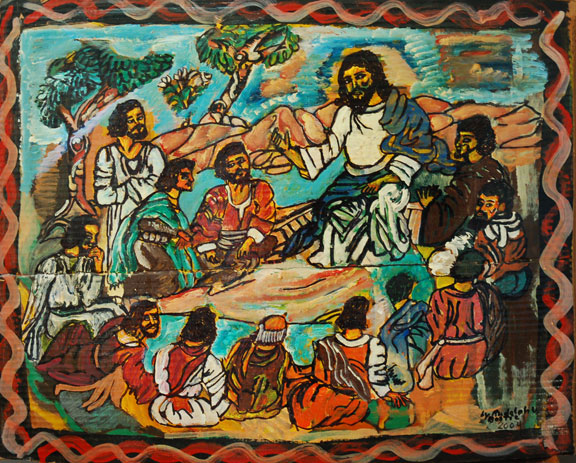
Jesus and the Disciples by Rudolph Bostic (1941-2021)
Jesus called the Twelve together and he gave them power and authority over all demons and to heal sicknesses. He sent them out to proclaim God’s kingdom and to heal the sick. He told them, “Take nothing for the journey—no walking stick, no bag, no bread, no money, not even an extra shirt. Whatever house you enter, remain there until you leave that place. Wherever they don’t welcome you, as you leave that city, shake the dust off your feet as a witness against them.” They departed and went through the villages proclaiming the good news and healing people everywhere. (Common English Bible)
You have likely heard the old nineteenth century adage from a member of the British Parliament, Lord Acton: “Power tends to corrupt, and absolute power corrupts absolutely.” The rest of the quote, which we seldom hear is this: “Great men are almost always bad men, even when they exercise influence and not authority.”
It’s almost as if Jesus knew this well before Lord Acton uttered it nearly two millennia later. Jesus Christ, in a truly wise and generous display of leadership, shared his power and authority with others. Rather than hoarding power and using authority to gain more authority, the Lord Jesus, rightful Ruler of the universe, delegated power and enabled those who ministered with him to share in carrying out his mission.
The only real Christian ministry is a bestowed ministry, granted to us by the delegation of Jesus. What this means for us, practically, is that believers minister as servants of God and stewards of the power and authority given to us. Grasping this basic accountability helps us to truly serve others with sensitivity and care – knowing we must give an account for the privilege of ministering in Christ’s name.
“There is no stronger test of a person’s character than power and authority, exciting as they do every passion, and discovering every latent vice.”
Plutarch (46-119, C.E.)
This has tremendous implications for us in all areas of life. Within the family, this means that parental authority can and ought to be delegated in wise increments, over time, as children grow and mature. The concept that a dad should be some sort of supreme leader who barks orders and demands fealty from mom and the kids is downright misguided, not to mention incredibly weird.
It also means that in the church and in faith communities, the wise use of power and authority will seek to identify and mentor younger disciples who will be given appropriate authority for expected ministry. Church leadership will listen to and equip those who have passions for particular service with the requisite authority to engage in effective ministry.
At the workplace, this involves forsaking a top-down approach of authority in favor of distributing power equitably amongst the workers with the greatest responsibilities.
In the political arena, this means Christians won’t tie their hopes in gaining power but rather in giving it away. They will seek equity and the common good of all citizens. And if that means deferring to a voice which isn’t being heard, then that is precisely what we do. Perhaps we see so little civility and concern for the other because Christians are much too enamored with dramatic miracles fueled by power.
Mosaic in the Papal Basilica, Rome, of Jesus and Disciples
Let’s not lose sight of the reality that healing sicknesses and suppressing the demonic is solely derived from Christ’s own authority, not ours. To press this reality home, Jesus instructed his disciples to take nothing with them. No staff, bread, bag, or money. Live among the locals, with them, on their turf and with their activities. Use the power and authority given to improve their lives and in so doing, lead them to greater spiritual truths.
If they don’t accept this gracious ministry, move on. No arm-twisting. No manipulation. No guilt-tripping. And definitely no using your given authority for grandstanding. A simple warning with shaking the dust off the feet is sufficient.
Every detail of the mission Christ gave to the disciples was a lesson in sheer and total dependence on God. Humble ministry and modest lifestyle will set the best table for a proper focus on benevolent and compassionate ministry. Just as increased knowledge ought to be used to love better and show us how much we actually don’t know, so increased authority ought to be used to serve others better and show us how much power we don’t have so that we might continually seek after the God who possesses all power and authority.
The good news is that God’s infinite and supreme power is given and focused in the person of Jesus Christ, who in turn, graciously bestows the authority to his followers so that they may proclaim forgiveness and new life. It’s a big message requiring large authority. And Jesus freely gives it:
And Jesus came and said to them, “All authority in heaven and on earth has been given to me. Go therefore and make disciples of all nations, baptizing them in the name of the Father and of the Son and of the Holy Spirit, and teaching them to obey everything that I have commanded you. And remember, I am with you always, to the end of the age.” (Matthew 28:18-20, NRSV)
It’s enough to make old Lord Acton smile in his grave.
Eternal God, you call us to live with faith in a world filled with so many challenges. Help us remember our mandate and our mission to use our given authority properly, lovingly, and confidently with obedience to our Lord.
Teach us by your Word, through our brothers and sisters in Christ, and in our prayers to learn and understand what you would have us to be and to do, so that we may fulfil our calling as Christ’s Body here on earth.
Draw your church together into one great company of disciples, together following our Lord Jesus Christ into every walk of life, together serving him in his mission to the world, and together witnessing to his love, in the strength of your Holy Spirit. Amen.
Praise the Lord, the God of Israel! He has come to save his people. Our God has given us a mighty Savior from the family of David his servant. Long ago the Lord promised by the words of his holy prophets to save us from our enemies and from everyone who hates us. God said he would be kind to our people and keep his sacred promise. He told our ancestor Abraham that he would rescue us from our enemies. Then we could serve him without fear, by being holy and good as long as we live.
You, my son, will be called a prophet of God in heaven above. You will go ahead of the Lord to get everything ready for him. You will tell his people that they can be saved when their sins are forgiven. God’s love and kindness will shine upon us like the sun that rises in the sky. On us who live in the dark shadow of death this light will shine to guide us into a life of peace. (Contemporary English Version)
This beautiful psalm and prophecy came from the old priest Zechariah. It is a praise to God for the Christ about to be born; and, a prediction of Zechariah’s own son, newly born, as one who will prepare the way for Jesus. This benediction speaks of better days to come, pointing forward to peace (shalom) spiritually, politically, and relationally.
Zechariah and his wife Elizabeth were old and well past the childbearing years. In fact, Zechariah is portrayed earlier in Luke’s Gospel as something of a stereotypical grump. After being taken up to the temple in a golf cart because he could walk so well anymore, Zechariah was confronted by an angel and nearly lost his dentures out of fear.
The angel Gabriel told old Zechariah that his wife would bear a son who will prepare the way of Messiah. Zechariah then gave a sort of “Hmpff! That’s not likely, Sonny. Look at me and my wife. Are you sure you have the right couple, and the orders in heaven didn’t get screwed up?”
Zechariah the Priest and the Archangel Gabriel by Alexander Andreyevich Ivanov (1806-1858)
Gabriel was not very keen on being doubted, and it earned Zechariah losing his voice until John the Baptist was born. It was after Zechariah had nine months to think about that encounter, and experience watching a child grow in his wife’s womb that, after John’s birth, Zechariah was a changed man.
Zechariah went from just one of many old priests in Israel, to being inspired by the Spirit and singing the praises of God. We can almost imagine him as an ancient version of Fred Astaire, picking up his cane and dancing with joy.
Our lives are not so different than Zechariah in this respect: We are a complex concoction of both fear and joy that could combust at any time in either direction.
We sway back and forth from fear and anxiety to joy and gratitude. Certain words can swing us to one extreme or the other: finances, pandemic, politics, religion, the future. They can create in us either immediate tension or smiling happiness; tomorrow they might do just the opposite. Zechariah went from anxious to elated, fearful to joyful.
We live in a toxic world filled with polarizing opposites and entrenched stereotypes of others. People vacillate between love and hate, pursed lips of anger and dispositions of peace. So, how do we rise above the heated rhetoric that exists in our world? How are we going to deal with all the disharmony and vitriol? By possessing the peace given to us in the prophecy and promise of Jesus. Our feet need to be guided in the path of peace.
Jesus came to give peace. All the words of Zechariah’s inspiration point toward the harmonious peace of salvation, rescue, and forgiveness. The time was finally coming when there would be peace in its fullest sense – wholeness and thriving in life which was unprecedented and unthinkable before Jesus.
“True peace is not merely the absence of some negative force, tension or war – it is the presence of some positive force, justice, good will, brotherhood.”
Martin Luther King, Jr.
We are to live the Christian life and have a ministry in the church and the world without fear. Instead, we are to focus on what we are called to be and to do. Jesus rescues and delivers so that we will have forgiveness of sins which enables us to serve the Lord in holiness and righteousness, without fear.
Peace does not just magically appear out of thin air. Peace was bought at an agonizing price – the blood of Jesus. Peace must be pursued. Practices of peace must be engrafted into our lives if we are going to experience it on the daily practical level. Yes, obtaining peace is difficult. Yet, we instinctively know it is worth it.
Spiritual health comes through cultivating the peace of God in our lives through:
Avoiding chronic negativity and embracing the positive.
Making things right with others and embracing a reconciling spirit.
Pursuing Jesus with heart, soul, mind, and strength.
Reframing our situations to a fresh vision of peace, wholeness, integrity, spiritual growth, and relational health, instead of focusing solely on problem-solving.
Zechariah, by means of the Holy Spirit, gave us a vision of a future full of peace, joy, and thriving. The name “Zechariah” means in Hebrew “God remembered.” God has not forgotten divine promises. The time has come to take hold of the vision God had from the very beginning to walk with humanity in continual fellowship and happiness in the garden, a place of abundant growth, beauty, and health.
Beginning ten years ago, a new kind of study has come from a task force put together by professionals across a wide spectrum of disciplines known as the World Happiness Report. Every country in the world is ranked according to criteria such as the gross domestic product, social support, healthy lifestyles, freedom to make choices, lack of corruption, and both negative and positive outlooks on life.
The United States has yet to make the top ten list on happiness. Even with America’s vast resources, we are, collectively speaking, a very unhappy people. I believe the most interesting finding from the World Happiness Report was their conclusion as to what makes one country happier than another. The Report consistently concludes that citizens of the happiest nations on earth continually find a steady stream of peace and joy in three sources: their families, their rituals/traditions, and their religion.
It will be hard to find joy in our lives through our Christianity if we are not experiencing the peace of Jesus Christ. Christian liturgical rituals and observances of seasons like Advent help remind us we have peace with God through our Lord Jesus Christ.
The birth of Jesus turned Zechariah’s world upside-down. Forgiveness of sins, spiritual peace, and human well-being can be found in Christ. Here are several practical ways we can implement the peace we have in Jesus Christ today:
Slow down, pause, breathe, and pray.
Do not worry about anything; instead, pray about everything. Tell God what you need and thank him for all he has done. Then you will experience God’s peace, which exceeds anything we can understand. His peace will guard your hearts and minds as you live in Christ Jesus. (Philippians 4:6-7, NLT)
Exchange fear for the presence of God.
For I, the Lord your God, hold your right hand; it is I who say to you, “Do not fear, I will help you.” (Isaiah 41:13, NRSV)
Listen to music, sing, or make music yourself.
Encourage each other with psalms, hymns, and spiritual songs. Sing and make music in your hearts to the Lord. (Ephesians 5:19, ERV)
Have a “go to” word, phrase, or Scripture verse.
The Lord is my shepherd. I lack nothing. (Psalm 23:1, CEB)
Unplug for a time from electronics and close your eyes.
We live by what we believe, not by what we can see. (2 Corinthians 5:7, NCV)
Try aromatherapy and activate your sense of smell.
Through us, God brings knowledge of Christ. Everywhere we go, people breathe in the exquisite fragrance. Because of Christ, we give off a sweet scent rising to God, which is recognized by those on the way of salvation—an aroma redolent with life. (2 Corinthians 2:14-15, MSG)
Set healthy boundaries.
Jesus went into a village. A woman named Martha welcomed him into her home. She had a sister named Mary. Mary sat at the Lord’s feet and listened to him talk. But Martha was upset about all the work she had to do. So, she asked, “Lord, don’t you care that my sister has left me to do the work all by myself? Tell her to help me.” The Lord answered her, “Martha, Martha! You worry and fuss about a lot of things. There is only one thing you need. Mary has made the right choice, and that one thing will not be taken away from her.” (Luke 10:38-42, GW)
May the peace of Christ guide you into the path of peace in this Advent season and be with you, now and forever. Amen.
As the crowds increased, Jesus said, “This is a wicked generation. It asks for a sign, but none will be given it except the sign of Jonah. For as Jonah was a sign to the Ninevites, so also will the Son of Man be to this generation. The Queen of the South will rise at the judgment with the people of this generation and condemn them, for she came from the ends of the earth to listen to Solomon’s wisdom; and now something greater than Solomon is here. The men of Nineveh will stand up at the judgment with this generation and condemn it, for they repented at the preaching of Jonah; and now something greater than Jonah is here. (New International Version)
Just when we think we might have a handle on Jesus as the meek and gentle Savior we get a picture of Jesus behaving badly. When the crowds begin increasing we might expect Jesus to be pleased. After all, we might reason, Jesus can reach more people, have a wider influence, and greater impact with a crowd. It’s good for kingdom business.
But Jesus isn’t down for all the people following him around. He opens his mouth and tells them they are an evil generation.
“The crowds” continually get a bad rap throughout the New Testament Gospels. That’s because Jesus isn’t much of a crowd kind of guy. Although he loved people deeply, the Lord Jesus typically had some hard words for the masses.
“It’s better to walk alone than with a crowd going in the wrong direction.”
Mahatma Gandhi
Maybe it would help if we used the word “mob.” This is likely the more nuanced understanding of “crowds.” It’s the herd mentality which tends to rub Jesus the wrong way, that is, doing something without understanding why you’re doing it, just because other people are doing it. A mob of people acting in concert never ends well, which is why Christ confronts the crowd.
Jesus chided the people who were looking for a cool miracle, a clear sign of his power, and nice clean lines of spiritual authority. Christ didn’t give it to them. Instead, Jesus let the mob know they have ample opportunity to accept him – yet they aren’t doing a dang thing to move in that direction.
Sometimes, we might so desperately want to make Jesus as Joe Cool so that others will follow him. If only Jesus will heal this person in a big audacious miraculous way, we wrongheadedly think, lots of people will believe.
Or, if only Jesus will compassionately and powerfully perform some grand universal sign that nobody can miss, we believe, the world will have to take notice and put their trust in God.
However, that’s not how Jesus rolls. Christ simply pointed people back to characters in the Old Testament. Jesus insists that if people won’t take notice of what they already have, they are not going to be swayed with a shiny new miraculous sign from heaven.
Jesus defies any stereotype we might try and corral him with. And that’s as it ought to be – since Jesus is the rightful and sovereign King.
So, this is why we need a steady daily stream of God’s Word to help ground us into the ways of Jesus. The more we allow the Scriptures to shape our spirituality, the more our lives will be formed into the likeness of Jesus.
Spiritual growth and maturity is a process. It is often slow. There are not a lot of bells and whistles to it. On most days, there is not a lot of drama – just the pedantic plodding of a faithful believer trying to make sense of living the Christian life.
And those are the people I think Jesus most likes to hang-out with.
“A man who wants to lead the orchestra must turn his back on the crowd.”
Max Lucado
The popular thing isn’t always the right or best thing. Rather than being a lemming which ends up running off a cliff, we have other options, especially when it comes to thinking spiritually and theologically about things:
Stop and think. It’s easy to go through a typical day on autopilot and do things out of habit. The best way to avoid this is to consciously stop and think about why you’re doing something or holding tightly to a particular belief. Does what I’m doing jive with the words and ways of Jesus? Why am I believing or living in this way? What is my purpose?
Take the necessary time to make sound decisions. Avoid copying other people and taking shortcuts. Instead, pray, consult, collaborate, seek wisdom, and make a deliberate and well-thought decision based in the ethics of God’s kingdom. Am I doing my due diligence with properly searching the Scriptures and praying before I act? Have I interacted with some trusted and sage people?
Be willing to stand out from the crowd. If what you believe and the way you need to live your life makes you stick out, well then, it makes you stick out. Giving up your power by letting others make decisions for you isn’t going to end well. To be a faithful followers of Jesus, we will likely have to go against some social norms and stand out as individual believers.
Astounding God, you sometimes shake us out our pre-conceived notions about you and invite us to see Jesus from a different viewpoint. Help me to see Jesus so that I might more fully embrace him and walk in his ways and in the strength of the Spirit. Amen.











 Rev. Tim Ehrhardt