Luke 19:41-44 – Theological Tears

As Jesus approached Jerusalem and saw the city, he wept over it and said, “If you, even you, had only known on this day what would bring you peace—but now it is hidden from your eyes. The days will come upon you when your enemies will build an embankment against you and encircle you and hem you in on every side. They will dash you to the ground, you and the children within your walls. They will not leave one stone on another, because you did not recognize the time of God’s coming to you.” (New International Version)

There are Christians who believe in withdrawing as much from the world as possible, this side of heaven. There are yet others who believe in accommodating to the world, its structures and society. And there are yet others who believe the world and the church are simply two distinct realms which Christians move back and forth within, like doffing one hat and donning another.

For the moment, let’s just leave all that aside. Instead, observe the pathos of Jesus. Christ came to Jerusalem, a city with deep roots in both religion and the world. He stopped and gazed affectionately at the ancient place with a heart full of longing for what she could be, as well as a heart profoundly sad for what she presently is.

And as Jesus stood and looked at the city in all of its religious piety, as well as its worldly pungencies, he wept.

This was not a quiet shedding of a tear. No, the word “wept” means that Jesus openly cried aloud over the city. This is the kind of crying which happens when a person is in the throes of grief and lament. Jesus was expressing great emotional heaves of loud weeping.

The reason Jesus was lamenting with so much feeling was that the city did not recognize they had a gracious visit from God. The Lord looked at the city and saw all the future disaster which was coming. He knew it could be different, and he was completely undone by the city’s inability to see God, right in front of their own face.

That Jesus wept over a city is more than a deep emotional response; it is also a profound theological statement of subversion against the present order of things. Tears and crying are ways of pronouncing that the status quo of human oppression and indifference is not okay – that there is an alternative path, The Way, which leads to peace and life.

Contrary to many contemporary forms of Christian spirituality, theology and tears are not antithetical nor foreign to one another. They are related, and when practiced well, they inform each other in a full-orbed Christianity that is both holistic and holy. We can no more separate the two anymore than we can divide the humanity and divinity of Christ into parts, as if Jesus were some weird schizophrenic God-Man.

A dispassionate follower of Jesus is really no follower, at all.

Now, let’s return to our view of the world and our involvement in it. Taking some cues from our Lord Jesus, the first and foremost posture we are to take toward the worldly city is not separation, accommodation, or dual citizenship – it is, rather, to weep, to grieve and lament, to sit with and feel the immense sadness of a society askew and awry of God.

The longing Jesus had in his heart was to see the city of Jerusalem annexed and incorporated into the kingdom of God. The way of peace, of shalom on this earth, is to bring all things and all the world under the benevolent reign of God. It’s as if there are Twin Cities, like Minneapolis and St. Paul, which exist side-by-side but have different municipal structures. 

The kingdom of this world and the kingdom of God exist next to each other. Jesus wanted to bring the earthly kingdom into the peaceful and gracious realm of God’s kingdom. But the people would have nothing to do with it. Both the religious establishment and the secular authorities of the city wanted their own municipal conceptions of how things should go – and they both rejected the Christ who could bring everyone true harmony.

King Jesus is our rightful benevolent ruler. Yet, there are so many who do not, or will not, acknowledge that grace and mercy is among them if they would but only look and see.

Let us lament this world, which is chocked full of both religious and secular people who do not recognize the time of God’s visitation. May we journey with Jesus and follow him in his Passion for this world and all its inhabitants. May we sit at the feet of Jesus and imbibe his deep love for all who are estranged from God.

Blessed Father, Son, and Holy Spirit, the holy Trinity whom I serve – the world and even sometimes the church is estranged from grace – they have not recognized your gracious coming and presence. I lament such a state of things, and ask you, blessed Spirit, to draw all people to the Savior, Jesus Christ, in whose name I pray.  Amen.

Luke 4:38-44 – Every One of Them

“Healing” by Ivan Filichev, 2014

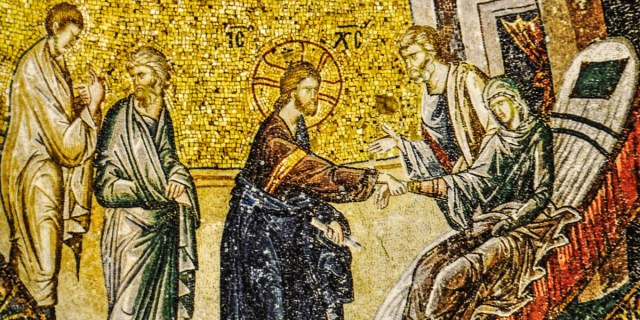
After leaving the synagogue he entered Simon’s house. Now Simon’s mother-in-law was suffering from a high fever, and they asked him about her. Then he stood over her and rebuked the fever, and it left her. Immediately she got up and began to serve them.

As the sun was setting, all those who had any who were sick with various kinds of diseases brought them to him; and he laid his hands on each of them and cured them. Demons also came out of many, shouting, “You are the Son of God!” But he rebuked them and would not allow them to speak, because they knew that he was the Messiah.

At daybreak he departed and went into a deserted place. And the crowds were looking for him; and when they reached him, they wanted to prevent him from leaving them. But he said to them, “I must proclaim the good news of the kingdom of God to the other cities also; for I was sent for this purpose.” So, he continued proclaiming the message in the synagogues of Judea. (New Revised Standard Version)

One of the most fundamental truths about the person of Jesus is that he heals all kinds of people. 

Even people who know very little about the historical Jesus know that he was a guy who brought healing to people while he was here on this earth.  For many Christians, the fact that Christ healed people is almost a “ho-hum” moment because we are so familiar with the Gospel stories about him doing the supernatural. 

Observation: Christ Healed Every One of Them

Yet, as with most Scripture stories we encounter, we really need to slow down a bit and let the story sink in. Then, we are likely to make simple but profound observations of the text. One of those observations is this: When people brought the sick and infirmed to Jesus, he healed every one of them. Christ laid his hands on each and every one of them and cured them.

Every one of them, Jesus healed. There is apparently no disease, no infirmity, no sickness, no malady, and no situation too much for Jesus to heal. Without exception, no matter the problem, every individual who came to Jesus was healed by Jesus. 

Observation: Every One of Them Were Healed Through Others

Here’s another simple but profound observation of the story: All those who had any who were sick brought them to Jesus. In other words, those needy folks didn’t come to Jesus on their own. It was their family, friends, and neighbors of the sick persons who brought them to Jesus for healing.

It is good to care for the sick. It is also good to encourage them to look to Jesus for their help and healing. Yet, it is also very good when we bring them to Jesus ourselves. 

Perhaps one of the main reasons we are not seeing more healing and new life in the Western church is because we are not bringing the needy to Jesus. Maybe it is our lack of faith and action, and not the sick person’s, that prevents healing from being realized. 

Methinks that a profound dearth and lack of prayer for others might be at the core of all the physical, mental, and spiritual sickness that abounds in this world. So, let us bring people to Jesus so that he will heal and cure every one of them.

A mosaic of Jesus healing Peter’s mother-in-law, from a Byzantine Church, c.1100 C.E.

Observation: Christ Cares about Every One of Them

Jesus accepts, heals, and cures those at the margins of society. The sick, infirmed, and demon-possessed were the most marginalized people in the ancient world. They were at the mercy of a caring relative, that is, if they had one. If not, the only way of making it was to beg and rely on public charity. Yet, that was difficult because, in many cases, depending upon the illness, they were considered impure. No one would get near them. They couldn’t participate in the community.

But Jesus welcomed them. He took the time and attention to place his hands on each one of them. Their divine healing was much more than physical; being cured meant they no longer needed to be at the margins, unaccepted and unwanted. Jesus was giving them full inclusion to society.

The good news of Jesus Christ consists of meeting the holistic needs of people for health and community. Our Lord desires to integrate excluded people into society. If that takes the miraculous healing of sickness to do it, then Jesus will make it happen.

Observation: Christ Looks to Heal and Care for Every One of Them, Besides Just Us

It can be a real temptation to believe that our little group has the corner on Jesus. We don’t. Jesus was given for the life of the world – not just a few people who look, think, and act like you and me. In today’s story, the people didn’t want Jesus to go. That’s understandable. Yet, Christ left them because there were others in need of healing of both body and soul.

Christ’s mission is so much broader than we sometimes see or expect. Evangelical Christians camp on saving the soul. Progressive Christians hang their hat on social justice and the real physical needs of people. In reality, the gospel involves both body and soul. To only focus on one aspect is to truncate the gospel as only okay news, not good news.

I would argue there is far too much proclaiming of okay news today. Christianity needs a full-orbed gospel that addresses the holistic needs of people, just like Jesus did. It needs a robust Trinitarian theology with the love of God the Father, the grace of Jesus Christ, and the empowerment of the Holy Spirit delivering souls from spiritual death and saving bodies from worldly injustice.

Anything less is simply picking and choosing what we want and trying to keep Jesus to ourselves. Let’s not do that. Instead, let’s preach the gospel, a kingdom message in which the power of God comes upon people – transforming them from the inside-out and bringing them from the outside-in.

Healing God, we bring to you all those who are discouraged, depressed, diseased, disordered, and damaged in some way by the sin of this world. Cure them by your mighty power so that they will be included into our communities, as well as your heavenly kingdom. Amen.

Why Is Our Ministry Important?

Welcome, friends! Luke 4:14-30 is the account of Jesus reading the words of Isaiah the prophet to proclaim good news to the poor, freedom for prisoners, recovery of sight for the blind, and release for prisoners. How Christ used those words caused a huge commotion, and still does. Let’s find out together what happened. Click the videos below and let us consider Jesus….

Pastor Tim Ehrhardt, Luke 4:14-30

Gracious God, you bring glad tidings to the poor, heal the brokenhearted and free prisoners from jails. Please come to us and send us out, as forgiven people, to the poor, the brokenhearted, and the imprisoned. Amen.

Luke 4:14-30 – Why Is Our Ministry Important?

Jesus Unrolls the Scroll in the Synagogue, by French artist James Tissot (1836-1902)

Jesus returned to Galilee in the power of the Spirit, and news about him spread through the whole countryside. He was teaching in their synagogues, and everyone praised him.

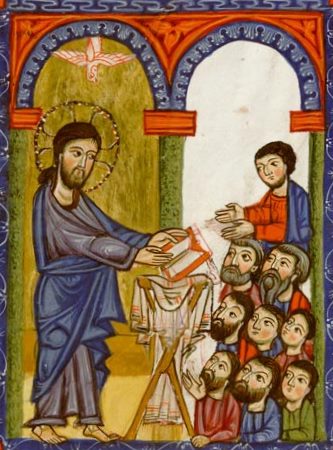
 He went to Nazareth, where he had been brought up, and on the Sabbath day he went into the synagogue, as was his custom. He stood up to read, and the scroll of the prophet Isaiah was handed to him. Unrolling it, he found the place where it is written:

 “The Spirit of the Lord is on me,
    because he has anointed me
    to proclaim good news to the poor.
He has sent me to proclaim freedom for the prisoners
    and recovery of sight for the blind,
to set the oppressed free,
     to proclaim the year of the Lord’s favor.”

Then he rolled up the scroll, gave it back to the attendant and sat down. The eyes of everyone in the synagogue were fastened on him. He began by saying to them, “Today this scripture is fulfilled in your hearing.”

All spoke well of him and were amazed at the gracious words that came from his lips. “Isn’t this Joseph’s son?” they asked.

Jesus said to them, “Surely you will quote this proverb to me: ‘Physician, heal yourself!’ And you will tell me, ‘Do here in your hometown what we have heard that you did in Capernaum.’”

“Truly I tell you,” he continued, “no prophet is accepted in his hometown. I assure you that there were many widows in Israel in Elijah’s time, when the sky was shut for three and a half years and there was a severe famine throughout the land. Yet Elijah was not sent to any of them, but to a widow in Zarephath in the region of Sidon. And there were many in Israel with leprosy in the time of Elisha the prophet, yet not one of them was cleansed—only Naaman the Syrian.”

All the people in the synagogue were furious when they heard this. They got up, drove him out of the town, and took him to the brow of the hill on which the town was built, in order to throw him off the cliff. But he walked right through the crowd and went on his way. (New International Version)

Jesus was the hometown boy of Nazareth, the rising star who was putting the small village on the map. He walked into the synagogue on the Sabbath with the people all watching with pride, their chests puffed with delight over one of their own making it to the big time. 

It just so happened that on that day the Old Testament reading was from the prophet Isaiah – a prophecy of grace and healing that fit the budding ministry of Jesus. Here was the hope of Israel. It was all bunnies and butterflies, until Jesus decided to say a few words to them all….

Jesus took the prophecy of Isaiah about proclaiming liberty to captives and the oppressed and then applied it, not to his fellow Jews who were present, but to, of all people, Gentiles! 

Jesus just had to open his mouth and point out that in the days of Elijah, the prophet was sent to a Gentile woman. In addition, Jesus let everyone know the prophet Elisha cleansed a Gentile. The gathered synagogue worshipers understood exactly what Jesus was doing – claiming to be the ultimate prophet, sent for those people. 

It was too much for the people gathered for worship. All hell broke loose as the “worshipers” became so angry and insolent that they drove Jesus out of town and tried to kill him. Jesus had that kind of effect throughout his earthly ministry by saying and doing the unexpected. 

The people of Nazareth seemed to have always interpreted the message of Isaiah and the prophets as being for themselves, not others. Whenever any believer or church loses sight of a biblical message and re-interprets it as being for only us, then we end up like the Nazarenes of old who did not recognize Jesus for who he really is and what he really came to do. 

Some believers and churches need a question asked of them: Are you ready to throw Jesus off a cliff?

Our faith is not merely individual; it is meant to impact the world. In the beginning the earth was created by God and it was good. Yet, it didn’t take long for things to go sideways. The fall of humanity into sin and disobedience brought death and decay to the world. Ever since, the human condition has been dominated by guilt, shame, indifference, violence, taking advantage of others, pride, and selfishness.

However, God did not leave the world to its own demise. The Lord began the process of reconciliation, culminating in the person and work of Jesus Christ. And now, Christians are a new society, the community of the redeemed, the church. As the people of God, we are called to do justice, love mercy, and walk humbly.

Jesus came to save us from our predicament, and to proclaim good news to the poor, freedom for prisoners, recovery of sight for the blind, and freedom for those oppressed by others. The kingdom of God is to extend over every square inch of this earth, every nation, every race and ethnicity, every institution and organization, and every individual. It all belongs to God’s rule and reign in Christ.

Jesus has made us, his disciples, ambassadors of reconciliation. Ever since the fall of humanity, God is reclaiming and redeeming, even now, all of creation back to himself. The Lord is seeking to bring people back into the harmony that existed in the Garden of Eden. Although this will only be fully realized when Christ returns, we presently now have the responsibility to be gracious agents of God’s kingdom, restoring all areas of this world and all people to their rightful place, at peace with God.

There is every reason to hope because a new world began emerging at the resurrection of Jesus Christ from death. As Christians, we accept struggle and hardship in this life and endure all things because, even though disease, destruction, and death claim so many lives, the love of God in Christ will never change nor die.

Because of the risen and ascended Christ, who is the light for all people everywhere, Christ’s disciples are able to respond to the great mass of human suffering with compassion.

This is important since compassion might not be our initial reaction to human suffering. Like the villagers in Christ’s hometown of Nazareth, we can chafe at the thought of compassionately reaching out to the poor, the prisoner, the blind, and the oppressed. We might either resist ministry to the “other” because we believe they caused their own poverty and adverse situation, or because we simply don’t believe we are wired for ministry to them.

If you knew me before I was a Christian, you might not recognize me. I didn’t love anybody. I had no compassion for anyone. It wasn’t until I experienced the love and compassion of Jesus Christ that my life turned upside-down. I began responding to human need with a deep concern. I sought to connect with all kinds of people. I wanted to make a difference in the world.

Back then I was (and to some degree still am) something of an agitator. Maybe that’s one reason I am so drawn to the compassion of Christ. For compassion is actually a radical form of criticism, declaring that our pains and our hurts are to be taken seriously, that they are not to be accepted as natural but abnormal and unacceptable for the human condition. It’s not supposed to be this way!

The compassion of Jesus needs to be understood as a totally subversive action against the kingdom of darkness, a bold and daring affront against all that keeps people locked into systems of oppression and poverty.

The world needs to experience the Church everywhere as a place and a people of good news – expressed in both word and deed – in which they are hospitably invited into the very life of God and experience the fullness of peace and joy in the Holy Spirit. In other words, we are not only in the personal transformation business, but we are also in the business of transforming society so that the common good of all persons is upheld.

As the church proclaims and seeks to establish the kingdom of God, it comes to see that all human need is important – whether it is spiritual, physical, mental, or emotional. We “do justice” by helping others experience the reality of God’s love in Christ and compassionately meet their holistic needs. We “love mercy” by showing hospitality and inviting folks very different from ourselves into our lives. We “walk humbly” with our God by emulating the compassionate ministry of Jesus to all people.

What is your “compassion quotient?” That is, how much compassion do you have in your life right now?

What are some tangible ways we can work on raising our level of compassion and demonstrating compassionate action to those around us and in our city?

It is questions like these that enable us to sync our lives with the heart of Jesus, who still desires to bring good news to the world.

Almighty God, you sent your Son Jesus Christ to reconcile the world to yourself: We praise and bless you for sending your people in the power of the Spirit to preach the Gospel to all nations. We thank you that in all parts of the earth a community of love has been gathered together by many prayers and labors, and that your people share in your mission of restoring all people to unity with yourself and one another in Christ; for the kingdom and the power and the glory are yours forever. Amen.