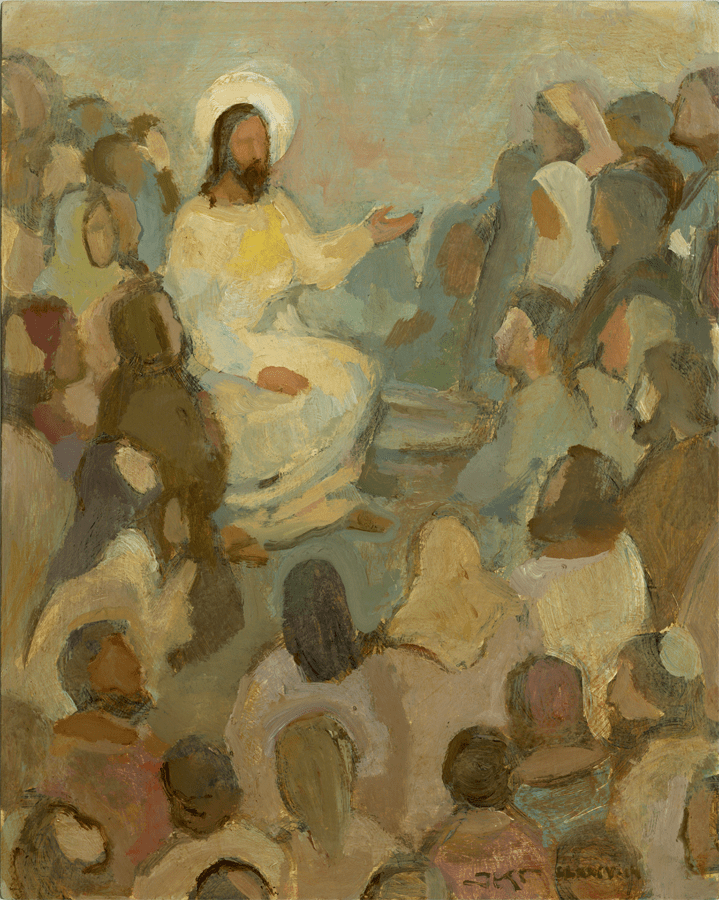
Luke 12:4-12 – Dealing with Trouble

Jesus the Teacher by J. Kirk Richards

“I tell you, my friends, do not be afraid of those who kill the body and after that can do no more. But I will show you whom you should fear: Fear him who, after your body has been killed, has authority to throw you into hell. Yes, I tell you, fear him. Are not five sparrows sold for two pennies? Yet not one of them is forgotten by God. Indeed, the very hairs of your head are all numbered. Don’t be afraid; you are worth more than many sparrows.

“I tell you, whoever publicly acknowledges me before others, the Son of Man will also acknowledge before the angels of God. But whoever disowns me before others will be disowned before the angels of God. And everyone who speaks a word against the Son of Man will be forgiven, but anyone who blasphemes against the Holy Spirit will not be forgiven.

“When you are brought before synagogues, rulers and authorities, do not worry about how you will defend yourselves or what you will say, for the Holy Spirit will teach you at that time what you should say.” (New International Version)

A new resurrected life is a beautiful thing. And it can be a hard thing, at the same time.

Decades ago, I once preached in a church for morning and evening worship services. As I entered the church building for the evening sermon, one of the deacons greeted me by saying, “Man, did you ever stir the pot this morning!”

It turns out, because I did not stay behind the pulpit when I preached, but freely roamed around the sanctuary, many parishioners believed I was not being under the authority of God’s Holy Word. They took my actions as subversive, even rebellious. Others defended the action. The entire church became divided over it.

What I found so interesting about the whole affair is that I was simply and genuinely being myself – and it caused trouble to the point of families dividing and imploding in on themselves.

Sometimes people lose sight of what’s really important, and the gospel of grace ends up bringing division. Jesus tended to cause trouble in his earthly ministry, just by being himself – and a lot of folks didn’t take kindly to him exercising authority like God does.

Trouble tends to follow Christian mission and service. That may seem odd. Yet, God’s kingdom is an upside-down one. The way of resurrection and new life comes through a cross and a death; the way to succeed is to fail; the one who loses their life will find it.

We ought to expect opposition and trouble from the world.

Fortunately, nobody ever accused me of being in cahoots with the devil. But that happened to Jesus, on more than one occasion. (Matthew 10:24-25)

Christians are not above their Master – they will be treated as he was. Jesus didn’t want his followers to be surprised whenever they face opposition.

We don’t need to be afraid of getting into trouble.

Fear has to do with the unknown and about what is going to happen to us. Since we know opposition and trouble is expected, we can avoid living in dread. Early on in the church, Christians actually rejoiced in their suffering because they considered it a privilege to be walking in the way of Jesus.

We are given a promise that we’ll receive special help in times of adversity. Believers possess the Holy Spirit, given to us to be our helper and advocate for such difficult situations.

God sees all things. The Lord isn’t surprised by your hardship and will eventually deal with all that is wrong in this old fallen world. The wrath of God is to be much more feared than the wrath of people.

God observes all the details of our lives. If God cares and is attentive to the least little things in my life, then how much more will the big issues in my life be handled!?

Blaspheming (saying hard things against) the Holy Spirit is nothing more nor less than attributing the work of Satan to God.

We aren’t doomed to hell if we are crushed under a heavy load of distress and pressure. God won’t strike us with lightning if we make mistakes, mess up, or fail to live as we ought. The Lord will likely be sad, but fire and brimstone will not be in the picture.

You might be wondering how I handled the hubbub with the church who fractured over my preaching apart from the pulpit. I came back in the evening and purposely caused trouble by preaching the Beatitudes of Jesus while walking up and down the aisle.

After all, when somebody is secure in Christ, why not say and do what needs to be said and done?

Gracious God, your love is sufficient for us. May your guidance and wisdom hold us tightly, along with our brothers and sisters in Christ around the world. Guard the hearts and minds of believers in places of hardship, war, and persecution so that your church may stand strong in faith.

Although trouble may come, neither any person nor any power on this earth can take our souls from us. We belong to you. May your church stand strong in grace and love, being assured with the reality that Jesus Christ is Lord of all.

We pray for the day when we will all be together in worship and praise at the consummation of your benevolent kingdom. Until that day, may your love flow to all our persecuted brothers and sisters. May your blessed Holy Spirit strengthen and fill them with faith, hope, and love, through Jesus Christ your Son, our Lord. Amen

Luke 24:36-40 – Peace Be with You

Jesus Shows Himself to Thomas by Rowan and Irene LeCompte, National Cathedral, Washington, D.C.

While they were still talking about this, Jesus himself stood among them and said to them, “Peace be with you.”

They were startled and frightened, thinking they saw a ghost. He said to them, “Why are you troubled, and why do doubts rise in your minds? Look at my hands and my feet. It is I myself! Touch me and see; a ghost does not have flesh and bones, as you see I have.”

When he had said this, he showed them his hands and feet. (New International Version)

Christ’s disciples were abuzz. Two dudes showed up and told eleven of the original disciples that they had seen and talked to Jesus himself! This was a lot to wrap both their heads and their hearts around. Maybe they dared to hope it was true.

Peter and John encountered an empty tomb. Now these guys from Emmaus are giving this wild testimony of a risen Savior. Into the weird mix of doubt, curiosity, grief, hope, wondering, and outright confusion, Jesus materializes out of the blue and says, “Peace be with you.”

Already feeling unsettled and uncertain, the disciples had anything but a peaceful response to the presence of their Lord. Startled, troubled, and frightened they were, as if somebody had just dropped a skunk into the room.

Why the fear? Why not be overjoyed or overcome with sheer delight at seeing Jesus?

The disciples were caught off guard, as if they had zero expectation of seeing Jesus. Believing him to be dead, they immediately went to thinking this was some ghost. After all, the door was locked. Nobody could have gotten into the room without the disciples knowing it. (John 20:19)

As it turns out, faith and belief are not uniform static terms. There are layers to faith. Yes, the disciples really did believe, and their faith developed over time with Jesus. However, their belief had not yet come to full bloom. So, in this sense, they still possessed a lack of faith and were rebuked by Jesus for it. (Mark 16:14)

A full-orbed belief in the Lord Jesus Christ is more than words, more than making professions, and more than signing-off on a doctrinal statement of faith. Faith is shown for what it is through our actions. (James 1:19- 2:26)

Faith comes to fruition when the head, the heart, and the hands all align together and conspire to proclaim the gospel in thought, word, and deed. If they are misaligned or incongruent with each other, then that faith is inadequate. There is yet another level to the belief which needs to emerge.

Perhaps this is instructive for people today. While maintaining beliefs about the person and work of Jesus, and acknowledging Christ’s death and resurrection, some Christians live as though he had never risen from the grave. If Jesus were to suddenly show up and say, “Peace be with you,” like a startled puppy, they’d likely have an accident on the floor.

As Jesus had done so many times before in his earthly ministry, he invited the disciples to experience him in a real, tangible, visceral way. This is no ghost. This is a Christ who has physical flesh and bones. You can eat with this Jesus, real food and drink. Look at his hands and feet. Touch and feel them if you must. But, by all means, believe!

Jesus came to give them, and us, peace. Peace is more than a greeting, more than the absence of conflict or anxiety. It is to enjoy harmony with self, others, and God. Peace is wholeness and integrity of being, even when all is going to hell around us.

A child is born to us, a son is given to us,
    and authority will be on his shoulders.
    He will be named
    Wonderful Counselor, Mighty God,
    Eternal Father, Prince of Peace.
There will be vast authority and endless peace
    for David’s throne and for his kingdom,
    establishing and sustaining it
    with justice and righteousness
    now and forever. (Isaiah 9:6-7, CEB)

The peace of God is closely associated with the presence of God. And so, conversely, the lack of peace is to experience a sense of divine absence. God’s peace and presence are inseparable. It is, therefore, no surprise that Jesus demonstrated his actual physical presence and spoke to the disciples about peace.

On the evening of that first day of the week, when the disciples were together, with the doors locked in fear of the Jewish leaders, Jesus came and stood among them and said, “Peace be with you!” After he said this, he showed them his hands and side. The disciples were overjoyed when they saw the Lord.

Again, Jesus said, “Peace be with you! As the Father has sent me, I am sending you.” And with that he breathed on them and said, “Receive the Holy Spirit. If you forgive anyone’s sins, their sins are forgiven; if you do not forgive them, they are not forgiven.” (John 20:19-23, NIV)

Chronic spiritual anxiety usually arises from the inability to perceive a generous and hospitable God having our backs and working on our behalf. Knowing God, who is gracious and compassionate, slow to anger and abounding in steadfast love, leads to peace and settled rest. 

May the Lord bless you
    and protect you.
May the Lord smile on you
    and be gracious to you.
May the Lord show you his favor
    and give you his peace. Amen. (Numbers 6:24-26, NLT)

The Wonder of Christ’s Resurrection

Welcome, friends! In the New Testament Gospel of Luke 24:1-12, we find an account of women approaching the grave of Jesus, only to find an empty tomb. Today, people search for reality in all kinds of empty places. There is, however, hope, because Christ is risen! He is risen, indeed! Click the videos below and let us enjoy and be in awe that Jesus is alive!

Pastor Tim Ehrhardt, Luke 24:1-12

May the glory and the promise of this joyous time of year bring peace and happiness to you and those you hold most dear.

And may Christ, Our Risen Savior, always be there by your side to bless you most abundantly and be your loving guide. Amen.

Luke 24:1-12 – The Wonder of Christ’s Resurrection

Women at the empty tomb of Jesus encountering an angel

On the first day of the week, very early in the morning, the women took the spices they had prepared and went to the tomb. They found the stone rolled away from the tomb, but when they entered, they did not find the body of the Lord Jesus. 

While they were wondering about this, suddenly two men in clothes that gleamed like lightning stood beside them. In their fright the women bowed down with their faces to the ground, but the men said to them, “Why do you look for the living among the dead? He is not here; he has risen! Remember how he told you, while he was still with you in Galilee: ‘The Son of Man must be delivered into the hands of sinners, be crucified and on the third day be raised again.’” Then they remembered his words.

When they came back from the tomb, they told all these things to the Eleven and to all the others. It was Mary Magdalene, Joanna, Mary the mother of James, and the others with them who told this to the apostles. But they did not believe the women, because their words seemed to them like nonsense. Peter, however, got up and ran to the tomb. Bending over, he saw the strips of linen lying by themselves, and he went away, wondering to himself what had happened. (New International Version)

“The message of Easter is that God’s new world has been unveiled in Jesus Christ and you’re now invited to belong to it.”

N.T. Wright

The disciples were stuck in the yesterday of Holy Saturday and the grief of Good Friday. Christ’s death was nothing but bad news, leaving them with an awful wondering about what could have been.

And now, an empty tomb. What does it mean? The disciples did not yet discern the reality and impact of what had happened. Their perplexity and curiosity eventually turned to a different kind of wondering: The amazement that Christ is alive! That Jesus has taken care of the sin issue once for all. That a new order is now in force that forever changes everything!

We, too, have the chance to be amazed and in wondrous awe over the resurrection of Jesus. Because the resurrection of Jesus is not just a doctrine to be believed; it is a powerful reality to be lived, and a source of eternal wonder and praise.

Women Arriving at the Tomb by He Qi

The Wonder of the Female Disciples

Do you wonder why women were the first disciples to encounter the empty tomb and the risen Lord?

Women are central to Luke’s resurrection account because women are central to the gospel. They play a significant role, along with men, in the ministry of the good news of Jesus. Within an ancient culture, and religious milieu, in which men were prominent and women were not regarded as reliable witnesses to anything, God used the female disciples as the very first witnesses of the empty tomb. 

Women now play an important part alongside men in ministry. 

This fact was not lost on the early church, who commissioned both men and women as apostles, serving in the highest ranks of the ministry. For example, Junia was a female apostle – an eyewitness of Christ’s life, ministry, and death, as well as a leader who helped build the Church. (Romans 16:7) 

If you ever “wonder” what role women ought to play in the church, the answer is: They ought to serve in the highest offices of leadership because the female disciples were prominent witnesses to the resurrection, on purpose.

The female disciples were curious about the empty tomb. While they were wondering about it, a couple of angels show up and ask them a question designed to lead them to a proper interpretation of Christ’s missing body:

“Why do look for the living among the dead?”

He Is Risen by He Qi

Many people today seek Jesus among the dead. They look for him in empty places.

Some look for Jesus in good ideas, as if knowledge or education save us. We may reason: If we have all the right information, express right belief, and sign-off on right doctrine, then we are okay. However, we are not saved by thoughts, even understanding, as if our brains are what deliver us from sin, death, and evil. We are saved by the person and work of Jesus Christ (Romans 6:1-23).

Many look for Jesus through their efforts, as if I can work my way into the good graces of God. We believe that action is the key. So, whenever we mess up, we seek penance by beating ourselves up, in some way, to somehow atone for the mistakes. However, Jesus finished the work! We participate with Christ in his death and resurrection through faith, not by works. We cannot do for ourselves what Christ has already done for us. Our “work” is to believe, and to be in wonder. (John 6:28-29)

Folks might search for Jesus in the heart – feeling that if our belief is sincere, if I’m basically a good person, if my heart is in the right place, that’s what matters. Yet, we are not saved through sincerity, or by warm-fuzzy feelings about God, as if our hearts save us.

Our hearts can be desperately wicked and are in need of redemption. Through repentance and faith, people find Jesus. Since Jesus is in the heart transplant business, you will find him wherever there are people with critically low heart function.

To find Jesus, in the ancient world, one needed to find the tax collectors, the lepers, the blind, the poor, or even a Roman Centurion. Today, if you want to find Jesus, he will still be found among the poor, the diseased, the refugee, the immigrant, the prisoner, and those who are despised by others.

The last place you would look, in Christ’s day, is with the religious leaders. And today, whenever we look for God to show up with all the answers and all the heart transformation in church, we then wonder why we cannot see Jesus. That’s because Jesus is not in the grave but, as the risen Christ, is out bestowing new life to the people with sick and hard hearts.

Why do you look for Jesus in church? Rather than asking Jesus to come to us, let’s go to where he is.

Since Christ is alive, we are alive.

We need not be perplexed about the empty tomb because Jesus is alive!  He is risen!  This reality is to impact our lives forever:

Since then, you have been raised with Christ, set your hearts on things above, where Christ is, seated at the right hand of God. Set your minds on things above, not on earthly things. For you died, and your life is now hidden with Christ in God. When Christ, who is your life, appears, then you also will appear with him in glory. (Colossians 3:1-4, NIV)

This is the gospel, the good news of Christ. It’s no secret. Jesus made this plainly known. The gospel is not insider news. It’s freely available to everyone. Early in his ministry Jesus said to his disciples:

“The Son of Man must suffer many things and be rejected by the elders, the chief priests and the teachers of the law, and he must be killed and on the third day be raised to life.” (Luke 9:22, NIV)

A few years later, before heading for Jerusalem, Jesus laid it out again for them:

“We are going up to Jerusalem, and everything that is written by the prophets about the Son of Man will be fulfilled. He will be delivered over to the Gentiles. They will mock him, insult him and spit on him; they will flog him and kill him. On the third day he will rise again.” (Luke 18:31-33, NIV)

The Wonder of Peter

The women hurried to tell the disciples. But the men were clueless; they didn’t believe the women. Peter, always the impetuous one, hurried to see the tomb for himself. He left wondering (thinking hard about) what all this empty tomb stuff means.

So, why (since the disciples were told what was going to happen) were they left wondering what in the world the empty tomb was all about? 

Its meaning was hidden from them. They did not know what Jesus was really talking about. But this would all change. After appearing to them…

Jesus opened their minds so they could understand the Scriptures. He told them, “This is what is written: The Messiah will suffer and rise from the dead on the third day, and repentance for the forgiveness of sins will be preached in his name to all nations, beginning at Jerusalem. You are witnesses of these things. I am going to send you what my Father has promised; but stay in the city until you have been clothed with power from on high.” (Luke 24:45-49, NIV)

Conclusion

Present-day Christians know of Christ’s redemptive events of cross, resurrection, ascension, and the giving of the Spirit at Pentecost. We do not need to wonder (be perplexed). We are clothed with power from on high to accomplish the mission of Christ on this earth.

We can now revel and rejoice in wonder and awe over the person and work of Jesus.  We possess forgiveness of sins, the Holy Spirit, and one another because of Christ’s mighty resurrection from death. 

Perhaps we need a newfound sense of wonder (awe) about Christ and his rising from death so that the resurrection of Jesus is not only a doctrine to believe, but a source of joy and wonder that impacts our daily lives.

Here are some ways we might cultivate a sense of wonder that will help us better connect with the risen Christ:

  • Watch kids play, learn, or do anything. Kids approach life with a sense of wonder. Everything is new, bright, and exciting – from being excited with a new toy to smiling at the simplest things – and even responding to Holy Scripture.
  • Read Scripture as if it were your first time. A great way to do this is to get together with someone or a group of people who aren’t familiar with the Bible. Spend some regular time reading through a book of God’s Word together, observing the wonder of the biblical characters.
  • Pay attention to God’s creation. All that we see is a window to the unseen. Whether taking a walk in nature, or traveling to other places, observe the changes of seasons and geography that elicits awe, reminding us of Christ’s resurrection.
  • Learn something new. Learn or rediscover a musical instrument. Research a topic you have always wanted to know something about. Take up a new hobby. Learn a new language. Doing anything new helps us to know new life in Christ better.

“Our Lord has written the promise of resurrection, not in books alone, but in every leaf in springtime.”

Martin Luther

All new life is wondrous and points to Easter, Resurrection Day. Whenever we lose our awe, we get stuck. Then, it’s hard to be excited about unseen spiritual realities. So, let us work at cultivating a sense of wonder so that the resurrection of Christ remains existentially fresh and alive.

Christ is risen!  Christ is risen, indeed!