Luke 10:13-16 – Confronting Hard Hearts

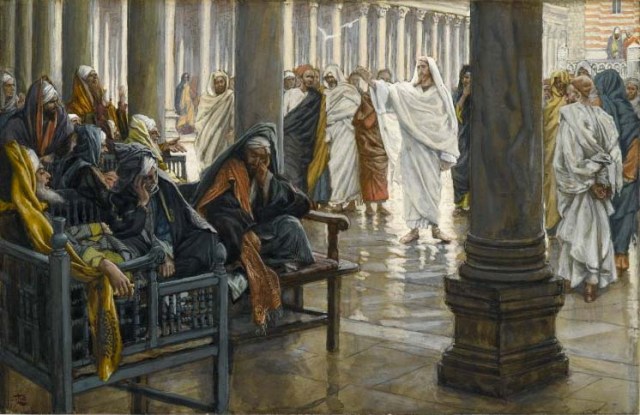
“Woe unto You” by French painter James Tissot (1836-1902)

“Woe to you, Chorazin! Woe to you, Bethsaida! For if the miracles that were performed in you had been performed in Tyre and Sidon, they would have repented long ago, sitting in sackcloth and ashes. But it will be more bearable for Tyre and Sidon at the judgment than for you. And you, Capernaum, will you be lifted to the heavens? No, you will go down to Hades.

“Whoever listens to you listens to me; whoever rejects you rejects me; but whoever rejects me rejects him who sent me.” (New International Version)

Hardness of heart is the greatest malady and the most serious condition which could ever afflict a spiritual person.

A soft heart needs only gentle words and humble responses in order to continue learning and growing in life. Not so with the hard heart. It needs a mighty chisel from God to scrape the encrusted barnacles off the heart so that it might receive goodness.

This is why today’s Gospel lesson recounts some rather harsh words from Jesus. Christ had some hard things to say in order to get at the hardness of heart he was experiencing from the people. His scathing words were specifically leveled at the towns in which he had performed miraculous healings. Their inability to accept what was happening in front of their very faces testified to how hard their hearts truly were.

The miracles of Jesus, in addition to being gracious restorations of individual lives, were also meant to demonstrate that the kingdom of God has broken into history in the person of Jesus Christ. The crowd refused to acknowledge this reality. So, Jesus began leveling a rebuke to the towns who observed his ministry firsthand, and yet did nothing in response to those good works.

A hard heart observing Christ’s ministry will likely be unresponsive to Jesus. A soft heart will likely reply with humility by forsaking everything to follow him. For Jesus, the height of hubris was to simply ignore his righteous works of merciful teaching and benevolent healing.

Christ’s denunciation of the particular towns came not because he was experiencing opposition or persecution; rather, he was denouncing them for their bonehead lack of response and refusal to change their lives to conform to what they were seeing and experiencing from God.

The crowd heard Christ’s teaching and saw his miracles, and it had no effect on them. So, Jesus gave them a big “C’mon, man!”

Judgment becomes the lot of someone who is unaffected and unresponsive to the vast sea of human need around them, viewing Jesus as just another voice, and living a life of mediocrity in the face of opportunity.

The Holy Spirit has been provided, who is the power source of the Christian life. We possess all the resources of grace necessary to step into this world and make a difference, yet so many do nothing but occupy a place in the pew [or couch] because they are too afraid to sacrifice their time in meaningful ministry.

There are neighbors, relatives, and co-workers who are lost and lonely, in need of the kind of grace Jesus gives, yet too many of us are oblivious to them and instead are constantly worried about things that, in the end, don’t really matter at all.

We have opportunities to grow in the grace and knowledge of Jesus Christ through a vast array of available ministries, yet many do not take the chance to change and be spiritually stretched. For these situations and more, the words of Jesus are there in front of our faces, and yet some, out of hardness of heart, will have the audacity to read them and remain unchanged, unchallenged, and unresponsive.

If our highest values in life are sameness, stability, and security, we may very well, at the least, miss Jesus altogether, and, at worst, find ourselves under his condemnation. These verses are for those whom Jesus has become all too familiar, as if he is just another piece of furniture in the living room – the coffee table with a dusty Bible resting on it.

There are times when nice gets us nowhere and we must have hard conversations because of hard hearts.

Yes, conversations, and not verbal rockets launched from one group to another. Jesus did not denounce from a distance; he did it up close and personal. Furthermore, he was specific and not generic about why he was speaking in the way he did.

So, may you be able to pray this prayer of repentance today with heartfelt conviction:

Almighty God, Father of our Lord Jesus Christ, Sovereign Lord of the universe, Creator of humanity, we, your unfaithful children, are sorry for our sins and the lives that we have lived apart from your grace. We sincerely believe and confess in our hearts that only through the precious blood of our Lord Jesus Christ on the cross, can we obtain your forgiveness.

We repent that: in thought, word, and deed, we have committed serious offences against you and our neighbors. Through spiritual laziness and prideful lust for power, we have provoked hatred, division, despair, and hurt within our communities.

Through our greed, deceit, and indifference, we have inflicted serious damage, unnecessary conflict, and aggravated destruction to those different than us.

Through our selfishness, insensitivity, and bias (both conscious and unconscious) we have encouraged and emboldened those who inflict hurt, pain, and sorrow on those who are already oppressed and poor.

In the name of religion, doctrine, and even of Christ himself, we have wounded fellow believers and those who genuinely pursue a faith different than ours.

In stubbornness, pride, and arrogance, we have caused division and strife within your church and among your people.

Mercifully send your Holy Spirit, the Spirit of order and comfort, to cleanse us from all unrighteousness; to restore in us true faith in Christ which brings truth, peace and harmony; and, to help us walk together
with our brothers and sisters in the peace of our Lord Jesus Christ, to the glory of your name. Amen.


Luke 9:51-62 – The Cost of Following Jesus

As the time approached for him to be taken up to heaven, Jesus resolutely set out for Jerusalem. And he sent messengers on ahead, who went into a Samaritan village to get things ready for him; but the people there did not welcome him, because he was heading for Jerusalem. When the disciples James and John saw this, they asked, “Lord, do you want us to call fire down from heaven to destroy them?” But Jesus turned and rebuked them. Then he and his disciples went to another village.

As they were walking along the road, a man said to him, “I will follow you wherever you go.”

Jesus replied, “Foxes have dens and birds have nests, but the Son of Man has no place to lay his head.”

He said to another man, “Follow me.”

But he replied, “Lord, first let me go and bury my father.”

Jesus said to him, “Let the dead bury their own dead, but you go and proclaim the kingdom of God.”

Still another said, “I will follow you, Lord; but first let me go back and say goodbye to my family.”

Jesus replied, “No one who puts a hand to the plow and looks back is fit for service in the kingdom of God.” (New International Version)

“The will of God, to which the law gives expression, is that men and women should defeat their enemies by loving them.”

Dietrich Bonhoeffer, The Cost of Discipleship

In his earthly ministry, Jesus made it clear to the large crowds of people following him that the life of a disciple is of utmost importance. People are to discover what following Jesus truly entails. They are to count the cost of Christian discipleship.

Following Jesus in Christian discipleship requires radical obedience. 

Love of family must not stand in the way. Jesus insisted our primary loyalty must lie with following him over every earthly relationship. To follow Jesus means that we will not use family responsibilities to avoid obeying Christ or use other loyalties and commitments to work and/or school as a reason to lay down our cross. 

This talk of Christian discipleship might smack of being like a cult. I don’t believe it is. Whereas a cult typically requires a radical withdrawal from the world so that the leader has complete control over the group, Jesus requires a radical engagement with the world.

Following Jesus is meant to impact the world with grace and love. Jesus went out of his way to not be like other leaders who use power, control, and gaslighting as the means of ruling and leading. Instead, Jesus shares his power with others. Christians are to bless the world and be involved in it.

The call of Jesus to Christian discipleship not only takes precedence, but it also re-defines the other loyalties we have. 

This call involves some level of detachment in order to pursue following Jesus. All of life is to be infused with being a disciple of Jesus. If we insist on making other commitments and loyalties as high a priority as following Jesus, we will find ourselves torn between two masters. 

Several years ago, I took a trip with some other church leaders into the Canadian wilderness. We were so far out in the boonies that we needed special first aid training because, if someone got hurt, it would be hours before help could come. 

We canoed the lakes and carried our backpacks and canoes between lakes for an entire week. Whatever we took with us, we had to carry. Some people thought they needed all kinds of clothes and other accessories. Not far into the week, they quickly began to leave things along the trail and learned, over time, that what they thought was important in their life, wasn’t really important to what they were doing.

It’s good to get back to basics and do what is essential. And what is of most importance is following Jesus. 

An un-salty disciple is worthless. Making a profession of Christ, without counting the cost, is foolish. Christian discipleship was never designed to be easy; it was intended to be a public display that Jesus is Savior and Lord in every area of life. That means we will struggle with questions, such as: 

  • How do I be a faithful follower of Jesus in my family? 
  • How do I be a disciple, and do the work of discipleship at my job? 
  • How do I practice following Jesus in my neighborhood, and everywhere I go?

If we do not plan to follow Jesus at home, at work, in the neighborhood, and in the world, we won’t, because all kinds of competing loyalties will take over.

Christians need to be very intentional about being disciples who loyally follow the words and ways of Jesus.The going will get difficult. And that’s okay.

“Jesus has many who love his kingdom in heaven, but few who bear his cross. He has many who desire comfort, but few who desire suffering. He finds many to share his feast, but few his fasting. All desire to rejoice with him, but few are willing to suffer for his sake. Many follow Jesus to the breaking of bread, but few to the drinking of the cup of his passion. Many admire his miracles, but few follow him in the humiliation of the cross.”

Thomas à Kempis, The Imitation of Christ

“Anyone who does not carry his cross and follow me cannot be my disciple.”

Jesus (Luke 14:27)

Joy comes not by pursuing happiness; it comes through discovering that to live is to die to self. Until we come to grips with that reality, we will likely be frustrated with our circumstances and other people.  

So, rather than trying to fit Jesus into our calendar, we are to let our calendar fill-out around the center of following Jesus. If Christians feel too busy for prayer; or for daily reading of Holy Scripture; or for loving one another; or for making disciples, then they have lost their way and must listen to the call of Jesus to be his disciple.

How, then, shall we live? What shall we do?

“Jesus stands between us and God, and for that very reason he stands between us and all other people and things. Christ is the Mediator, not only between God and people, but between person to person, between humanity and reality.”

Dietrich Bonhoeffer, The Cost of Discipleship

Imagine that in our heart is a big conference room including a big table, leather chairs, coffee, bottled water, and a whiteboard. A committee sits around this table in your heart. There is the social self, the private self, the work self, the sexual self, the recreational self, the religious self, and others.

The committee is arguing, debating, and voting. They’re agitated and upset. Rarely can they come to a unanimous, wholehearted decision.

We tell ourselves we’re this way because of our many responsibilities or our high level of stress. Yet, the truth is that we are internally divided, unfocused, hesitant, and feeling trapped. 

One way of dealing with this situation is to invite Jesus to come sit as a committee member. Give him a vote, too. But then he becomes just one more complication.

A better way is to say to Jesus, “My life isn’t working. Please come in, become my CEO and fire my committee, every last one of them. I hand myself over to you. I am your responsibility now. Please run my whole life for me.” 

Being a disciple of Christ is not just adding Jesus; it is also subtracting the idols that are in my heart. 

Following Jesus is not for the faint of heart; it is for those who humbly acknowledge that Jesus is the way, the truth, and the life. This is the path of Christian discipleship. Let’s give Jesus his due: our very lives.

Gracious and almighty God, all hearts are open to you, all desires known, and no secrets are hid. Cleanse the thoughts of our hearts by the inspiration of your Holy Spirit so that we may perfectly love the Lord with all our hearts and magnify the holy Name of Jesus Christ our Lord. Amen.

Luke 1:26-38 – The Holy Spirit Will Come on You

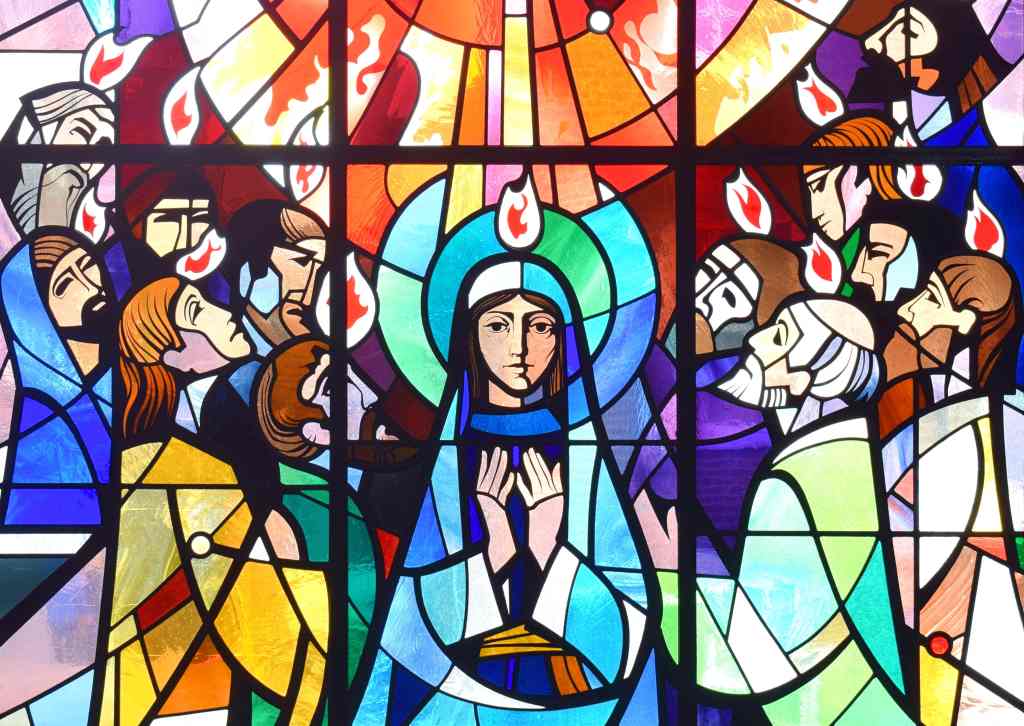
Pentecost by Jen Norton

In the sixth month of Elizabeth’s pregnancy, God sent the angel Gabriel to Nazareth, a town in Galilee, to a virgin pledged to be married to a man named Joseph, a descendant of David. The virgin’s name was Mary. The angel went to her and said, “Greetings, you who are highly favored! The Lord is with you.”

Mary was greatly troubled at his words and wondered what kind of greeting this might be.But the angel said to her, “Do not be afraid, Mary; you have found favor with God. You will conceive and give birth to a son, and you are to call him Jesus. He will be great and will be called the Son of the Most High. The Lord God will give him the throne of his father David,and he will reign over Jacob’s descendants forever; his kingdom will never end.”

“How will this be,” Mary asked the angel, “since I am a virgin?”

The angel answered, “The Holy Spirit will come on you, and the power of the Most High will overshadow you. So, the holy one to be born will be called the Son of God. Even Elizabeth your relative is going to have a child in her old age, and she who was said to be unable to conceive is in her sixth month. For no word from God will ever fail.”

“I am the Lord’s servant,” Mary answered. “May your word to me be fulfilled.” Then the angel left her. (New International Version)

It is good that the Daily Lectionary has us considering these verses of Scripture outside of the Advent season. In this time of year, in which we focus on the Spirit, we need to remember that these stories, and our faith, are meant to be held throughout the entire year.

Most of life is lived in the mundane, even in times of uncertainty. For the most part, our everyday lives involve going about our business and dealing with the daily grind. That’s because we are common ordinary people. So, we can especially relate to Mary because she is rather plain. 

To put Mary’s life in our contemporary vernacular, at the time of this encounter with the angel, she is of junior high age but has never attended school. She wears mostly clothes from Goodwill, and occasionally can get some from Wal-Mart. She cannot read because girls of her day rarely did.

Her parents make all the decisions that affect her life, including the one that she should be married to an older man named Joseph. We don’t know if she even liked him. Mary lives in a small town that most people cannot even point to on a map. 

One night, into the bedroom of this young girl comes the brightly beaming divine messenger Gabriel whose name means, “God has shown himself mighty.” Mary stands there in her ratty old flannel nightgown, her life very quickly moving from the ordinary to the extraordinary.

The juxtaposition could not be more pronounced: a mighty angel and a plain teen-ager; a messenger of the Most High God and a girl barely past puberty; a holy angelic light which beams in a simple candlelit bedroom; an awesome power encountering complete vulnerability.

Mary, compared to Gabriel, is defenseless, fragile, and overwhelmed. She’s in way over her head. That’s why we can relate to her. We can get our human arms around Mary. She is like us. She has faced life with little power to make it turn out the way she planned. Forces beyond her have rearranged her life and altered it forever.

Descent of the Holy Spirit by John Lawson

Mary is the Matron Saint of the Ordinary. We can totally understand why Mary responds the way she does. Mary’s initial reaction to the angel Gabriel was to be greatly troubled. She was disturbed and shaking in her hand-me-down slippers.

The angel confidently told Mary that she had found favor with God. This scenario didn’t happen because Mary had some extreme spirituality. Instead, God simply chose her to be the mother of Jesus.

Mary needed to come to grips with what was happening to her. This was well beyond anything she could have expected.  Becoming pregnant with the Savior of the world was not even remotely on her radar. 

She immediately sensed the crazy disconnect between what was being told to her and who she was. After all, she was a plain ordinary girl from the hick town of Nazareth and was being told that she would raise a king.  Maybe somebody in heaven screwed up. Maybe Gabriel got the wrong girl. Maybe his Google map sent Gabriel on a wild goose chase.

Relating to Mary, we can totally understand that she would question how in the world all this was going to happen. Not only is Mary ordinary and far from royalty, but she is also very much a virgin. Nothing about any of this made any sense.

But, then again, this is the very sort of thing that the wild and seemingly reckless Holy Spirit would do.

The angel let Mary know that God specializes in the impossible. There is nothing outside of God’s power. There’s nowhere we can go, no place on earth, no situation whatsoever, that is beyond God’s ability and reach to affect divine power.

We very rarely get straightforward answers to our questions about God. Yet, Mary asked a question and got a straight answer: She really can be pregnant with Jesus because the Holy Spirit will come upon her, will overshadow her with power.

If the story were to end there it would be a great story. However, the Spirit’s work goes well beyond effecting the miraculous. The Spirit also brings about faith.

God has poured out his love into our hearts by means of the Holy Spirit, who is God’s gift to us.

Romans 5:5, GNT

Mary believed the message and submitted herself completely to God’s will. We may completely understand if Mary simply said in her plain ordinary way that she was not prepared for this. We would totally “get it” if Mary pushed back on what the angel said to her. We could relate if Mary just dismissed the angel’s presence as a hallucination from using some bad chickpeas to make the hummus.

Yet, Mary not only believed; she also humbly submitted herself to what was happening. And this is what I believe we need to relate to most about Mary – not her being just a plain ordinary person in a non-descript village but stepping up to the calling she received.

We, too, have received a calling in our lives. We, too, have been given the power of the Holy Spirit. We, too, are ordinary people who have been given a very extraordinary task. 

Our response today can be the same as Mary all those centuries earlier: “I am the Lord’s servant; may it be to me as you have said.”

The Church is pregnant with possibilities because of the Holy Spirit.

We know the end of Mary’s story. She gave birth to Jesus and raised him in her plain ordinary way. She watched him grow up and embark on a ministry to proclaim that the kingdom of God is near. Mary didn’t always understand what Jesus said or what he was doing. And she experienced every mother’s nightmare in seeing her beloved son killed in a terribly gruesome manner right in front of her eyes. 

Yet, just as the Holy Spirit was with the birth of Jesus, so the Spirit was with Jesus at his resurrection from the dead. Jesus lived an ordinary life in a very extraordinary way. Furthermore, today Jesus invites us to do the same.

“You will receive power when the Holy Spirit has come upon you, and you will be my witnesses in Jerusalem, in all Judea and Samaria, and to the end of the earth.”

Jesus (Acts 1:8, CEB)

Because Christ accomplished his mission of saving people from their sins and establishing a kingdom that will never end, he has given us the same Holy Spirit to follow him forever and call other people to follow him, too. 

To trust and obey is God’s only way to live into the life of Jesus. The Christian life may often be difficult, but it isn’t complicated. It’s rather simple, just like Mary.

Mary responded to God’s revelation with faith, choosing to fully participate in what God was doing. “I am the Lord’s servant” is our confession, as well. Along with Mary we declare, “May it be to me as you have said.”

Good and gracious God, thank you for giving us your Son, the Lord Jesus. Draw us into the mystery of your love. Join our voices with the heavenly host, that we may sing your glory on high. Give us a place amongst all of your saints so that we may experience your Word made flesh, who lives and reigns with you in the unity of the Holy Spirit, in the splendor of eternal light, God forever and ever. Amen.

Luke 9:18-27 – Jesus Makes All the Difference

Christ the Redeemer, Rio De Janeiro, Brazil

Once when Jesus was praying in private and his disciples were with him, he asked them, “Who do the crowds say I am?”

They replied, “Some say John the Baptist; others say Elijah; and still others, that one of the prophets of long ago has come back to life.”

“But what about you?” he asked. “Who do you say I am?”

Peter answered, “God’s Messiah.”

Jesus strictly warned them not to tell this to anyone. And he said, “The Son of Man must suffer many things and be rejected by the elders, the chief priests and the teachers of the law, and he must be killed and on the third day be raised to life.”

Then he said to them all: “Whoever wants to be my disciple must deny themselves and take up their cross daily and follow me. For whoever wants to save their life will lose it, but whoever loses their life for me will save it. What good is it for someone to gain the whole world, and yet lose or forfeit their very self? Whoever is ashamed of me and my words, the Son of Man will be ashamed of them when he comes in his glory and in the glory of the Father and of the holy angels.

“Truly I tell you, some who are standing here will not taste death before they see the kingdom of God.” (New International Version)

In my work as both a church pastor and hospital chaplain, not to mention just being a regular guy, I rarely encounter people who characterize Christians as setting self-interest aside to follow Jesus completely with humble ministry which is willing to suffer on behalf of others.

Instead, I daily interact with folks who have long left the Church with stories of Christians squelching genuine questions about God and faith; being judgmental toward others who are not like them; having a hypocritical double-standard approach to most issues; and verbally abusing individuals who don’t conform to their cultural ideas and biblical interpretations.

We need Christians who make a difference in this world. We need Jesus.   

A right and real confession of Jesus by his Church speaks a relevant word into the culture; proclaims the gospel of grace (not judgment); and consistently and lives what it believes.

Confessing Jesus as Lord makes all the difference.

After interacting with a lot of people on their ministry journeys, Jesus asked two questions of his disciples: “Who do people say I am?” and “Who do you say I am?” Out of all the questions we can ask people, these are two good ones: “Who do others say Jesus is?” and “Who do you say Jesus is?”  

The disciples gave a variety of answers, which is to be expected. Today, you will also get variegated answers, such as, Jesus is a good teacher, a model humanitarian, a myth or a legend. A few times I’ve been told that Jesus was an alien from another planet. My all-time personal favorite response is that Jesus was a nudist and that if we all just took off our clothes, there would be peace in the world.

Although the disciples are sometimes clueless, Peter as the spokesperson, gave an insightful answer: “You are God’s Messiah.” 

Messiah or Christ literally means, “The Answer.”  Peter confessed Jesus as being The Answer, the person for whom it all comes down to. Peter may not have fully understood what he was saying, but he said it, nevertheless.

Being called by God makes all the difference.

“The Answer” was revealed to Peter by the heavenly Father. Faith in Jesus Christ is a gift given to us by God.

“My Father has entrusted everything to me. No one truly knows the Son except the Father, and no one truly knows the Father except the Son and those to whom the Son chooses to reveal him.” (Matthew 11:27, NLT)

Peter was blessed – not because he did anything to deserve it – but because of sheer grace. It was revealed to Peter who Jesus really is, The Answer. We know who God is and who Jesus is by revelation, by God’s gracious self-revealing to people. Scripture is God’s revelation, a self-disclosure. It is through Scripture that we know. 

Revelation isn’t just a matter of waiting for some spiritual zap to occur, in which God bonks me in the brain and deposits the knowledge and understanding of who Jesus is. 

Peter put himself in a position to know by obeying the voice of Jesus to follow him. Then, Peter got to know Jesus over time.

Since it took years of being with Jesus for Peter and the other disciples to make a right confession of faith, then we need to have a great deal of patience for others, as well as ourselves. Others need time to get to know us, they need some time in the Scriptures, and they need some time with Jesus, too.

People do not typically come to a right confession of Jesus without having spent a good deal of time around us and within Holy Scripture.

Denying self, taking up our cross, and following Jesus makes all the difference.

God chooses to use you and me. The Lord only knows why. We are most certainly an imperfect people. Yet, it seems that our imperfections are the very thing God keeps using to reveal Jesus to others. Another way to put the matter is this: Genuine openness and vulnerability is needed, and not perfection or keeping up a tidy appearance.

Most people aren’t crazy about the word “vulnerable.”  We might expect openness in others yet have no intention of being vulnerable ourselves. If you have ever poured out your heart to someone or a group of people and only got blank stares in return; sincerely loved someone and they did not love you back; shared your genuine thoughts on something important to you and received only criticism; well then, we may believe vulnerability is a bad thing and not worth the emotional effort.

However, Jesus became vulnerable – descending from heaven, submitting to the machinations of evil persons, and exposed on a cruel cross. (Philippians 2:5-11)

In the Gospel of John, Mary displayed vulnerability in pouring expensive perfume on Jesus’ feet and wiping them with her hair, all the while exposing her true feelings for her Lord. In return, Mary got pushback and criticism from Judas. But Jesus upheld Mary’s actions and told Judas to leave her alone. (John 12:1-8).

In the Psalms, even a cursory reading reveals a boatload of vulnerability on the part of the psalmists. They were unafraid to explore the depth of human emotion, misery, joy, and praise of God.

Maybe we need the person who will stand up and say they are finally learning patience by being among a group of really annoying co-workers. Perhaps instead of laboring so hard to keep our thoughts and emotions in check, we need a church environment that lends itself to a person bawling their eyes out, while others just sit and cry with them.

That kind of vulnerability won’t happen unless we ourselves are real with God, who is never fooled by our deceitful hearts. Our evil-radar might be carefully attuned to others’ sin, but we are woefully inept at identifying the blackness within ourselves.

Jesus became completely exposed, naked, abandoned, alone and vulnerable on a cruel cross. Yet, instead of being shamed by the whole thing, Jesus scorned the shaming power of his crucifixion and embraced the suffering as the means of victory for our salvation. 

Vulnerability might seem ugly, but it turns whatever it touches into beauty. God can change our weakest, worst, and most shameful places into incredible strength and newfound love.

The broken and despised, the struggling and the lost, are the ones worthy of God’s kingdom. 

Whenever we are too afraid to walk into the mud of people’s lives, including our own, and are enamored instead with every spiritual shiny thing that comes along, we may have lost sight of our Lord, whom we are to imitate in his vulnerability. 

Christians don’t  have all the answers. But we do know the One who knows all things.

Methinks people will be drawn to Jesus when they observe Christians forsaking the path of the self-righteous prick, in favor of the humble servant who loses their life, only to find it.