Wednesday of Holy Week (John 13:21-32)

The Lord’s Supper, by Rubem Zevallos Técnica

After saying this Jesus was troubled in spirit and declared, “Very truly, I tell you, one of you will betray me.” The disciples looked at one another, uncertain of whom he was speaking. One of his disciples—the one whom Jesus loved—was reclining close to his heart; Simon Peter therefore motioned to him to ask Jesus of whom he was speaking. So while reclining next to Jesus, he asked him, “Lord, who is it?” 

Jesus answered, “It is the one to whom I give this piece of bread when I have dipped it in the dish.” So when he had dipped the piece of bread, he gave it to Judas son of Simon Iscariot. After he received the piece of bread, Satan entered into him. Jesus said to him, “Do quickly what you are going to do.” 

Now no one knew why he said this to him. Some thought that, because Judas had the common purse, Jesus was telling him, “Buy what we need for the festival,” or that he should give something to the poor. So, after receiving the piece of bread, he immediately went out. And it was night.

When he had gone out, Jesus said, “Now the Son of Man has been glorified, and God has been glorified in him. If God has been glorified in him, God will also glorify him in himself and will glorify him at once. (New Revised Standard Version)

In some Christian traditions, Wednesday of Holy Week is known as “Spy Wednesday.” It’s a reference to Judas Iscariot, and recalls his betrayal of Jesus to the religious authorities. Historically, the association of Wednesday with this betrayal of Jesus led to Wednesdays being observed as fast days in the church, a tradition still observed by some. 

Jesus was gathered with his disciples for the meal we know as the “Last Supper.” Jesus had just taken a towel and a bowl of water and washed the feet of those gathered with him. Peter, predictably, protested to Christ doing such a thing. Yet, Jesus told Peter that if there’s no foot washing, there’s no Christ. 

The Lord Jesus then went on to say that not all the disciples are clean. Christ knew he was about to be betrayed. Since Judas was there with the other disciples, that meant Jesus knelt to wash his feet, as well. Hence, the heightened reason why Jesus was so troubled in the moment.

The clueless men didn’t know what or who in the world Jesus was talking about. Nobody around the table suspected Judas as a betrayer. That’s how much Judas was a part of the group. He was trusted enough to be the purse holder who handled the common money account.

It appears that only Jesus and Judas know what’s going on when Judas is handed the piece of bread; then Jesus told him to do quickly what he must do. Sadly and unfortunately, Judas made his own free and deliberate choice, without any coercion – except perhaps with some satanic nudging.

The Last Supper, by Unknown artist, c.1400 C.E.

To betray the Son of God seems unthinkable. What could ever motivate a person to sell out Jesus? What reasoning is there behind such a foul decision? Why would anyone choose to be a turncoat toward an innocent man?

Although we may be interested in answers to such questions, and even though I myself have my own thoughts about the matter, the Apostle John gives us no motive for the decision of Judas. He simply did what he did, with no other comment than that.

With Judas out of the room, Jesus began speaking of glory – of the glorious relationship between the Father and the Son, and the divine love which comes tumbling out on Christ’s followers. And the divine choice is for love.

We also have a choice. We can choose to be self-aware, to be attentive to our emotions, to recognize the consequences of behaviors and choices, to avoid unhealthy and harmful patterns of living. These choices help us to have love tumble out of us when it’s needed.

Faith can, and ought, to play a leading role in life. It is when folks refuse to listen to their conscience and ignore their gut feelings, that questionable decision-making of the head and heart can take over.

There’s a lot that’s out of our control. Yet, we always have the choice of self-control concerning our words and actions. Things like kindness, empathy, and love are within our ability to choose. And we are always free to live into our spiritual identity as loved by Jesus and belonging to God.

It’s hard, though. Making such choices in the face of such betrayal. Christ was troubled in his spirit, not because of his upcoming humiliation and torture, but because he knew that one in his inner circle would betray him.

A mosaic of The Last Supper, in Monreale Cathedral, Palermo, Sicily, Italy

If you have ever had someone very close turn on you, then you well understand why this troubled Jesus and wounded him more than a physical cross. It is terribly disheartening to know that someone is not who they seem.

Remember, Jesus chose Judas as a disciple. And Judas chose to follow Jesus. As such, Judas was privy to all of Christ’s private explanations of parables and events. Judas was entrusted with the money; he knew everything on the event itinerary.

In other words, Judas was trusted to be a faithful follower. But instead, he sold out Jesus. It really must have been weird for Judas when Jesus brought up the matter before everyone – that he was going to be betrayed by one of them.

An outright naming of the scoundrel, however, was not the purpose of Christ’s raising the issue. This was no mystery game to be played around the table. A simple sharing of bread and wine was the only tip Jesus gave as to who it was. John caught on to what was happening, at least later, if not at the time.

The symbolism happening was packed with meaning. Bread, wine, and sharing them together symbolized the blood about to be spilled; a body about to be broken. And, ironically, Judas is the one who set it in motion. He did his part in making the blood flow and breaking the body.

There is, however, for the Christian, even more going on than that. These very symbols have become for us reminders of radical grace and forgiveness. The elements become the means of gathering together to remember and partake of that original event.

So, when Judas left to enact his betrayal, Jesus spoke not of the bad apple in the bushel, but of God’s glory. For it is soon to be revealed. And none of it will really be about Judas. It is now about demonstrating the purpose of God, the heart of Jesus, and the power of the Spirit.

Creator of the universe, you made the world in beauty, and restore all things in glory through the victory of Jesus Christ. We pray that, wherever your image is still disfigured by selfishness, greed, and betrayal, the new creation in Jesus Christ may appear in justice, love, and peace, to the glory of your name. Amen.

Tuesday of Holy Week (John 12:20-36)

Now among those who went up to worship at the festival were some Greeks. They came to Philip, who was from Bethsaida in Galilee, and said to him, “Sir, we wish to see Jesus.” Philip went and told Andrew, then Andrew and Philip went and told Jesus. 

Jesus answered them, “The hour has come for the Son of Man to be glorified. Very truly, I tell you, unless a grain of wheat falls into the earth and dies, it remains just a single grain, but if it dies it bears much fruit. Those who love their life lose it, and those who hate their life in this world will keep it for eternal life. Whoever serves me must follow me, and where I am, there will my servant be also. Whoever serves me, the Father will honor.

“Now my soul is troubled. And what should I say: ‘Father, save me from this hour’? No, it is for this reason that I have come to this hour. Father, glorify your name.” Then a voice came from heaven, “I have glorified it, and I will glorify it again.”The crowd standing there heard it and said that it was thunder. Others said, “An angel has spoken to him.” 

Jesus answered, “This voice has come for your sake, not for mine. Now is the judgment of this world; now the ruler of this world will be driven out. And I, when I am lifted up from the earth, will draw all people to myself.”He said this to indicate the kind of death he was to die. The crowd answered him, “We have heard from the law that the Messiah remains forever. How can you say that the Son of Man must be lifted up? Who is this Son of Man?” 

Jesus said to them, “The light is in you for a little longer. Walk while you have the light, so that the darkness may not overtake you. If you walk in the darkness, you do not know where you are going. While you have the light, believe in the light, so that you may become children of light.”

After Jesus had said this, he departed and hid from them. (New Revised Standard Version)

We continue to journey with Jesus during this Holy Week, on Tuesday. A mix of both Jews and devout Gentiles made their way to Jerusalem for the Passover festival. It was amongst this group of people that Jesus delivered his final public teaching to the crowd.

There were some Greeks who really wanted to see Jesus, and they saw an opportunity to do so when everyone was gathering at Passover time. They asked some of Christ’s disciples if they could do so, and the word was passed to Jesus. This occasion prompted Jesus to let the disciples know that the time has come for death, and therefore, life.

For those with the eyes to see what was happening, many of the people were being drawn to Jesus, rather than the temple. The Lord Jesus was gathering the nations – foreigners and outcasts – to the holy mountain to meet with him. Salvation would be found in him.

Do not let the foreigner joined to the Lord say,
    “The Lord will surely separate me from his people,”
and do not let the eunuch say,
    “I am just a dry tree.”
For thus says the Lord:
To the eunuchs who keep my Sabbaths,
    who choose the things that please me
    and hold fast my covenant,
I will give, in my house and within my walls,
    a monument and a name
    better than sons and daughters;
I will give them an everlasting name
    that shall not be cut off.

And the foreigners who join themselves to the Lord,
    to minister to him, to love the name of the Lord,
    and to be his servants,
all who keep the Sabbath and do not profane it
    and hold fast my covenant—
these I will bring to my holy mountain
    and make them joyful in my house of prayer;
their burnt offerings and their sacrifices
    will be accepted on my altar,
for my house shall be called a house of prayer
    for all peoples.
Thus says the Lord God,
    who gathers the outcasts of Israel:
I will gather others to them
    besides those already gathered. (Isaiah 56:3-8, NRSV)

Jesus does the work of connecting the disconnected, of bringing together disparate humanity into a needed and peaceful wholeness and integrity. Christ is the ultimate gatherer, fostering get-togethers that bring the opportunity for divine/human connection, as well as the chance for unity and reconciliation between people.

Christ was about to die on behalf of the nations. He was sacrificing himself in order to bring Jews everywhere scattered in diaspora together. And he was giving himself for the sake of Greeks and all sorts of ethnicities, so that both Jew and Gentile might be gathered together as the one people of God. In other words, Jesus Christ offers himself for the life of the whole world.

There was certainly a gathering of people on Palm Sunday with Christ’s triumphal entry. Yet, this was not the event that truly brings everyone together. It is the death of Christ that does that.

Up to this point, on Holy Tuesday, Jesus had already communicated several times in various ways about his upcoming death. (i.e. John 2:20; 3:14-15) On this day he refers to it again through the cryptic language of stating that the hour has come for the Son of Man to be glorified.

Using an agricultural metaphor that surely connected with his hearers, Jesus let the gathered ones know that he is the seed who will fall, and die, yet produce an incredible harvest. He is the one who willingly gives up his soul on behalf of the world. Jesus does this in obedience to his Father’s will.

In fact, Jesus is so sure about his mission as Savior of the world, that he confidently proclaims he will face death without asking for divine deliverance from it.

The confused and divided crowd of people were given a direct voice from heaven. This was not to assure or reassure Jesus, but was for the sake of the gathered folks in Jerusalem. They were provided some light, so that there was some guidance in the midst of the darkness which was about to happen in a few days.

Wanting to see Jesus needs to become more than a desire to meet a celebrity, or to fawn over him as a fan or a groupie following him around. Our ears need unclogging. Our eyesight requires some correction. The crucifixion and resurrection of Jesus will unclog us and correct us.

The darkness will always be around the corner, this side of heaven. And death will persist, too, until Christ returns. Therefore, we must trust that God will bring about life through death. In the darkest of times, a light will illumine the path.

Holy and immortal God, from earliest times you have named us and called us into discipleship. Teach us to follow the One whose light scatters the darkness of our world, so that we may walk as children of the light. Amen.

Monday of Holy Week (John 12:1-11)

Mary Anoints the Feet of Jesus, by Wayne Forte

Six days before the Passover Jesus came to Bethany, the home of Lazarus, whom he had raised from the dead. There they gave a dinner for him. Martha served, and Lazarus was one of those reclining with him. Mary took a pound of costly perfume made of pure nard, anointed Jesus’s feet, and wiped them with her hair. The house was filled with the fragrance of the perfume. 

But Judas Iscariot, one of his disciples (the one who was about to betray him), said, “Why was this perfume not sold for three hundred denarii and the money given to the poor?” (He said this not because he cared about the poor but because he was a thief; he kept the common purse and used to steal what was put into it.) 

Jesus said, “Leave her alone. She bought it so that she might keep it for the day of my burial. You always have the poor with you, but you do not always have me.”

When the great crowd of the Jews learned that he was there, they came not only because of Jesus but also to see Lazarus, whom he had raised from the dead. So the chief priests planned to put Lazarus to death as well, since it was on account of him that many of the Jews were deserting and were believing in Jesus. (New Revised Standard Version)

Sharing a meal around a table is much more than just eating some food together. There is the chance to look one another in the eye. An opportunity is afforded to truly see one another and find acceptance. The conditions are ripe for receiving the blessing of blessings.

Please notice with me that on this last week of Christ’s earthly life and ministry, the people who are around the table with Jesus. He shares his cup with his disciples, including both women and men. Mary and Martha are there, along with Peter, James, and John, and, of course, Judas Iscariot, as well.

Jesus, those various people, and others, had the great privilege of looking into the eyes of Jesus, and having Jesus look directly into theirs. It appears, however, that not everyone took advantage of this situation. But Mary did. She evidences having looked into the face of Jesus, and having Jesus gaze into her eyes with divine love.

To look, to see, to gaze, is to connect. To look away and not see, is to disconnect. It is the difference between acceptance and rejection. Jesus looked as long as he could at the friend he loved.

Let us never forget that the presence of God needs to be experienced – not just in the mind, nor even only in the heart – but as a feeling in every cell of the body.

Christ’s divine gaze communicated more than words ever could. Mary knew she belonged with God, and became convinced she was accepted and loved. So, she did what a person who has been touched with the eyes does: Mary responded with the most heartfelt devotion she could, with what she had at the time.

Mary Anointing the Feet of Jesus, by David Finley

Mary anointed the feet of Jesus with expensive perfume by using her own hair to apply it. She shared in the presence and in the love of Christ.

This really ought to make complete sense to the one reading this story whose life has been seen and touched by Jesus. For through such divine love, we become a witness in testifying to the light, much like John the Baptist. The one devoted to Jesus understands that they are not even worthy to untie the thong of Christ’s sandal.

Women never touch a rabbi. Yet, long ago in the town of Bethany in Judea, a woman was worthy to do even more than untie a sandal – Mary was permitted to anoint Christ’s feet. The house became filled not only with the fragrance of the perfume, but also with the aroma of Mary’s witness to us of Jesus and his incredible work in her life as a disciple.

In considering such a story on this Monday of Holy Week, it’s easy to focus on what Mary did, how much it truly cost her, and even on the pathetic and judgmental reaction of Judas to it all. Yet, here we see, if we are looking, what Jesus does for Mary.

The love of Jesus turned Mary into a witness. Jesus lifted her up, even above all the men. And that is what Christ continually did for the lowly, the outcast, the ostracized, the poor. For to them belongs the dominion of God.

Through a simple heartfelt response to Christ’s love, we are filled with the aroma of God, experience a cup of blessing, and see the light of Jesus for us. What’s more, the world’s judgmental spirit is undone. Judas is silenced, along with all of our petty selfish agendas.

Mary directs us to Jesus, and to all those who were previously unseen, unloved, and rejected. Mercy simultaneously puts away the judgmental spirit so it is not seen, while bringing the poor in spirit into the light of God’s grace and love.

Merciful and loving God, Your name is glorified even in the anguish of your Son’s death. Grant us the courage to receive your anointed servant who embodies a wisdom and love that is foolishness to the world. Empower us in witness so that all the world may recognize in the scandal of the cross the mystery of reconciliation. Amen.

The Message of Palm Sunday (John 12:12-16)

Christ enters Jerusalem, by Hanna-Cheriyan Varghese

The next day the great crowd that had come to the festival heard that Jesus was coming to Jerusalem. So they took branches of palm trees and went out to meet him, shouting,

“Hosanna!
Blessed is the one who comes in the name of the Lord—
    the King of Israel!”

Jesus found a young donkey and sat on it, as it is written:

“Do not be afraid, daughter of Zion.
Look, your king is coming,
    sitting on a donkey’s colt!”

His disciples did not understand these things at first, but when Jesus was glorified, then they remembered that these things had been written of him and had been done to him. (New Revised Standard Version)

Here are two questions to keep in mind as we consider Palm Sunday, the day we remember Jesus coming into Jerusalem during the Feast of Passover (Holy Week): 

  1. Is Jesus really enough for me, just the way he is? 
  2. Or, do I think he ought to be different than he is?

Many of the people who gathered to give Jesus praise at the beginning of the week, shouted to the Roman authorities to have him crucified at the end of the week. So, what changed? Why the big turn around? 

The change in attitude came because Jesus did not fit the crowd’s expectations of who the Messiah is, and what he should do. Jesus, just as he is, was not enough for them. They did not accept him for who he was. 

Let’s be aware and in touch with our own expectations for God, and for what we believe Jesus ought to be and to do. Because missed expectations create either hurt, anger, or both. 

How we view Jesus determines how we view the Christian life and the Christian Church. If we see Jesus like an earthly king or politician, and emphasize his war chest, while downplaying his meekness, we will then have a triumphalist view of Christianity. We’ll be disappointed when there is no practical victory taking place. 

The crowd wanted assurances that in Christ’s first 40 days in office, he would put the big hurt on the Roman authorities. The people had expectations of strong leadership, making things happen now, and accomplishing big hairy audacious goals of upending the establishment. 

But if we view Jesus as the Gentle King and the Humble Sovereign – viewing him as lowly royalty – giving due emphasis to both his authority and his humility, then we will likely worship Jesus as he truly is, and not as we want him to be. 

Most of the crowd was following Jesus with misguided expectations

Jesus did some incredible miracles, especially the one where he raised Lazarus from the dead. Over a million people came to Jerusalem every year during the week of Passover, and word had spread about a man who just might be the hope of Israel. They heard about his power and authority, and wanted to check him out.

And this is a good thing, not a bad thing. It’s important that people investigate Jesus and see for themselves who he is and what he’s all about. 

Just because there are people who do not respond immediately to Jesus, doesn’t mean they won’t in the future. After all, even the disciples who were closest to Jesus did not fully understand who he was or what he was doing. Only later, after the resurrection and ascension, did they put it all together and “get it.” So, cut others (and yourself) some slack.

Let’s give a lot of latitude to people who seek Jesus. They need the good news of forgiveness and new life in Christ. They don’t need immediate pressure to follow Jesus, or given a set of moral rules to follow, right now, as if clean living brings salvation from sin, death, and hell. 

People need room to investigate Jesus, and plenty of helpful guides along the way to point them in the right direction. So, let’s encourage honest questions and real conversations about Jesus.

However, some of the crowd checking out Jesus already had their minds made up about who they thought he should be. They had no room for a suffering servant and a humble savior, seeing only the sins of others, and not their own faults. 

Those with closed minds believed Jesus should be a political liberator from the Gentile Romans. The crowd was understandably weary of being dominated by non-Jews. But what many wanted was some serious payback and a new establishment with Messiah in charge.

This would be like, in our own day, getting completely jazzed-up about a particular presidential candidate who did some incredible things on the campaign trail and is now entering Washington D.C. to a ticker-tape parade and lots of flag-waving. 

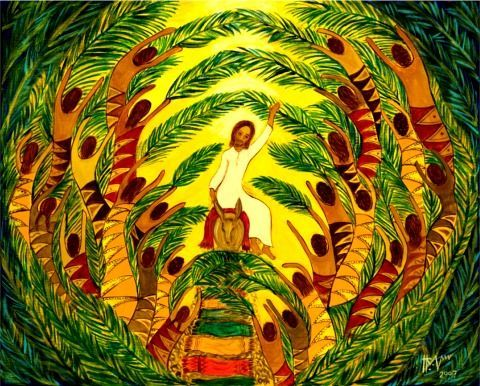
Art by Kris Miller

Palm branches were the national symbol for Israel, like our flag displays. There was no question about what the crowd of people wanted: A strong leader-king who was going to change the establishment and inaugurate a new administration of peace and prosperity that put the Romans in their place and give prominence to the Jews, like King David of old.

But Jesus made it evident he was not going to submit to what the crowd wanted. Christ had a different idea about what needed to take place.

Jesus did not ride into Jerusalem on a war horse, but on a donkey

An enthused crowd. People anticipating Jesus… and then he shows up! “What in the heck is he riding on…?  Is that a donkey!?” It was an anti-climactic moment.

Jesus purposely chose a donkey to ride into Jerusalem – serving notice to everyone that he was not going to capitulate to the crowd’s agenda for him and become the political savior they were looking for. The establishment was not going to be overturned.

Christ was giving balance to the people about who he was. Yes, he actually is a king, and the sovereign Lord of all – but a gentle King, a humble Sovereign, a meek Messiah. Those adjectives were not in most people’s vocabulary for a king. But Jesus is a king on his terms, not anybody else’s.

Because Jesus is a gentle king, we need not be afraid

Sometimes, what we think we need, and what we actually need, are two different things. Jesus uses his royal authority and power to help, not hurt. Although he might not meet all the expectations of the crowd, that doesn’t mean he will avoid giving them what they really need. 

The crowd was too hung up on their hardships and expecting deliverance from a human government. But what they received was something better: salvation from the dark powers of sin, death, and hell. 

Jesus will certainly come and right every wrong, but he will do it in God’s timing, not ours. 

In the meantime, when evil seems to be winning the day, we can be assured that God’s judgment will deal with each and every sin committed against God’s people. Jesus is attentive to his followers; his grace and power combine to give us what we truly need.

Conclusion

Ironically, Jesus ended up not being enough for his own people; they wanted something different than what they got. Here is the timeless point today’s story emphasizes:

We must adjust to who Jesus is, and not the other way around. 

In truth, Jesus came to take on the establishment – just not the Roman one. Jesus came to overturn the ruling establishment of Satan and his wicked spirits; to upend the principalities and powers of this dark world.

Jesus came to take back the people of this earth for God, and he would not do it through a political revolution, but by a spiritual one. Jesus would seize power by becoming a sacrifice for sin, making it possible for people to live a new life without the world, the flesh, and the devil dogging them at every turn.

Jesus is the rightful Ruler of both the church and the world. And he rules in humility, meekness, gentleness, and love. Jesus calls his followers to serve him by living in that same way. Just a few days after the entrance into Jerusalem with palm branches waving, Jesus told his disciples exactly what he wanted from them: 

“Now that I, your Lord and Teacher, have washed your feet, you also should wash one another’s feet. I have set you an example that you should do as I have done for you. I tell you the truth, no servant is greater than the master, nor is a messenger greater than the one who sent him (this is Jesus’ way of saying that they all must adjust to him, and not the other way around). Now that you know these things, you will be blessed if you do them.” (John 13:13-17, NIV)

Jesus went on to give them a clear command:

“Love one another.  As I have loved you, so you must love one another (this is Jesus’ way of emphasizing what is to be the priority of his subjects in the kingdom of God). By this all men will know that you are my disciples if you love one another.” (John 13:34-35, NIV)

Jesus is engaging in a revolution, but not in a worldly sense. Christ sends his followers to spread the message of forgiveness and new life for individuals, families, workplaces, neighborhoods, and nations. It is a revolution that will be ushered in through love, not hate; through the violence of a singular sacrifice, and not through the violence of wars and political coups.

Is Jesus really enough for me, just the way he is? Or, do I believe he ought to be different than he is?  

I daily strive to say, no matter the circumstance, that the grace of Jesus Christ is enough for me. If all were stripped and taken from me, if all the world were against me, if nothing went right and all was upside-down, I would still have the love of God in Jesus Christ. Amen.