The Message of Palm Sunday (John 12:12-16)

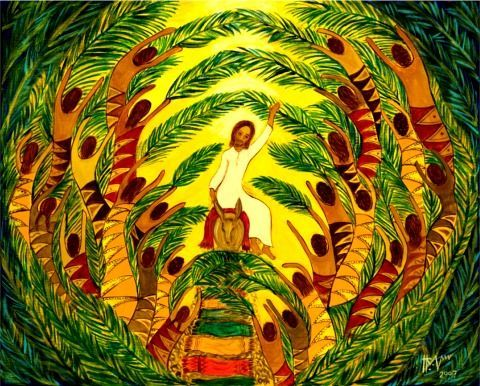
Christ enters Jerusalem, by Hanna-Cheriyan Varghese

The next day the great crowd that had come to the festival heard that Jesus was coming to Jerusalem. So they took branches of palm trees and went out to meet him, shouting,

“Hosanna!
Blessed is the one who comes in the name of the Lord—
    the King of Israel!”

Jesus found a young donkey and sat on it, as it is written:

“Do not be afraid, daughter of Zion.
Look, your king is coming,
    sitting on a donkey’s colt!”

His disciples did not understand these things at first, but when Jesus was glorified, then they remembered that these things had been written of him and had been done to him. (New Revised Standard Version)

Here are two questions to keep in mind as we consider Palm Sunday, the day we remember Jesus coming into Jerusalem during the Feast of Passover (Holy Week): 

  1. Is Jesus really enough for me, just the way he is? 
  2. Or, do I think he ought to be different than he is?

Many of the people who gathered to give Jesus praise at the beginning of the week, shouted to the Roman authorities to have him crucified at the end of the week. So, what changed? Why the big turn around? 

The change in attitude came because Jesus did not fit the crowd’s expectations of who the Messiah is, and what he should do. Jesus, just as he is, was not enough for them. They did not accept him for who he was. 

Let’s be aware and in touch with our own expectations for God, and for what we believe Jesus ought to be and to do. Because missed expectations create either hurt, anger, or both. 

How we view Jesus determines how we view the Christian life and the Christian Church. If we see Jesus like an earthly king or politician, and emphasize his war chest, while downplaying his meekness, we will then have a triumphalist view of Christianity. We’ll be disappointed when there is no practical victory taking place. 

The crowd wanted assurances that in Christ’s first 40 days in office, he would put the big hurt on the Roman authorities. The people had expectations of strong leadership, making things happen now, and accomplishing big hairy audacious goals of upending the establishment. 

But if we view Jesus as the Gentle King and the Humble Sovereign – viewing him as lowly royalty – giving due emphasis to both his authority and his humility, then we will likely worship Jesus as he truly is, and not as we want him to be. 

Most of the crowd was following Jesus with misguided expectations

Jesus did some incredible miracles, especially the one where he raised Lazarus from the dead. Over a million people came to Jerusalem every year during the week of Passover, and word had spread about a man who just might be the hope of Israel. They heard about his power and authority, and wanted to check him out.

And this is a good thing, not a bad thing. It’s important that people investigate Jesus and see for themselves who he is and what he’s all about. 

Just because there are people who do not respond immediately to Jesus, doesn’t mean they won’t in the future. After all, even the disciples who were closest to Jesus did not fully understand who he was or what he was doing. Only later, after the resurrection and ascension, did they put it all together and “get it.” So, cut others (and yourself) some slack.

Let’s give a lot of latitude to people who seek Jesus. They need the good news of forgiveness and new life in Christ. They don’t need immediate pressure to follow Jesus, or given a set of moral rules to follow, right now, as if clean living brings salvation from sin, death, and hell. 

People need room to investigate Jesus, and plenty of helpful guides along the way to point them in the right direction. So, let’s encourage honest questions and real conversations about Jesus.

However, some of the crowd checking out Jesus already had their minds made up about who they thought he should be. They had no room for a suffering servant and a humble savior, seeing only the sins of others, and not their own faults. 

Those with closed minds believed Jesus should be a political liberator from the Gentile Romans. The crowd was understandably weary of being dominated by non-Jews. But what many wanted was some serious payback and a new establishment with Messiah in charge.

This would be like, in our own day, getting completely jazzed-up about a particular presidential candidate who did some incredible things on the campaign trail and is now entering Washington D.C. to a ticker-tape parade and lots of flag-waving. 
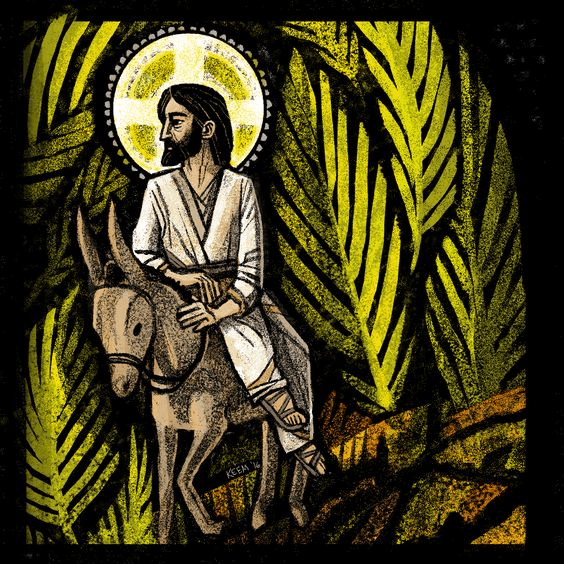
Art by Kris Miller

Palm branches were the national symbol for Israel, like our flag displays. There was no question about what the crowd of people wanted: A strong leader-king who was going to change the establishment and inaugurate a new administration of peace and prosperity that put the Romans in their place and give prominence to the Jews, like King David of old.

But Jesus made it evident he was not going to submit to what the crowd wanted. Christ had a different idea about what needed to take place.

Jesus did not ride into Jerusalem on a war horse, but on a donkey

An enthused crowd. People anticipating Jesus… and then he shows up! “What in the heck is he riding on…?  Is that a donkey!?” It was an anti-climactic moment.

Jesus purposely chose a donkey to ride into Jerusalem – serving notice to everyone that he was not going to capitulate to the crowd’s agenda for him and become the political savior they were looking for. The establishment was not going to be overturned.

Christ was giving balance to the people about who he was. Yes, he actually is a king, and the sovereign Lord of all – but a gentle King, a humble Sovereign, a meek Messiah. Those adjectives were not in most people’s vocabulary for a king. But Jesus is a king on his terms, not anybody else’s.

Because Jesus is a gentle king, we need not be afraid

Sometimes, what we think we need, and what we actually need, are two different things. Jesus uses his royal authority and power to help, not hurt. Although he might not meet all the expectations of the crowd, that doesn’t mean he will avoid giving them what they really need. 

The crowd was too hung up on their hardships and expecting deliverance from a human government. But what they received was something better: salvation from the dark powers of sin, death, and hell. 

Jesus will certainly come and right every wrong, but he will do it in God’s timing, not ours. 

In the meantime, when evil seems to be winning the day, we can be assured that God’s judgment will deal with each and every sin committed against God’s people. Jesus is attentive to his followers; his grace and power combine to give us what we truly need.

Conclusion

Ironically, Jesus ended up not being enough for his own people; they wanted something different than what they got. Here is the timeless point today’s story emphasizes:

We must adjust to who Jesus is, and not the other way around. 

In truth, Jesus came to take on the establishment – just not the Roman one. Jesus came to overturn the ruling establishment of Satan and his wicked spirits; to upend the principalities and powers of this dark world.

Jesus came to take back the people of this earth for God, and he would not do it through a political revolution, but by a spiritual one. Jesus would seize power by becoming a sacrifice for sin, making it possible for people to live a new life without the world, the flesh, and the devil dogging them at every turn.

Jesus is the rightful Ruler of both the church and the world. And he rules in humility, meekness, gentleness, and love. Jesus calls his followers to serve him by living in that same way. Just a few days after the entrance into Jerusalem with palm branches waving, Jesus told his disciples exactly what he wanted from them: 

“Now that I, your Lord and Teacher, have washed your feet, you also should wash one another’s feet. I have set you an example that you should do as I have done for you. I tell you the truth, no servant is greater than the master, nor is a messenger greater than the one who sent him (this is Jesus’ way of saying that they all must adjust to him, and not the other way around). Now that you know these things, you will be blessed if you do them.” (John 13:13-17, NIV)

Jesus went on to give them a clear command:

“Love one another.  As I have loved you, so you must love one another (this is Jesus’ way of emphasizing what is to be the priority of his subjects in the kingdom of God). By this all men will know that you are my disciples if you love one another.” (John 13:34-35, NIV)

Jesus is engaging in a revolution, but not in a worldly sense. Christ sends his followers to spread the message of forgiveness and new life for individuals, families, workplaces, neighborhoods, and nations. It is a revolution that will be ushered in through love, not hate; through the violence of a singular sacrifice, and not through the violence of wars and political coups.

Is Jesus really enough for me, just the way he is? Or, do I believe he ought to be different than he is?  

I daily strive to say, no matter the circumstance, that the grace of Jesus Christ is enough for me. If all were stripped and taken from me, if all the world were against me, if nothing went right and all was upside-down, I would still have the love of God in Jesus Christ. Amen.

Dealing with Disrespect and Disbelief (John 12:34-50)

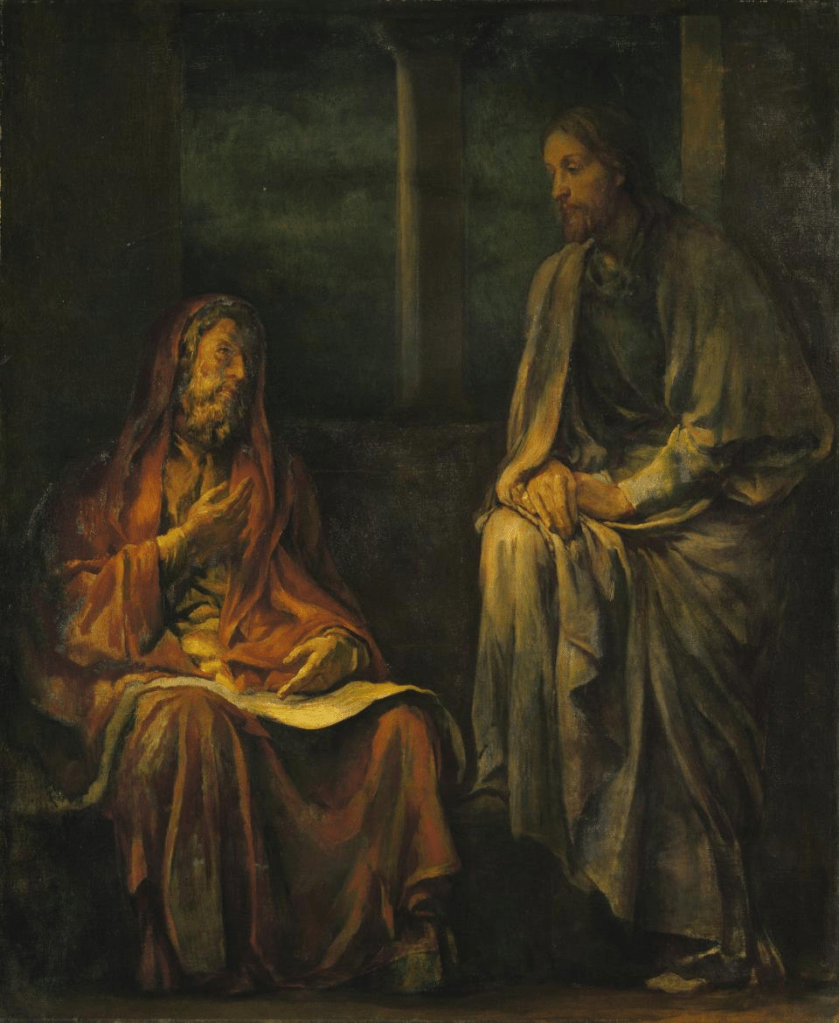
Christ and the Pharisees, by Anthony van Dyck (1599–1641)

The crowd spoke up, “We have heard from the Law that the Messiah will remain forever, so how can you say, ‘The Son of Man must be lifted up’? Who is this ‘Son of Man’?”

Then Jesus told them, “You are going to have the light just a little while longer. Walk while you have the light, before darkness overtakes you. Whoever walks in the dark does not know where they are going. Believe in the light while you have the light, so that you may become children of light.” When he had finished speaking, Jesus left and hid himself from them.

Even after Jesus had performed so many signs in their presence, they still would not believe in him. This was to fulfill the word of Isaiah the prophet:

“Lord, who has believed our message
    and to whom has the arm of the Lord been revealed?”

For this reason they could not believe, because, as Isaiah says elsewhere:

“He has blinded their eyes
    and hardened their hearts,
so they can neither see with their eyes,
    nor understand with their hearts,
    nor turn—and I would heal them.”

Isaiah said this because he saw Jesus’ glory and spoke about him.

Yet at the same time many even among the leaders believed in him. But because of the Pharisees they would not openly acknowledge their faith for fear they would be put out of the synagogue; for they loved human praise more than praise from God.

Then Jesus cried out, “Whoever believes in me does not believe in me only, but in the one who sent me. The one who looks at me is seeing the one who sent me. I have come into the world as a light, so that no one who believes in me should stay in darkness.

“If anyone hears my words but does not keep them, I do not judge that person. For I did not come to judge the world, but to save the world. There is a judge for the one who rejects me and does not accept my words; the very words I have spoken will condemn them at the last day. For I did not speak on my own, but the Father who sent me commanded me to say all that I have spoken. I know that his command leads to eternal life. So whatever I say is just what the Father has told me to say.” (New International Version)

It seems that nowadays, the more one rises in popularity and garners national attention, the more some folks want to disrespect them.

Out of the many examples of this phenomenon, consider the case of a young woman from my home state of Iowa. Sportswriter Mike DeCourcy recently mused on why the University of Iowa’s Caitlin Clark has discovered that not all the greats of women’s college basketball welcome her success.

Several women – who ought to know better – have cynically reacted to Clark’s legitimate college greatness with a sort of “Why her, why not us?” attitude. They’ve indulged in misinformation and cheap shots that clearly say more about them than Caitlin Clark.

This is especially curious, since Clark has elevated women’s basketball to a level of attention that her now detractors and others have envied for decades. DeCourcy writes, “None of this [delegitimizing Clark] is a good look for NCAA women’s basketball, and neither does it appear to be the most prudent way to continue growing the sport.”

The same type of thing could be said about Jesus and the movement he was sparking during his ministry on this earth. Many of the religious leaders refused to acknowledge his greatness, nor believe in the words he was saying. Instead, they sought to knock down Jesus and the good work he was doing.

It seems the religious leaders wanted the praise and attention Jesus was getting. Even many who believed in what was happening, kept their mouths shut and let the misinformation spread, because they, too, loved the praise of others instead of praise from God.

Playing with the game of darkness, nobody wins. People end up only being a mere shadow of the person they could be. Trying to disrespect others in order to shine the light on yourself is a convoluted and misguided way of handling anyone or any situation.

Carl Jung (1875-1961) described this hidden shadow self as an unconscious aspect of the human personality. In other words, the shadow results from the conscious self being unaware or unconscious concerning areas of its own personality. Without the light of conscious awareness, the shadow self runs amok within the psyche of a person and far too often calls the shots in speaking and behavior.

“Everyone carries a shadow,” Jung wrote, “and the less it is embodied in the individual’s conscious life, the blacker and denser it is.” (Psychology and Religion, 1938)

According to Jung, the shadow side of a person is prone to psychological projection, in which a perceived personal inferiority is recognized as a perceived moral deficiency in someone else. If those projections remain hidden, they eventually come out sideways by harming others because there is a dark illusion, even delusion, that others are stealing what is rightfully mine.

Hence, the sinless Jesus is denigrated, disrespected, and disbelieved. And it is what led to him being tortured and killed by those who thought they are doing a good thing.

It’s easy to be hard on the religious rulers in the New Testament, but this is the Christian season of Lent, and so, we must shine the light of Scripture upon ourselves. This is the time to deliberately gain awareness of our own shadow selves.

Perhaps the burning question for all believers at this time of year is: Do I seek the presence of God more than the presence of anything or anyone else?  

Maybe you live in fear at work and are more concerned about the presence of people around you than the presence of God, so you keep quiet when you ought to speak up or turn a blind eye to the shadows of an organization. Or worse, you talk bad about someone good, just because they’re getting the attention you feel you deserve.

In these remaining days of Lent, as we journey with Jesus to Jerusalem, let’s let the light of his gracious ministry dispel the dark shadows of our hearts and make us aware of who we are, and what we need to change.

If we can learn to appreciate the God-given and hard-earned talents of a young woman playing basketball, then perhaps we can then also learn to glory in One who is greater than any sports celebrity, and celebrate the great work done on this earth for us and for our salvation.

Good and gracious God, we are far too often influenced by what others think of us. We sometimes pretend to be either richer or smarter or nicer than we really are. So, prevent us from trying to divert attention from others to ourselves. Don’t let us gloat over praise received from others, nor be discouraged by criticism from another. Show us, instead, how to be humble of heart, like the Lord Jesus, in whose name we pray. Amen.

Life Through Death (John 12:20-33)

Now among those who went up to worship at the festival were some Greeks. They came to Philip, who was from Bethsaida in Galilee, and said to him, “Sir, we wish to see Jesus.” Philip went and told Andrew, then Andrew and Philip went and told Jesus. Jesus answered them, “The hour has come for the Son of Man to be glorified. Very truly, I tell you, unless a grain of wheat falls into the earth and dies, it remains just a single grain, but if it dies it bears much fruit. Those who love their life lose it, and those who hate their life in this world will keep it for eternal life. Whoever serves me must follow me, and where I am, there will my servant be also. Whoever serves me, the Father will honor.

“Now my soul is troubled. And what should I say: ‘Father, save me from this hour’? No, it is for this reason that I have come to this hour. Father, glorify your name.” Then a voice came from heaven, “I have glorified it, and I will glorify it again.” The crowd standing there heard it and said that it was thunder. Others said, “An angel has spoken to him.” Jesus answered, “This voice has come for your sake, not for mine. Now is the judgment of this world; now the ruler of this world will be driven out. And I, when I am lifted up from the earth, will draw all people to myself.” He said this to indicate the kind of death he was to die. (New Revised Standard Version)

The fifth Sunday in Lent is now here. We are quickly approaching Jerusalem. Holy Week will be here before you know it. 

Why is this all significant? Because Jesus is important. By taking advantage of Lent with its focus on spiritual discipline, prayer, and repentance, we come face-to-face with the shadowy parts of our selves. We discover that within us there is the pull to hold-on to unhealthy rhythms and habits of life, as well as a push to arrange our lives with the fragmentation of disordered love.

Perhaps our reflexive response to things we do not like about ourselves is to either use sheer willpower to change or try to somehow manage our brokenness, as if we could boss our way out of darkness. The problem and the solution are much more radical than we often would like to admit.

We must die. 

Yes, you heard that right. This is the teaching of Jesus – to die to ourselves. Sin cannot be managed or willed away – it must be eradicated and completely cut out, like the cancer it is. Transformation can only occur through death. 

Jesus used the familiar example of a seed to communicate his point. A tiny little seed can grow, break the ground, and develop into something which provides sustenance for others. It does no good to remain a seed in the ground.

Christ was only telling others to do, what he himself was willing to do. Jesus is the ultimate example of the one who died to himself, and literally died for us. Through suffering and death, he secured deliverance for us from guilt and shame. 

By his wounds we are healed. Through his tortuous death a resurrection became possible – and we must always remember that there must be a death if there is to be a resurrection. Death always precedes life. There is suffering before glory.

Through dying to self, and following Jesus, there is the hope of transformative change which the world so desperately needs. If we persist in making puny attempts at trying to straddle the fence in dual/rival kingdoms, we will be spiritually schizophrenic and left with a divided soul. 

Following Jesus – leaving all to walk with him – is true repentance and authentic discipleship. The act of journeying with Christ is the means to a new life. Change is possible by letting Jesus Christ be the center from which all of life springs.

Maybe you think I’m being too forceful, too insistent about this Jesus stuff. 

Yes, you have perceived well. I am being quite single-minded about the need for dying to self and living for Christ. 

Somehow, within many corners of Christianity, this wrongheaded notion that suffering is not God’s will has made it into the life of the church. But I’m here to say, on the authority of God’s Holy Word (not to mention your own internal gut and conscience) that dying to ourselves is necessary. And it hurts. The epistle reading for today bears this out:

In the days of his flesh, Jesus offered up prayers and supplications, with loud cries and tears, to the one who was able to save him from death, and he was heard because of his reverent submission.  Although he was a Son, he learned obedience through what he suffered; and having been made perfect, he became the source of eternal salvation for all who obey him. (Hebrews 5:7-9, NRSV)

Christians are not above their Master. Even Christ’s life on this earth, before his death and resurrection, was marked with suffering. Even Jesus learned obedience through struggle and adversity. Jesus Christ did what he now asks of us. 

The Son gave up himself to do the Father’s will. So, we must give up ourselves in submission to King Jesus.  Jesus offered loud cries and tears, and submitted to what the Father wanted. His followers must do no less. 

We don’t get to choose which parts of Christ’s life and teaching we will adhere to, and which ones we won’t, as if Jesus were some spiritual buffet line. All who live for Jesus, follow him into the path of suffering, of death to self, and of new life through the power of his resurrection.

Those who love their life lose it, and those who hate their life in this world will keep it for eternal life.

How do we follow Jesus through dying to self? What does that mean for you and me on a practical daily basis?

Surrender

Every moment of every day is an opportunity for giving ourselves to Jesus. We have hundreds, maybe thousands, of small daily decisions with the use of our time, money, energy, and relationships. 

If we have tried to fix what is broken inside of us, we will likely just try to hastily fix the problems and the people in our lives – and then move on with getting things done on our to do list. 

Instead, there is a need to surrender ourselves – to create the sacred space for solitude and silence, prayer and repentance. 

Take the time to sit with a person in pain and listen. Reflect on how to use your money in a way which mirrors kingdom values. Begin to see your life as a holy rhythm of hearing God and responding to what he says. It takes intentional surrender to do that.

Sacrifice

Holding-on to our precious stuff and time is the opposite of sacrifice. 

Are we truly willing to give-up everything to follow Jesus? 

It is more than true that we are not Jesus. Our sacrifice and suffering are not efficacious, that is, it doesn’t deliver other people from sin. Only Christ’s death does that. Yet, we are still called to sacrifice. The Apostle Paul understood this, with a statement that I’ll let you wrestle with and mull over without comment on my part:

I am now rejoicing in my sufferings for your sake, and in my flesh I am completing what is lacking in Christ’s afflictions for the sake of his body, that is, the church. (Colossians 1:24, NRSV)

Happiness is important; but it isn’t the summum bonum of life. There is more to life than living for self. Jesus calls us to see our communities, neighborhoods, and families as a mission field of grace to a world who needs him. That takes sacrificial love on our part.

Christianity is not really a religion that’s for people who have put neat theological answers and tidy packaged certainties to all of life’s questions. 

Rather, Christianity is a dynamic religion of learning to follow Jesus, discovering how to die to self, and struggling to put Christ’s teaching and example into practice. 

Those who don’t struggle are in big trouble. But those who go through the pain of dying to themselves for the sake of their Lord, find that the fruit they harvest leads to eternal life.

May you struggle well, my friend.

Whoever Believes (John 3:14-21)

Interview Between Jesus and Nicodemus, by James Tissot (1836-1902)

Just as Moses lifted up the snake in the wilderness, so the Son of Man must be lifted up,that everyone who believes may have eternal life in him.”

For God so loved the world that he gave his one and only Son, that whoever believes in him shall not perish but have eternal life. For God did not send his Son into the world to condemn the world, but to save the world through him. Whoever believes in him is not condemned, but whoever does not believe stands condemned already because they have not believed in the name of God’s one and only Son. 

This is the verdict: Light has come into the world, but people loved darkness instead of light because their deeds were evil. Everyone who does evil hates the light, and will not come into the light for fear that their deeds will be exposed. But whoever lives by the truth comes into the light, so that it may be seen plainly that what they have done has been done in the sight of God. (New International Version)

For many, the truth about God’s purposes in Christ is confusing, even troubling. It was for Nicodemus. And even though there many today who simplify the exchange between Jesus and Nicodemus with a single Bible verse of John 3:16, taking a good look at the Gospel of John puts most of us with Nicodemus.

Nicodemus, a learned Jewish scholar, a Pharisee, found Christ’s words both confusing and troubling because it required him to let go of everything he understood – to let go and become like a newborn baby, receiving and discovering the world on new and different terms. In other words, Nicodemus had to unlearn some things before he could learn truth.

There are some things that are hard to grasp, not because they are so intellectually challenging, but because those things ask a lot of us, demanding our very lives. And so, we don’t so much want to understand; it would require a radical change.

But why would anyone not want to understand the good news that God so loved the world that gave the Son so that we may believe and have eternal life? Because we would then have to contend with the ways Jesus describes himself.

Jesus likened himself to the serpent that Moses lifted up in the desert (John 3:14; Numbers 21:4-9). In that story of Moses in the Old Testament book of Numbers, God sent poisonous snakes into the Israelite camp as punishment for the people’s incessant complaining against God.

Then, when the people repented, God told Moses to make a bronze snake, put it on a pole, and lift it up, so that anyone bitten by one of the poisonous snakes could see it and live. Jesus likened himself to the story. In the same way the bronze snake was lifted on a pole, Jesus explained that so must the Son of Man be lifted up, or exalted high above the people.

Visit of Nicodemus to Christ, by John La Farge, 1880

In the typical language of the Apostle John, using double meanings to a single concept, he meant to communicate that Jesus would be physically lifted onto the cross, above the people; and also that Jesus would be lifted up by God as the exalted One above all creation. (John 8:28; 12:32)

Just as the ancient Israelites were facing death because of their sin, and deliverance because of God’s action through Moses, so people everywhere in every age face the consequences of their sinful complaining; yet through the action of God through Christ’s crucifixion, resurrection and ascension, they can look up to the exalted and glorified Lord and receive deliverance from sin, death, and hell.

There is more to looking up at the lifted One than a mere incline of the head and eyes. In modern terms, we would refer to the sheer action of looking as an intellectual assent to faith. The Apostle John, however, means to have us believe, not simply acknowledge.

Jesus did not tell Nicodemus to simply acknowledge him as Savior, to accept him into the heart, and so, be saved. No, this was an encounter that left an intelligent man and an accomplished scholar scratching his head in bewilderment as he went back out into the darkness.

Today’s Gospel lesson is a story about how any one of us might reject the light offered to us because of the way it exposes what is dark within us. Therefore, to believe requires ultimate trust in another. It isn’t to acknowledge that Jesus was real and had an actual ministry on earth; it’s more than believing something happened in history in the ancient world of the first century.

To believe is to let our own lives be transformed by the Jesus we encounter in this story. And here is what that means:

  1. Realizing and becoming aware of the ways we are complicit in and benefit from having our loyalties elsewhere, other than Jesus. To believe demands us answering the question: Whom shall you serve?
  2. Placing our ultimate trust, allegiance, and loyalty in Jesus Christ. To believe begs the question: To whom will you commit all that you have, and all that you are?
  3. Forsaking all other competing loyalties and “gods,” including both secular and religious deities. To believe means a single-minded devotion, which asks of us all: To whom and to what will you forsake in order to embrace Jesus?
  4. Confronting inconvenient truths of our own personal values which clash with Christ’s ideals of righteousness. To believe presses us to answer the question: To whom and for what are you truly living for?
  5. Willing to die to self and to anything that would hinder knowing Jesus and him crucified, risen, ascended, and coming again. To believe forces us to ask ourselves: Am I willing to die for Jesus?

While there is nothing in this world worth killing for, there are things worth dying for. The lifting up of Jesus lets us know that the true life God has promised us is not the life that we can secure for ourselves through self-interest, caution, and theological debate.

Most merciful God,
we confess that we have sinned against you
in thought, word, and deed,
by what we have done,
and by what we have left undone.
We have not loved you with our whole heart;
we have not loved our neighbors as ourselves.
We are truly sorry and we humbly repent.
For the sake of your Son Jesus Christ,
have mercy on us and forgive us;
that we may delight in your will,
and walk in your ways,
to the glory of your Name. Amen.