Later, Jesus himself appeared again to his disciples at the Sea of Tiberias. This is how it happened:Simon Peter, Thomas (called Didymus), Nathanael from Cana in Galilee, Zebedee’s sons, and two other disciples were together. Simon Peter told them, “I’m going fishing.”
They said, “We’ll go with you.” They set out in a boat, but throughout the night they caught nothing. Early in the morning, Jesus stood on the shore, but the disciples didn’t realize it was Jesus.
Jesus called to them, “Children, have you caught anything to eat?”
They answered him, “No.”
He said, “Cast your net on the right side of the boat and you will find some.”
So, they did, and there were so many fish that they couldn’t haul in the net. Then the disciple whom Jesus loved said to Peter, “It’s the Lord!” When Simon Peter heard it was the Lord, he wrapped his coat around himself (for he was naked) and jumped into the water. The other disciples followed in the boat, dragging the net full of fish, for they weren’t far from shore, only about one hundred yards.
When they landed, they saw a fire there, with fish on it, and some bread. Jesus said to them, “Bring some of the fish that you’ve just caught.” Simon Peter got up and pulled the net to shore. It was full of large fish, one hundred fifty-three of them. Yet the net hadn’t torn, even with so many fish. Jesus said to them, “Come and have breakfast.” None of the disciples could bring themselves to ask him, “Who are you?” They knew it was the Lord. Jesus came, took the bread, and gave it to them. He did the same with the fish. This was now the third time Jesus appeared to his disciples after he was raised from the dead. (CEB)
Sometimes, maybe oftentimes, it takes a bit of time to wrap our heads and our hearts around a new reality. After all, if you’ve been used to operating a particular way for a long time, it can be hard to come around to embracing difference – even if that change is really good.
Good ol’ Peter, you’ve got to love him. Bless his heart, the Lord Jesus is risen from death and he, along with some of the other disciple fishermen, are not quite up to speed on resurrection. Christ is alive, the disciples have already seen him on two separate occasions, yet they seem like a dog who has chased a rabbit and now don’t know what to do with it once they’ve surprisingly gotten it.
So, Peter goes fishing. Yep, when all else seems upside-down and topsy-turvy, just go fishing. The problem is: Peter and the boys are going back to a life that doesn’t exist anymore. And that’s pretty much what we all tend to do when we are stuck in a liminal space, caught in a situation of uncertainty without much of a clue what to do. We simply go back to what we’ve always done and hope we catch some fish.
But we can’t catch fish. It isn’t the same anymore. The resurrection of Jesus has completely upended the world. There’s no going back to any sort of pre-resurrection days. All has changed. I’m not sure if the disciples believed they were going to catch any fish, or not. Seems they just had to go do something familiar.
Unknown to them, the rules changed. The old way of fishing won’t work. While they’re off trying to live from the old life, Jesus shows up on shore. The disciples don’t realize its him. So, they don’t anticipate that when Jesus calls out and encourages them that they’ll end up with a nice haul of fish. While the old life yields nothing, the new life with Christ brings abundance, blessing, and fellowship. After the big catch of fish, here are the disciples now eating breakfast with the King of Kings, yet they’re still scratching their heads. What’s going on? Who is it? Well, of course, it’s Jesus, but is it? What’s the plan? I’m so confused.
In the passage and the journey from one reality to another, from a place of familiarity to a place of a future we’ve never seen, from an old life to a new life, there is both the shadow of doubt which makes everything feel so uncertain and the confidence of faith which keeps us going forward. In this middle space there is a continual vacillating between doubt and faith. Rarely is there ever a black-and-white existence. No, instead its wise to become friends with the gray because most lessons we learn come while inhabiting this weird in-between space.
When the disciples encountered Jesus in today’s Gospel story, it was an experience of Jesus in the middle – a six-week time between resurrection and ascension. It was also an experience of the disciples in the middle. There was no going back to a pre-resurrection time of walking and talking with Jesus as they had done before. And there is also no future where they can live in the past or pick up the fishing business just like before.
Although we have the advantage of knowing how the story shakes-out with Christ’s ascension, the giving of the Spirit, and a robustly bold group of disciples going out to change the world – the disciples cannot picture that future in their liminal space on the beach.
We, too, inhabit a middle space. We are in-between the two advents of Christ. This truly is an awkward time in which we, along with disciples, experience a mix of belief and doubt because we aren’t at the end of the story. So, a combination of worship and wondering exists in the here-and-now. Jesus doesn’t chide the disciples for sometimes believing and sometimes not; and, our Lord isn’t exasperated with us because one of the certainties for the Christian is that grace overcomes everything. Sitting down with Word and Meal creates a new space where we can begin to make sense of our sometimes very nonsensical lives.
Great God of Resurrection, help me to embrace both the meaning and the mystery of faith as I negotiate and interpret every situation in my life through the light of Jesus Christ, your Son, my Lord, who lives and reigns with you and the Holy Spirit, one God, now and forever. Amen.
Click There Is a Hope by Stuart Townsend for encouragement through your liminal space.
Early on the first day of the week, while it was still dark, Mary Magdalene went to the tomb and saw that the stone had been removed from the entrance. So she came running to Simon Peter and the other disciple, the one Jesus loved, and said, “They have taken the Lord out of the tomb, and we don’t know where they have put him!”
So Peter and the other disciple started for the tomb. Both were running, but the other disciple outran Peter and reached the tomb first. He bent over and looked in at the strips of linen lying there but did not go in. Then Simon Peter, who was behind him, arrived and went into the tomb. He saw the strips of linen lying there, as well as the burial cloth that had been around Jesus’ head. The cloth was folded up by itself, separate from the linen. Finally, the other disciple, who had reached the tomb first, also went inside. He saw and believed. (They still did not understand from Scripture that Jesus had to rise from the dead.)
Then the disciples went back to their homes, but Mary stood outside the tomb crying. As she wept, she bent over to look into the tomb and saw two angels in white, seated where Jesus’ body had been, one at the head and the other at the foot.
They asked her, “Woman, why are you crying?”
“They have taken my Lord away,” she said, “and I don’t know where they have put him.” At this, she turned around and saw Jesus standing there, but she did not realize that it was Jesus.
“Woman,” he said, “why are you crying? Who is it you are looking for?”
Thinking he was the gardener, she said, “Sir, if you have carried him away, tell me where you have carried him, and I will get him.”
Jesus said to her, “Mary.”
She turned toward him and cried out in Aramaic, “Rabboni!” (which means Teacher).
Jesus said, “Do not hold on to me, for I have not yet returned to the Father. Go instead to my brothers and tell them, ‘I am returning to my Father and your Father, to my God and your God.’”
Mary Magdalene went to the disciples with the news: “I have seen the Lord!” and she told them that he had said these things to her.
Although Peter and John have a role in this story about Christ’s resurrection, the main character is Mary Magdalene. This is significant and symbolic of the fact that it was Mary who experienced one of the most profound and deep changes of life due to the ministry of Jesus. Mary had been an immoral woman and spiritually enslaved to the machinations of seven demons. It was Jesus who thoroughly delivered her from her personal hell. Mary was forever thankful to him for changing her life, and so, she followed Jesus and supported him in any way she could. Mary was at the foot of the cross when Jesus died. While other disciples were keeping their distance out of fear, Mary was bold in standing with the other women for all to see that they were completely devoted to Jesus. Mary never turned her back on Jesus. It was Mary who was there on the Sunday morning of Christ’s resurrection. Whereas the other followers were nowhere to be found, Mary came to the grave, still with a heart given to Jesus and grieving over his death.
Because Mary had been given a new chance at life, she was deeply thankful and everything she had belonged to Jesus. Mary Magdalene was forgiven much, and, so she loved much. Here she is, after her Lord’s crucifixion, death, and burial, at the grave of Jesus. Mary came to the tomb on Easter Sunday still living in a Good Friday world – grieving, sad, and discouraged. She soon discovered, however, that Christ is risen!
In the midst of your days of disappointment, loss, or sadness, how have you been surprised by joy and the presence of the risen Christ? How has your grief been turned to gratitude? Have you seen the risen Lord?
One day, 33 years ago, I was down sick with the flu and in bed. I barely remember my wife coming into the bedroom after a doctor’s appointment upset and crying. She was trying to rouse me with a mix of good and bad news. Mary had gone to the doctor thinking that she probably had picked up my flu. Instead, the doctor gave her the news that she was pregnant with our first child. But there was more….
After the examination the doctor had reason to believe that our little baby might be in the wrong place – that she was not where she should be and may very well be in the fallopian tube and not the womb. So, here I am – barely able to move getting out of bed – driving my wife to the hospital for an ultrasound with such a range of emotions within me that all I can do is weep, feeling, much like Mary Magdalene, that my Lord has been taken away from me. It just felt like I didn’t know where Jesus was at that moment and why I was going through this surreal craziness.
I will never forget the words and even the tone of voice of the ultrasound technician as we anxiously stared at a screen we didn’t understand. The technician said, “She is right where she is supposed to be!” The tears turned to complete joy. And the words were prophetic. There was no way that the technician could know at six weeks in the womb that we were having a little girl, yet she referred to the peanut within my wife as “she.” And we immediately knew what her name was: “Sarah,” which is the Hebrew name for “Princess.” God had graced us with a precious gift of royalty, coming from the grace of King Jesus.
I want us to know this morning, on this great Day of Resurrection, that we are right where we are supposed to be. It might seem out of place spending so much time at home; not working in ways we’re used to, or even working at all; wondering where God is or how the divine fits into this topsy-turvy situation of pandemic and economic instability. The truth of matter is this: You are right where you are supposed to be. God has you precisely where he wants you. This morning, right now, you are a witness to the resurrection of Jesus. Along with Mary Magdalene there is the astonished declaration, “I have seen Jesus.”
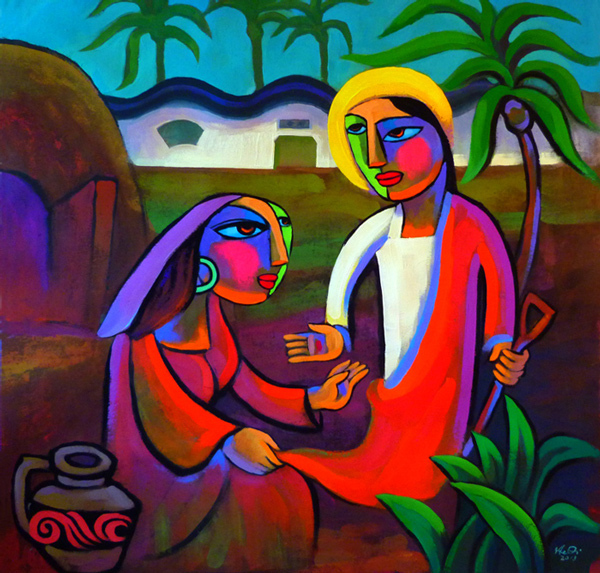
“Do Not Hold On to Me,” by He Qi, 2013. Jesus and Mary Magdalene
Let Mary Magdalene’s experience be of encouragement to you. Mary had been given a new life and was transformed by the Lord. Yet, on Easter Sunday she did not immediately get what the heck was going on. Jesus rising from death was not anywhere on her radar. The empty tomb and the angels did not immediately lead her to faith – not until she saw Jesus, and even then, she did not recognize him. Only when Jesus called her name did Mary recognize him and respond, believing it was her Lord. And Jesus is still calling out names. He is calling your name. Jesus had said to his disciples that the sheep listen to the shepherd’s voice; he calls his own sheep by name and leads them out (John 10:3-4). One little word can change our lives forever: our name.
Easter opens a whole new world for us, as it did for Mary – a future of announcing good news and proclaiming resurrection. There is a simple reason why the grave clothes were left in the tomb just lying there – they were not needed anymore! We no longer need the grave clothes of discouragement, defeat, and despair. We no longer need to weep and wonder, because Christ is risen! He has called our name and we hear his voice.
The 20th century Swiss theologian, Karl Barth, said that what brings people to worship God – not just on Easter, but any day – is an unspoken question clinging to our minds and hearts: Is it true? Is it true that God lives? Is it true that Jesus is alive? Could it be true that I can live a new life in Christ? Is it true that I can rebuild my life? Is it all true? Mary Magdalene approached the tomb and found that it was true.
All over the world, this very day, followers of Jesus are testifying that this is all real: Christ is risen, and there is new life in Jesus our Lord. Right now, believers across the globe are worshiping the risen Lord because they declare along with us, “I have seen the Lord!”
God has always been in the business of changing lives. British author A. N. Wilson, used to be known for his scathing attacks on Christianity and proclaimed the death of God… celebrated Easter in 2009 at a church with a group of other church members, proclaiming that that the story of the Jesus of the Gospels is the only story that makes sense out of life and its challenges. Wilson said, “My own return to faith has surprised none more than myself …. My belief has come about in large measure because of the lives and examples of people I have known—not the famous, not saints, but friends and relations who have lived, and faced death, in light of the resurrection story, and in the quiet acceptance that they have a future after they die.”
The moment Jesus calls a person’s name, the power of the resurrection is enabled—the same power that raised Jesus from the dead. See what you consider as immovable slabs of stone in your life—maybe it’s bitterness, insecurity, fear, self-doubt or cynicism. Those immense rocks can be rolled away. To know Jesus is to know the power of the resurrection. We don’t need to merely hear testimonies of changed lives like Mary Magdalene’s; we can experience new life ourselves.
There is one word, one name, which has forever changed the world: “Jesus.” And Jesus wants to change the world by uttering one simple word, one name: your name, so that you can exclaim with great joy, “I have seen the Lord!”
Mighty God, as Christ burst forth from the grave, may new life explode from us and show itself in acts of love and healing to a hurting world. May your ever-living Son, Jesus our Lord, keep our hearts rejoicing and grant us peace this day and always in resurrection power. Amen.
Ethiopian Orthodox Church icon of Jesus washing the disciples’ feet
It was before Passover, and Jesus knew that the time had come for him to leave this world and to return to the Father. He had always loved his followers in this world, and he loved them to the very end.
Even before the evening meal started, the devil had made Judas, the son of Simon Iscariot, decide to betray Jesus.
Jesus knew that he had come from God and would go back to God. He also knew that the Father had given him complete power. So, during the meal Jesus got up, removed his outer garment, and wrapped a towel around his waist. He put some water into a large bowl. Then he began washing his disciples’ feet and drying them with the towel he was wearing.
But when he came to Simon Peter, that disciple asked, “Lord, are you going to wash my feet?”
Jesus answered, “You don’t really know what I am doing, but later you will understand.”
“You will never wash my feet!” Peter replied.
“If I don’t wash you,” Jesus told him, “you don’t really belong to me.”
Peter said, “Lord, don’t wash just my feet. Wash my hands and my head.”
Jesus answered, “People who have bathed and are clean all over need to wash just their feet. And you, my disciples, are clean, except for one of you.” Jesus knew who would betray him. That is why he said, “except for one of you.”
After Jesus had washed his disciples’ feet and had put his outer garment back on, he sat down again. Then he said:
Do you understand what I have done? You call me your teacher and Lord, and you should, because that is who I am. And if your Lord and teacher has washed your feet, you should do the same for each other. I have set the example, and you should do for each other exactly what I have done for you. I tell you for certain that servants are not greater than their master, and messengers are not greater than the one who sent them. You know these things, and God will bless you, if you do them….
Now the Son of Man will be given glory, and he will bring glory to God. Then, after God is given glory because of him, God will bring glory to him, and God will do it very soon.
My children, I will be with you for a little while longer. Then you will look for me, but you won’t find me. I tell you just as I told the people, “You cannot go where I am going.” But I am giving you a new command. You must love each other, just as I have loved you. If you love each other, everyone will know that you are my disciples. (CEV)
Love. We need it. Without love, relationships devolve into silent standoffs and destructive triangles. The world ceases to spin on its axis. With love, however, all things are beautiful; personal relations have meaning and joy; and, all seems right and just in the world.
Yet, love comes with a cost. Because we live in a broken world filled with pride and hubris, greed and avarice, hate and envy, we are victims of loveless and faceless systems doing unjust actions. We need love to rescue us, to redeem us from the sheer muck of such an existence. It’s as if we are constantly walking knee deep through sludge so thick we can barely get anywhere. We need saving. We need Jesus.
Christians everywhere around the world are journeying through Holy Week, the most sacred time of the year for followers of Christ. When we think about Holy Week, we are familiar with Good Friday and certainly Easter; but Maundy Thursday?
On this day the church remembers the last evening that Jesus shared with his disciples in the upper room before his arrest and crucifixion. The experiences in the upper room were highly significant because this was the last teaching, modeling, and instruction Jesus gave before facing the cross. Jesus was careful and deliberate to communicate exactly what was important to him: to love one another.
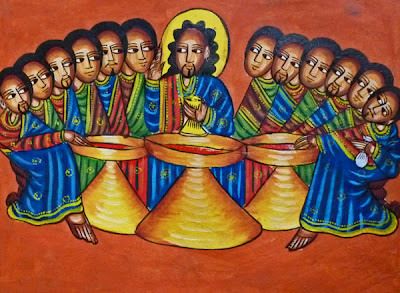
Ethiopian Orthodox Church icon of the Last Supper
Maundy Thursday marks three important events in Christ’s Last Supper with his disciples:
The washing of the disciples’ feet (the action of loving service)
The instituting of the Lord’s Supper (the remembrance of loving sacrifice)
The giving of a “new” commandment to love one another (the mandate of a loving system).
For Jesus, the last night with his disciples was all about love, God’s love. On that fateful night, having loved his disciples for the past three years, Jesus showed them the full extent of his love by taking the posture of a servant and washing each and every one of the disciples’ feet, including Judas. After demonstrating for them a totally humble service, Jesus said,
“I have set you an example that you should do as I have done for you.” Jesus Christ loves me just as I am, and not as I should be.
He loves me even with my dirty stinky feet, my herky-jerky commitment to him, and my pre-meditated sin.
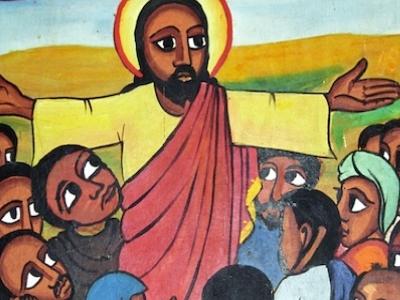
Ethiopian artist depiction of Jesus teaching
Not only did Jesus wash the disciples’ feet; he also lifted the cup of wine and boldly asserted:
“Take this and divide it among you. For I tell you I will not drink again of the fruit of the vine until the kingdom of God comes.” And he took the bread, gave thanks and broke it, and gave it to them, saying, “This is my body given for you, do this in remembrance of me.” In the same way, after the supper he took the cup saying, “This cup is the new covenant in my blood, which is poured out for you” (Luke 22:17-20, NIV).
Because of these words from Jesus, the church throughout the world, for two millennia, have practiced this communion, this supper so that we might have the redemptive events of Jesus pressed firmly into both our minds and our hearts by means of the visceral and common elements of bread and wine. We are to not just know about Jesus – we are to experience being united with him.
Having washed the disciples’ feet, and proclaimed to them the meaning of his impending death, Jesus gave them a clear commandment:
“A new command I give you: Love one another. As I have loved you, so you must love one another. By this everyone will know that you are my disciples, if you love one another.”
Love one another, insisted Jesus, through imitation of his humble service. We represent Christ on this earth when we carefully, diligently, and persistently practice love. Although love was by no means a new concept for the disciples, in the form and teaching of Jesus love was shown with four distinctions:
Jesus is the new model of love
A new motive of love, that Christ first loved me
A new motivator to help us love, the Holy Spirit
A new mission, the evangelization of the world, utilizing the power of Christ’s love to accomplish it
Maundy Thursday is a highly significant day on the Church Calendar – one which deserves to be observed, and an opportunity to remember the important words and actions of Jesus on our behalf. Through Jesus Christ we are to live always in love, modeling our life and church ministry after him.
In Christ we are to allow love to characterize our life together as we proclaim God’s love in words and deeds. A watching world will only take notice and desire to be a part of our fellowship if we are deeply and profoundly centered in the love of God in Christ. This is the reality that Maundy Thursday brings to us.
God of love, you have given us a new command to love each other. Help us to show that love in our care of creation, to all nations and ethnic peoples, in our communities and neighborhoods, through the Church everywhere, and with the persons closet to us and their needs. In all our thoughts, words, and actions may we be your servants and reflect your love; through our loving Savior, Jesus Christ, your Son, who lives and reigns with you and the Holy Spirit, one God, now and forever. Amen.
To continue our remembrance of Christ’s loving service, click As I Have Done For You written by Dan Schutte.







 Rev. Tim Ehrhardt