John 11:45-57 – Against Fear and Worry

Therefore, many of the Jews who had come to visit Mary, and had seen what Jesus did, believed in him. But some of them went to the Pharisees and told them what Jesus had done. Then the chief priests and the Pharisees called a meeting of the Sanhedrin.

“What are we accomplishing?” they asked. “Here is this man performing many signs. If we let him go on like this, everyone will believe in him, and then the Romans will come and take away both our temple and our nation.”

Then one of them, named Caiaphas, who was high priest that year, spoke up, “You know nothing at all! You do not realize that it is better for you that one man die for the people than that the whole nation perish.”

He did not say this on his own, but as high priest that year he prophesied that Jesus would die for the Jewish nation, and not only for that nation but also for the scattered children of God, to bring them together and make them one. So, from that day on they plotted to take his life.

Therefore, Jesus no longer moved about publicly among the people of Judea. Instead he withdrew to a region near the wilderness, to a village called Ephraim, where he stayed with his disciples.

When it was almost time for the Jewish Passover, many went up from the country to Jerusalem for their ceremonial cleansing before the Passover. They kept looking for Jesus, and as they stood in the temple courts, they asked one another, “What do you think? Isn’t he coming to the festival at all?” But the chief priests and the Pharisees had given orders that anyone who found out where Jesus was should report it so that they might arrest him. (NIV)

Effective ministry and service is risky business. Just ask Jesus. The Jewish ruling council (Sanhedrin) was deeply disturbed by all the hubbub Jesus was stirring. Rather than celebrating the healing of many people in both body and soul, the rulers were anxious, worried, and afraid. They feared the worst: The Romans will obliterate both temple and nation.

Wherever you find a group of folks living in continual fear that something awful is going to happen, there you will find a strict code of conformity and no allowances for difference. After all, rocking the boat only draws attention. If anything, or anyone, deviates from established protocol, the voice of fear says, the entire religious system and even its people will be destroyed.

Well, my goodness, Jesus was anything but a conformist to the status quo. He frequently operated outside of established religious norms. Thus, Christ was viewed by many religious leaders as a loose cannon that was making too much noise and needed to be silenced before something terrible happened.

One of the problems with living in the fearful worry of what horrible thing may occur is that we play an ignorant game of prognostication. We simply do not know the future. We can predict. We can become full-time pundits. Yet, when all is said and done, the future is not ours to see. Only God is privy to standing above time and space.

Churches, Christian organizations, and really any institution whose chief focus is keeping everyone in line out of a fear of losing influence, power, privilege, money, devotion, buildings, or people will likely experience a self-fulfilled prophecy of doom. It is necessary we define our ministries, services, and actions by who we are and not by what we don’t do.

Today’s Gospel lesson chronicles the forward progress to the ultimate suffering and death of Jesus. Within the Apostle John’s account, two streams run parallel with one another. There is a group of Jews who observed Jesus, listened to his teaching, saw his miraculous works, and believed in him.  Alongside them is another group of Jews who experienced all the same events and heard all the same words of Jesus – yet responded in a quite different manner by plotting how Jesus might be arrested and killed.

Fear can take such a tight hold on some that premeditated murder is planned and executed without any moral misgivings. Worry can worm its way so deeply into a group that verbal assassinations seem both justified and necessary. Anxiety can overwhelm an institution to such a degree that rationalizations for unethical behavior are rife. People cease to be looked at as people. They are referred to as threats, demonized as monsters who are trying to take away a way of life.

Christ before Caiaphas by Dutch artist Gerrit van Honthorst, c.1617

Caiaphas, the high priest, spoke to his fellow religious leaders, perhaps without even knowing the truth and deep import of his prophetic words: “You know nothing at all.  Nor do you understand that it is better for you that one man should die for the people, not that the whole nation should perish.” Indeed, not only did Jesus die for the nation of Israel, but on behalf of all nations, and all people. 

The implications of Christ’s death are magnanimous. The extent of his atonement for the people includes redemption from the bondage of sin; reconciliation between us and God; satisfaction of God’s wrath against the sin of the world; and, victory over the demonic realm, death, and hell. With all this incredible work of restoration and renewal, fear and worry take a back seat. Courage and confidence take the wheel.

Merciful Jesus, you are my guide, the joy of my heart, the author of my hope, and the object of my love. I come seeking refreshment and peace. Show me your mercy, relieve my fears and anxieties, and grant me a quiet mind and an expectant heart, that by the assurance of your presence I may learn to abide in you, who is my Lord and my God. Amen.

John 12:44-50 – Christ’s Philosophy of Ministry

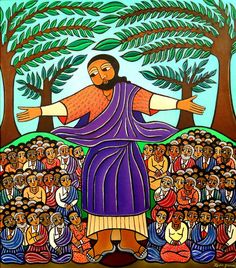
Jesus teaching
“Sermon on the Mount” by Laura James

In a loud voice Jesus said:

Everyone who has faith in me also has faith in the one who sent me. And everyone who has seen me has seen the one who sent me. I am the light that has come into the world. No one who has faith in me will stay in the dark.

I am not the one who will judge those who refuse to obey my teachings. I came to save the people of this world, not to be their judge. But everyone who rejects me, and my teachings will be judged on the last day by what I have said. I do not speak on my own. I say only what the Father who sent me has told me to say. I know that his commands will bring eternal life. That is why I tell you exactly what the Father has told me. (CEV)

Everybody has a philosophy of ministry of how to proceed with the actual doing of Christian works and service to others. We might think of philosophy as a theory about how to gain knowledge and what we are supposed to do with the knowledge we possess. We all have philosophies, even if they are not written down for others to see.

Ponder the thought that Jesus had a philosophy of ministry… which he did.  If Christ’s words carry a lot of weight for us, then perhaps he articulated what he believes about the nature of knowledge; what to do with that knowledge; and, how to handle humanity. Contained within today’s Gospel lesson is the heart of Christ’s philosophical (and thus practical) approach.

Here are several observations about Christ’s philosophy of ministry:

  1. True faith is Trinitarian faith.
  2. Jesus came to dispel darkness by deposing its ruler.
  3. Jesus did not come to nit-pick, harangue, or reject people.
  4. Jesus came to save the world.
  5. Jesus has the authority to save the world.
  6. Belief in Jesus brings deliverance from sin, death, and hell.

Yes, there is a Day of Judgment coming – but that day is not today. Today is the day of salvation, of availing oneself of the opportunity to discover the life, teaching, claims, death, resurrection, and ascension of Christ. Jesus has declared (in a loud voice so we can hear him) that he is the light of the world, the path to God, the Savior of humanity. Those are some very audacious assertions! So, before tomorrow comes, we need to consider the claims of Christ today.

Those whose philosophies include generous portions of people-pleasing and posturing for people-praise will not be judged or rejected by Jesus today (and, so, ought not to be rejected by us, as well!) but will be judged by the words and message of Jesus on the Last Day. According to this philosophy of ministry, there is neither a precedent nor a need to step in and (attempt) to do the Spirit’s work. Rather, we place our faith in Jesus and allow that belief to shape our conversations and interactions with others.  A Christian philosophy of ministry does not need to be complex; it just needs to be Christ-centered.

Great God of deliverance, thank you that you sent your Son, Jesus, to save people from their sins.  I believe in you and what you did and what you stand for.  Each time I open my mouth, may you form my words so that they are not judgmental, but helpful in bringing others to realize life-giving faith through the power of your Holy Spirit.  Amen.

John 13:1-17 – Do as I Have Done for You

Jesus washing feet

It was just before the Passover Festival. Jesus knew that the hour had come for him to leave this world and go to the Father. Having loved his own who were in the world, he loved them to the end.

The evening meal was in progress, and the devil had already prompted Judas, the son of Simon Iscariot, to betray Jesus. Jesus knew that the Father had put all things under his power, and that he had come from God and was returning to God; so he got up from the meal, took off his outer clothing, and wrapped a towel around his waist. After that, he poured water into a basin and began to wash his disciples’ feet, drying them with the towel that was wrapped around him.

He came to Simon Peter, who said to him, “Lord, are you going to wash my feet?”

Jesus replied, “You do not realize now what I am doing, but later you will understand.”

“No,” said Peter, “you shall never wash my feet.”

Jesus answered, “Unless I wash you, you have no part with me.”

 “Then, Lord,” Simon Peter replied, “not just my feet but my hands and my head as well!”

Jesus answered, “Those who have had a bath need only to wash their feet; their whole body is clean. And you are clean, though not every one of you.” For he knew who was going to betray him, and that was why he said not everyone was clean.

When he had finished washing their feet, he put on his clothes and returned to his place. “Do you understand what I have done for you?” he asked them. “You call me ‘Teacher’ and ‘Lord,’ and rightly so, for that is what I am. Now that I, your Lord and Teacher, have washed your feet, you also should wash one another’s feet. I have set you an example that you should do as I have done for you. Very truly I tell you, no servant is greater than his master, nor is a messenger greater than the one who sent him. Now that you know these things, you will be blessed if you do them. (NIV)

One of the reasons I like Jesus Christ so much is that he loves me as I am, and not as I should be. Jesus loves me even with my dirty stinky feet, my herky-jerky commitment to him, and my pre-meditated sin. Jesus loved even Judas and washed his feet. Jesus serves people because they need his love, and not so that they will love him back.

I recently read about a man who lives in Paris. His wife has Alzheimer’s. He was an important businessman and his life was filled with busyness. Yet, he said when his wife fell sick, “I just couldn’t put her into an institution, so I kept her. I fed her. I bathed her. Through the experience of serving my wife every day, I have changed. I have become more human. The other night, in the middle of the night, my wife woke me up. She came out of the fog for a moment, and she said, ‘Darling, I just want to say thank you for all you are doing for me.’ Then she fell back into the fog. I wept for hours to know this grace.”

Sometimes Christ calls me to love people who either cannot or will not love me in return. They live in the fog of some sort of disability, depression, poverty, or common spiritual blindness. As I serve them, I may only receive brief glimpses of gratitude. Just as Jesus loves me within my own spiritual confusion, so I desire to continue loving others as they walk through whatever fog they are in.

I can truthfully say that I have no interest in anything but the love of God which in Christ Jesus.  Lord willing, my life will be useful through my words and my witness. If God desires, my life will bear fruit through my prayers, my service, and my love. Yet, the usefulness of my life is God’s concern, not mine; it would be indecent of me to worry about that. I simply desire follow my Lord’s example.

dirty dishes

Neither many Christians nor churches wash feet anymore. So, the following is today’s Gospel lesson put in a slightly different context:

It was just before the biggest and most important feast of the year, Passover. Jesus knew that it was finally the time for him to face the cross and die for the world’s sins. Having spent the past three years loving his followers, he now wanted to leave them with a clear demonstration of his love that they would never forget.

The evening meal was being served, and the devil had already gotten a hold of Judas Iscariot to betray Jesus to those who wanted him dead and gone. But it was all according to plan. Jesus knew that his heavenly Father had given him all authority because he was his Son, and he was ready to do what needed to be done to secure salvation and return to his rightful place at his Father’s right hand.  So, Jesus got up from the meal, rolled up his sleeves, put an apron on, and ran a sink full of hot water.  Jesus told the servants to take the night off, and he began taking the dishes from the dinner table and started washing them, taking care to do all that waiters and dishwashers would do.

When Jesus came to take care of Simon Peter’s dishes and serve him dessert and coffee, Peter said to him, “Lord, are you going to serve me?” Jesus replied, “I know you do not understand why I am doing this since it seems like something that is beneath me to do, but later you will look back on this night and understand completely what I am doing.”

“No,” said Peter, “this is not right – you are the Master, and this is not what a well-respected rabbi does – you are only disrespecting yourself and making us all look foolish. You are not going to take my dishes and wash them.”

Jesus answered, “Unless I wash these dishes and serve you, you are not going to be able to follow me anymore and you will have no part of what I am doing in this world.”

“Well, then, Lord,” Simon Peter replied, “if that is the way it really is, then don’t just wash the dishes – come on over to my place and clean out the fridge and scrub the kitchen floor!”

Jesus answered, “A person who has had a decent meal needs only to wash the dishes so that he can enjoy the freedom of hospitable relationships with me and those around him.  And all of you here have had a decent meal, though not every one of you.”  For Jesus knew that Judas was only picking at his food in anticipation of betraying him.

When Jesus was all done washing the dishes and serving his disciples, he took his apron off, rolled his sleeves back down, and returned to the table.  He looked them all squarely in the eye and said, “Do you understand what I just did for you?  You call me ‘Teacher’ and ‘Master,’ and rightly so, for that is exactly what I am.  So, now that I, your Master, and your Teacher have washed your dishes, you also should wash one another’s dishes.  I have set you an example that you should do as I have done for you.  I am telling you the plain truth that no follower is greater than the one he follows, nor is a preacher greater than the one he preaches about.  Now that you know that it is your task in this life to provide humble loving service, you will have God’s stamp of approval on your life if you quit thinking about how to possess and use power for your own purposes, and start thinking about how to use the authority I am giving you to love other people into the kingdom of God.

Loving Lord Jesus, how shocking it was for your disciples to be served by you in such a humble manner.  But I cannot be spiritually cleansed unless I allow you to love me in an almost embarrassing fashion.  Help me not to be so proud that I neither refuse your humble loving service toward me, nor neglect to offer that same kind of service to others.  May love be the word, the idea, and the action that governs my every motivation and movement in your most gracious Name, I pray.  Amen.

John 14:15-17 – Love and the Trinity

Trinity Love

[Jesus said] “If you love me, keep my commands. And I will ask the Father, and he will give you another advocate to help you and be with you forever— the Spirit of truth. The world cannot accept him because it neither sees him nor knows him. But you know him, for he lives with you and will be in you.” (NIV)

“The best love is the kind that awakens the soul and makes us reach for more, that plants a fire in our hearts and brings peace to our minds.”–Noah, from the movie, The Notebook

“Dear friends, let us love one another, for love comes from God. Everyone who loves has been born of God and knows God.” (1 John 4:7)

Love makes the world go around. Love is the invisible spiritual and emotional atom giving our lives substance, energy, and meaning. God is that atom, constantly creating love within himself in an explosion of attentive fatherly protons, gracious messianic neutrons, and active Spirit electrons.

In this post Day of Pentecost time, as well as the anticipation of Trinity Sunday, we are reminded of the connection between God the Son, God the Father, and God the Spirit. Yes, as today’s Gospel lesson demonstrates to us, Christians serve a triune God – one God in three persons. Many metaphors have been attempted (attempt is the right term for my atom analogy) to try and explain the Trinity. The truth is, although some images are helpful, they all fall short. That is because I can no more explain God than I can explain my wife and daughters. Just as females are an enigma to males, so God moves, acts, and speaks in ways that are ofttimes puzzling to humanity. Maybe that is why Jesus said the world does not discern or accept the Holy Spirit. Far too many folks like nice tidy answers to clear questions. Jesus babbling about some person living in us appears highly nonsensical to a chunk of humanity.

So, for me, I continually come back to what I know and understand about the Trinity: It is an intimate fellowship of love. In love, the Father and the Son have sent the Spirit to be with us forever – the Spirit of truth. In a world where evidence-based reasoning typically eschews any sort of intuitive knowledge, there are many learned people who believe spiritual matters are best left to guys like me. Yet, we severely truncate our ability to know anything if our epistemic presuppositions are bereft of knowledge beyond our five senses. For Christians and many other spiritually sensitive people, we discern there are senses beyond taste, touch, sight, smell, and hearing. Indeed, for those with spiritual eyes to see and ears to hear, there is a vast multi-dimensional world far above and beyond the habitation of our three-dimensional space. And love binds it all together.

I once asked an extremely secular-minded friend about love. He talked of loving words and actions that are derived from biological instinct and well-developed brain chemistry. After he spoke at some length about this, I simply asked him, “Does that kind of understanding about love help you in your relationships, especially with your girlfriend?” He looked at me like I had caught him with his hand in the cookie jar. “It doesn’t – and we are not doing so well in our relationship.”

I am not here to make digs at secular thinkers. In fact, I deeply appreciate the many friends I have whose worldviews are quite different than mine. I just have personally discovered that the Bible rings true for me (and it did not for many years when I was younger) and that the Trinity is a reality because of the Holy Spirit’s witness of truth in me.

Trinity Love 2

Love is a matter of the gut and the head as well as the heart. Love can no more be relegated to limited spheres of being than a mule can be tamed with nicely asking him to settle down. Love is much too big, expansive, and powerful to be contained. So, it resides within God because God is the only Being which can hold it. God’s words and actions are not merely loving – God himself is love. And God lovingly bestows that love to us in measures and in ways we can absorb it and know it. Just as people can die of a broken heart, so their hearts can burst if filled with such overwhelming love. The Father and the Son have graciously given the Spirit to be a kind of steward of love within us – dispensing love with great care and attention in ways we feel it and may not be able to explain it with words.

I take great solace in the fact that the Holy Spirit is my Advocate. We all have times in our lives when we just cannot seem to get anywhere – or do not have the ability to express what we want. In such times, we need an advocate, someone who has the weight to be heard by others – someone who has our back when we are experiencing limitations. The Spirit is such a person. And the Spirit advocates for us in loving ways for all parties involved. The only thing impossible for God is to be unloving and unkind; it is not in his nature. Because of divine love, God sent the Son, then the Spirit, to be with us forever so that we would never be alone and always have someone to champion our well-being.

Living in obedience to the God of Love is sheer joy and delight. Laboring for the Lord seems almost effortless when we have a true vision of God high above, surveying all creation with eyes of love for his people – as well as a vision of God below and right next to us, listening with rapt attention to our every word and himself delighted with each movement we make.

Look upon us, O Lord, and let all the darkness of our souls vanish before the beams of your brightness. Fill us with holy love, and open to us the treasures of your wisdom. All our desires are known to you, therefore, perfect what you have begun and what your Spirit has awakened us to ask in prayer. Turn your face toward us and show us your great love and glory. Then shall our longings be satisfied, and our peace shall be perfect.

–A Prayer of St. Augustine, 354–430 CE