Welcome, friends! John 21:1-19 is a story of Jesus and the disciples in the six weeks between Christ’s resurrection and ascension. It’s an awkward time for the disciples, as they try and come to grips with a new reality in which all the old rules have changed. Click the videos below and let’s help each other move into a new reality….
Pastor Tim Ehrhardt, John 21:1-19
Before us it is blessed, behind us it is blessed, below us it is blessed, above us it is blessed, around us it is blessed as we set out with Christ. Our speech is blessed as we set out for God. With beauty before us, with beauty behind us, with beauty below us, with beauty above us, with beauty around us, we set out for a holy place indeed. Amen. –A traditional Navajo blessing
Afterward Jesus appeared again to his disciples, by the Sea of Galilee. It happened this way: Simon Peter, Thomas (also known as Didymus), Nathanael from Cana in Galilee, the sons of Zebedee, and two other disciples were together. “I’m going out to fish,” Simon Peter told them, and they said, “We’ll go with you.” So, they went out and got into the boat, but that night they caught nothing.
Early in the morning, Jesus stood on the shore, but the disciples did not realize that it was Jesus.
He called out to them, “Friends, haven’t you any fish?”
“No,” they answered.
He said, “Throw your net on the right side of the boat and you will find some.” When they did, they were unable to haul the net in because of the large number of fish.
Then the disciple whom Jesus loved said to Peter, “It is the Lord!” As soon as Simon Peter heard him say, “It is the Lord,” he wrapped his outer garment around him (for he had taken it off) and jumped into the water. The other disciples followed in the boat, towing the net full of fish, for they were not far from shore, about a hundred yards. When they landed, they saw a fire of burning coals there with fish on it, and some bread.
Jesus said to them, “Bring some of the fish you have just caught.” So, Simon Peter climbed back into the boat and dragged the net ashore. It was full of large fish, 153, but even with so many the net was not torn. Jesus said to them, “Come and have breakfast.” None of the disciples dared ask him, “Who are you?” They knew it was the Lord. Jesus came, took the bread and gave it to them, and did the same with the fish. This was now the third time Jesus appeared to his disciples after he was raised from the dead.
When they had finished eating, Jesus said to Simon Peter, “Simon son of John, do you love me more than these?”
“Yes, Lord,” he said, “you know that I love you.”
Jesus said, “Feed my lambs.”
Again, Jesus said, “Simon son of John, do you love me?”
He answered, “Yes, Lord, you know that I love you.”
Jesus said, “Take care of my sheep.”
The third time he said to him, “Simon son of John, do you love me?”
Peter was hurt because Jesus asked him the third time, “Do you love me?” He said, “Lord, you know all things; you know that I love you.”
Jesus said, “Feed my sheep. Very truly I tell you, when you were younger you dressed yourself and went where you wanted; but when you are old you will stretch out your hands, and someone else will dress you and lead you where you do not want to go.” Jesus said this to indicate the kind of death by which Peter would glorify God. Then he said to him, “Follow me!”(New International Version)
The Miraculous Catch of Fish by Belgian artist Erik Tanghe
Sometimes, maybe oftentimes, it takes a bit of time to wrap both our heads and our hearts around a new reality. After all, if you’ve been used to operating a particular way for a long time, it can be hard to come around to embracing something different – even if that change is really good.
Good ol’ Peter, bless his heart, you’ve got to love him. The Lord Jesus is risen from death and he, along with some of the other disciple fishermen, are not quite up to speed on resurrection. Christ is alive, the disciples have already seen him on two separate occasions, yet they seem like a dog who has chased a rabbit and now don’t know what to do with it once they’ve surprisingly gotten it cornered.
So, Peter goes fishing. Yep, when all else seems upside-down and topsy-turvy, just go fishing. The problem is: Peter and the boys are going back to a life that doesn’t exist anymore. And that’s pretty much what we all tend to do when we are stuck in a liminal space (to be at the threshold of something new, but not quite there yet) caught in a situation of uncertainty without much of a clue what to do. We simply go back to what we’ve always done and hope we catch some fish.
But we can’t catch fish. It isn’t the same anymore. There’s a new reality. The resurrection of Jesus has completely upended the world. There is no going back to any sort of pre-resurrection days. All has changed. I’m not sure if the disciples believed they were going to catch any fish, or not. Seems they just had to go do something familiar.
Unbeknown to them, the rules changed. The old way of fishing won’t work, anymore. While they’re off trying to live from the familiar confines of the old life, Jesus shows up on shore. The disciples don’t realize its him. So, they don’t anticipate that when Jesus calls out and encourages them that they’ll end up with a nice haul of fish.
While the old life yields nothing, the new life with Christ brings abundance, blessing, and fellowship. After the big catch of fish, here are the disciples now eating breakfast with the King of Kings, yet they’re still scratching their heads. What’s going on? Who is it? Well, of course, it’s Jesus, but is it? What’s the plan? I’m so confused.
In the passage and through the journey from one reality to another – the place of familiarity to a place of a future we’ve never seen – there is both the shadow of doubt which makes everything feel so uncertain and the confidence of faith which keeps us going forward.
In this middle passage, this liminal space, there is a continual vacillating between doubt and faith. Rarely is there ever a black-and-white existence. Instead, it’s wise to become friends with the gray because most lessons we learn come while inhabiting this weird in-between space.
When the disciples encountered Christ in today’s Gospel story, it was an experience of Jesus in the middle – a six-week time between resurrection and ascension. It was also an experience of the disciples in the middle. There was no going back to a pre-resurrection time of walking and talking with Jesus as they had done before. And there is also no future where they can live in the past or pick up the fishing business just like before.
Although we have the advantage of knowing how the story shakes-out with Christ’s ascension, the giving of the Spirit, and a robustly bold group of disciples going out to change the world – the disciples cannot picture that future in their present liminal space on the beach.
This is why Jesus helps and coaxes Peter along with three consecutive questions – enabling this Rock of a disciple to move through his own liminal space to a new place of the bold and confident apostle that we find in the book of Acts.
We, too, inhabit a middle space. We are in-between the two advents of Christ. This truly is an awkward time in which we, along with disciples, experience a mix of belief and doubt because we are not yet at the end of the story.
So, a strange combination of worship and wondering exists in the here-and-now. Jesus did not chide the disciples for sometimes believing and sometimes not. And, what’s more, our Lord isn’t exasperated with us. That’s because one of the certainties for the Christian is that grace overcomes and overwhelms literally everything. Sitting down with Word and Meal creates a new space where we can begin to make sense of our sometimes very nonsensical lives.
Great God of Resurrection, help me to embrace both the meaning and the mystery of faith as I negotiate and interpret every situation in my life through the light of Jesus Christ, your Son, my Lord, who lives and reigns with you and the Holy Spirit, one God, now and forever. Amen.
It was now the day before the Passover Festival. Jesus knew that the hour had come for him to leave this world and go to the Father. He had always loved those in the world who were his own, and he loved them to the very end.
Jesus and his disciples were at supper. The Devil had already put into the heart of Judas, the son of Simon Iscariot, the thought of betraying Jesus. Jesus knew that the Father had given him complete power; he knew that he had come from God and was going to God.
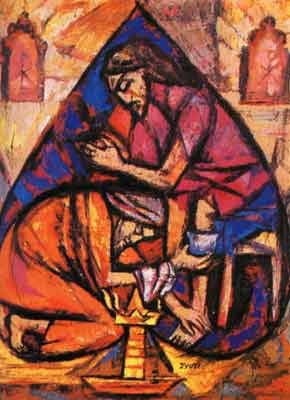
So, he rose from the table, took off his outer garment, and tied a towel around his waist. Then he poured some water into a washbasin and began to wash the disciples’ feet and dry them with the towel around his waist.
He came to Simon Peter, who said to him, “Are you going to wash my feet, Lord?”
Jesus answered him, “You do not understand now what I am doing, but you will understand later.”
Peter declared, “Never at any time will you wash my feet!”
“If I do not wash your feet,” Jesus answered, “you will no longer be my disciple.”
Simon Peter answered, “Lord, do not wash only my feet, then! Wash my hands and head, too!”
Jesus said, “Those who have taken a bath are completely clean and do not have to wash themselves, except for their feet. All of you are clean—all except one.” (Jesus already knew who was going to betray him; that is why he said, “All of you, except one, are clean.”)
After Jesus had washed their feet, he put his outer garment back on and returned to his place at the table.
“Do you understand what I have just done to you?” he asked. “You call me Teacher and Lord, and it is right that you do so, because that is what I am. I, your Lord and Teacher, have just washed your feet. You, then, should wash one another’s feet. I have set an example for you, so that you will do just what I have done for you. I am telling you the truth: no slaves are greater than their master, and no messengers are greater than the one who sent them. Now that you know this truth, how happy you will be if you put it into practice!…
Jesus said, “Now the Son of Man’s glory is revealed; now God’s glory is revealed through him. And if God’s glory is revealed through him, then God will reveal the glory of the Son of Man in himself, and he will do so at once. My children, I shall not be with you very much longer. You will look for me; but I tell you now, what I told the Jewish authorities, ‘You cannot go where I am going.’
“And now I give you a new commandment: Love one another. As I have loved you, so you must love one another. If you have love for one another, then everyone will know that you are my disciples.” (Good News Translation)
We all need love.
Without love, relationships devolve into silent standoffs and destructive triangles. The world ceases to spin on its axis.
But with love, all things are beautiful, personal relations have meaning and joy, and all seems right and just in the world.
This wonderful love, however, comes with a great cost.
Because we live in a broken world filled with pride and arrogance, greed and avarice, hate and envy, we are victims of loveless, faceless, and unjust systems.
We need Love to rescue and redeem us from the muck and crud of injustice.
It’s as if we are constantly walking knee deep through icky sludge so thick that we can barely get anywhere.
We need saving…. We need Jesus.
Christians everywhere around the world are journeying through Holy Week, the most sacred time of the year for followers of Christ. When we consider Holy Week, many are familiar with Good Friday and certainly Easter, but Maundy Thursday?
On this day the church remembers the last evening Jesus shared with his disciples in the upper room before his arrest and crucifixion.
The experiences in the upper room were highly significant because this was the last teaching and modeling that Jesus gave before facing the cross. Jesus was deliberate in communicating exactly what was important to him: Love one another.
Maundy Thursday marks three important events in Christ’s Last Supper with his disciples:
The washing of the disciples’ feet (the action of loving service)
The instituting of the Lord’s Supper (the remembrance of loving sacrifice)
The giving of a “new” commandment to love one another (the mandate of a loving system).
For Jesus, the last night with his disciples was all about love, God’s love. On that fateful night, having loved his disciples for the past three years, Jesus showed them the full extent of his love by taking the posture of a servant and washing each and every one of the disciples’ feet, including Judas.
After demonstrating for them a totally humble service, Jesus said, “I have set you an example that you should do as I have done for you.”
Jesus Christ loves me just as I am, and not as I should be.
Christ loves me even with my dirty stinky feet, my inconsistent half-hearted commitment to him, and my pre-meditated sin.
Not only did Jesus wash the disciples’ feet; he also lifted the cup of wine and boldly asserted:
“Take this and divide it among you. For I tell you I will not drink again of the fruit of the vine until the kingdom of God comes.” And he took the bread, gave thanks and broke it, and gave it to them, saying, “This is my body given for you, do this in remembrance of me.” In the same way, after the supper he took the cup saying, “This cup is the new covenant in my blood, which is poured out for you.” (Luke 22:17-20, NIV)
Because of these words from Jesus, the church throughout the world, for the past two millennia, have practiced this communion so that we might have the redemptive events of Jesus pressed firmly into both our minds and our hearts by means of the visceral and common elements of bread and wine.
We are to not just know about Jesus – we are to experience being united with him.
Having washed the disciples’ feet and proclaimed to them the meaning of his impending death, Jesus gave them a clear commandment: “A new command I give you: Love one another. As I have loved you, so you must love one another. By this everyone will know that you are my disciples if you love one another.”
Love one another, insisted Jesus, through imitation of his humble service. We represent Christ on this earth when we carefully, diligently, and persistently practice love.
Although love was by no means a new concept for the disciples, in the form and teaching of Jesus love was shown with four distinctions:
A new model of love: Jesus
A new motive of love, that Christ first loved me
A new motivator to help us love, the Holy Spirit
A new mission, the evangelization of the world, utilizing the power of Christ’s love to accomplish it
Maundy Thursday is a highly significant day on the Church Calendar – one which deserves to be observed. It’s an opportunity to remember the important words and actions of Jesus on our behalf.
In Christ, we allow love to characterize our life together as we proclaim God’s love in both word and deed. A watching world will only take notice and desire to be a part of our fellowship if we are deeply and profoundly centered in the love of God in Christ. This is the reality that Maundy Thursday brings to us.
God of love, you have given us a new command to love each other. Help us to show that love in our care of creation, to all nations and ethnicities, in our communities and neighborhoods, through the Church everywhere, and with the persons closet to us and their needs. In all our thoughts, words, and actions may we be your servants and reflect your love, through our Savior, Jesus Christ, your Son, who lives and reigns with you and the Holy Spirit, one God, now and forever. Amen.
Some Greeks were among those who had gone to Jerusalem to worship during the festival. They went to Philip (he was from Bethsaida in Galilee) and said, “Sir, we want to see Jesus.”
Philip went and told Andrew, and the two of them went and told Jesus. Jesus answered them, “The hour has now come for the Son of Man to receive great glory. I am telling you the truth: a grain of wheat remains no more than a single grain unless it is dropped into the ground and dies. If it does die, then it produces many grains. Those who love their own life will lose it; those who hate their own life in this world will keep it for life eternal. Whoever wants to serve me must follow me, so that my servant will be with me where I am. And my Father will honor anyone who serves me.
“Now my heart is troubled—and what shall I say? Shall I say, ‘Father, do not let this hour come upon me’? But that is why I came—so that I might go through this hour of suffering. Father, bring glory to your name!”
Then a voice spoke from heaven, “I have brought glory to it, and I will do so again.”
The crowd standing there heard the voice, and some of them said it was thunder, while others said, “An angel spoke to him!”
But Jesus said to them, “It was not for my sake that this voice spoke, but for yours. Now is the time for this world to be judged; now the ruler of this world will be overthrown. When I am lifted up from the earth, I will draw everyone to me.” (In saying this he indicated the kind of death he was going to suffer.)
The crowd answered, “Our Law tells us that the Messiah will live forever. How, then, can you say that the Son of Man must be lifted up? Who is this Son of Man?”
Jesus answered, “The light will be among you a little longer. Continue on your way while you have the light, so that the darkness will not come upon you; for the one who walks in the dark does not know where he is going. Believe in the light, then, while you have it, so that you will be the people of the light.”
After Jesus said this, he went off and hid himself from them. (Good News Translation)
Today is another step in our journey together with Jesus. The path we are on together leads to a cruel cross. For the past six weeks the Christian has been on a Lenten walk. To keep the long sojourn going, believers focus on spiritual discipline, prayer, and repentance.
Shadow
Along the way we come face-to-face with the shadow parts of ourselves. We discover that within us there is the pull to hold-on to unhealthy rhythms and habits of life. There is an inner push to arrange our lives with the fragmentation of disordered love.
Our reflexive response to things we do not like about ourselves might be to either use sheer willpower to change, or to try and manage our brokenness – as if we could boss our spiritual selves out of the darkness. However, the problem and the solution are much more radical than we often would like to admit.
While on this journey, Jesus invites us to die to ourselves. The pull and push of sin cannot be managed or willed away – it must be eradicated and completely cut out, like the cancer it is. Transformation and new life can only occur through death.
A tiny little seed can grow, break the ground, and develop into something which provides sustenance for others. It does no good to remain a seed in the ground. The little kernel must change beyond it’s current recognition if it is to reach for the sky and become food for the world.
Suffering
Christ is the ultimate example of the one who died to himself and for us. Only through suffering and death did he secure deliverance and freedom from sin, death, and hell. By his wounds we are healed. Through his tortuous death, new life became possible – because there must be a death if there is to be a resurrection; there must be suffering before there is glory.
Through dying to self and following Jesus, a transformative experience happens. As we change, mature, and produce a crop, we bring the kind of spiritual sustenance the world so desperately needs. Following Jesus, leaving all to walk with him, is true repentance and authentic discipleship.
Perhaps you protest, thinking I’m being too forceful or insistent about this Jesus stuff. Yes, you have perceived rightly. Within some corners of Christianity, a wrongheaded notion has developed that believes suffering is not God’s will.
Jesus, however, is insistent that dying to self is necessary. And it hurts like hell. It’s a hard teaching to absorb when you so desperately want things to be rainbows and unicorns. Suffering, whether we like it, or not, is the way of Jesus:
“In the days of his flesh, Jesus offered up prayers and supplications, with loud cries and tears, to the one who was able to save him from death, and he was heard because of his reverent submission. Although he was a Son, he learned obedience through what he suffered; and having been made perfect, he became the source of eternal salvation for all who obey him.” (Hebrews 5:7-9, NRSV)
We are not above our Master. Christ’s life on this earth, before his crucifixion and death, was marked with suffering. Jesus learned obedience through struggle and adversity. The Lord himself did what he is now asking us to do.
Christ gave himself up to do the Father’s will. Jesus offered loud cries and tears and submitted to what the Father wanted. We must do no less. We don’t get to choose which parts of Christ’s life and teaching we will observe and which ones we won’t, as if Jesus were some spiritual buffet line.
All who live for Jesus will follow him into the path of suffering, of death to self, and of new life through the power of his resurrection. In Christ’s own words: “Those who love their life will lose it, and those who hate their life in this world will keep it for eternal life.” We must…
Surrender
We have hundreds, maybe thousands of small decisions every day with the use of our time, our money, our energy, and our relationships. If we have tried to fix what is broken inside of us, we will likely just try to hastily fix the problems and the people in our lives, then move on with getting things done on our to-do list.
Instead, we have the invitation to surrender. We have the opportunity to create sacred space for solitude and silence, prayer and repentance. Take the time to (in person or virtually) sit with a person in pain and listen. Reflect on how to use your money for kingdom values. See your life as a holy rhythm of hearing God and responding appropriately.
Sacrifice
Holding-on to our stuff and time is the opposite of sacrifice – it’s avarice. I understand that you and I are not Jesus – our sacrifice and suffering are not efficacious, that is, it doesn’t deliver other people from sin. Only Christ’s death does that. Yet, we are still called to sacrifice:
“I am now rejoicing in my sufferings for your sake, and in my flesh, I am completing what is lacking in Christ’s afflictions for the sake of his body, that is, the church.” (Colossians 1:24, NRSV)
Pleasure is not the summum bonum of life. Our lives are not meant to be lived solely for minimizing pain and maximizing comfort. Jesus has extended the call to view our workplaces, communities, neighborhoods, and families as our mission field of grace to a world in need of basic human kindness and attention – which takes sacrificial love on our part.
Christianity isn’t a religion that’s for people who have neatly packaged theological answers and certainties to all of life’s questions. Rather, Christianity is a dynamic religion of learning to follow Jesus, discovering how to die to self, and struggling to put Christ’s teaching and example into practice.
The way of Christ is often characterized by a three-steps-forward, two-steps-backward sort of reality. The road is zig-zags with plenty of potholes. Those who don’t struggle are in big trouble. However, those who go through the pain of dying to self for the sake of their Lord, find that the harvest they produce leads to eternal life.
May you struggle well, my friend.
Almighty God, your dear Son did not ascend to joy until he first suffered pain; he did not enter glory before he was crucified. Mercifully grant that we, walking in the way of the cross, may find it as the true wayof life and peace, through Jesus Christ, your Son, our Lord. Amen.






 Rev. Tim Ehrhardt