“I Have Set You an Example” (John 13:1-17)

Jesus Washes Peter’s Feet

Now before the festival of the Passover, Jesus knew that his hour had come to depart from this world and go to the Father. Having loved his own who were in the world, he loved them to the end. The devil had already decided that Judas son of Simon Iscariot would betray Jesus. And during supper Jesus, knowing that the Father had given all things into his hands and that he had come from God and was going to God, got up from supper, took off his outer robe, and tied a towel around himself. Then he poured water into a basin and began to wash the disciples’ feet and to wipe them with the towel that was tied around him. 

He came to Simon Peter, who said to him, “Lord, are you going to wash my feet?” Jesus answered, “You do not know now what I am doing, but later you will understand.” Peter said to him, “You will never wash my feet.” Jesus answered, “Unless I wash you, you have no share with me.” Simon Peter said to him, “Lord, not my feet only but also my hands and my head!” Jesus said to him, “One who has bathed does not need to wash, except for the feet, but is entirely clean. And you are clean, though not all of you.” For he knew who was to betray him; for this reason he said, “Not all of you are clean.”

After he had washed their feet, had put on his robe, and had reclined again, he said to them, “Do you know what I have done to you? You call me Teacher and Lord, and you are right, for that is what I am. So if I, your Lord and Teacher, have washed your feet, you also ought to wash one another’s feet. For I have set you an example, that you also should do as I have done to you. Very truly, I tell you, slaves are not greater than their master, nor are messengers greater than the one who sent them. If you know these things, you are blessed if you do them. (New Revised Standard Version)

One of the reasons I like Jesus so much is that he loves me as I am, and not merely as I should be. Jesus loves me even with my dirty stinky feet, my herky-jerky commitment to him, and my pre-meditated sin.

In fact, Jesus loved even Judas and washed his feet. Jesus serves people because they need his love, and not so that they will love him back.

I recently read about a man who lived in Paris. His wife had Alzheimer’s. He was an important businessman and his life was filled with busyness. Yet, he said when his wife fell sick:

“I just couldn’t put her into an institution, so I kept her. I fed her. I bathed her. Through the experience of serving my wife every day, I have changed. I have become more human. The other night, in the middle of the night, my wife woke me up. She came out of the fog for a moment, and she said, ‘Darling, I just want to say thank you for all you are doing for me.’ Then she fell back into the fog. I wept for hours to know this grace.” A Severe Mercy, by Sheldon Vanauken

Sometimes Christ calls me to love people who either cannot or will not love me in return. They live in the fog of some sort of disability, depression, poverty, or common spiritual blindness. As I serve them, I may only receive brief glimpses of gratitude. Just as Jesus loves me within my own spiritual confusion, so I desire to continue loving others as they walk through whatever fog they are in.

Lord willing, my life will be useful through my words and my witness. If God desires, my life will bear fruit through my prayers, my service, and my love. Yet, the usefulness of my life is God’s concern, not mine; it would be indecent of me to worry about that. I simply desire to follow my Lord’s example.

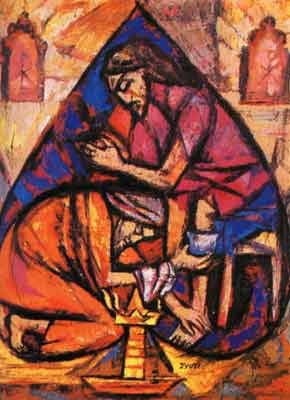
Ethiopian Orthodox Church icon of Jesus washing the disciples’ feet

Neither many Christians nor churches wash feet anymore. So, the following is today’s Gospel lesson put in a slightly different contemporary context:

It was just before the biggest and most important feast of the year. Jesus knew that it was finally the time for him to face the cross and die for the world’s sins. Having spent the past three years loving his followers, he now wanted to leave them with a clear demonstration of his love that they would never forget.

The evening meal was being served, and the devil had already gotten a hold of Judas Iscariot to betray Jesus to those who wanted him dead and gone. But it was all according to plan. Jesus knew that his heavenly Father had given him all authority because he was his Son, and he was ready to do what needed to be done to secure salvation and return to his rightful place at his Father’s right hand. 

So, Jesus got up from the meal, rolled up his sleeves, put an apron on, and ran a sink full of hot water. Jesus told the servants to take the night off, and he began taking the dishes from the dinner table and started washing them, taking care to do all that waiters and dishwashers would do.

When Jesus came to take care of Simon Peter’s dishes and serve him dessert and coffee, Peter said to him, “Lord, are you going to serve me?” Jesus replied, “I know you do not understand why I am doing this since it seems like something that is beneath me to do, but later you will look back on this night and understand completely what I am doing.”

“No,” said Peter, “this is not right – you are the Master, and this is not what a well-respected rabbi does – you are only disrespecting yourself and making us all look foolish. You are not going to take my dishes and wash them.”

Jesus answered, “Unless I wash these dishes and serve you, you are not going to be able to follow me anymore, and you will have no part of what I am doing in this world.”

“Well, then, Lord,” Simon Peter replied, “if that is the way it really is, then don’t just wash the dishes – come on over to my place and clean out the fridge and scrub the kitchen floor!”

Jesus answered, “A person who has had a decent meal needs only to wash the dishes so that he can enjoy the freedom of hospitable relationships with me and those around him. And all of you here have had a decent meal, though not every one of you.” For Jesus knew that Judas was only picking at his food in anticipation of betraying him.

When Jesus was all done washing the dishes and serving his disciples, he took his apron off, rolled his sleeves back down, and returned to the table. He looked them all squarely in the eye and said, “Do you understand what I just did for you? 

You call me ‘Teacher’ and ‘Master,’ and rightly so, for that is exactly what I am. So, now that I, your Master, and your Teacher have washed your dishes, you also should wash one another’s dishes. I have set you an example that you should do as I have done for you. I am telling you the plain truth that no follower is greater than the one he follows, nor is a preacher greater than the one he preaches about. 

Now that you know it is your task in this life to provide humble loving service, you will have God’s stamp of approval on your life if you quit thinking about how to possess and use power for your own purposes, and start thinking about how to use the authority I am giving you to love other people into the kingdom of God.

Loving Lord Jesus, how shocking it was for your disciples to be served by you in such a humble manner. But I cannot be spiritually cleansed unless I allow you to love me in an almost embarrassing fashion. Help me not to be so proud that I neither refuse your humble loving service toward me, nor neglect to offer that same kind of service to others. May love be the word, the idea, and the action that governs my every motivation and movement in your most gracious Name, I pray. Amen.

The Spirit’s Ministry (John 14:25-26)

Jesus said:

“I have spoken these things to you while I am with you. The Companion, the Holy Spirit, whom the Father will send in my name, will teach you everything and will remind you of everything I told you.” (Common English Bible)

“These things I have spoken to you while I am still with you. But the Helper, the Holy Spirit, whom the Father will send in my name, he will teach you all things and bring to your remembrance all that I have said to you.” (English Standard Version)

“I’m telling you these things while I’m still living with you. The Friend, the Holy Spirit whom the Father will send at my request, will make everything plain to you. He will remind you of all the things I have told you.” (The Message)

“All this I have spoken while still with you. But the Advocate, the Holy Spirit, whom the Father will send in my name, will teach you all things and will remind you of everything I have said to you.” (New International Version)

“These things have I spoken unto you, while yet abiding with you. But the Comforter, even the Holy Spirit, whom the Father will send in my name, he shall teach you all things, and bring to your remembrance all that I said unto you.” (American Standard Version)

“These things I have spoken to you, while I am still with you. But the Counselor, the Holy Spirit, whom the Father will send in my name, he will teach you all things, and bring to your remembrance all that I have said to you.” (Revised Standard Version)

“The Holy Spirit is the bond by which Christ unites us to himself.”

John Calvin

We are now in the season of “Ordinary Time” or “Proper Time” in the Church Year. It is “ordinary” in the sense that the Holy Spirit has been given to do the “proper” ongoing work of growing believers in Christ and helping them live into his directives.

The Spirit is our Teacher, cultivating and stirring-up within us all that we need for the Christian life.

As you can see from a few of the various English translations of today’s Gospel verses, there is no uniform rendering of the original Greek word, “Paraclete.” That’s because this word for the Spirit is so rich and full that it’s difficult to encompass what it means with a single English word.

A straightforward literal translation of “Paraclete” needs a phrase rather than a word: “Called alongside for encouragement,” fairly-well translates it. All the various words used in the different versions of the New Testament are accurate – yet they merely bring out one dimension to the understanding of the Holy Spirit’s ministry.

Our needs as followers of Jesus are many – thus requiring a multi-faceted mentoring ministry by the Spirit.

The Spirit was sent to be with Christians continually as their Teacher, reminding them of all Jesus has said and done as the ultimate witness to Christ’s life and ministry.

The role of the Holy Spirit is to provide comfort and aid for Christians, especially in difficult situations; the Spirit helps in a time of need.

The force of “Paraclete” is even more than this because there’s also the dimension of the Spirit being our close companion. Indeed, it is a special friend who stands up for us, advocates on our behalf, gives us remedial teaching, and brings comfort.

The Holy Spirit is motivated (just like the Father and the Son) with love for us, to give whatever we need to live a successful, abundant, and full Christian life.

In whatever situation we face, the Holy Spirit is something of a divine concierge in the middle of adversity who is attentive to every need.

The true difficulty in describing the Spirit’s ministry with us is that the Spirit is God – and no amount of description will adequately get our minds around the Spirit. God is much too big for that. All metaphors, images, and words fall short of genuinely expressing the Spirit’s immense work.

Perhaps a story will better illustrate the Spirit’s nature and work. When my girls were small and I was a financially struggling seminarian, we were one evening down to our last bit of food. Although they thought it was a privilege to eat Wheaties for supper, my wife and I knew the cupboard was now bare. So, we prayed.

As we got up from our knees and started off for bed, there was a knock at our patio back door. We looked at each other wondering who in the world it could be at such a late hour. When I drew the shades, one of our neighbors, a little Puerto Rican woman, was outside holding what appeared to be more than her own body weight in overflowing grocery bags.

I ushered her in and before I could say a word, she said, “I went to bed and had just fallen into a deep sleep. But the Holy Spirit woke me up and told me to take as many groceries as I could carry to you. So, here I am.” In that moment, I knew in my head and felt in my heart a ministry of the Spirit which transcends language.

The next morning our girls learned something about God that they would never get from listening to their Dad’s teaching and preaching. This is a story which gets retold often because it reminds us of how God meets us in our need and how much God cares.

Through such encounters with the Spirit (and I have mercifully been granted many of them!) I begin to understand and appreciate the wisdom of the saints throughout the ages:

“When the grace of the Holy Spirit enters a soul and is established there, it gushes forth more powerfully than any other spring; it neither ceases, dries up, nor is exhausted. And the Savior, to signify this inexhaustible gift of grace, calls it a spring and a torrent; He also calls it gushing water, to indicate its force and impetus.”

St. John Chrysostom

“Trying to do the Lord’s work in your own strength is the most confusing, exhausting, and tedious of all work. But when you are filled with the Holy Spirit, then the ministry of Jesus just flows out of you.”

Corrie Ten Boom

May you know the ministry of the Spirit, inside and out, in all ways and in all circumstances.

A Prayer of St. Augustine:

Breathe in me, O Holy Spirit,
That my thoughts may all be holy.
Act in me, O Holy Spirit,
That my work, too, may be holy.
Draw my heart, O Holy Spirit,
That I love only what is holy.
Strengthen me, O Holy Spirit,
To defend all that is holy.
Guard me, then, O Holy Spirit,
That I always may be holy. Amen.

How Jesus Prayed (John 17:1-11)

After Jesus said this, he looked toward heaven and prayed:

“Father, the hour has come. Glorify your Son, that your Son may glorify you. For you granted him authority over all people that he might give eternal life to all those you have given him. Now this is eternal life: that they know you, the only true God, and Jesus Christ, whom you have sent. I have brought you glory on earth by finishing the work you gave me to do. And now, Father, glorify me in your presence with the glory I had with you before the world began.

“I have revealed you to those whom you gave me out of the world. They were yours; you gave them to me and they have obeyed your word. Now they know that everything you have given me comes from you. For I gave them the words you gave me and they accepted them. They knew with certainty that I came from you, and they believed that you sent me. I pray for them. I am not praying for the world, but for those you have given me, for they are yours. 

All I have is yours, and all you have is mine. And glory has come to me through them. I will remain in the world no longer, but they are still in the world, and I am coming to you. Holy Father, protect them by the power of your name, the name you gave me, so that they may be one as we are one.” (New International Version)

Prayer can be described in many ways. Yet, at it’s heart, prayer is simply talking to God. Jesus had taught his disciples early in his ministry about how to pray (The Lord’s Prayer). Now he demonstrates the way to pray, also revealing the heart of God in the process. Our prayers reflect our values and what is truly in our hearts. As Jesus offers his petitions to the Father, let’s notice what they are, and so, align our own hearts with the heart of God.

First Petition: Glorify God

Jesus prayed that he himself would be glorified, so that then he might turn right around and glorify the Father in heaven. This is a great lesson for all who pray – that we seek to receive in order to give.

All of life is dependent upon rhythms of receiving and giving. We breathe in and breathe out in a consistent flow. If that doesn’t happen, we have major health issues. Jesus promised that he would send the Spirit of God to help us breathe spiritually.

And so, it’s important that we routinely inhale the Holy Spirit so that we may exhale the virtues of love, joy, peace, patience, kindness, goodness, faithfulness, gentleness, and self-control for the benefit of the church and the blessing of the world.

Please never forget that we are stewards of the grace given to us by God. That means our purpose is not for avarice (to hoard the spiritual resources so generously given to us) but to receive, so that we can give. And God’s grace is inexhaustible; we shall never run out of offering peace and reconciliation to the world. That, my friends, is how we glorify God and show God’s Name as holy. (Matthew 6:9)

Two Groups and Three Givings

            Jesus mentions two groups: The Father and Son; and the World and Church. And he prays that the Father will give in three distinct ways:

  1. The Father gave the Son authority over all humanity. Jesus truly has the whole world in his hands. And when the Son has a hold of people, there’s no snatching them out. Jesus is not a hired hand; he is the hand of God. Since Jesus is in charge, we can be fully confident that every single member of the human race will be treated with respect in this life and with fairness on Judgment Day.
  2. The Father has given Jesus a second group of people out of the whole of humanity: the Church. Both the World and the Church are in Christ’s hands. Jesus has other sheep who are not yet in the fold. He is presently, by means of the Holy Spirit, gathering them into his divine sheep pen. There are two groups and three givings; but there is only One Shepherd and one Flock. And this one Flock of Christ is to be a kingdom of priests to serve the interests of the entire world. (1 Peter 2:9-10)
  3. The Church has been given the gift of Jesus by the Father. The Flock has received life – abundant and everlasting life. This by no means implies that we are in some sort of holding pattern until Christ returns to take us to be with him. Rather, now we are to be busy giving the world the gift of grace we ourselves have received. Life – real life, true life – is to know the Father and the Son.

God is glorified when we take up the mission given to us by Jesus:

  • We are called by God for a reason: to do justice, to love mercy, and to walk humbly with our God (Micah 6:8)
  • We are given a purpose of bearing witness to what God has done for us in Christ Jesus (Acts 1:8)
  • We are commissioned to make disciples from all nations, all ethnicities, and every sort of people (Matthew 28:19)
  • We are commanded to do it all through love of God and neighbor (Mark 12:28-31)

Second Petition: Protect the Church

Why does Jesus pray for our protection? So that we might be one as the Father and Son are one – and will not fragment and be scattered without any relation to each other.

Here are a couple of simple observations: this prayer of Jesus is not yet answered; and if Jesus can have unanswered prayer for two thousand years, maybe we ought to cut ourselves (and others!) a bit of slack on not getting our own prayers answered.

When we consider the Church throughout the world, we see that various Christian traditions just plain don’t like each other, and even accuse one another of not being Christians at all! And, what’s more, a chunk of the Church seems to be abusive.

Whether it’s Roman Catholicism and the sad story of the priest sexual abuse, or the steady stream of stories about Protestant Evangelical pastors who do the same and use their authority for personal and selfish advantage, there is plenty of awful crud out there.

And what the world sees, far too often, is a profound lack of grace – which brings us back to what we need to be doing to begin with: receiving grace so that we can give it to others. If this is not at the heart of our prayers (and apparently isn’t for many Christians) then we ought not be surprised whenever the world wants nothing to do with Christianity.

Unity is important to Jesus; it ought to be important to us. We need to work at it and work toward it. As God is One, so are God’s people to be one.

Unity does not mean:

  • one cultural expression (i.e. American)
  • the same personality (i.e. extroverted)
  • Christendom (i.e. the Church holding political power)

Unity does involve:

  1. being one in our basic mindset (humble, merciful, holy, peaceful)
  2. being one in purpose (glorifying God)

Therefore if you have any encouragement from being united with Christ, if any comfort from his love, if any common sharing in the Spirit, if any tenderness and compassion, then make my joy complete by being like-minded, having the same love, being one in spirit and of one mind. Do nothing out of selfish ambition or vain conceit. Rather, in humility value others above yourselves, not looking to your own interests but each of you to the interests of the others. In your relationships with one another, have the same mindset as Christ Jesus. (Philippians 2:1-5, NIV)

The Church, the people of God, are to be protected and kept safe from fragmenting into mere special interest groups who only care about their particular pet convictions or projects. Instead, we are to take a step back and see the big forest of Christianity and appreciate all the various trees within it. The Gospel of Jesus Christ is preserved and secured whenever we keep this unity of Christ in the middle of everything, and let go of everything else as being a test of Christian unity (e.g. personal convictions, church dogma and confessional statements).

Conclusion

So, what does this all mean for us? Pray. Talk to God. And talk to God about the same things that Jesus prayed about while he was here on this earth. We might discover that many of the issues we care about will resolve themselves if we simply pray as Jesus has modeled for us.

O God, the Father of our Lord Jesus Christ, our only Savior, the Prince of Peace: Give us grace to set aside and let go of all dissension and division in Christ’s Church. Take away all hatred and prejudice, and everything that hinders us from unity and harmony.

As there is but one Body, and one Spirit, and one hope of our calling, one Lord, one faith, one baptism, one God and Father of us all; so may all your people be of one heart, and of one soul, united in one holy bond of truth and peace, and of faith and love, with one mind and one mouth glorifying you, through Jesus Christ our Lord. Amen.

The Truth About You (John 8:21-30)

Once more Jesus said to them, “I am going away, and you will look for me, and you will die in your sin. Where I go, you cannot come.”

This made the Jews ask, “Will he kill himself? Is that why he says, ‘Where I go, you cannot come’?”

But he continued, “You are from below; I am from above. You are of this world; I am not of this world. I told you that you would die in your sins; if you do not believe that I am he, you will indeed die in your sins.”

“Who are you?” they asked.

“Just what I have been telling you from the beginning,” Jesus replied. “I have much to say in judgment of you. But he who sent me is trustworthy, and what I have heard from him I tell the world.”

They did not understand that he was telling them about his Father. So Jesus said, “When you have lifted up the Son of Man, then you will know that I am he and that I do nothing on my own but speak just what the Father has taught me. The one who sent me is with me; he has not left me alone, for I always do what pleases him.” Even as he spoke, many believed in him. (New International Version)

Jesus was an interesting guy – both cagey and confrontational at the same time. He had a way (the way, in fact) that left those who longed for mercy and encouragement to receive it, while also giving rebuke to those satisfied with being stuck in their misguided lives.

This made Christ one of those persons whom you either loved or hated. The people that loved him, adored him; and those that hated him, sought to kill him.

It’s really a matter of self-perception. The ones who tend to self-loathe and wonder if they’re accepted, or not, are the ones who feel on the outside. These are the folks who discover themselves on the inside, accepted by God. And Jesus made it happen for them.

On the other hand, the ones who are enamored with themselves and their superior religion, looking down at others and feeling secure as insiders, are the people who will find they’re actually on the outside looking in; indeed, they will die in their self-delusion.

Our self-identification matters. If identity is tied to what we’re able to do for God, and/or how pious we look for others to see, then our inflated egos will eventually be popped with the pinprick of divine judgment. But if identity is tethered to belonging to God by divine grace and mercy, then we shall know true acceptance.

We need to know the truth about ourselves. Both truth and error are powerful. If we have misguided notions of self, we are like empty wells with no water to draw from. Many of our problems, failures, and shame are largely due to a misunderstanding of the kind of person we are. 

A profound result of this misunderstanding is a lack of self-worth. When we are in error about who we really are, we are severely limited in what we can do in our lives. We can neither solve the problem by comparing ourselves with others nor by trying to generate good feelings about ourselves. Only through accepting what the Holy Scriptures say about us, and responding in faith, can we be truly helped.

So, here are some bedrock truths about us:

  1. We are created in the image and likeness of God. (Genesis 1:16-17)  We begin to understand ourselves by beginning with the creation of the world. Since God is a Person of infinite perfection and goodness, to be created in God’s image means we are persons of great potential and value.
  2. We are special to God. The Lord treats us as persons; therefore, we may not treat ourselves any less than that. To be a person means that we are self-conscious and can make decisions. We also have inherent rights to know, to be heard, to feel, to have an opinion, to be honored, to develop potential, to assume responsibility, and to enjoy life and all creation.
  3. We are loved by God (John 15:9; 17:23) God recognizes us as persons, gives us our rightful place in the divine life, and will do what is right by us. In other words, God has our back. The Lord will not gaslight us.
  4. We are called to a relationship with the loving God (1 Corinthians 1:9) No greater honor could be bestowed on us than to be invited to interact with the Living God. As we do, the door is open so God can minister to us and lead us into the knowledge and practice of a good life.
  5. We are the recipients of divine revelation (Hebrews 1:1-3) Having the Holy Scriptures available to us is the greatest possession we could ever receive. There is nothing more powerful than the truth about God and God’s design for our daily life. Therefore, we commit a profound sin when we neglect and disobey what God has so graciously given us.
  6. We are the objects of divine redemption (Romans 5:8-9) The great evidence of our human worth is the reality that Jesus Christ has secured our redemption from sin, death, and hell. Jesus, the Son of God, has loved us and gave himself for us. (Galatians 2:20)
  7. We are the temple of the Holy Spirit (1 Corinthians 6:19-20) The actual physical temple of the Old Testament was filled with the glory of God. Today, through Christ’s redeeming love on the cross, every believer in Jesus is God’s temple. Therefore, God wants to work in us and through us for to bless and serve the world.

The conclusion to the matter is that the only way we will know true self-worth is to accept what God says about us and respond by faith and love to this loving and redeeming message. You are a person of infinite worth to God, so live into this wonderful truth.

Gracious Creator, blessed all-knowing God, be merciful to upgrade my opinion of myself and my vision for the future so I never feel the need to protect and preserve the past. Show me how to be a faithful steward of the greatness you have placed within me.

Loving Lord, you know everything about me and love me anyway! As I accept and experience your grace and mercy, help me to grasp the depth and perfection of your love as demonstrated by the sacrifice of your only Son, Jesus Christ my Lord, who with you and the Holy Spirit are one God, now and forever. Amen.