Fight, Flight, Freeze, or Faith (Psalm 11)

I have taken refuge in the Lord.
    So how can you say to me,
    “Flee to the hills like a bird
        because the wicked
        have already bent their bows;
        they’ve already strung their arrows;
        they are ready to secretly shoot
        those whose heart is right”?
When the very bottom of things falls out,
    what can a righteous person possibly accomplish?

But the Lord is in his holy temple.
    The Lord! His throne is in heaven.
His eyes see—
    his vision examines all of humanity.
The Lord examines
    both the righteous and the wicked;
    his very being hates anyone who loves violence.
God will rain fiery coals and sulfur on the wicked;
    their cups will be filled
    with nothing but a scorching hot wind
    because the Lord is righteous!
    He loves righteous deeds.
    Those whose heart is right will see God’s face. (Common English Bible)

We all know what it feels like to take the brunt of someone’s poison verbal darts. It’s scary and stressful. What do you do? In a state of fear, shock, or panic, we will likely either fight, flight, freeze, or faith.

Fight

If you have ever received a nasty email based on half-truths and accusations; stood dumbfounded as someone hurled misinformation and criticism at you; and/or experienced the victimization that comes from slanderous and gossiping tongues, then the psalmist knows exactly how you feel. 

Cobbling together a hasty email response, full of anger and vitriol, only sucks us into the person’s evil ways. Metaphorically punching someone in the face for their slap to your face is how the demonic realm handles offenses. Fighting back with an equal or greater force is diametrically opposed to the way of Jesus in loving our enemies and praying for those who persecute us.

Flight

Then, there is the response of taking flight from the nastiness. Indeed, it sometimes seems as if good people are always getting swallowed whole by unjust words and behaviors directed squarely at them. 

And it doesn’t help when the downers among us stroll along and give us their unhelpful fatalism about how there is nothing we can do and how nothing will ever change.

Freeze

Some folks are just plain dumbfounded that another person can be so mean or controlling, so they freeze, unable to speak or do anything. They end up suffering in silence, without their victimization having a voice.

Faith

To be the target of evil speech or malevolent actions is, at the least, unsettling, and, at worst, can bring years of struggle, depression, and inability to serve. Yet, there is someone who sees it all, and that someone will address the wrong. 

We have an option beyond fighting back in anger, fleeing altogether in fear, or freezing in our tracks. We can trust God. We can have faith.

God Sees

The Lord sits aloft, overseeing all, and knows everything humanity does and says. God always does right and wants justice done. Everyone who shares a divine sense of what is right and just will see God’s face. God will act because the Lord abhors and despises those who are cruel and enjoy violence.

It’s not a good idea to get on God’s bad side. The way to flare God’s anger is by possessing an acerbic tongue; relishing in verbal violence; and, having no remorse about any of it. Because God loves people, God hates evil. 

The righteous can take solace in the truth that God really does see the harm done and is in a position to do something about it. Like the psalmist, we seek the Lord. The Lord fights our battles.
Not Okay

Whenever we are harassed and the ungodly give us a hard time, the psalmist isn’t offering some nice religious platitudes such as, “Just let go and let God,” “Everything works for the good of those who love God,” or “It’s okay, you’ll be in heaven someday.”

In another context, maybe those statements are helpful. But being in the teeth of the wicked, all is not okay. As much as some folks try to sanitize an evil situation with rainbows and butterflies, the evil is real, and it’s there.

The truth is that everything is not okay. And it’s okay to not feel okay. The earth is filled with violence, malevolence, oppression, injustice, and systemic evil. The psalmist knows this, all too well.

Humble yourselves under God’s power so that he may raise you up in the last day. Throw all your anxiety onto him because he cares about you.

1 Peter 5:6-7, CEB

God Acts

Today’s psalm is reminding and reassuring us that the Lord is aware of what’s going on and will most certainly do something about it. God will act to punish the wicked and deliver the Lord’s people.

There may not be peace this present moment, yet it will not always be this way. We shall behold the face of the Lord.

The Lord is a righteous judge. Justice is the foundation of God’s throne. God sees the entire spectrum of humanity and can make a right assessment of people’s thoughts, intents, words, and actions.

We, however, cannot. Therefore, it is most necessary for us to put our trust in a Divine Being who cares about right and wrong and has the power to act with justice.

Whenever we are hemmed-in through the schemes of diabolical persons and are powerless, there is always the choice to trust in the Lord. The outcome of every life on earth rests in the hands of God. And it will be a just and right rendering.

Trust in the Lord and do good. Seek peace and pursue it. We might struggle mightily on both the inside and outside – our hard circumstance might not change immediately – yet God is the One who will vindicate the just person when the time is right.

You are not alone. The Lord is with you always.

God of justice, look at the state of your servant and act on my behalf. Do not let evil prevail. Thwart the ungodly so that they can no longer do any harm. Amen.

Dealing with Injustice (1 Kings 1:28-48)

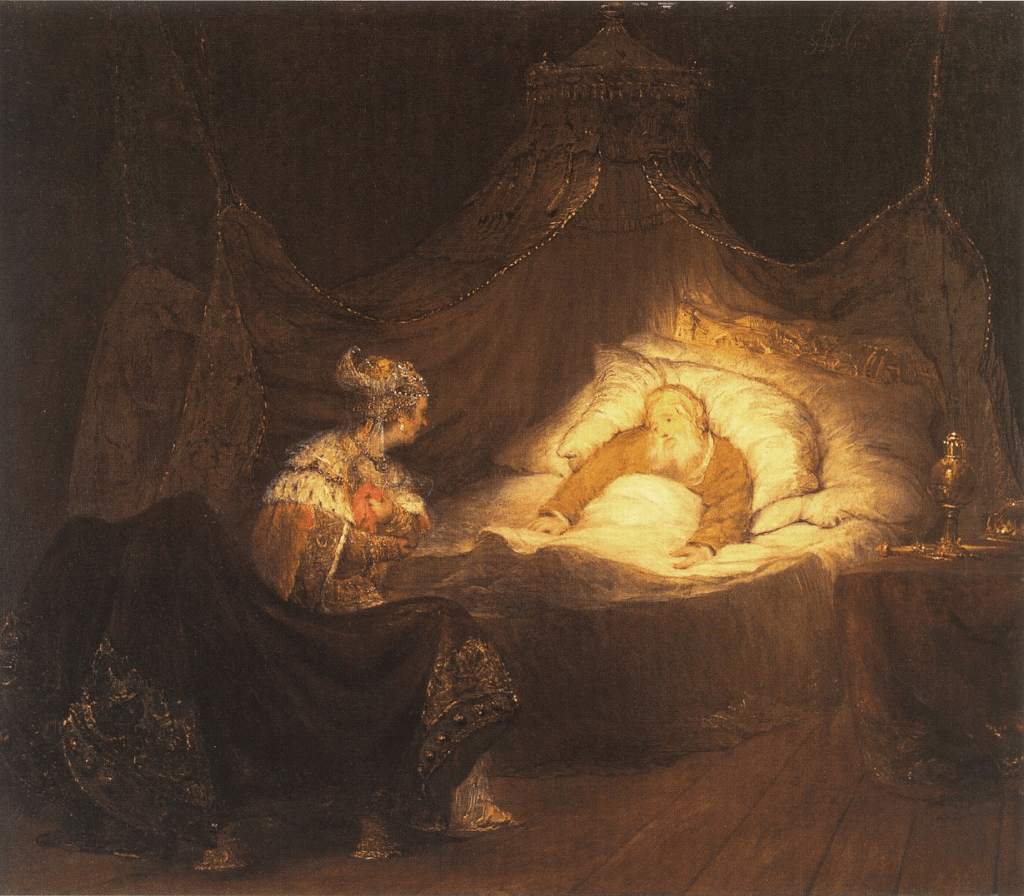
Bathsheba appeals to David, by Arent de Gelder, c.1685

Then King David said, “Call in Bathsheba.” So she came into the king’s presence and stood before him.

The king then took an oath: “As surely as the Lord lives, who has delivered me out of every trouble, I will surely carry out this very day what I swore to you by the Lord, the God of Israel: Solomon your son shall be king after me, and he will sit on my throne in my place.”

Then Bathsheba bowed down with her face to the ground, prostrating herself before the king, and said, “May my lord King David live forever!”

King David said, “Call in Zadok the priest, Nathan the prophet and Benaiah son of Jehoiada.” When they came before the king, he said to them: “Take your lord’s servants with you and have Solomon my son mount my own mule and take him down to Gihon. There have Zadok the priest and Nathan the prophet anoint him king over Israel. Blow the trumpet and shout, ‘Long live King Solomon!’ Then you are to go up with him, and he is to come and sit on my throne and reign in my place. I have appointed him ruler over Israel and Judah.”

Benaiah son of Jehoiada answered the king, “Amen! May the Lord, the God of my lord the king, so declare it. As the Lord was with my lord the king, so may he be with Solomon to make his throne even greater than the throne of my lord King David!”

So Zadok the priest, Nathan the prophet, Benaiah son of Jehoiada, the Kerethites and the Pelethites went down and had Solomon mount King David’s mule, and they escorted him to Gihon. Zadok the priest took the horn of oil from the sacred tent and anointed Solomon. Then they sounded the trumpet and all the people shouted, “Long live King Solomon!” And all the people went up after him, playing pipes and rejoicing greatly, so that the ground shook with the sound.

Adonijah and all the guests who were with him heard it as they were finishing their feast. On hearing the sound of the trumpet, Joab asked, “What’s the meaning of all the noise in the city?”

Even as he was speaking, Jonathan son of Abiathar the priest arrived. Adonijah said, “Come in. A worthy man like you must be bringing good news.”

“Not at all!” Jonathan answered. “Our lord King David has made Solomon king. The king has sent with him Zadok the priest, Nathan the prophet, Benaiah son of Jehoiada, the Kerethites and the Pelethites, and they have put him on the king’s mule, and Zadok the priest and Nathan the prophet have anointed him king at Gihon. From there they have gone up cheering, and the city resounds with it. That’s the noise you hear. Moreover, Solomon has taken his seat on the royal throne. Also, the royal officials have come to congratulate our lord King David, saying, ‘May your God make Solomon’s name more famous than yours and his throne greater than yours!’ And the king bowed in worship on his bed and said, ‘Praise be to the Lord, the God of Israel, who has allowed my eyes to see a successor on my throne today.’” (New International Version)

Solomon at the deathbed of King David, by Giulio Romano (1499-1546)

One of King David’s sons, Adonijah, was a stinker. He tried to pull a fast one on his aging father, in order to try and take the throne. But some of the people caught wind of what was afoot.

Even Nathan the prophet got involved and gave some sage instructions to Bathsheba, Solomon’s mother, so that the king’s wishes could come to fruition – namely, that Solomon would succeed David.

As a result, despite King David’s struggles toward the end of life, he had enough wherewithal to attempt some decisive leadership. He confirmed Solomon as his royal successor.

Despite Adonijah’s attempt to take advantage of his father’s failing capacity and execute a coup d’état, the king immediately took action by anointing and enthroning Solomon without any delay.

The installation of Solomon as king was accomplished so quickly that it caught the conniving Adonijah and his cohorts off guard. King David may have lost several steps in his old age, but he was still someone to be reckoned with. That underestimation would cost the connivers dearly.

To be honest, I don’t like Adonijah. And that’s what the storyteller wants us to feel. We are meant to read the narrative and walk away saying to ourselves that we don’t want to be like Adonijah; we don’t want injustice to have the day; instead, we want King David’s wishes honored, and to see a just and right Ruler ensconced as king.

The Lord is a just God. And since we are people created in God’s image and likeness, we have an inherent sense of justice down deep inside us. So, it drives people nuts whenever there are things happening which are not right nor good.

Everyone faces injustice, and things that are not right, in this life. The trick is to deal with it, without becoming unjust ourselves. It’s not an easy thing to do. It’s tough. So, how do we maintain being just while handling injustice?

The feeling of helplessness is rather uncomfortable, even painful. It doesn’t feel good to think that your efforts at doing right and being just don’t accomplish much of anything, and are only a drop in the bucket of what’s needed. It also doesn’t feel right whenever we see others going through injustice, and we have little to no way in helping the situation.

The first step in dealing with the world’s injustice is to acknowledge it. Don’t purposely ignore it, avoid it, or pretend that it isn’t there. Everything in life must be acknowledged before anything can be done about it – whether it’s dealing with an event, or your own emotions.

So, it is imperative that your care for yourself. And it’s the most important thing in being of service and help to others. Attend to the whole self – body, mind, emotions, and spirit – because it is necessary in order to move through unjust circumstances with health, confidence, and sobriety.

When facing injustice and dealing with it, no matter whether it concerns yourself or another, it’s good to keep in mind that our brains tend to gravitate toward the negative, to the detriment of seeing good and positive things.

Therefore, we must work at keeping our “compassion quotient” high, and not let our compassion turn to fatigue, then burn-out.

It seems that King David continually worked on maintaining a robust spirit and healthy self, so that, even when he was old, his compassionate and wise instincts kicked in – the ones he had spent a lifetime developing.

In contrast, Adonijah appears to have nurtured a self-centered and bitter spirit. He did not attend well to his spiritual and emotional health. His mind turned to the dark thoughts of intrigue and rebellion. Arrogance clouded his right mind. This would not end well for him.

Dealing with injustice is never easy. And it very much requires us to be healthy and just ourselves, so that when we are faced with issues of justice, we can deal with them in a good and right manner.

Almighty God, you have given all peoples one common origin.
It is your will that they be gathered together
as one family in yourself.
Fill the hearts of humanity with the fire of your love
and with the desire to ensure justice for all.
By sharing the good things you give us,
may we secure an equality for all
our brothers and sisters throughout the world.
May there be an end to division, strife and war.
May there be a dawning of a truly human society
built on love and peace. Amen.

The Grace of Redemption and Gratitude (Exodus 37:1-16)

Bezalel made the ark of acacia wood—two and a half cubits long, a cubit and a half wide, and a cubit and a half high. He overlaid it with pure gold, both inside and out, and made a gold molding around it. He cast four gold rings for it and fastened them to its four feet, with two rings on one side and two rings on the other. Then he made poles of acacia wood and overlaid them with gold. And he inserted the poles into the rings on the sides of the ark to carry it.

He made the atonement cover of pure gold—two and a half cubits long and a cubit and a half wide. Then he made two cherubim out of hammered gold at the ends of the cover. He made one cherub on one end and the second cherub on the other; at the two ends he made them of one piece with the cover. The cherubim had their wings spread upward, overshadowing the cover with them. The cherubim faced each other, looking toward the cover.

They made the table of acacia wood—two cubits long, a cubit wide and a cubit and a half high. Then they overlaid it with pure gold and made a gold molding around it. They also made around it a rim a handbreadth wide and put a gold molding on the rim. They cast four gold rings for the table and fastened them to the four corners, where the four legs were. The rings were put close to the rim to hold the poles used in carrying the table. The poles for carrying the table were made of acacia wood and were overlaid with gold. And they made from pure gold the articles for the table—its plates and dishes and bowls and its pitchers for the pouring out of drink offerings. (New International Version)

This section is, for the most part, a mirror image of Exodus 25:23-40 – which provides meticulous instructions from God on how to build the Ark of the Covenant and the Table that goes with it.

The purpose of this section in Holy Scripture is to give a detailed report that everything the Lord instructed Moses to do, was obediently done, down to every last detail.

This was of upmost importance to the biblical writer, because half-obedience is really not obedience, at all. And there needs to be obedience in order to realize blessing.

God had a purpose with ancient Israel to establish them as God’s people, with God dwelling amongst them. The way this would happen was by means of all the specific prescriptions for the Tabernacle with its worship implements.

Foremost amongst those worship implements was the Ark and the Table, simply because that was the place of meeting with God – and even more specifically – the place of redemption.

The Tabernacle was built, then erected and put into place, just as it was described by God to Moses. And that is the point. The Lord does not change. There was no Plan B or altering the agenda as things went along, because human sin and people’s foibles mucked up everything. No, that’s not how it went down.

Nothing detracts or sidelines God from accomplishing divine purposes – especially when it comes to redeeming people and coming alongside them.

Just because the Israelites disastrously made an idol in the form of a golden calf, and worshiped it as if it were God, did not mean God’s plan failed.

In fact, the Lord made the plan even better by showing exceeding grace in not wiping out the entire lot of them – but instead used the situation to demonstrate steadfast love and accomplish the divine purpose of redemption.

No matter how you slice or dice it, it always comes out as grace.

My hope is that you can see that through all of the details of worship implements and Tabernacle protocol, God bent over backwards to be with the people.

God is holy. God is absolute purity and light. That holiness and purity would incinerate us in a nanosecond if we didn’t have things in place to help us be with God. That was what the Ark and the Table helped to do for Israel.

There are times in Holy Scripture when things get repeated. Repetition, according to many scholars, communicates emphasis. The repeated details of the Ark and the Table, as well as all the other articles associated with worship, communicate the heart of God in wanting us to have access to the divine. In other words, its repeated because it’s important.

Access, redemption, worship, and mercy are all important for the believer. We learn from today’s seemingly mundane verses that:

  • Sin must be addressed in order to have access to God
  • A way has been made for us to be with God
  • We are enabled and empowered to approach God
  • We have received the mercy of redemption from God
  • We are to therefore give mercy to others through table fellowship and forgiveness
  • And we are to give thanks and have gratitude in our hearts to God

Listening to the instructions of God, obeying them, and enjoying them is at the heart of good religion. May it be so, to the glory of God.

Accept, O Lord, our thanks and praise for all that you have
done for us. We thank you for the splendor of the whole
creation, for the beauty of this world, for the wonder of life,
and for the mystery of love.

We thank you for the blessing of family and friends, and for
the loving care which surrounds us on every side.

We thank you for setting us at tasks which demand our best
efforts, and for leading us to accomplishments which satisfy
and delight us.

We thank you also for those disappointments and failures
that lead us to acknowledge our dependence on you alone.

Above all, we thank you for your Son Jesus Christ; for the
truth of his Word and the example of his life; for his steadfast
obedience, by which he overcame temptation; for his dying,
through which he overcame death; and for his rising to life
again, in which we are raised to the life of your kingdom.

Grant us the gift of your Spirit, that we may know him and
make him known; and through him, at all times and in all
places, may give thanks to you in all things. Amen.

Use Your Freedom For Good (Exodus 33:1-6)

Then the Lord said to Moses, “You and the people you brought out of Egypt must leave this place. Go to the land I promised to Abraham, Isaac, and Jacob with an oath, saying, ‘I will give it to your descendants.’ I will send a Messenger ahead of you, and I will force out the Canaanites, Amorites, Hittites, Perizzites, Hivites, and Jebusites. Go to that land flowing with milk and honey. But I will not be with you, because you are impossible to deal with, and I would destroy you on the way.”

When the people heard this bad news, they acted as if someone had died. No one wore any jewelry. The Lord had said to Moses, “Tell the Israelites, ‘You are impossible to deal with. If I were with you, I might destroy you at any time. Now take off your jewelry, and I’ll decide what to do with you.’” After they left Mount Horeb, the Israelites no longer wore their jewelry. (God’s Word Translation)

It took little time for the covenant between God and the Israelites to be violated. The relationship between the Lord and the people was meant to be cemented through a special covenant in which Yahweh makes promises to them and gives them instructions and commandments; and the Israelites pledge their fealty and promise to obey.

But the people quickly reneged on the relationship. While Moses was up on Mount Sinai, receiving the Law from God, the Israelite grumbles and complaints came to full flower. They went their own way and made a calf idol out of gold.

So, the Lord’s judgment broke out amongst them. The Levites, to their credit, rallied around Moses and the Lord, and took out the rabble rousers in the camp. What’s more, God sent a plague that killed many.

In the aftermath of the rebellion against Moses and the Lord, God ordered the people to leave Mount Sinai – the place where everyone was to have a positive experience of Yahweh’s presence. God’s anger and wrath were so aroused that it became impossible for the divine presence to go with the people. Only Moses, as God’s emissary, would be able to guide the Israelites so that they are not completely eradicated.

Mount Sinai, by Sefira Lightstone

Yet, even after all the bad attitudes, rebellious actions, and an idolatrous spirit among the Israelites, Yahweh will still keep the divine promise to Abraham, Isaac, and Jacob to deliver them and bring them to the Promised Land.

Today’s story has the feel of a chastened child sitting in the corner, having to think about what they just did to raise the ire of the parent. The Israelites moved from Sinai in a somber mood, realizing more clearly than ever how much their lives are tied and linked to God’s divine presence.

At God’s command, the people removed their jewelry and took off their party clothes from the celebration that got them into so much trouble. It began to sink in, that the Lord departed from them because of their great sin. They started to realize, albeit too late, that they really screwed up their relationship with God.

The Israelites didn’t know how good they had it with the divine pillar of cloud by day and fire by night to lead them – and how much they actually depended on the God-given manna for their sustenance and existence.

It’s all too typical for us humans that we fail to realize what we have, until it’s gone. The ancient Israelites were freed from a cruel slavery in Egypt. They clearly did not handle their freedom well, at all. Perhaps the people were so used to being in bondage that, when they go their freedom, they just adopted a different sort of slavery – to their sinful passions.

Let’s handle our freedom with some responsibility and accountability, so that we do not go down the same rebellious path as the ancient people of God. You and I are free to choose what we do, what we think, and how we spend our time. It’s easy to blame outside forces when circumstances are hard; and to grumble whenever we don’t like something.

Freedom is a spiritual discipline; we must learn how to intentionally practice it and use it for good. The following are four areas to purposefully work on with our freedom by making good choices:

Choose your words carefully. What comes out of your own mouth is up to you. Let those words reflect who you truly are; and let your speech impact others around you for good, and not evil.

Choose your attitude with some self-awareness. With awareness comes choices. For example, if we are not aware of our own anger, it will eventually come out sideways on another person. Our sullen attitude and jaded perspective will color our relational interactions. But if we are aware of our emotions, we can choose to effectively work through them, and then decide what sort of attitude we’re going to have.

Choose your actions before you do them. Seemingly insignificant choices turn into small actions. The small actions become habits. And habits shape character and create a life. We make choices every day about what we’ll do and not do. In every sort of situation we have choices to act, such as: Will I let go, or will I try and control others? Will I walk, or drive? Will I spend, or save? Shall I prepare, or procrastinate? Be fit, or be fat? Talk or listen?… and a thousand other choices of action.

Choose your beliefs with care. Our beliefs and our faith determines how we act and behave. If we believe in a good God who has our best interests at heart, we will freely trust such a God. But if we believe God to be a capricious Being who is aloof from my concerns, then we will make choices to watch out for number one and view others with suspect.

If you are behaving in ways that aren’t working for you, examine what belief is causing that behavior. Then decide whether that’s a belief you really need to have, or not, then change it, if necessary.

Every choice we make, contributes to the person we want to become, and sets us on the path to where we want to be in life. Maybe if the ancient Israelites had more awareness of this, they might have chosen very differently.

Gracious God, grant me clarity and awareness to make wise decisions. Enlighten my heart and mind, as I seek to follow your divine guidance. In the face of uncertainty, give me the courage to trust your promises. Help me embrace the path set before me, with a spirit of love and grace. Amen.