Two Ways of Living: Blessed or Cursed

Blessed is the one
    who does not walk in step with the wicked
or stand in the way that sinners take
    or sit in the company of mockers,
but whose delight is in the law of the Lord,
    and who meditates on his law, day and night.
That person is like a tree planted by streams of water,
    which yields its fruit in season
and whose leaf does not wither—
    whatever they do prospers.

Not so the wicked!
    They are like chaff
    that the wind blows away.
Therefore the wicked will not stand in the judgment,
    nor sinners in the assembly of the righteous.

For the Lord watches over the way of the righteous,
    but the way of the wicked leads to destruction. (Psalm 1:1-6, NIV)

The Righteous and the Wicked

This psalm presents two ways we can choose to shape our lives: the way of the righteous and the way of the wicked, blessed or cursed. The way of the righteous leads to human blessing, flourishing, and living. The way of the wicked leads to human cursing, degenerating, and dying.

Distinguishing between the righteous and the wicked is not always as easy as it looks. Only at the end of the age, when Judgment Day comes, will we know for certain the righteous and the wicked.

To discern the difference between the two, let’s refer to the Reformer, Martin Luther, to help us. You might be familiar with Luther’s 95 Theses posted on the door of the Wittenberg castle church, sparking the Reformation of Christianity. Less familiar is the theological meat of Luther’s reforming spirit, his Heidelberg Disputation of 1518, written the year following the 95 Theses.

Theology of the Cross and Theology of Glory

Like Psalm 1, Luther contrasts two opposing ways. He calls these two ways the theology of the cross and the theology of glory. The cross, as expressed by Luther, is God’s attack on human sin. It is the death of Christ which is central to Christianity. Therefore, one must embrace the cross and rely solely upon Christ’s finished work on the cross to handle human sin. It is through being crucified with Christ we find the way to human flourishing and life. In other words, righteousness is gained by grace through faith in Christ.

The theology of glory is the opposing way of the cross. It’s important to understand Luther because he has a key which helps us unlock Scripture by not walking in the way of the wicked, as expressed in Psalm 1. For Luther, the wicked person, and the vilest offender of God, is not the person who has done all kinds of readily observable outward sinning. You, perhaps like me, have an idea in your head of what the worst of sinners is like. My guess is that it probably has something to do with certain lifestyles or evil acts. 

“Good” Works?

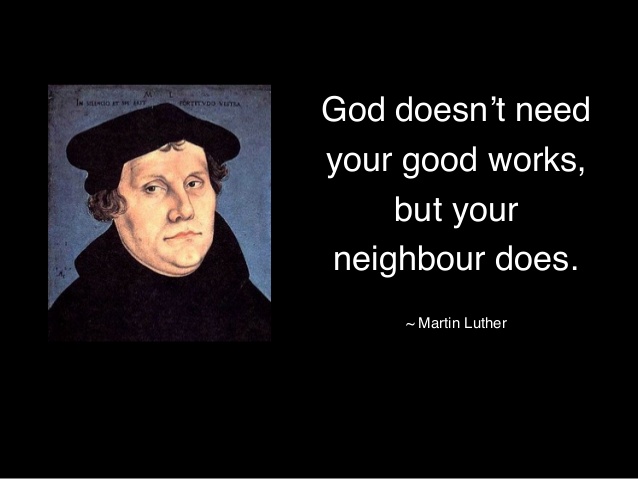
Luther, however, insisted the worst of sinners are people who do good works. Specifically, the wicked person is one who has clean living and does nice things but does them disconnected from God by wanting others to see their good actions. Another way of putting it: The wicked person seeks to gain glory for themselves rather than give glory to God.

Our good works can be the greatest hindrance to righteousness and living the way of the cross. It is far too easy to place faith in our good works, done apart from God, rather than placing complete trust in Christ alone. It can be too easy, doing good things, for the primary purpose of having others observe our goodness, rather than do them out of the good soil of being planted in God’s Word. 

The remedy for sin is the cross, and the sinner lives life apart from that cross, trusting in self, so that people will give personal recognition, respect, and accolades.

“It is impossible for a person not to be puffed by his good works unless he has first been deflated and destroyed by suffering and evil until he knows that he is worthless and that his works are not his but God’s.”

Martin Luther

Delight, or Not

The answer to this problem of doing good works to gain glory for self is not to avoid good works, but to do them from the good soil of being planted in God’s law and connected to Christ’s vine. The psalmist uses the word “law” in referring to Scripture as a whole, to all the acquired wisdom about how life is supposed to be lived in God’s world.

People who yield juicy abundant fruit have immersed themselves in the law. Because they delight in God; secretly rise early to meditate on God’s Word; privately read the Bible’s message; and pray to put that message into practice. They will be blessed. 

The wicked are too busy to notice the law. They serve to be seen and desire public recognition for their charity and works. But those works will not stand in the Judgment. Jesus described them this way:

“You are like white-washed tombs, which look beautiful on the outside, but on the inside are full of dead men’s bones and everything unclean….  On the outside you appear to people as righteous, but on the inside, you are full of hypocrisy and wickedness.” (Matthew 23:27, NIV)

Which is Which?

Identifying the righteous and the wicked is not as simple as saying the wicked are “those people” out there, and the righteous people are in here. The truly righteous person delights in God through the law. They have the humble sense they could easily drift from God if not staying connected, rooted in Jesus, and grounded in the way of the cross. 

The wicked, in contrast, are like chaff – worthless. They are arrogant and annoying – wanting all the attention which God rightly deserves. When I was a kid, I always wore a mask during the corn harvest because of the chaff and corn dust. Every year, from the time I was seven years old, I had the job of taking the tractor out and hitching up the wagons of corn and bringing them back. Then, I unloaded the wagon of corn into the auger which sent it up and into the corn bin. The corn dust flew everywhere. It was annoying and could easily take over my lungs if I weren’t masked up.

The wicked have nothing of substance to contribute to God’s kingdom – they add no value to what is going on. In fact, they are a hindrance to the harvest of souls God is trying to accomplish. Conversely, the righteous do good works which sprout from rich Iowa-type soil, producing a harvest of righteousness. 

The righteous person takes the time to know God’s law; satisfies the needs of those who are not able to pay them back or give them proper recognition; and cultivates relationships with those they help. The righteous are relational.

Righteous Job

The biblical character, Job, is an example of a righteous person. Job did all kinds of good works. And he did them because of his close walk with God. Job persevered through intolerable suffering and grief because he knew God. Job assisted the needy; helped others no matter their situation; championed the less fortunate; and gave glory to God even amid terrible trouble. Job did not throw in the towel when his reputation, his family, and his wealth were completely taken away. Instead, he said:

“Naked I came from my mother’s womb, and naked I will depart. The Lord gave and the Lord has taken away; may the name of the Lord be praised.” In all this, Job did not sin by charging God with wrongdoing. (Job 1:21-22, NIV)

Generosity marks the righteous because God is generous. Grace defines the righteous because God is gracious. Gentleness is the way of the righteous because Christ is gentle. Spiritual prosperity is born of a righteous relationship with Jesus Christ. The Lord watches over the way of the righteous.

Injustice and Judgment

However, the wicked perish. There are sixteen prophetic books in the Old Testament, all given to a single message: Judgment is coming because of wickedness. And the wicked turn out to be some of God’s covenant people. That’s because they selectively did their good works to gain glory for themselves. And they withheld the good they could have done because it did not add any value to their reputation or personal goals. 

For example, prophesying to those who fasted so that others would see their spirituality, the prophet Isaiah communicated God’s message:

“Is not this the kind of fasting I have chosen:
to loosen the chains of injustice
    and untie the cords of the yoke,
to set the oppressed free
    and break every yoke?
Is it not to share your food with the hungry
    and to provide the poor wanderer with shelter—
when you see the naked, to clothe them,
    and not to turn away from your own flesh and blood? (Isaiah 58:6-7, NIV)

God desires genuine spiritual growth. That happens when we eschew a theology of glory, and embrace a theology of the cross, which delights in God and God’s law, meditating on it day and night.

A Choice

We always have a choice between the way of the righteous and the way of the wicked, to embrace a theology of the cross or a theology of glory. Here is how that choice is framed in the book of Deuteronomy when the ancient Israelites were about to enter the Promised Land:

See, I set before you today life and prosperity, death and destruction. For I command you today to love the Lord your God, to walk in obedience to him, and to keep his commands, decrees and laws; then you will live and increase, and the Lord your God will bless you in the land you are entering to possess….

I have set before you: life and death, blessings and curses. Now choose life, so that you and your children may live and that you may love the Lord your God, listen to his voice, and hold fast to him. For the Lord is your life, and he will give you many years in the land he swore to give to your fathers, Abraham, Isaac and Jacob.” (Deuteronomy 30:15-20, NIV)

The idolatry which can easily seduce us are our own good works done for a human audience who will recognize and affirm. Jesus said we must play to the audience of one:

But when you give to the needy, do not let your left hand know what your right hand is doing, so that your giving may be in secret. Then your Father, who sees what is done in secret, will reward you.” (Matthew 6:3-4, NIV)

Our daily choice must be to love God supremely and give God glory for everything good in our lives. Perhaps Christianity needs another Reformation – one in which we do not just uphold the authority of Scripture, but reform our habits by loving God through basic disciplines of Bible-reading and simple obedience; and by loving our neighbor through giving them time and attention, the gift of relationship and friendship.

What will you choose this day?

Ephesians 2:1-10 – Saved for a Reason

At one time you were like a dead person because of the things you did wrong and your offenses against God. You used to live like people of this world. You followed the rule of a destructive spiritual power. This is the spirit of disobedience to God’s will that is now at work in persons whose lives are characterized by disobedience. At one time you were like those persons. All of you used to do whatever felt good and whatever you thought you wanted so that you were children headed for punishment just like everyone else.

However, God is rich in mercy. He brought us to life with Christ while we were dead because of those things that we did wrong. He did this because of the great love that he has for us. You are saved by God’s grace! And God raised us up and seated us in the heavens with Christ Jesus. God did this to show future generations the greatness of his grace by the goodness that God has shown us in Christ Jesus.

You are saved by God’s grace because of your faith. This salvation is God’s gift. It is not something you possessed. It is not something you did that you can be proud of. Instead, we are God’s accomplishment, created in Christ Jesus to do good things. God planned for these good things to be the way that we live our lives. (CEB)

Christians are not saved so that they can just sit in a worldly holding tank until Jesus comes back. Deliverance is only one side of the salvation coin. We are saved so that we will engage in good works for in the here-and-now.

Christians know they are saved from sin through the forgiving work of Jesus Christ. It is an act of sheer grace on God’s part. A believer is not born again through personal effort any more than a baby is birthed because of her own doing. Salvation is thoroughly the work of God. Even the faith needed to believe is a gift graciously provided by God.

There is more. The Lord also has some plans and purposes in mind for the people of God. Christians were birthed into a new spiritual community with new commitments to do all kinds of good deeds. It is as if sin were a weight or an obstacle that has been removed so that living a life full of goodness can now move ahead and do its work. To be saved is to be freed for a vigorous moral life.

The great problems of our world are, at their core, spiritual problems which are an opportunity for believers in Jesus to take the lead in agitating for change. Expecting human governments or corporate systems to take the lead in moral transformation is like asking the fox to guard the hen house.

Christians, churches, and faith communities can and ought to storm the gates of hell for the lives of women caught in sex trafficking; provide uplift and the tools to a better life for those in grinding poverty and hunger; challenge the idolatry of the American gun culture; speak up and step out for equality and an egalitarian culture; care for the sick and dying; reform morals; hold the world ethically accountable for its actions; and, hundreds of other realities of living in a fallen broken world.

In essence, when stripped to the center of the issue, these problems are not political, social, or cultural concerns – they are spiritual. Mass murder violates God’s command to not kill. Hunger and poverty too often result from greedy leaders in power who covet resources for themselves, violating God’s commands to provide for the poor and needy. Sexual slavery treats persons as chattel property and not as image-bearers of God. 

God has delivered us from the vice grip of sin so that we are free to tackle the immorality of the world around us. Perhaps you have a boss who is nothing more than a master of a small world and bullies and manipulates his employees. Maybe your local municipal authorities turn a blind eye to moral evil and cannot see they are public servants. It could be that within your own family there are problems of addiction which need to be graciously confronted and dealt with. 

Whatever the issues are in your sphere of influence, God has providentially placed us in the places we inhabit for just such a time as this so that we can do good works, both big and small, taking on immoral establishments as well as little acts of kindness. Doing good comes in all sizes, and all of us are to share our lives for the betterment of others.

Saving God, you have only good plans for your world and your people. Use me today and every day to be an agent of blessing and goodness, working for the benefit of others who need the freedom of Christ’s redemption and the power of his resurrection in their lives. Amen.

Pass It On

I am the youngest of five children, and because of that reality I had to follow my siblings in school with many of the same teachers they had. I heard these statements more than once: “Why can’t you be more like your sister?” (the studious valedictorian) and “Why aren’t you like your brother?” (the nice quiet one).  I sometimes had this icky feeling in school that I somehow fell short because I wasn’t like them. 

The task of the Christian is to imitate Christ – not impersonate Jesus by being someone we are not. God created each of us uniquely and has sovereignly gathered us together as the church. So, we need to strive to be the best individual person possible in imitating Jesus by means of who we are, learning to work together, appreciating one another as we seek to follow Christ. 

The Apostle Paul wrote the New Testament letter to the Philippian Church because the fellowship had broken down into some rancorous in-fighting. This left the believers disillusioned. So, Paul passed on four imitations of Christ (not impersonations) to help them (and us) experience the unity God desires for his people.  

1. We are to imitate Christ through passing on the right values (Philippians 2:1-2).   

Shared values, not smooth sailing, keeps a group of people together. Paul appealed to lived experience. If anyone has experienced encouragement, comfort, fellowship, tenderness, or compassion, then we need to recognize it, remember it, and then pass it on to others. Those values happened because God granted blessings to us through other people. In other words, we owe to others what God has done through others for us.   

These common valued experiences occur as we participate in the life of our triune God. They come from the perfect relational dynamic that endlessly occurs within God himself as Father, Son, and Spirt. As we spend time with God and are filled with the divine life, these relational values spill-over in our human interactions.   

Passing on encouragement and compassion is not a function of willpower in trying to impersonate Jesus; it is a matter of spending time with God – because people tend to imitate those they hang around. If we spend time with people who typically complain, we will end up constantly cranky. If we hang out with people who continually pray, we will find ourselves reflexively praying about everything. If we are around chronically negative people, we will become constantly unhappy. If we make it a regular practice to hang out with Jesus, we discover that we are imitating him in our relationships through encouragement, love, comfort, and compassion. 

The word “joy” pops up a lot in Paul’s letter to the Philippians, yet it is never an exhortation to be joyful but rather an exhortation to unity. The by-product of unity is joy. Joy and happiness are the direct result of unity, and unity comes from embracing the shared common values Paul expressed. 

2. We are to imitate Christ through passing on the right service (Philippians 2:3-4).   

Humility is the remedy for dissension and disunity. Strife comes from stubbornly guarding our own opinions. Humility, however, considers others better than oneself. We are to do nothing out of selfishness or vain conceit. Instead, we are to imitate Jesus – to take up our crosses and follow him through dying to things which create disunity. Trying to impersonate Jesus results in lording over people and circumstances. It leads to division. However, imitating Jesus results in being like him in his humility and gentleness. It brings unity and peace.   

Nik Wallenda is a Christian and a high wire artist. In 2012 he walked a tightrope across Niagara Falls; and, in 2013 he became the first person to high wire walk across the Grand Canyon. Nearly a combined billion people saw those two incredible feats. After every tight rope walk for the crowds, Nik Wallenda engages in a simple spiritual discipline: he walks where the throngs of people just stood and watched him, and quietly picks up their trash.  

Wallenda says about this practice, “My purpose is simply to help clean up after myself. The huge crowd left a great deal of trash behind, and I feel compelled to pitch in. Besides, after the inordinate amount of attention I sought and received, I need to keep myself grounded. Three hours of cleaning up debris is good for my soul. Humility does not come naturally to me. So, if I must force myself into situations that are humbling, so be it …. I know that I need to get down on my hands and knees like everyone else. I do it because it is a way to keep from tripping. As a follower of Jesus, I see him washing the feet of others. I do it because if I don’t serve others, I’ll be serving nothing but my ego.” 

3. We are to imitate Christ by passing on the right attitude (Philippians 2:5-11).   

The Apostle Paul bluntly stated that our attitude is to be the same as Jesus: laying down life for the benefit of others. Impersonating Jesus leads to a martyr complex that wants others see our good works. However, imitating Christ’s attitude is to serve without being concerned who sees it or who gets the credit. It is an attitude of passing on what we have received from God. 

In the way of Jesus, the way up is down; the way to gain is by giving; the way to life is through death; the way to praise God is humble service for others. When my grandson was in one of his many hospital stays in the epilepsy ward, I watched him (3 years old at the time and without any prompting) make his way from room to room encouraging other patients and serving them. In the room where a ten year old girl had just had brain surgery with no hair and unattractive bandages, I overheard him say, “Oh, I like your new hat; it looks great on you!”  Making his way to the next room of a twelve-year-old boy who was near death, he said, “Would you like a drink?  I can get a drink for you!”   

I saw parents in the epilepsy ward who were as different from one another as you could imagine. Yet, we all shared a common purpose which gave us a common attitude. We all wanted these kids to be seizure free, and we were doing whatever it took to help each other realize that dream. 

Jesus humbled himself and became a man, being obedient to death on a cross, because his purpose was for humanity to be sin-free. Christ did whatever it took to make that happen.  If a small little boy can be used of God, then how much can you and I adopt the attitude of Jesus and do whatever it takes to see that people realize freedom in Jesus Christ!? 

4. We are to imitate Christ through passing on the right commitments (Philippians 2:12-13).   

The Christian life is meant to be lived together with other believers. We can try to impersonate Jesus, which will result in trying to impress the wrong crowd. However, when we imitate Christ, we commit ourselves to the people God has placed in our lives. Just as it was not our choice which family we were born into, so it is not our choice which spiritual family we are born again into. The church is not a voluntary society, any more than a family is. The church belongs to Jesus and we are neither to just fluidly move in and out of it as if it were a hobby that we toy with once-in-a-while, nor treat it as a spectator sport just watching what happens and playing arm-chair quarterback on Monday morning. 

Paul exhorted the believers to work out their salvation with fear and trembling. That means we are to live-out our collective salvation together in being mindful of each other. In other words, unity takes a lot of work – work which requires imitating Christ through a shared commitment to one another. 

The promise we have is that when we do this kind of good work that it is God who acts to bend everything to his good purposes. This is a wonderful promise, one we need to take to heart with a good dose of godly reverence and awe. 

Conclusion 

My oldest sister was the valedictorian of her class. I did not follow in her steps. My brother was the kind of kid that teachers envied to have in their classes. I think my teachers wondered if we were from the same family. My other sister was friends with all her teachers, and they all enjoyed her. I just remember getting a lot of sighs and eye-rolling from my teachers. I often struggled with my identity as a kid.   

I found my identity in Christ. I discovered I did not have to be like anyone else. God used me for who I am right where I was, learning to imitate Jesus. We need not be worried or discouraged about how far short we fall in comparison to others. Instead, we are to be concerned about how God wants to fulfill all his good promises in Christ through us – because at the name of Jesus every knee will bow and every tongue will confess that Jesus is Lord to the glory of God.  We are to pass on to others every good thing we have in Jesus Christ. 

Ephesians 2:1-10 – Saved for a Reason

ap_20078856119676

“As for you, you were dead in your transgressions and sins, in which you used to live when you followed the ways of this world and of the ruler of the kingdom of the air, the spirit who is now at work in those who are disobedient. All of us also lived among them at one time, gratifying the cravings of our flesh and following its desires and thoughts. Like the rest, we were by nature deserving of wrath. But because of his great love for us, God, who is rich in mercy, made us alive with Christ even when we were dead in transgressions—it is by grace you have been saved. And God raised us up with Christ and seated us with him in the heavenly realms in Christ Jesus, in order that in the coming ages he might show the incomparable riches of his grace, expressed in his kindness to us in Christ Jesus. For it is by grace you have been saved, through faith—and this is not from yourselves, it is the gift of God— not by works, so that no one can boast. For we are God’s handiwork, created in Christ Jesus to do good works, which God prepared in advance for us to do.” (NIV)

Humanity is spiritually hard-wired to do good in this world.  Yes, from a Christian perspective we live in a fallen world and experience the evil of pandemics and poverty as well as personal and corporate corruption.  However, this is not our original design.

In the Christian tradition, believers in Jesus are not delivered from sin, death, and hell so that they can idly sit in a worldly holding tank until Christ returns. 

Deliverance is the initial dimension of God’s plan – and not the end game.  We are saved for good works to be done in the here-and-now.

Christians know that they are saved from individual and systemic sin through the forgiving work of Jesus Christ.  It’s an act of sheer grace on God’s part.  A believer in Jesus is not spiritually reborn through her effort any more than a baby’s birthed because of her own doing.  It is thoroughly the work of God.  Even the faith needed to believe is a gift graciously provided by God.

This, however, is far from the whole story.  God has plans and purposes in mind for his people.  Christians were birthed into a new spiritual community with new commitments to do all kinds of good deeds.  It’s as if sin is a weight or an obstacle that has been removed so that living a life full of goodness can now move forward and do its work.

To be “saved” is to be freed for a vigorous moral life deeply concerned with altruistic actions in a world full of need.

There is a profound spiritual wound which underlies the great problems of our world.  Behind so many of our world issues are matters of the spirit.  The unseen world is just as real as the world which is seen.  Just as we know germs are present, they are real, and we must account for them – so there is spiritual world very much real and we ignore it at our great peril.

Thus, it seems to me that spiritual people, including Christians delivered for the purpose of good deeds, are to graciously, wisely, and lovingly agitate for earthly change.  Expecting human governments or corporate systems to take the lead in moral transformation is like asking the fox to guard the hen house.

I will admit to you that I don’t much have the stomach right now for what seems to me to be a useless and emotionally energy consuming debate among some Christian communities about whether to gather on Easter Sunday, or not.  As redeemed people, delivered for a purpose, I believe it is sage to put our focus on discovering how we can support and bless the essential services laboring to keep a pandemic at bay.  God has raised us up for such a time as this, if we have the spiritual eyes to see.

Christians, churches, and spiritual communities must labor at the gates of hell for the lives of women caught in sex trafficking; provide uplift and the tools to a better life for those in grinding poverty and hunger; challenge the idolatry of a materialist culture; and, hundreds of other realities of living in a fallen broken world, including the scourge smack in front of our faces of disease and death.

As Christians, God has delivered us from sin so that we will do good in this world.  God, in his sovereignty,  has placed you and I in places and positions for just this time so that we will do good works, both big and small, tackling immense issues as well as little acts of kindness.

Doing good comes in all sizes, and all of us are to share our lives for the betterment of humanity.

After all, we really are our brother’s keeper.

God Almighty, I pray that your people may not lose heart in this world.  May you strengthen your church with spiritual power so that the words and ways of Jesus will ground them for faithful service to this planet you have created.  May Christians everywhere be rooted and established in the divine love which supports good works done in the humility of a gentle spirit; through Jesus Christ our Lord, who lives and reigns with you and the Holy Spirit, one God, now and forever.  Amen.