Jeremiah 31:7-14 – A Restored People

Now this is what the Lord says:
“Sing with joy for Israel.
    Shout for the greatest of nations!
Shout out with praise and joy:
‘Save your people, O Lord,
    the remnant of Israel!’
For I will bring them from the north
    and from the distant corners of the earth.
I will not forget the blind and lame,
    the expectant mothers and women in labor.
    A great company will return!
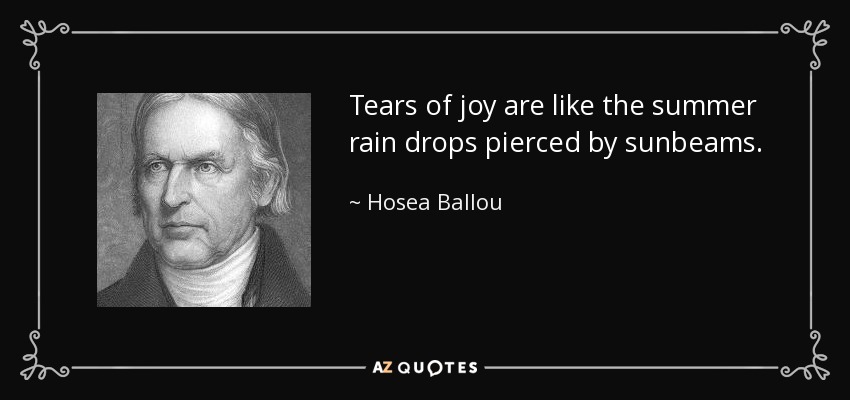
Tears of joy will stream down their faces,
    and I will lead them home with great care.
They will walk beside quiet streams
    and on smooth paths where they will not stumble.
For I am Israel’s father,
    and Ephraim is my oldest child.

“Listen to this message from the Lord,
    you nations of the world;
    proclaim it in distant coastlands:
The Lord, who scattered his people,
    will gather them and watch over them
    as a shepherd does his flock.
For the Lord has redeemed Israel
    from those too strong for them.
They will come home and sing songs of joy on the heights of Jerusalem.
    They will be radiant because of the Lord’s good gifts—
the abundant crops of grain, new wine, and olive oil,
    and the healthy flocks and herds.
Their life will be like a watered garden,
    and all their sorrows will be gone.
The young women will dance for joy,
    and the men—old and young—will join in the celebration.
I will turn their mourning into joy.
    I will comfort them and exchange their sorrow for rejoicing.
The priests will enjoy abundance,
    and my people will feast on my good gifts.
    I, the Lord, have spoken!” (New Living Translation)

Experiencing restoration is a beautiful thing. Sick and suffering bodies restored to health brings rejoicing. Estranged relationships brought together again elicits singing. Spirits broken by sin made whole again through restoring grace causes shouts of joy.

God is an expert in restoration. Dilapidated communities, broken individuals, and peoples in diaspora can find fresh hope amid challenging circumstances.

Take a look at the actions of God through the verbs in today’s Old Testament lesson:

  • “I will bring.” The Lord gathers scattered people together, as well as making the disparate parts of people into a unified whole again.
  • “I will not forget.” In the gathering action of God, no one is left behind. Attention is given to the stragglers, to those unable on their own strength or ability to journey on the road back to the Lord.
  • “I will turn.” The unfortunate are turned into the fortunate. The underprivileged become privileged. Grief, lament, and mourning give way to joy and a new lease on life.
  • “I will comfort.” A great reversal occurs with God’s intervention. Sorrow is transformed into praise. Goodness is found in abundance because the Lord is a good God.

God calls the people to action, to a response of experiencing the restorative powers of grace. The Lord encourages such behavior because it helps us never forget that no one and no circumstance is ever beyond the renewing grace of God. Notice the verbs which characterize that response:

  • “Sing.” No mumbling here, my friends. No timidity about being off tune. A lonely person, fragmented group, depressed community, polarized neighborhood, or scattered nation restored by God’s merciful grace becomes an exuberant people. Singing organically arises from them.
  • “Shout.” Even the rocks will cry out if the people don’t. A last second win in the sports stadium amongst thousands of fans doesn’t even hold a candle to celebrative shouts of believers gathered and restored.
  • “Listen.” Whenever hearing God’s voice results in restoration, then the desire and motivation to listen increases exponentially.
  • “Proclaim.” Proclaiming good news is a joy and privilege. And in anticipation of Epiphany, the gospel declared to Gentiles is a gracious message of inclusion and hope.

We are helped to picture the incredible restoration of people coming together and gathered by God with two metaphors:

  1. The Good Shepherd. Like a faithful shepherd over the flock of sheep, the Lord actively seeks the lost, brings them home, and continues to stand watch over them as a compassionate guardian.
  2. The Exodus. Just as God redeemed the people out of Egyptian slavery and took them to a good land of abundance, so the Lord shall return those persons exiled from that abundant place and restore them to the peace of settled rest.

The restoring action of God gathers the scattered. The lost are found. That which is fragmented is made whole. Those previously disabled become able. The weak become strong, the sick healed, the hungry fed, and the prisoner freed.

In times of famine, pandemic, poverty, hardship, and scant resources, there is hope. The Lord knows how to restore fortunes and bring untold abundance amid the most difficult of situations.

True joy comes through hard suffering. The pains of childbirth give way to unspeakable joy.

Today is the final day in the twelve days of the Christmas season. God, entering humanity through a woman, in the flesh, began the gracious work of ransoming, redeeming, and restoring a sinful world that had exiled itself from peace and abundance. In Christ, our lives are full of blessing.

Praise the God and Father of our Lord Jesus Christ for the spiritual blessings that Christ has brought us from heaven! (Ephesians 1:3, CEV)

“I am the gate. Those who come in by me will be saved; they will come in and go out and find pasture. The thief comes only in order to steal, kill, and destroy. I have come in order that you might have life—life in all its fullness. I am the good shepherd, who is willing to die for the sheep.” (John 10:9-11, GNT)

May you know and experience the restorative grace of God in Christ today and every day. Amen.

Micah 5:2-5a – He Will Be Our Peace

“But you, Bethlehem Ephrathah,
    though you are small among the clans of Judah,
out of you will come for me
    one who will be ruler over Israel,
whose origins are from of old,
    from ancient times.”

Therefore, Israel will be abandoned
    until the time when she who is in labor bears a son,
and the rest of his brothers return
    to join the Israelites.

He will stand and shepherd his flock
    in the strength of the Lord,
    in the majesty of the name of the Lord his God.
And they will live securely, for then his greatness
    will reach to the ends of the earth.

 And he will be our peace. (New International Version)

An Awful Situation

In the prophet Micah’s day, there was no “peace on earth, goodwill to all.” After the reign of King Solomon, Israel was divided between north and south. Samaria was the capital of the northern kingdom of Israel. Jerusalem was the capital of the southern kingdom of Judah. 

In the eighth-century B.C.E. the Assyrian Empire conquered the northern kingdom of Israel. They deported many of the Israelites and re-populated the cities with their own people.  This is why the Jews in Christ’s day looked down on Samaritans. They pejoratively viewed them as “half-breeds,” a mix of Jewish and Assyrian descent.

The Assyrian takeover of Israel not only left the northern kingdom in shambles; it had a huge impact on the southern kingdom of Judah. Even though Judah had not been conquered, they were still forced to pay tribute to the Assyrians. 

The problem was exacerbated with the leadership of Judah seeking to maintain their power and lifestyle. They did not look to God for help and ignored the needs of the people. Judah’s leaders expected the poor common folk to shoulder the burden of the tribute to the Assyrians. In addition, thousands of refugees from Israel were flooding into Judah and Jerusalem. They had lost their homes, their land, and had nothing but their lives. So, the already scant resources in Judah were pushed to the brink.

Those in authority and power, the ones with resources to make a difference, didn’t. Instead, they took advantage of the situation by buying fields and land at a fraction of its worth because people were just trying to survive. In some cases, the leadership leveraged their power by simply pushing people off their own land and taking it over.

There Is Hope

Into this awful situation, Micah prophesied judgment to the leaders oppressing the people – and hope for the poor and the displaced. Micah said a new kind of leader will come – one with humble origins, like the common oppressed people of Judah. The refugees, the displaced farmers, and the poor will have a champion. He will feed them and shepherd them, leading them to green pastures. This leader will serve the people.

Christians discern Micah’s prophecy as speaking of Jesus – which is why we look at Scriptures like this one during the season of Advent. Just as the ancient Jews needed hope and the promise of a different ruler, so today we, too, need hope and the anticipation of security, peace, and goodwill.

Christ’s leadership and power is different than earthly politicians and officials. Over the centuries, Israel and Judah were so filled with bad kings and self-serving leadership, that Christ’s disciples could barely conceive of anything different. So, Jesus said to them: 

“You know that those who are regarded as rulers of the Gentiles lord it over them, and their high officials exercise authority over them. Not so with you. Instead, whoever wants to become great among you must be your servant, and whoever wants to be first must be slave of all. For even the Son of Man did not come to be served, but to serve, and to give his life as a ransom for many.” (Mark 10:42-45, NIV)

A Shepherd Leader Is Coming  

The people of Micah’s day needed to see beyond their terrible circumstances and to realize hope – better days ahead with food, peace, and protection. We, too, feel the insecurity and the anxiety of living in today’s world. We want leaders to be wise and just toward the vulnerable, the poor, and the displaced. Yet, while we look to elections and politicians for hope, the prophet Micah is jumping up and down, pointing us to a different leader – a shepherd leader.

Micah says the shepherd leader will come from Bethlehem. When Micah gave his message, King David had been dead for nearly three-hundred years. The nation had strayed far from those days when David led the people with God’s covenant love and kindness. Yet, another shepherd leader is coming and will bring restoration, renewal, revival, and hope!

“Bethlehem” is two Hebrew words put together: beth is “house,” and, lechem is “bread.” Bethlehem means “house of bread.” God communicated to the people that the coming shepherd leader will provide food and care for them.

The Bread of Life

Jesus is the Bread of Life. He generously feeds us so that we will offer both physical and spiritual bread to others. Jesus satisfies all our hungers and cravings in this life. We may not wonder where our next meal is coming from, nor struggle with going to bed hungry. Yet, we hunger for security in our world, satisfaction in our daily activities, loved ones to know Jesus, and for peace. Our spiritual stomachs growl, hungering for spiritual food. Many are spiritually starving because they are searching for peace and goodwill in everyplace but Jesus.

“I am the bread of life. Whoever comes to me will never go hungry, and whoever believes in me will never be thirsty…. All those the Father gives me will come to me, and whoever comes to me I will never drive away. For I have come down from heaven not to do my will but to do the will of him who sent me. And this is the will of him who sent me, that I shall lose none of all those he has given me but raise them up at the last day. For my Father’s will is that everyone who looks to the Son and believes in him shall have eternal life, and I will raise them up at the last day.” (John 6:35-40, NIV)

Satisfaction, contentment, and peace have come from the most unlikely sources: Bethlehem and Nazareth. Can anything good come from villages in Judea that don’t even show up on most maps in the ancient world?  Peace, hope, and goodwill can and do come from the least expected places and people. 

Joni Eareckson Tada and Corrie Ten Boom are two women that changed their worlds, despite being ordinary people with weakness. The two of them once met many years ago. Joni remembers the encounter: 

“I relive each moment of my visit with Corrie after she was paralyzed by a stroke. Helpless, and for the most part dependent, I felt our mutual weakness. Yet I am certain neither of us had ever felt stronger. It makes me think of the Cross of Christ–a symbol of weakness and humiliation, yet at the same time, a symbol of victory and strength….  A wheelchair may confine a body that is wasting away. But no wheelchair can confine the soul that is inwardly renewed day by day. For paralyzed people can walk with the Lord. Speechless people can talk with the Almighty. Sightless people can see Jesus. Deaf people can hear the Word of God. And those like Corrie, their minds shadowy and obscure, can have the very mind of Christ.”

The Good Shepherd

Jesus Christ is our peace. He was not born in the halls of power, did not attend the best schools, or make lots of money. Nothing on his earthly resume was remarkable enough for anyone to seek him for any leadership position. And yet, Jesus stands and shepherds the flock in the strength of the Lord, providing everything we need. 

“I am the good shepherd; I know my sheep and my sheep know me—just as the Father knows me and I know the Father—and I lay down my life for the sheep. I have other sheep that are not of this sheep pen. I must bring them also. They too will listen to my voice, and there shall be one flock and one shepherd. The reason my Father loves me is that I lay down my life—only to take it up again.” (John 10:14-17, NIV)

Through Jesus there is peace – financial peace, emotional peace, relational peace, social peace, and spiritual peace. Jesus is the One who brings a full-orbed wholeness and wellness to our lives, no matter the situation. Jesus is the shepherd leader who brings peace amidst any and every situation this world throws at us.

He tends his flock like a shepherd:
    He gathers the lambs in his arms
and carries them close to his heart;
    he gently leads those that have young. (Isaiah 40:11, NIV)

The prophet Ezekiel prophesied in a similar situation as Micah:

For this is what the Sovereign Lord says: “I myself will search for my sheep and look after them. As a shepherd looks after his scattered flock when he is with them, so will I look after my sheep. I will rescue them from all the places where they were scattered…. They will lie down in good grazing land, and there they will feed in a rich pasture on the mountains of Israel. I myself will tend my sheep and have them lie down. I will search for the lost and bring back the strays. I will bind up the injured and strengthen the weak, but the sleek and the strong I will destroy. I will shepherd the flock with justice.” (Ezekiel 34:11-16, NIV)

Conclusion

There is something yet we must do. Jesus said:

“The work of God is this: to believe in the one he has sent…. I am the living bread that came down from heaven. If anyone eats of this bread, he will live forever.  This bread is my flesh, which I will give for the life of the world…. Unless you eat the flesh of the Son of Man and drink his blood, you have no life in you…. Whoever eats my flesh and drinks my blood remains in me, and I in him…. The person who feeds on this bread will live forever.” (John 6:29, 51-59, NIV)

We are to ingest Jesus. We must be filled with him. Jesus comes into the very depths of our lives to nourish us. Jesus is our food and drink, our peace, our shepherd, and our king. Believing in Jesus is not simply a matter of agreeing with him or being his fan. Faith in Christ means to give our lives to him. The greatest Christmas gift we can give this season is the gift of our lives to Jesus Christ, the promised Messiah.

Blessed Lord Jesus, many have strayed far from your flock – taking matters into their own hands and doing things their own way. Many have let their love grow cold and have chosen to feed in pastures that will never satiate their hunger. May they believe that you died on the cross for all the messed up things done, and good things left undone without you.  You rose from death to give them life. Please forgive us all, change our lives, and show us how to know you. Amen.

John 10:11-18 – “Good” Shepherd?

The Good Shepherd by He Qi

“I am the good shepherd. The good shepherd lays down his life for the sheep. The hired hand is not the shepherd and does not own the sheep. So, when he sees the wolf coming, he abandons the sheep and runs away. Then the wolf attacks the flock and scatters it. The man runs away because he is a hired hand and cares nothing for the sheep.

 “I am the good shepherd; I know my sheep and my sheep know me— just as the Father knows me and I know the Father—and I lay down my life for the sheep. I have other sheep that are not of this sheep pen. I must bring them also. They too will listen to my voice, and there shall be one flock and one shepherd. The reason my Father loves me is that I lay down my life—only to take it up again. No one takes it from me, but I lay it down of my own accord. I have authority to lay it down and authority to take it up again. This command I received from my Father.” (NIV)

Sheep and Shepherds

Many people in today’s contemporary times are completely unfamiliar with sheep and shepherds. So, when it comes to picturing Jesus as the good shepherd, idyllic scenes might come to mind, full of green meadows and pastoral landscapes in which there is perfect peace and rest.

Having been raised in rural Midwest America, I can confidently say there is little romanticism to the life of shepherds and sheep. Sheep eat a lot. They’ll eat just about anything that’s growing out of the ground. Think about how you would feel if you ate copious amounts of plants. Yep. Lots of gas, trips to the bathroom, and stink.

That’s how it is with sheep. They continually poop and the smell is downright awful. A lot of a shepherd’s daily work is helping sheep deal with all the gas inside them. Sheep are easily prone to bloating from excess gas. This isn’t just an uncomfortable situation for a sheep; it’s an emergency life-and-death scenario. The shepherd must continually be vigilant to the sheep and take care of such circumstances immediately and carefully.

Taking care of sheep is dangerous, difficult, and tedious work. Historically, shepherds were rough characters, constantly on the move to find good pastures for the flock’s voracious appetite. They had to deal with both animal and human predators looking for an easy meal. Being mostly outdoors, even at night, led to their reputation as drinkers – keeping up a consistent nip of spirits to keep warm. And, of course, they smelled bad.

So, when Jesus described himself as the “good shepherd,” this was anything but a pleasing picture for people in the ancient world. The closest equivalents to our modern day might be for Jesus to say, “I am the good migrant worker,” or the “good carny” (carnival employee).

Identifying with the Lowly

Anyone or any profession in which we might deem a person in that line of work as of dubious character – that is how a shepherd and their work were viewed by ancient people. It is the lowly of society who get down and dirty. Because of their work, they get a suspicious and contemptuous reputation. Remarkably, Jesus unabashedly aligned himself with such people.

And yet, it is the discounted profession and the counted out in which we must pay attention because God is probably at work in their midst. The despised Samaritan gained the label of “good” by Jesus for giving himself fully to save a stranger. Jesus puts the same adjective in front of shepherd. Whereas no one in polite society would use “good” for shepherd, Jesus labels himself as the Good Shepherd who lays down his life for the sheep.

Jesus, this incredible figure who puts good and shepherd together also goes out of his way to bring other sheep into his fold. Since Christ identifies himself as a stinky lowly shepherd, he has no problem connecting with everyone. After all, when one is already low, there is no looking down on another.

People everywhere, no matter their station in life, can hear the voice of Jesus speaking to them when they, too, are low enough to be able to listen.

The Sacrificial Lamb

Jesus, the Good Shepherd, is also the sacrificial lamb. In laying down his life he takes it up again (John 10:17). And when we participate in that dying and rising, when we eat the bread and drink the cup of salvation, we know he abides in us (1 John 3:24). Remaining in Christ with our good shepherd means, we, too, lay down our lives:

This is how we have discovered love’s reality: Jesus sacrificed his life for us. Because of this great love, we should be willing to lay down our lives for one another… Beloved children, our love can’t be an abstract theory we only talk about, but a way of life demonstrated through our loving deeds. (1 John 3:16, 18, TPT)

Community is messy. People are stinky. Stepping into another’s life is rarely picturesque or idyllic. Yet, it is the same time elegant and aromatic. For we discover that our old ideas of beauty are obsolete. We gain a new spiritual sense which is redolent with the fragrance of Christ.

O God, Shepherd of all your people, deliver us from all troubles, worries and cares that assail us so that we may always do what is pleasing in your sight, and remain safe in the care of our Good Shepherd, Jesus Christ our Lord. Amen.

Micah 5:1-5a – The Shepherd Leader

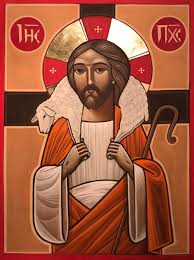
Coptic Church icon of Jesus the Good Shepherd

Jerusalem, enemy troops
    have surrounded you;
they have struck Israel’s ruler
    in the face with a stick.

Bethlehem Ephrath,
you are one of the smallest towns
    in the nation of Judah.
But the Lord will choose
one of your people
    to rule the nation—
someone whose family
    goes back to ancient times.
The Lord will abandon Israel
    only until this ruler is born,
and the rest of his family
    returns to Israel.
Like a shepherd
    taking care of his sheep,
this ruler will lead
    and care for his people
by the power and glorious name
    of the Lord his God.
His people will live securely,
and the whole earth will know
    his true greatness,
because he will bring peace. (CEV)

In Micah’s day there was no peace on earth, goodwill to all. In the eighth century B.C.E. the powerful Assyrian Empire came and conquered the northern kingdom of Israel, deporting many of the people and re-populating the cities with their own.

The Assyrian takeover of Israel not only left the northern kingdom in shambles but had a large impact on the southern kingdom of Judah.  All of Judah and Jerusalem were in extreme duress.  Even though Judah had not been conquered and was intact, they were still forced to pay tribute to the Assyrians to keep them at bay. 

The problem became even more exacerbated because the leadership of Judah sought to maintain their power and lifestyle.  The leaders neither looked to God for help nor looked out for the interests of the people.  Instead, they expected the already burdened poor to shoulder the burden of the tribute to the Assyrians.

What is more, thousands of refugees from Israel flooded into Judah and Jerusalem.  So, the already scant resources in Judah were pushed to the brink. Those in authority, the ones with resources who could make something of a difference, ended up taking advantage of the situation by buying fields and land at a fraction of its worth.  In some cases, they leveraged their power by simply pushing people of their land and taking it over. It was anything but a time of security, peace, and actions of goodwill.

Into this terrible situation of hardship and survival, Micah prophesied judgment upon the leaders who were oppressing the poor and displaced.  Micah’s message of hope was that a new kind of leader will come from humble origins, just like the common oppressed people of Judah.  The refugees, the displaced farmers, and the poor will have a champion.  He will feed and shepherd them, leading them to green pastures.  This leader will serve the people instead of the people serving the leader.

Christians see Jesus in Micah’s prophecy. Just as the ancient Jews needed hope and the promise of a different ruler, so today we, too, need hope and the anticipation of the leader who will come again using his power for security, peace, and goodwill.

Christ’s authority is different than earthly politicians and officials.  Israel and Judah had been so filled with bad kings and self-serving leadership over the centuries that Christ’s disciples could barely conceive of a different kind of rule. So, Jesus called his disciples together and said:

“You know that those who are regarded as rulers of the Gentiles lord it over them, and their high officials exercise authority over them.  Not so with you.  Instead, whoever wants to become great among you must be your servant, and whoever wants to be first must be slave of all.  For even the Son of Man did not come to be served, but to serve, and to give his life as a ransom for many” (Mark 10:42-43, NIV).

The people of Micah’s day needed to see beyond their terrible circumstances to hope of better days with food, peace, and protection.  We, too, feel insecure and anxious. We want leaders to be wise and just toward the vulnerable, the poor, and the displaced.  But while we look to our politicians and election cycles for our hope, the prophet Micah is jumping up and down, pointing us to a different leader – a shepherd leader.

Micah said the shepherd leader will come from Bethlehem.  When Micah proclaimed this, King David, the original shepherd king, had been dead for nearly three-hundred years. The people immediately made the connection between the coming leader and David.  There would be restoration and renewal!  A benevolent kingly reign is coming! 

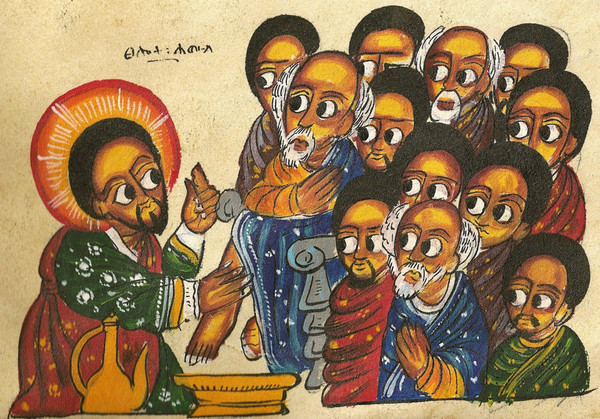
Ethiopian Orthodox Church depiction of Jesus the Bread of Life

“Bethlehem” is two Hebrew words put together: beth (“house”) and lechem (“bread”) thus being “House of Bread.” God was communicating that the coming shepherd leader would provide abundant food and care for them. God wanted, and still wants, a society that does not feed on itself, but is a house of bread for others. Jesus is the Bread of Life. Christ feeds us so that we will become a people who offer bread to others – both physical and spiritual bread.

Jesus is the bread for all the hungers we have in this life. We hunger for security in our world; satisfaction in our daily work; loved ones to be healthy and happy. In short, we hunger for peace. Our spiritual stomachs growl with hunger for spiritual food.  Many are spiritually starving because they are searching for peace and goodwill in places without food.

Satisfaction, contentment, and peace have come from the most unlikely places of Bethlehem and Nazareth. Can anything good come from villages in Judea that do not even show up on most maps of the ancient world?  Peace, hope, and goodwill can and do come from the least expected places and people. 

Christ was not born in the halls of power. Yet, through him there is peace, in the complete sense of the word. Jesus is the One who brings a full-orbed wholeness and wellness to life, no matter the situations around us. Jesus is our peace:

Like a shepherd, God will tend the flock; he will gather lambs in his arms and lift them onto his lap. He will gently guide the nursing ewes. (Isaiah 40:11, CEB)

“Yes, I will feed my flock, and I will lead them to a place of rest. I will search for the lost sheep. I will bring back the sheep that were scattered and put bandages on the sheep that were hurt. I will make the weak sheep strong, but I will destroy the fat and powerful shepherds. I will feed them the punishment they deserve.” (Ezekiel 34:15-16, ERV)

 “I am the Good Shepherd. I know my own sheep and my own sheep know me. In the same way, the Father knows me, and I know the Father. I put the sheep before myself, sacrificing myself if necessary. You need to know that I have other sheep in addition to those in this pen. I need to gather and bring them, too. They’ll also recognize my voice. Then it will be one flock, one Shepherd.” (John 10:14-16, MSG)

“I am the bread of life. He who comes to Me shall never hunger.” (John 6:35, NKJV)

When Jesus originally said those words, it was scandalous, unheard of rhetoric. So, Jesus, the stinker he could be, pressed it even more:

“I am the bread of life. Your ancestors ate the manna in the wilderness, yet they died. But here is the bread that comes down from heaven, which anyone may eat and not die. I am the living bread that came down from heaven. Whoever eats this bread will live forever. This bread is my flesh, which I will give for the life of the world… Very truly I tell you, unless you eat the flesh of the Son of Man… you have no life in you. (John 6:48-51, 53, NIV)

We are to ingest Jesus – to be filled with him. We need Jesus because he is our house of bread, our peace, our shepherd, and our king. Believing in him is to give our lives to him. The greatest Christmas gift we can give this season is the gift of our lives to Jesus Christ, the promised Messiah.

Lord Jesus, I have strayed far from your flock and taken matters into my own hands. I have chosen to feed in pastures that will never take care of my real hunger.  I need Your forgiveness. I believe You died on the cross for all the things I have done and left undone.  You rose from the grave to give me life. So, I want to stop going my own way and start going yours. Amen.