Welcome, friends! Christians around the world celebrate good news of great joy because God became flesh and blood and moved into the neighborhood. Click the video below, and let us enjoy a time around God’s Word.
The video below is, of course, a classic…
The Christmas speech of Linus, quoted from Luke 2
The Christian’s unspeakable joy comes from the incarnation of Christ…
My Soul Magnifies the Lord by Chris Tomlin from the album Glory in the Highest
May Christ, the Sun of Righteousness, shine upon you, scatter the darkness from before your path, and make you ready to meet him when he comes in glory. Amen.
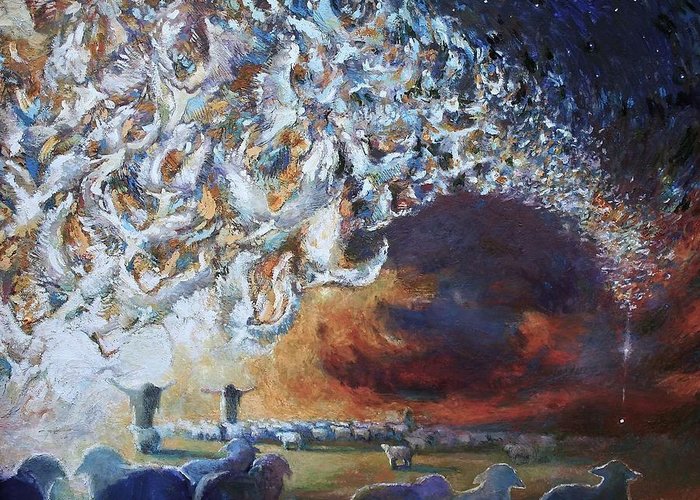
Seeing Shepherds by American painter Daniel Bonnell
There were shepherds living out in the fields nearby, keeping watch over their flocks at night. An angel of the Lord appeared to them, and the glory of the Lord shone around them, and they were terrified. But the angel said to them, “Do not be afraid. I bring you good news that will cause great joy for all the people. Today in the town of David a Savior has been born to you; he is the Messiah, the Lord. This will be a sign to you: You will find a baby wrapped in cloths and lying in a manger.” (Luke 2:8-12, NIV)
When I think of sheer unbounded joy, I think of dogs. My own dog, Max Power, waits every day for me to get home from work. And when I walk through the door, he acts as if he has not seen me in months, wagging his tail so hard that it looks like it will fly off his butt. This is one reason people like dogs so much – their joy brings us joy. It is not a joy that was ever learned in obedience school – it is just built into the relationship.
Genuine joy does not come from getting all the presents we want for Christmas or having everything go our way.
Joy is not a product we can buy at the store. Authentic, real joy is the fruit of meaningful relationships. My dog cares nothing about how much money I have or even if he has the best dog food to eat and a trendy collar to wear; his joy comes from being with me.
The good news of a Savior coming to this earth means God is coming to be with us. This is good news of great joy! We are loved because God is good, not because we are good. And because God is good, and we are a mess of humanity, there is joy that the Lord is coming to save us!
The reason Christ’s birth was good news of great joy to the shepherds is that they were shepherds. Shepherds in the ancient world were generally looked on with contempt. In fact, Egyptians refused to eat with Jews because they were mostly shepherds (Genesis 46:31-34).
Shepherds spent most of their time living with their sheep outdoors, to protect the flock. Shepherds were neither well-dressed nor culturally refined. They mostly smelled like sheep poop. Shepherds also had the notoriety of being drinkers. Because they slept with the sheep, many shepherds passed the time and dealt with the chilly air by taking a nip of alcohol. We do not really know whether most shepherds were drunkards, or not; but we do know they had a bad reputation.
Becoming a shepherd was not a profession a young person aspired to. Nobody took out a student loan to major in shepherding at the University of Jerusalem. King David started out as a shepherd. He was the youngest in the family and got stuck with the job nobody else wanted.
Out of all the persons and people-groups the heavenly angels could have come to announce the birth of Christ, it was shepherds.
This is truly a gospel of grace. The angelic announcement to a bunch of stinky shepherds is profoundly significant. It is important because grace is being shown to the lowliest of society. A lowly Savior, born to a lowly family, and placed in a lowly feeding trough, came to reach the lowly, common, ordinary person.
The Shepherds by Malaysian artist Hanna Varghese (1938-2009)
To have this kind of attention from God Almighty is like the master of a dog walking into the house. We, as the common, ordinary mutts of society, are beside ourselves with joy, feeling privileged to be in the same room as Jesus.
It is only the lowly and humble in heart who will see God and enjoy the Lord’s presence. That is because God opposes the proud but gives grace to the humble. It is why the angels came to the shepherds and not to the religious leaders. It is good news of great joy for all the people.
The gospel is not limited to those who are the most educated, the wealthiest, or from the most prominent of families – it is for everyone.
Yet, even with this good news of grace, many people still live their lives in fear and worry instead of joy. The message seems to only linger on the surface, not getting firmly pressed into minds and hearts.
Even though a Savior is born, we still experience the harshness of a world under the dominion of darkness. We worry about constant disease, financial difficulties, and the daily stresses of life. We fret about dealing with ornery people, hard circumstances, family members who go astray, and the little plastic things on our shoelaces coming off leaving the shoestrings frayed!
Sometimes, we strain our eyes to try and see some joy.
Jesus is the son of David, born in the town of David – both were anointed as kings but had to go through a lot of hardship before realizing their kingships. We live in the time between the two advents of Christ in which God’s kingdom is already here but not yet here. It is a topsy-turvy time characterized by a weird mix of sinner and saint, despair and joy, adversity, and comfort.
Real joy is not found in having every circumstance go our way and having everyone like us, all the time. Joy comes from the gospel of grace, from God coming down and being with us. Being in the presence of the Master makes all the difference. If joy comes from being with God in Christ, then cultivating and practicing the presence of Jesus in our daily lives is important and necessary.
Had the angels come into Bethlehem, a town swelling in numbers of people because of the Roman census, I am not sure anybody would have heard them. The shepherds were away from the noise, out in the quiet solitude of the fields by themselves. So, they were able to hear the message of God when it came.
Noise comes in various forms, both around us and within us. Sometimes we even create noise on the outside so that the boisterous racing thoughts on the inside will get drowned. To be quiet is to be able to listen. To listen is to receive another’s voice.
Receiving the voice of the angels, their message, and their praise to God, is the pathway to joy and the way out of unhappy inner noise.
We need deliverance from our brokenness and unhealthy ways of coping. There is far too much unhappiness in this world. One in every two-hundred teenage American girls cut themselves on a regular basis. More than half of people in the United States with serious depression do not receive or will not get adequate help. Anxiety disorders affect nearly sixty million adults in the United States.
The coming of Jesus Christ into this world makes a difference. God has come to be with us to meet the deepest needs of our lives. The deliverance can be realized as we eagerly anticipate the Master, spend time with him, and allow the Lord’s loving presence and compassionate voice to transform our hearts and change us from the inside-out.
Christianity is not a magic happy pill to swallow; it is a relationship with God which is cultivated and grows over time.
Joy is relational. That means no amount of positive thinking, buying new stuff, or good situations will create joy or sustain it. Christianity offers joy in Jesus – not a cheap sentimental happiness of having every prayer answered or each situation go our way – but the settled joy of God with us through the valleys as well as on the mountain tops.
Neither worry nor fret. Do not be afraid. I bring you good news of great joy that will be for all the people. In the town of David, a Savior is born. He is Christ the Lord. What can I give him, poor as I am? If I were a shepherd, I would bring a lamb. If I were a wealthy man, I would give him frankincense or gold. Yet, what can I give him?…
It is true that some preach Christ out of envy and rivalry, but others out of goodwill. The latter do so out of love, knowing that I am put here for the defense of the gospel. The former preaches Christ out of selfish ambition, not sincerely, supposing that they can stir up trouble for me while I am in chains. But what does it matter? The important thing is that in every way, whether from false motives or true, Christ is preached. And because of this I rejoice.
Yes, and I will continue to rejoice, for I know that through your prayers and God’s provision of the Spirit of Jesus Christ what has happened to me will turn out for my deliverance. I eagerly expect and hope that I will in no way be ashamed but will have sufficient courage so that now as always Christ will be exalted in my body, whether by life or by death. For to me, to live is Christ and to die is gain. (NIV)
It was the late U.S. President Ronald Reagan who said, “There is no limit to the amount of good you can do if you don’t care who gets the credit.” The ability to have disinterested attention from others and freedom from selfishness comes from a place of humility and strength – the power to know oneself well and be secure in that knowledge, as well as the humility to care more about an important cause than self.
The Apostle Paul had so learned humility from his Lord and was so thoroughly convinced of the gospel’s centrality that he did not care who got the credit when it came to proclaiming Jesus. Paul was quite aware of the varied motives of preachers other than himself. And much to the astonishment of many, he cared little about receiving personal credit even though recognition went to others who likely did not deserve it.
Paul had such a disinterested stance toward receiving accolades from his preaching because his burning, driving, constant, and passionate pursuit was the proclamation of Christ – and he cared little who did it, so long as it got done. He wanted the entire world to know Jesus Christ crucified, risen from death, ascended, and coming again. It seems Paul would have done anything toward this overarching purpose and dream, draining himself of every drop of self-centeredness in order to champion the cause of seeing people repent and believe the gospel of forgiveness and realize new life in Christ.
I freely admit that my own heart resonates deeply with Paul’s – I am absolutely enamored with the person and work of Jesus. Along with Paul, my desire is ardent to see God’s grace in Christ transform the world with a collective and miraculous enlargement of heart toward our fellow humanity. In fact, my longings for this are such that I sometimes lay awake at night wondering how to introduce Jesus to others through basic kindness and altruism. I want the great cause of my life to meet the world’s deep need with the deep love of Jesus Christ.
From decades of personal and anecdotal experience, I can say that attention and recognition are far too overrated – and giving up one’s life for a cause greater than oneself is much too underrated. If you and I really want to find our lives, we must give them up. For to live is Christ, and to die is gain. Thus, we have nothing to lose.
Gracious God, thank you for the example of your servant Paul. I rejoice in what you did in and through his life. I am available for your purposes. Use me in the advance of your gospel of grace so that I might fully participate in your grand forgiveness mission. Amen.
I thank my God every time I remember you. In all my prayers for all of you, I always pray with joy because of your partnership in the gospel from the first day until now, being confident of this, that he who began a good work in you will carry it on to completion until the day of Christ Jesus.
It is right for me to feel this way about all of you, since I have you in my heart and, whether I am in chains or defending and confirming the gospel, all of you share in God’s grace with me. God can testify how I long for all of you with the affection of Christ Jesus.
And this is my prayer: that your love may abound more and more in knowledge and depth of insight, so that you may be able to discern what is best and may be pure and blameless for the day of Christ,filled with the fruit of righteousness that comes through Jesus Christ—to the glory and praise of God.
Now I want you to know, brothers and sisters, that what has happened to me has served to advance the gospel. As a result, it has become clear throughout the whole palace guard and to everyone else that I am in chains for Christ. And because of my chains, most of the brothers and sisters have become confident in the Lord and dare even more to proclaim the gospel without fear. (NIV)
Physical health does not just happen. Care of the body is necessary through eating well, exercising, and coping adequately with stress. In the same way, spiritual health and care for the Body of Christ occurs when we put every effort to keep the unity of the Spirit through the bond of peace (Ephesians 4:3).
When spiritual health breaks down in the Body of Christ there are divided loyalties, unhappiness, and disunity. And this is precisely what happened in the ancient Philippian Church. They were spiritually sick and relationally fragmented through inattention to one another.
Unity is much more than the absence of division. It is a common community, sharing life together, working on supporting one another and reaching out to others. In our New Testament lesson for today, the Apostle Paul begins his letter with emphasizing that the Body of Christ realizes unity through a shared purpose of embracing the good news of Jesus Christ and proclaiming it to others.
Every pronoun, each “you” used in these verses is not singular but plural. We are meant to establish our common life together around a shared mission of gospel proclamation: The kingdom of God is near. Through repentance and faith in the person and work of Jesus there is forgiveness of sins, new life, and participation in the life of God. The mission is not for larger church attendance, although that is nice and may happen; it isn’t to do more, or to get other people to stop swearing or avoid tattoos.
The Apostle Paul knew that without a focus on mission, on sharing the good news with each other and proclaiming the gospel to others, that the lack of purpose would create spiritual sickness. Apart from a deliberate focus on centering life and mission around the person and work of Christ, a group of people just nit-pick one another to death with all their various opinions and wants.
Wherever there is an absence of shared purpose, there you will find constant complaining, endless arguing, and a bunch of crotchety curmudgeons who nobody wants to be around.
Conversely, with a polestar on mission, the community of the redeemed work together in close fellowship with the result being joy. Happy people are a breath of fresh air to be around. A good healthy spirit is a delight to others. In fact, folks will find hope and healing through a common purpose of life together which imbibes liberally from the redemptive events of Jesus.
Good news is fun to share. It is joyful. The gospel of Jesus Christ is wonderful news, worthy of exuberant celebration. The Apostle Paul had fond memories of his partnership in the gospel with the Philippian believers. Although he had been jailed and beaten, Paul joyously sang in the prison – to the point where the jailer took notice and listened to the good news of new life in Christ. The jailer and his entire family became followers of Jesus. (Acts 16:16-34)
The Philippians were Paul’s spiritual children. They had sacrificed with Paul toward the shared vision of proclaiming good news. So, Paul wanted them to remember their own significant events of coming to faith, enjoying fellowship together, and working toward common objectives. In reminding the Philippian believers, Paul hoped to help get their heads screwed on straight again. He was confident this would happen, having an unshakable belief that God would continue the good work started within them.
This confidence was the basis of Paul’s prayers for the church. He beseeched God to unleash the Philippians’ collective love in a grand experiential knowledge of the divine so that they might discern well, making solid decisions which place the gospel as central to all of life.
There is an incredible depth to human need – a deep spiritual longing for what is good and beautiful. Relational unity brings out the beauty and majesty of humanity. Sometimes we just need to recall past days when this was true of us when we are facing animosity and acrimony.
In times of frustration, anger, demonstrations, riots, violence (both physical and verbal) and injustice, we desperately need a vision of humanity which locks arms in unity without vilifying one another.
When we place priority on the good news, I believe we will again discover the joy of life, of knowing Christ. Perhaps, with a watching world observing basic human kindness and joyful relations, we will find ways of being better together and working toward the common good of all persons. And methinks, Jesus wants to help with this, if we will only let him.
May the risen and ascended Lord strengthen our efforts to mend the ruptures of the past and to meet the challenges of the present with hope in the future. May we embrace the grace which a sovereign God holds out to us and to our world. Amen.








 Rev. Tim Ehrhardt