Consider Wisdom (Proverbs 1:1-19)

By Peter Max, 2008

The proverbs of Solomon, son of David and king of Israel.

Here are proverbs that will help you recognize wisdom and good advice, and understand sayings with deep meaning. They can teach you how to live intelligently and how to be honest, just, and fair. They can make an inexperienced person clever and teach young people how to be resourceful. These proverbs can even add to the knowledge of the wise and give guidance to the educated, so that they can understand the hidden meanings of proverbs and the problems that the wise raise.

To have knowledge, you must first have reverence for the Lord. Stupid people have no respect for wisdom and refuse to learn.

My child, pay attention to what your father and mother tell you. Their teaching will improve your character as a handsome turban or a necklace improves your appearance.

My child, when sinners tempt you, don’t give in. Suppose they say, “Come on; let’s find someone to kill! Let’s attack some innocent people for the fun of it! They may be alive and well when we find them, but they’ll be dead when we’re through with them! We’ll find all kinds of riches and fill our houses with loot! Come and join us, and we’ll all share what we steal.”

My child, don’t go with people like that. Stay away from them. They can’t wait to do something bad. They’re always ready to kill. It does no good to spread a net when the bird you want to catch is watching, but people like that are setting a trap for themselves, a trap in which they will die. Robbery always claims the life of the robber—this is what happens to anyone who lives by violence. (Good News Translation)

“To educate a man in mind and not in morals is to educate a menace to society.”

Theodore Roosevelt

A proverb is a short pithy statement of experiential truth. Proverbs are meant to teach one how to live a good life. This sort of education requires a lifetime of learning. There is always wisdom to be gained.

In order to have true understanding and wisdom, there needs to be a balance of intellectual knowledge, affective feeling, and intuitive knowledge. Only possessing some of these elements makes one nothing more than a half-wit.

A commitment to virtue, morality, and ethics is a must in the acquisition of wisdom, and thus, a good life. Physical, mental, emotional, and spiritual maturity all take time. Marinading over a long period of time in the wisdom of biblical proverbs will prove to be a life saver. At the end of one’s life, they can look back with gratefulness and satisfaction, instead of sorrow and regret.

So, from the very outset of approaching the Book of Proverbs, the mindset and heart stance must not be one of popping a few proverbial pills in order to achieve a self-centered goal or gain an immediate solution.

Rather, proverbial wisdom demands daily immersion in its wise sayings. It requires implementation and experimentation every single day. There needs to be decisive action, coupled with contemplative reflection. Anything short of this truncates and stunts one’s growth.

There is yet one more necessary prerequisite toward the sagacious and good life. Without this, nothing is possible. But with this, all things are possible: Acknowledgment, awareness, and adoration of the Lord.

A fool is one who stubbornly refuses to take in the full range of epistemic knowledge. Being only book smart is to actually be stupid. To be only a walking heart of emotional intelligence is foolish. And to live only by gut instinct alone is to cut off yourself from wisdom’s teaching.

A wise life includes the head, the heart, and the gut – and to have them all aligned together as an integral whole. To live other than this is to live as a fool who believes they already have the answers and the key to knowledge and understanding.

Furthermore, this means that to take God and transcendent things off of the table, to begin with, is the most foolish decision a person can make. Conversely, to forsake the intellectual life and believe that all one needs is the spiritual, is to betray a woefully foolish approach to the good life.

There are also those who distance themselves from family, especially parents. On some level, this makes sense, if one had a childhood full of traumatic memories and difficult relationships.

However, learning to honor even these parents is to place oneself on the path of wisdom, and to learn what the good life truly entails. And this approach allows the person to see the good, and strain out the bad.

In other words, we discover that good and bad, wise and foolish, smart and stupid, exists within everyone and in every place. Wholesale jettisoning of persons and/or institutions gains us little to nothing.

This distancing from family and/or God is an attempt to assert some control, to effect one’s willpower upon life. But this will lead us away from the true path of wisdom.

That’s because wisdom is not something to be mastered. Wise sayings don’t exist to be collected, and their sagacity harnessed for one’s personal goals.

Yes, we are to avail ourselves of wisdom, yet perhaps not as we may believe or think. We do not capture wisdom, but are captured by it.

The importance of this mental, emotional, and spiritual stance must not be undervalued. We only learn wisdom by means of humility and reverence before powers greater than ourselves. Any vestige of pride in us shall cause wisdom to disappear and slip from our grasp.

Only until we both intellectually and experientially recognize that the essential operations of the universe are beyond us, shall anyone begin to trust and risk in a wisdom greater than our own.

“Without humility, all shall be lost.”

St. Teresa of Avila

Put another way, if we refuse to learn from God and from our parents, then we won’t.

Only by accepting this can anyone discern what to do and don’t do, say and don’t say, when faced with competing voices.

For there is continually a voice of foolishness, of wickedness, enticing us to get what we want quickly, selfishly, without any thought to the consequences or the effect upon others. A group of such voices becomes a gang who tries outdoing each other in competitive evil.

There is also a voice of wisdom, which admonishes us to avoid the fast, fun, and friendly gang of evil speech and behavior. The wise person discerns that what the wicked person does to another, comes back upon them.

The patient and powerful voice of wisdom communicates prudence in all things, that is, to do today what will lead to a better tomorrow.

So then, my friend, what is the thing – the decision, the action, the words – that you can and will do today which will help you accomplish a good, right, and just life for yourself (and others) for tomorrow?

Great God of all wisdom, help me to trust You and follow Your precepts in every twist and turn of my life. Grant me good understanding and guide my steps, so that Your will is done on earth, as it is always done in Your heaven. Amen.


Respect Wise Sayings (Proverbs 22:1-9)

Being respected is more important than having great riches.
    To be well thought of is better than silver or gold.

The rich and the poor are alike
    in that the Lord made them all.

The wise see danger ahead and avoid it,
    but fools keep going and get into trouble.

Respecting the Lord and not being proud
    will bring you wealth, honor, and life.

Evil people’s lives are like paths covered with thorns and traps.
    People who guard themselves don’t have such problems.

Train children to live the right way,
    and when they are old, they will not stray from it.

The rich rule over the poor,
    and borrowers are servants to lenders.

Those who plan evil will receive trouble.
    Their cruel anger will come to an end.

Generous people will be blessed,
    because they share their food with the poor. (New Century Version)

The Bible is a big book. In fact, it is more like a compilation of many books – 66 of them, to be precise, contained in the Old and New Testaments. Although the Bible has the grand theme of presenting a redemptive drama, it is not a flat one-dimensional piece of literature. 

Throughout the Bible’s contents, from Genesis to Revelation, it is chocked full of various literary genres. From poetry and narrative stories to apocalyptic accounts and exhortative epistles, Holy Scripture provides a many-sided look at the unfolding drama of God’s redemption toward humanity. 

Included in this big Bible is the book of Proverbs, a collection of wise sayings to help people navigate God’s big world. The chief reason it’s important to know that the Bible contains different types of literature is so that we can read it and interpret it well. 

A proverb is a short pithy statement of experiential truth. 

It’s not the same as commands or law. The individual Hebrew proverbs are designed to point out that, all things being equal, this is how the world works. For example, let’s consider one of the most misunderstood and misused verses in the Bible: Train up a child in the way he should go; even when he is old he will not depart from it. 

Many a parent has been made to feel unrelenting guilt over a wayward son or daughter, believing that somehow they have failed. The reason they have such feelings is that they treat the book of Proverbs as clear promises to claim. But biblical proverbs simply were not meant to be stretched in this manner.

Rather, the proverb is meant to communicate to us that if parents are diligent and faithful in raising kids, that in all likelihood, this training will never leave them; it will always stick with them in some way, shape, or form. 

Furthermore, it’s also true that many a parent has rejoiced over an adult child coming back to their faith after a sojourn in the muck of the world. Important to that return is the foundation laid years ago with faithful parenting that desired to pass on wise and good instruction.

Proverbs, therefore, are meant to encourage us, not with an ironclad promises, but with the hope that all the blood, sweat, and tears that parents, teachers, mentors, and others put into children, and into their diligent work, will someday likely bear much fruit of responsible lives that contribute and benefit the church and the world. 

So, be diligent, patient, and do not give up; keep persevering knowing that your labor in the Lord is not in vain.

And also consider the proverb that honoring, respecting, and fearing God will bring a person wealth, riches, and an abundant life. It might. Perhaps likely. But it’s neither a promise nor a command. And it’s definitely not a math equation; you cannot build an algorithm from it to get rich quick. No, the verse is a proverb.

In other words, if we are careful to pay attention to God, and seek to obey and trust the Lord for all things, then, it is quite likely that you will find yourself with plenty, and not be in want. Thus, we ought never to look at the world with black-and-white glasses that unthinkingly believes that all rich people are hard workers and godly, whereas all poor folk are lazy good-for-nothing’s.

What’s more, many a poor person is rich in faith and good works, whereas many of the rich, care little for God and spend their wealth on self-centered concerns. Understanding a proverb as a proverb helps us to avoid stereotyping people and giving them labels they don’t deserve.

Let’s keep going. I do believe, as the proverb says, that generous people will be blessed. But know this: genuine generosity always costs us something. It will take money, time, energy, and/or resources which become depleted when we give liberally. Some folk never acquire wealth because they are committed to sharing what they have with others. And, in my opinion, these are the persons who are truly blessed.

If we keep an eye toward acquiring wisdom, pursuing experiential knowledge, and trusting God, then we look to places in the Bible like the Proverbs, and seek to live life as it was intended to be lived.

Internalize the biblical proverbs and, all things being equal, you are quite likely to have a good and blessed life.

Blessed and almighty God, the Giver of life, it is from your hand that we have received all we have, and are, and will be. We understand that your divine call upon us is to be the stewards of your abundance, the caretakers of all you have entrusted to us. Help us always to use your gifts wisely; and teach us to share them generously. May our faithful stewardship bear witness to the love of Christ in our lives; we pray with grateful hearts, in the gracious name of Jesus. Amen.

Idolatry Is the Tail Wagging the Dog (Psalm 106:1-6, 19-23)

Praise the Lord!
    O give thanks to the Lord, for he is good,
    for his steadfast love endures forever.
Who can utter the mighty doings of the Lord
    or declare all his praise?
Happy are those who observe justice,
    who do righteousness at all times.

Remember us, O Lord, when you show favor to your people;
    help us when you deliver them,
that we may see the prosperity of your chosen ones,
    that we may rejoice in the gladness of your nation,
    that we may glory in your heritage.

Both we and our ancestors have sinned;
    we have committed iniquity, have done wickedly…

They made a calf at Horeb
    and worshiped a cast image.
They exchanged the glory of God
    for the image of an ox that eats grass.
They forgot God, their Savior,
    who had done great things in Egypt,
wondrous works in the land of Ham,
    and awesome deeds by the Red Sea.
Therefore he said he would destroy them—
    had not Moses, his chosen one,
stood in the breach before him,
    to turn away his wrath from destroying them. (New Revised Standard Version)

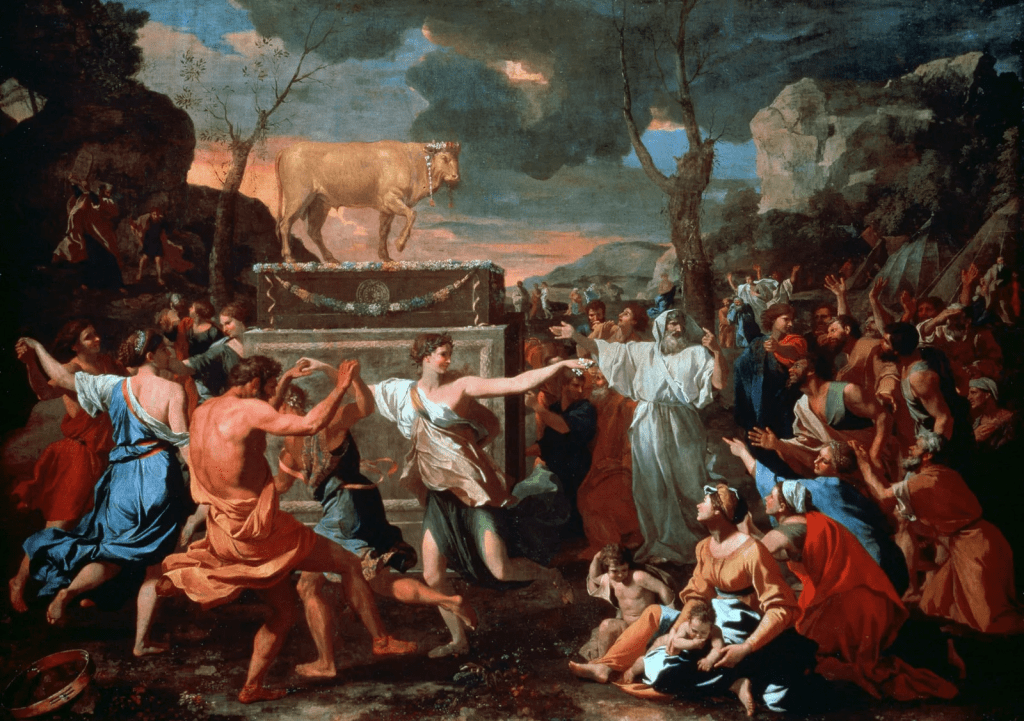
Adoration of the Golden Calf, by Nicolas Poussin (1594-1665)

When it comes to sin, especially the sin of idolatry, it’s imperative that we name it for what it is. It will do no good to fudge on it by saying that so-and-so struggles with it more than me, or that it’s not as bad as assault or murder.

No, we must call sinful idolatry just that, because the problem of idolatry is at the heart of humanity’s spiritual struggle. The first of the Ten Commandments frames it and names it squarely:

“I am the Lord your God who brought you out of slavery; do not worship other gods.” (Exodus 20:2-3, NRSV)

And the second commandment straight up prohibits any manufacturing or worshiping of idols:

“You shall not make for yourself an idol, whether in the form of anything that is in heaven above or that is on the earth beneath or that is in the water under the earth. You shall not bow down to them or serve them….” (Exodus 20:4-5, NRSV)

In the New Testament Gospels, Jesus also drew sharp lines between God and idolatry:

“No one can serve two masters, for a slave will either hate the one and love the other or be devoted to the one and despise the other. You cannot serve God and wealth.” (Matthew 6:24, NRSV)

The early church fathers (and mothers) forsook dependence on anything or anyone other than the one true God. Idolatry is an obsessive and fruitless search to satisfy a legitimate need in an illegitimate manner by giving oneself to someone or something other than the true object of the heart’s longing.

“You have made us for yourself, O Lord, and our heart is restless until it rests in you.”

St. Augustine

None of this means that the material and physical world is somehow bad – that money, possessions, food, books, nature, and other people are objects to avoid – because they are most certainly not! The problem arises whenever we seek to replace God with the things God made, God’s own creation.

By seeking to save our souls and fill the emptiness in our spirits with more and more wealth, or more and better jobs, or more time and expense for reading, or just about any other activity or possession there is, those things which were given for our use and enjoyment and to be stewarded well by us, end up becoming the users and our masters.

Inanimate objects, ideas, and activities begin calling the shots and giving the commands about what we should do and not do. What we own, now owns us. Even the poor can succumb to idolatry through the sin of covetousness by wanting things they do not have in the belief that wealth and possessions will make their lives whole and worthy. But this breaks the tenth commandment:

“You shall not covet your neighbor’s house; you shall not covet your neighbor’s wife, male or female slave, ox, donkey, or anything that belongs to your neighbor.” (Exodus 20:17, NRSV)

Nature and all the earth were formed by the Creator. And, as such, they too, give glory to God and recognize they themselves are not to be worshiped.

The heavens are telling the glory of God,
    and the firmament proclaims his handiwork.
Day to day pours forth speech,
    and night to night declares knowledge. (Psalm 19:1-2, NRSV)

Genuine wealth, prosperity, happiness and peace are found in the Creator of all good things. It is God who will:

  • wipe every tear from our eyes (Isaiah 25:1-9)
  • provide protection and guidance through the hard times of life (Isaiah 54:17)
  • be present with us as we walk through the valley of despair and ascend the mountain of celebration and joy (Psalm 23)

The reason idolatry is so insidious and difficult to name is that our affections are typically on a good thing which God has created and given for us. It’s just that, over time and through an extended process, the tail begins to wag the dog. For example:

  • Humanity serves the Sabbath instead of the Sabbath serving humanity
  • Parishioners venerate a church building instead of the church building being a tool for ministry
  • People are slaves to their hobbies instead of the hobby serving the person
  • Spouses worship one another instead of worshiping the God who brought them together
  • Groups let their traditions hold them with an iron grip, instead of traditions being held loosely by groups

It could (and does) happen to each one of us. And when it does, we need the wisdom and humility to see it for what it has become. Then, confess it as idolatry, and accept the forgiveness which is freely available from the Divine.

Almighty and everlasting God: Not to us, but to your name we give glory, for the sake of your steadfast love and your faithfulness! Yet because of the idolatry in our hearts, we have strayed far from you. We have disobeyed your commandments; we have trusted our own judgement; and we wonder why we feel distant from you. We have worshipped idols of silver and gold—and idols of self and comfort. Forgive us for not loving you as we ought, not obeying you as we were taught, and not trusting that our forgiveness has been bought. Amen.

Free to Live a New Life (Romans 7:1-6)

You shouldn’t have any trouble understanding this, friends, for you know all the ins and outs of the law—how it works and how its power touches only the living. For instance, a wife is legally tied to her husband while he lives, but if he dies, she’s free. If she lives with another man while her husband is living, she’s obviously an adulteress. But if he dies, she is quite free to marry another man in good conscience, with no one’s disapproval.

So, my friends, this is something like what has taken place with you. When Christ died he took that entire rule-dominated way of life down with him and left it in the tomb, leaving you free to “marry” a resurrection life and bear “offspring” of faith for God. For as long as we lived that old way of life, doing whatever we felt we could get away with, sin was calling most of the shots as the old law code hemmed us in. And this made us all the more rebellious. In the end, all we had to show for it was miscarriages and stillbirths. But now that we’re no longer shackled to that domineering mate of sin, and out from under all those oppressive regulations and fine print, we’re free to live a new life in the freedom of God. (The Message)

The goal of salvation is to be delivered from oppressive bondage so that we are free to live a true and beautiful life – a holy life, set apart for good.

Romans chapters 6-8 are the Apostle Paul’s pointed discussion of how we become holy in a real and practical way. The theological word we typically use for this is “sanctification,” which means “to become holy,” and “set apart” for God. To be delivered from sin, death, and hell through the person and work of Jesus Christ is not the end of the story; it is just the beginning.

Becoming holy and good in our everyday lives boils down to this: identity and belonging.

One of the healthiest ways of looking at the entirety of the Bible’s message is that we belong to God. Our identities are thoroughly wrapped around Jesus. The process of realizing this, and coming to grips with it, is how we grow as people in holiness and righteousness.

Because of Christ’s finished work on the cross, we have been delivered from the realm of sin. Our change in status from condemned to accepted provides us the awareness to make daily affirmations of faith and live a new life.

Yet, the sinful nature (flesh) or the old person is still there. Although it is now toothless, our past can, and may often, exert a powerful influence on us. Even though there is a medium-rare T-bone steak on the table for us to enjoy, there are times we go back to the old bologna sandwich with stale white bread.

We no longer need to fall short of our true humanity. That’s because we belong to God. We are adopted into God’s family, having been orphaned by sin’s cruel influence.

However, just because we have been saved from the power of sin, sin itself is not extinct. We still must deal with it. We are alive to God and need to take up this great spiritual reality and live into it, for the force of sin still exerts a powerful influence in the world.

We deal with sin’s continued presence (the world, the flesh, and the devil) through embracing God’s grace versus trying to overcome it with the law.

Paul used an illustration from marriage to expand our understanding of grafting grace into our daily lives. By law, a married woman is bound to her husband (keeping in mind this sense of belonging was the predominant view of marriage in the Apostle’s day). But if the husband dies, the wife is released from the legal marriage. If she were to give herself to another man while her husband is still alive and they are married, then she becomes an adulteress. However, if she is a widow, then marries again, she is not an adulteress.

Paul applies this understanding to our relationship with the law. Death has separated us from the law. We died with Christ. Therefore, we have been set free from the law and have become alive to grace. As believers in Jesus, God’s grace and love changed our lives:

  • We now “belong to another, to him who was raised from the dead.” (Romans 7:4)
  • “When Christ’s body hung upon the cross, when God spared not his own Son but gave him up for us all.” (Romans 8:32)
  • “Christ took on himself for us all the curse of the law which inflicted all of us.” (Galatians 3:13)
  • We died to the law. God’s grace has made the death of Jesus the death of all from the realm of sin. (2 Corinthians 5:14)

As a married man, let me use Paul’s illustration to get down to the gist of his teaching. Yes, I am legally married and belong to my wife. I made vows to my wife on our wedding day which bind me legally to do what I said I would do. Yet, if I fulfill those vows in a strictly legalistic manner, I can vouch for my wife that this would not qualify as an acceptable situation for her. You see, my wife (and, me, too!) are freely bound to one another in love and grace. I care for my wife because I love her deeply, and not because it is my legal duty to do so.

The Christian life was neither designed nor meant to serve as a bare legal contract or covenant between us and God. God forbid such a thought! Jesus died to clear us from all the legality stuff so that we could freely love and serve God with joyful abundance and gratitude.

I am follower of Jesus because I love him deeply. What impels and motivates me is God’s grace. The law is there and has its place. However, it is not the law that causes me to be a Christian; it is the love of Christ which saved me from myself and compels me to live like Jesus.

May the God of peace make you pure, belonging only to him. May your whole self—spirit, soul, and body—be kept safe and blameless when our Lord Jesus Christ comes. The one who chose you will do that for you. You can trust him. Amen.