
Not Ashamed (2 Timothy 1:8-12)

So never be ashamed to tell others about our Lord. And don’t be ashamed of me, either, even though I’m in prison for him. With the strength God gives you, be ready to suffer with me for the sake of the Good News. 

For God saved us and called us to live a holy life. He did this, not because we deserved it, but because that was his plan from before the beginning of time—to show us his grace through Christ Jesus. 

And now he has made all of this plain to us by the appearing of Christ Jesus, our Savior. He broke the power of death and illuminated the way to life and immortality through the Good News. And God chose me to be a preacher, an apostle, and a teacher of this Good News.

That is why I am suffering here in prison. But I am not ashamed of it, for I know the one in whom I trust, and I am sure that he is able to guard what I have entrusted to him until the day of his return. (New Living Translation)

Guilt and Shame

Shame is a nasty feeling. Whereas guilt is a function of the conscience, and helps steer us toward making things right with others, shame lays an unnecessary heavy burden on the soul. Guilt says that I did or said something that wasn’t good. But shame says we did or said something because I am a failure.

The Apostle Paul insisted to his young protégé, Timothy, that there’s no basis for shame when it comes to proclamation of the gospel. In fact, the Good News confronts shame by putting a wooden stake through its heart.

Shame is a vampire that lives in the shadows and feeds on secrets. But the light of the Gospel penetrates life, disintegrating shame and putting it to death.

God’s word is alive and powerful! It is sharper than any double-edged sword. God’s word can cut through our spirits and souls and through our joints and marrow, until it discovers the desires and thoughts of our hearts. Nothing is hidden from God! He sees through everything, and we will have to tell him the truth. (Hebrews 4:12-13, CEV)

Not a Failure

From a particular perspective, Paul would seem like a failure to many. He was an up and coming star in Judaic circles, but gave it all up to follow Jesus. And then, his life was marked by continual hardship, even persecution. To top it off, he landed in prison. Ironically, Paul found himself in a bad place just for being a preacher of good. He never left his imprisonment, and was eventually killed.

Yet Paul had no shame about any of it. Rather, he embraced the suffering, the difficulty, and all the circumstances that went sideways. Why? Because he had complete faith in who he was serving and what he was doing.

A lot of people, especially church pastors, struggle with shame. Most of them don’t have “successful” ministries when looked at from a certain angle. They see themselves as failures, and end up leaving the ministry and never going back.

Our strength and our help, however, no matter whether we’re clergy or laity, is in the name of the Lord who made heaven and earth; our assistance is found in the Good News we proclaim, in Jesus Christ, who himself was not ashamed of being tortured and killed.

Let us also lay aside every weight and the sin that clings so closely, and let us run with perseverance the race that is set before us, looking to Jesus, the pioneer and perfecter of faith, who for the sake of the joy that was set before him endured the cross, disregarding its shame, and has taken his seat at the right hand of the throne of God. (Hebrews 12:1-3, NLT)

No More Shame

Christ has defanged the vampire of shame. And because of the work achieved on the Cross, we can now live in confidence, knowing who we believe, and trusting that the shame-busting Good News of grace will have it’s penetrating way in the world.

Salvation entails being delivered from something so that we can live for something else. We have been saved from the terrible grip of shame – which then allows us to live a vulnerable and confident faith in Jesus through the power of the Spirit.

Deliverance from shame enables us to respond to our holy calling from God.

For he chose us in him before the creation of the world to be holy and blameless in his sight. (Ephesians 1:4, NIV)

God chose us to be holy. He does not want us to live in sin. (1 Thessalonians 4:7, ERV)

“Salvation” is a wonderful word which needs to be reclaimed as so much more than going to heaven someday. In reality, it is the divine purpose by which God makes us just, right, and holy, forgiving our offenses and transforming us by the Spirit into the image of Christ.

Christ, in his incarnation, life, ministry, death, burial, resurrection, and ascension has redeemed us. Jesus has torn down every wall, removed each barrier, and built bridges in connecting us to a life without shame and with everything we need to live well.

Christians embody the life of Christ within them by living a holy life, free of the weight of shame, and boldly proclaiming a message of grace, forgiveness, and freedom from the dark secrets we all carry.

This isn’t merely an ethereal gospel; it is Good News of great joy that has real impact for the nitty-gritty of our everyday lives.

O God, the author of peace and lover of harmony, to know you is eternal life and to serve you is deliverance and freedom: Defend us, your humble servants, in all assaults of our enemies; that we, surely trusting in your defense, may not fear the power of any adversaries, through the might of Jesus Christ our Lord. Amen

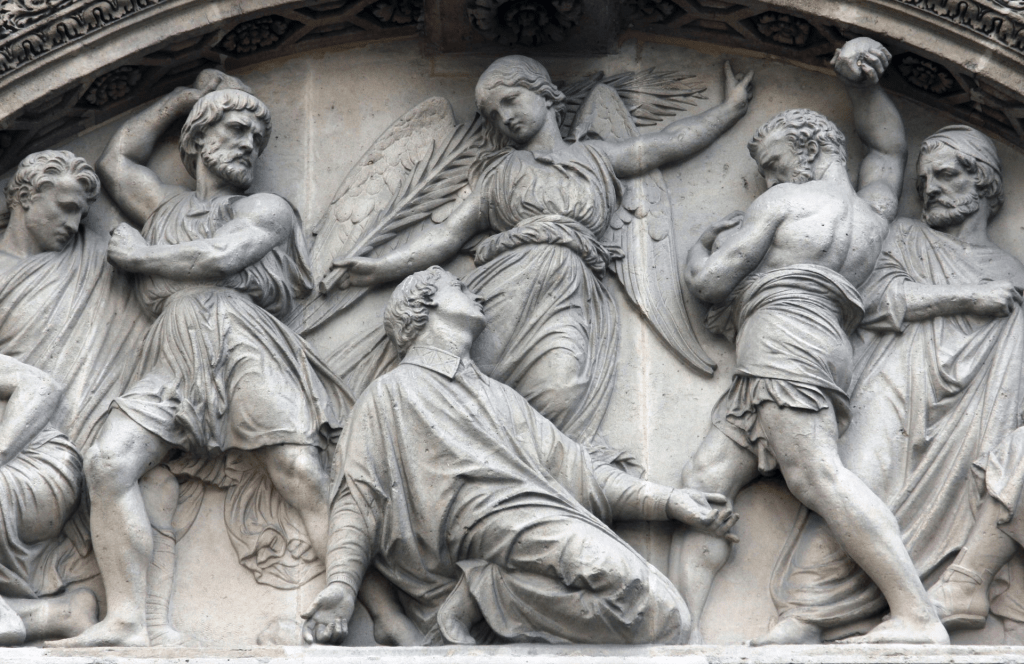
Put To Death (Acts 7:55-60)

The Martyrdom of Stephen, by sculptor Gabriel-Jules Thomas (1824-1905)

But Stephen, full of the Holy Spirit, looked up to heaven and saw the glory of God, and Jesus standing at the right hand of God. “Look,” he said, “I see heaven open and the Son of Man standing at the right hand of God.”

At this they covered their ears and, yelling at the top of their voices, they all rushed at him, dragged him out of the city and began to stone him. Meanwhile, the witnesses laid their coats at the feet of a young man named Saul.

While they were stoning him, Stephen prayed, “Lord Jesus, receive my spirit.” Then he fell on his knees and cried out, “Lord, do not hold this sin against them.” When he had said this, he fell asleep. (New International Version)

Although I am a trained in biblical exegesis and hermeneutics (interpreting Scripture) I believe that most insights come from making simple observations about the text. So, I want to point out: Stephen was not martyred by the Romans, a religiously pagan group, nor Gentile people; he was martyred by those of his own ethnicity, by “God’s people.”

The religious authorities were more than just unhappy with Stephen. The Sanhedrin (the Jewish ruling council) were incensed with him, so mad that they were grinding their teeth at him. The council sincerely believed Stephen was a blasphemer of God, that what he was saying was so subversive and religiously radical, they could stone him to death with a clear conscience, as if this act were upholding God’s honor and God’s Law.

The result was not only the death of a humble man; it also sparked an intense persecution against the church which caused a new Christian diaspora (Acts 8:1-3). Many believers in Jesus found themselves as Christian refugees trying to eke out a living and worshiping Christ in foreign places.

I wish I could say the greatest opposition I’ve ever experienced as a Christian came from non-Christians who simply misunderstood and misinterpreted me. However, my most hurtful wounds have come from the hands of church folk, believing they were acting on God’s behalf by exacting an emotional martyrdom upon me with the stones of gossip, slander, backbiting, blame-shifting, and outright lying (and a few threats of violence).

Whenever I encounter persons who no longer attend church and have no intention of ever returning to any local congregation, I get it. I understand. Yet, although the church is sometimes like a woman of disrepute, I still love her, and will do whatever I can to edify her and not repay evil with evil.

Stoning a believer, either actually with physical rocks or virtually with verbal stones, is akin to persecuting Jesus himself. That’s because Christ so closely identifies with his people that it is as if he is a head, and his followers are a body – joined together in a vital union.

So, when Christ’s Body is subjected to what I call, “hermeneutical hubris,” in which one group of people insists there is only one way to interpret Scripture, and then uses their authority and structures of power to force compliance on another group, the result is persecution.

And that is precisely why Christians can abuse other Christians.

Rather than discerning that all Christians belong to God, one narrow-minded and small-hearted group excludes all other groups who disagree with them as blaspheming the name of Christ.

For example, insisting that a literal interpretation in the only means of understanding the Bible’s authority is to ignore and abuse the actual and real authority which exists with the Bible. I am in no way encouraging an “anything goes” type of approach to Holy Scripture that lets it say whatever you want it to say. 

What I am saying is that the biblical writers themselves employed different methods of interpretation, as well as the early church fathers (which is one reason I hold to the interpretive guides of the ancient Christian creeds, i.e. The Apostles’ Creed and Nicene Creed).

Far too often, churches stick to a particular interpretation because they believe they are keeping biblical fidelity. This is many times born of a fear that Christendom will be lost, and society will sink into an abyss of egregious sin. The irony is that many churches are sinking into forms of abusive and ungracious behavior by fighting battles that Scripture does not call them to fight.

The binary thinking of “I’m right and you’re wrong” is not an approach you’ll find in God’s Holy Word.

Even if the Sanhedrin in Stephen’s day intended on upholding the holiness of their God and the rightness of their cause, the impact it had on the church was martyrdom, death, and diaspora.

Unfortunately, throughout Christian history, the tables have too often turned with Christians persecuting Jews. I myself would like to avoid being the persecutor. If I kill anything, may it be putting to death my own sin – because that is what the Bible calls me to do.

Dear brothers and sisters, you have no obligation to do what your sinful nature urges you to do. For if you live by its dictates, you will die. But if through the power of the Spirit you put to death the deeds of your sinful nature, you will live.

The Apostle Paul (Romans 8:12-13, NLT)

Since, then, you have been raised with Christ, set your hearts on things above, where Christ is, seated at the right hand of God. Set your minds on things above, not on earthly things. For you died, and your life is now hidden with Christ in God. When Christ, who is your life, appears, then you also will appear with him in glory.

Put to death, therefore, whatever belongs to your earthly nature: sexual immorality, impurity, lust, evil desires and greed, which is idolatry. Because of these, the wrath of God is coming.You used to walk in these ways, in the life you once lived. But now you must also rid yourselves of all such things as these: anger, rage, malice, slander, and filthy language from your lips. 

Do not lie to each other, since you have taken off your old self with its practices and have put on the new self, which is being renewed in knowledge in the image of its Creator. Here there is no Gentile or Jew, circumcised or uncircumcised, barbarian, Scythian, slave or free, but Christ is all, and is in all.

Therefore, as God’s chosen people, holy and dearly loved, clothe yourselves with compassion, kindness, humility, gentleness and patience. Bear with each other and forgive one another if any of you has a grievance against someone. Forgive as the Lord forgave you. And over all these virtues put on love, which binds them all together in perfect unity.

Let the peace of Christ rule in your hearts, since as members of one body you were called to peace. And be thankful. Let the message of Christ dwell among you richly as you teach and admonish one another with all wisdom through psalms, hymns, and songs from the Spirit, singing to God with gratitude in your hearts. And whatever you do, whether in word or deed, do it all in the name of the Lord Jesus, giving thanks to God the Father through him. (Colossians 3:1-17, NIV)

Gracious God, as your Son humbled himself on this earth, so may your church walk continually in such humility that believers everywhere work together in unity for the sake of gospel of grace as a blessing to the world in the power of your Holy Spirit. Amen.

Spiritual Growth (1 Peter 2:1-3)

Therefore, rid yourselves of all malice and all deceit, hypocrisy, envy, and slander of every kind. Like newborn babies, crave pure spiritual milk, so that by it you may grow up in your salvation, now that you have tasted that the Lord is good. (New International Version)

Spiritual growth is of vital importance.

God made humanity in the divine image and likeness – which means we were created as spiritual persons. We must therefore recognize that the area of our greatest value, potential, fruitfulness, and life fulfillment will be in the realm of the spiritual. 

If we deny our spirituality, whether in thought or in practice, we will inevitably become confused and set ourselves up for failure. That’s because our basic nature is one of being spiritual persons. Our spiritual growth is important; and God has made the provision for us to experience this growth.

For spiritual growth to occur, we will need to do away with everything that prevents that growth from happening. All evil and wickedness, hypocrisy and envy, slander and gossip, must be jettisoned as inconsistent with our spiritual selves and our new birth as believers in Jesus.

Just as babies need milk for growth, Christians need to ingest the apostolic teaching given to them as indispensable to their growth toward salvation. In the words of the psalmist, Christians have found the Lord Jesus as good to the taste.

Taste and see how good the Lord is!
    The one who takes refuge in him is truly happy! (Psalm 34:8, CEB)

Spiritual growth is both a necessity and a command; it’s neither optional nor something to work on if we have some discretionary time. God has made every provision for our spiritual growth; the Lord has not left us alone.

You, therefore, beloved, since you are forewarned, beware that you are not carried away with the error of the lawless and lose your own stability. But grow in the grace and knowledge of our Lord and Savior Jesus Christ. To him be the glory both now and to the day of eternity. Amen. (2 Peter 3:17-18, NRSV)

Grace refers to all the privileges of being a redeemed person. Knowledge denotes all the benefits of God’s revelation to us. This is our sustenance in order to spiritually grow as Christians.

And we are to crave it with the same kind of intensity that a newly born baby will seek for food. As babies, my girls were barracudas when it came to feeding time. They went at breast-feeding with so much gusto that my poor wife was often left in downright pain afterwards. 

That same kind of desire for feeding must be present with us as believers in Christ’s church. When we obey the command of the Apostle Peter and make it a priority in our life, we will grow.

One of the problems with spiritual growth is that there is a disease-like force operating in our lives – a destructive tendency toward lethargy and passivity toward spiritual things. 

It’s ironic that people who confess Jesus as Lord can be so attentive about trivial things, and yet, at the same time, be so unconcerned about giving focus to feeding on the Word of God. We cannot go on living like this and expect to be successful in the Christian life.

To grow spiritually requires speaking the truth in love, instead of using our words for tearing-down others. Loving exhortation and encouragement causes us to grow up into the people Christ wants us to be. (Ephesians 4:15)

We are to have an aggressive application of the truth, in both speech and action, that impacts our daily faith walk with Jesus. The way we grow spiritually, both personally and corporately, is through practicing the truth of Holy Scripture. Our priorities, goals, and values need to reflect a solid commitment to fulfill scriptural truth in daily life. Have we:

  • Come before God and confessed the things we have done and left undone when it comes to God’s revealed will?
  • Humbled ourselves before one another in the church and asked for prayer?
  • Read the Bible on the subject of spiritual growth and followed its teachings so we can know the joy and love God has for us?
  • Been lethargic and passive about our spiritual selves?

The Holy Spirit has been gifted to us for our spiritual growth so that we might be brought into close fellowship with the Lord Jesus. 

By obeying the Scripture in this area of practicing biblical truth, we will begin to experience spiritual growth and the joy of the Lord. 

However, if we allow ourselves to remain lethargic and apathetic concerning spirituality, we will never become our true selves. We must choose to make a biblical response both to God and to one another when it comes to our personal and collective growth as spiritual persons. 

This is not a matter of personal willpower because spiritual growth is much more than our own effort. We must face our spiritual condition and seek both God’s help and the help of God’s community of the redeemed, the church. 

Only then will spiritual growth become a reality.

Good and blessed God, we keep asking that we may be filled with the knowledge of God’s will in all spiritual wisdom and understanding, so that we may live worthy lives, fully pleasing to you, as we bear fruit in every good work and grow in the grace and knowledge of the Lord Jesus. 

May you make us strong with all the strength that comes from your glorious power, so that we may have endurance and patience, joyfully giving thanks to you who has enabled us to share in the inheritance of the saints in the light, through Christ our Savior, in the power of the Holy Spirit. Amen.

It’s All About Jesus (Luke 24:44-53)

“Road to Emmaus” by He Qi

Jesus said to them, “These are my words that I spoke to you while I was still with you—that everything written about me in the Law from Moses, the Prophets, and the Psalms must be fulfilled.” Then he opened their minds to understand the scriptures. He said to them: 

“This is what is written: the Christ will suffer and rise from the dead on the third day, and a change of heart and life for the forgiveness of sins must be preached in his name to all nations, beginning from Jerusalem. You are witnesses of these things. Look, I’m sending to you what my Father promised, but you are to stay in the city until you have been furnished with heavenly power.”

He led them out as far as Bethany, where he lifted his hands and blessed them. As he blessed them, he left them and was taken up to heaven. They worshipped him and returned to Jerusalem overwhelmed with joy. And they were continuously in the temple praising God. (Common English Bible)

Perhaps you are feeling lost, maybe overwhelmed. Likely, you have experienced the feeling, even many times in your life, of being ungrounded, lacking a solid foundation under your feet – not quite knowing what’s up or down.

You sense there needs to be a great unifying force in your life – something to orient yourself around and make sense of the world, others, and especially yourself.

From the standpoint of Christianity, all of Holy Scripture – both Old and New Testaments – are focused upon and have their centrality in the person and work of Jesus the Christ. And it is this same Christ who opens us to understanding the scriptures.

My earliest memories of the Bible are in the church in which I grew up. I remember Bible stories from Sunday School and the pastor talking about particular verses from the Bible while I sat in our regular family pew. 

It wasn’t until my late teen years that I took up the task of reading the Scriptures for myself. And, I have to tell you, it absolutely changed my life. I found that many of the stories I heard as a kid were a lot juicier than I realized. I also discovered that there were simply a lot of things in the Bible I didn’t know even existed. 

However, the most profound breakthrough for me was plowing through all four Gospels and seeing the life and ministry of Jesus. My adoration and appreciation of Christ rose exponentially after watching him in action throughout Matthew, Mark, Luke, and John.

Rowan LeCompte (1925–2014) and Irene Matz LeCompte (1926–1970), The Walk to Emmaus. Resurrection Chapel, National Cathedral, Washington, DC. Photo: Victoria Emily Jones

I was so impressed with reading the Gospels that I moved into the rest of the New Testament. Then, I went back to the Old Testament and read the entire thing. In a matter of months I had read the entire Bible. Yet, I had more questions than when I started. There was just far too much I didn’t understand about it. 

So, I read the whole thing again… then again… and again… somewhere along the line, I’ve lost count of how many times I have read the Bible – I estimate around four-hundred times for the New Testament and the Old Testament about two hundred. And I still have so much more to learn and discover!

I’m not telling you this to impress anyone. In fact, many feel as if all that reading of the Bible is over the top. I assure you that it isn’t. 

After all, how could the living Christ ever open my mind to understanding the scriptures if I never bothered to read them?

And, after having read it once, why in the world would I spend so much of my life in plain straightforward reading of the Bible? I offer several reasons for my practice:

I can only lay hold of God’s promises if I know what they are. 

Living from a place of faith and calm in the midst of uncertainty and unrest doesn’t just happen. It comes from knowing the words of Scripture and allowing Christ to permeate my soul. The promises of Scripture are like an asthmatic’s inhaler, enabling us to slow down and take a deep breath.

I can only be like Jesus if I am getting to intimately know him. 

Reading Scripture about Jesus is like eating food. I have to do it regularly. It nourishes me for the day. Bible reading is stored energy, stockpiled emotional and psychological capital.   can speak and act like Jesus throughout the day by making moment-by-moment withdrawals from that vast reservoir of stored Scripture knowledge.

I can only be wise if I am connected to wisdom literature. 

By nature, we are all ignorant, and have to learn what is wise, just, and good through humility and experience. Over time, we can shed folly and become wise. I need help with becoming wise. I need a word from God each and every day to face life’s challenges, its ups-and-downs, as well as its mediocrity and mundane nature. Every day the Bible tweaks my life and prompts fresh mid-course corrections.

I need to see Jesus for who he is, and not what I think he is. 

Everyone has an idea about Jesus. But I believe the Christian Scriptures tell me who Jesus really is in all of his attributes, character, and sovereignty – which then tells me who God actually is. God is pretty big – so big that I can read the Bible for a lifetime and never exhaust knowing the Lord. I read my Bible in order to sharpen my vision of God and to think more accurately about all that matters most in this life.

I need to see the Church for what it is, and not what I think it is. 

Everybody and their dog have an opinion about how church should be and operate. But I must take my cues from the Bible about what is most important about the church and what it should be doing. I read the Bible in order to better know and understand who God’s people really are, and what they ought to be doing in this world. That’s important because the church is Christ’s Body.

I need Jesus. 

Reading the Bible is a personal experience — an actual encounter with the author. Daily Bible reading requires routine and structure, but it’s not mechanical—just as a body requires a bony skeleton, but it’s not the skeleton that gives it life. We do with the Bible what the Psalms guide us in doing—adore God, thank God, complain to God, wrestle with God, express perplexity to God, etc. Without God I am lost. Which is why, apart from Scripture, I am lost.

Reading the Bible is an investment of time, energy, reflection, meditation, and prayer. Struggling through its contents can change your life. It did mine. 

One of the great tasks you could ever do is to read the entire Bible from Genesis to Revelation, because it is God’s Word that reveals to us Jesus, the center of it all, the way, the truth, and the life.