Follow God’s Word (Deuteronomy 6:10-25)

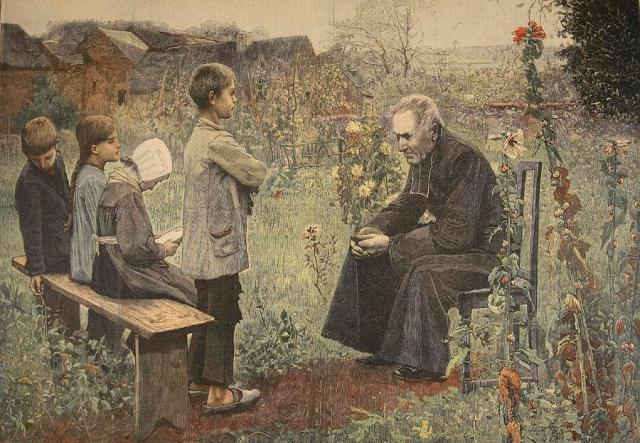
Priest Teaching Children The Catechism, by Jules-Alexis Meunier, 1898

Now once the Lord your God has brought you into the land that he swore to your ancestors, to Abraham, Isaac, and Jacob, to give to you—a land that will be full of large and wonderful towns that you didn’t build, houses stocked with all kinds of goods that you didn’t stock, cisterns that you didn’t make, vineyards and olive trees that you didn’t plant—and you eat and get stuffed, watch yourself! Don’t forget the Lord, who brought you out of Egypt, out of the house of slavery. 

Revere the Lord your God, serve him, and take your solemn pledges in his name! Don’t follow other gods, those gods of the people around you—because the Lord your God, who is with you and among you, is a passionate God. The Lord your God’s anger will burn against you, and he will wipe you off the fertile land. Don’t test the Lord your God the way you frustrated him at Massah. 

You must carefully follow the Lord your God’s commands along with the laws and regulations he has given you. Do what is right and good in the Lord’s sight so that things will go well for you and so you will enter and take possession of the wonderful land that the Lord swore to your ancestors, and so the Lord will drive out all your enemies from before you, just as he promised.

In the future, your children will ask you, “What is the meaning of the laws, the regulations, and the case laws that the Lord our God commanded you?” Tell them: We were Pharaoh’s slaves in Egypt. But the Lord brought us out of Egypt with a mighty hand. Before our own eyes, the Lord performed great and awesome deeds of power against Egypt, Pharaoh, and his entire dynasty. But the Lord brought us out from there so that he could bring us in, giving us the land that he swore to our ancestors. Then the Lord commanded us to perform all these regulations, revering the Lord our God, so that things go well for us always and so we continue to live, as we’re doing right now. What’s more, we will be considered righteous if we are careful to do all this commandment before the Lord our God, just as he commanded us. (Common English Bible)

The Catechism, by Edith Hartry, 1919

Christians often refer to the Bible as “God’s Word.” By that reference we mean that God has graciously revealed the divine nature to us through this Book, the Holy Scriptures. 

The ancient Hebrews referred to the first five books of the Old Testament as the Law of the Lord or the Torah. The Jewish people understood God as a great, high and holy Being who mercifully accommodated or communicated to us on our level by giving the Law. 

Just as a parent coos and babbles and speaks in a very different way to a baby in a crib, so God speaks to us in a way we can understand about the care, concern, and love the Lord has for us. Just as an infant is unable to understand an adult conversation taking place, so God is a lofty Being who is well above our comprehension. We have no ability to understand anything God says unless the Lord graciously and lovingly bends down to speak to us on our level.

God’s Law, the Torah, was the curriculum for Israel’s religious instruction. The Law of the Lord is meant to be a behavior pattern, to be embodied in the lives of God’s people through both teachers and parents who learn God’s Word and, in turn, pass it along to children and others – thereby providing guidance for how to live in God’s world. 

God’s law is an extension of God’s grace, and we are to gratefully accept the grace of God expressed in God’s Word. We are to ingest it, eat it, reflect on it, and dwell with it, in order to know God and be the people God wants us to be.

There are several other words that come from the root word for Law, Torah, in the Hebrew language. A teacher is a “moreh.” A parent is a “horeh.” Parents and teachers are to be living guides in the way of God’s Word. The Hebrew word for teaching is “yarah.” 

So, in other words, the moreh’s and the horeh’s are to yarah the Torah. Parents and teachers are to point and lead others into the ways of the Lord. The fifth book of the Law, Deuteronomy, makes it clear how parents, mentors, teachers, and influencers are to pass on God’s Word:

Israel, listen! Our God is the Lord! Only the Lord! Love the Lord your God with all your heart, all your being, and all your strength. These words that I am commanding you today must always be on your minds. Recite them to your children. Talk about them when you are sitting around your house and when you are out and about, when you are lying down and when you are getting up. Tie them on your hand as a sign. They should be on your forehead as a symbol. Write them on your house’s doorframes and on your city’s gates. (Deuteronomy 6:4-9, CEB)
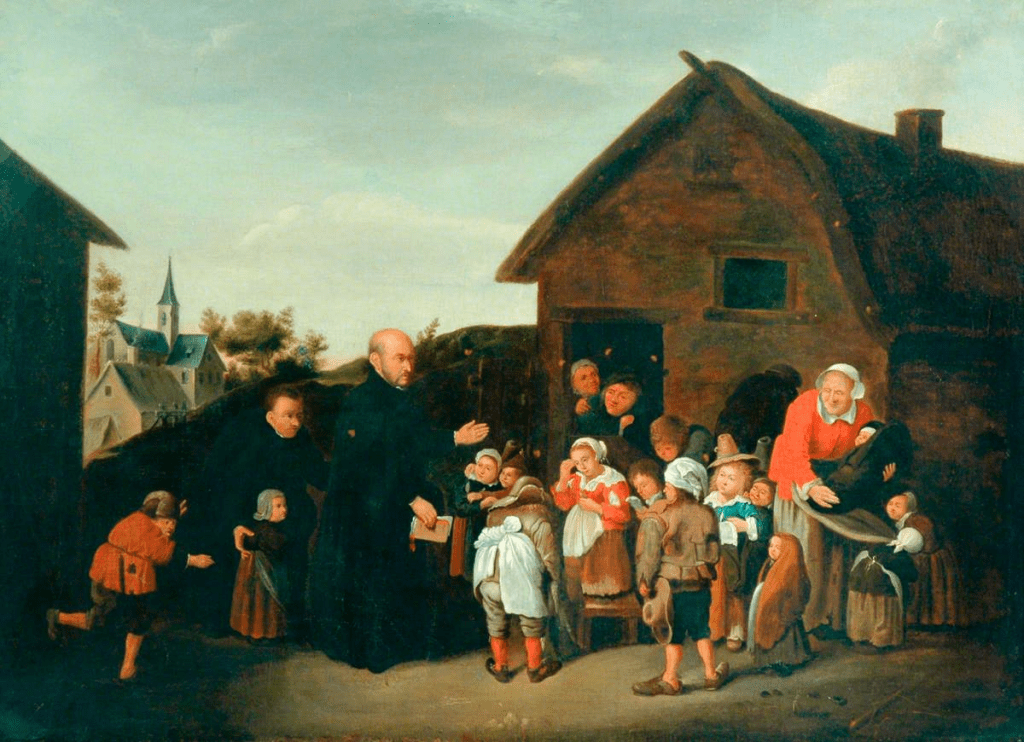
A Village Catechism, by David Rychaert III (1612-1661)

God’s Law, or God’s Word, is to be as familiar to us as our back door and it is to be in front of us all the time. When children ask us anything about God’s commands and regulations, we are to have a ready answer for them, in language and ways that they can understand.

We do this by carefully and systematically engrafting Holy Scripture into our minds and hearts. As we get God’s Word into ourselves, we are to also get it into our children and others. It happens by continually talking about Scripture – at home around the dinner table, as well as when we are working or playing together.

God’s Holy Word is to be continually in front of us, so that we do not forget it. We need to start each day and end each day with God’s Word. We can put the words of God on our refrigerator and our car’s dashboard. There is always an opportunity refer to God’s Word and incessantly chatter about it with others.

Someone may say, “That’s pretty radical – I don’t need to do all that!” Then I would say that you are missing out on living a blessed life because people are blessed when they walk according to God’s Word and keep God’s Law in front of them and seek God through God’s Word with all their heart. 

Let us not be so busy, pre-occupied, nor worried, that we end up pushing God’s Word to the margins of our lives as only a Sunday activity – or something for our discretionary time (which doesn’t actually exist). 

Let’s take the time to carefully look at God’s Word and let God speak to us through it.

Let us be intentional about connecting with the God who has so graciously given us a guide for grateful living. 

And let us lay solid plans to catechize people into the basics of faith and holy living in the church. Amen.

Encountering God (Exodus 19:9-25)

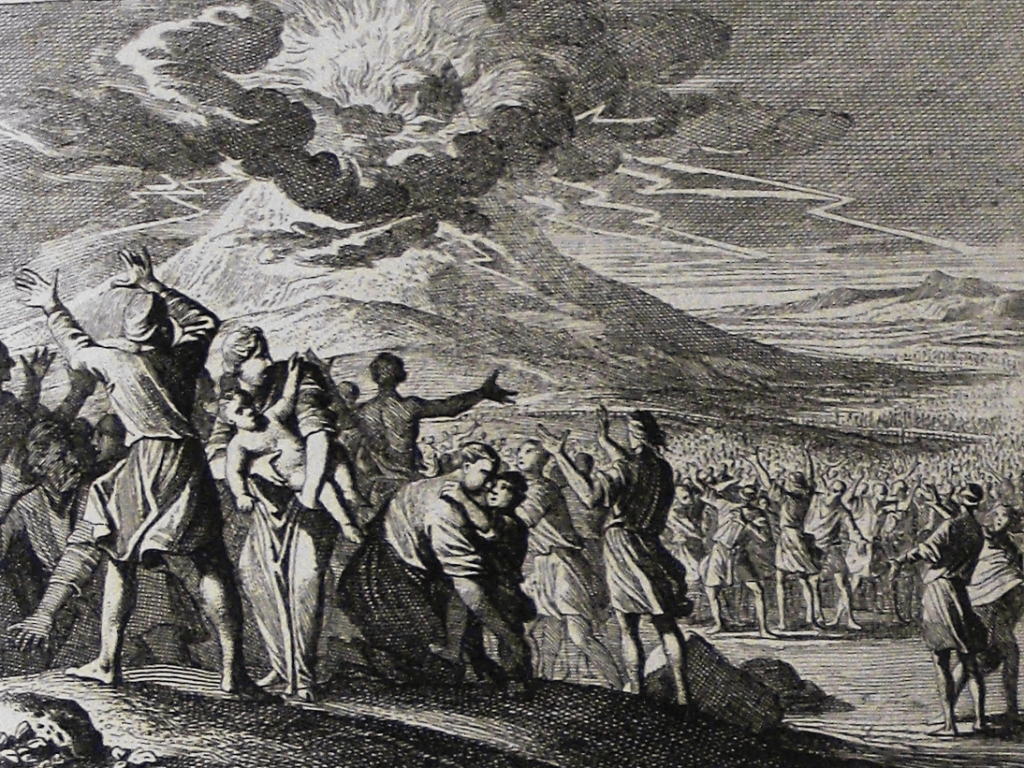
Israel at Mount Sinai, by Jan Luijken (1649–1712)

Then the Lord said to Moses, “I will come to you in a thick cloud, Moses, so the people themselves can hear me when I speak with you. Then they will always trust you.”

Moses told the Lord what the people had said. Then the Lord told Moses, “Go down and prepare the people for my arrival. Consecrate them today and tomorrow, and have them wash their clothing. Be sure they are ready on the third day, for on that day the Lord will come down on Mount Sinai as all the people watch. Mark off a boundary all around the mountain. Warn the people, ‘Be careful! Do not go up on the mountain or even touch its boundaries. Anyone who touches the mountain will certainly be put to death. No hand may touch the person or animal that crosses the boundary; instead, stone them or shoot them with arrows. They must be put to death.’ However, when the ram’s horn sounds a long blast, then the people may go up on the mountain.”

So Moses went down to the people. He consecrated them for worship, and they washed their clothes. He told them, “Get ready for the third day, and until then abstain from having sexual intercourse.”

On the morning of the third day, thunder roared and lightning flashed, and a dense cloud came down on the mountain. There was a long, loud blast from a ram’s horn, and all the people trembled. Moses led them out from the camp to meet with God, and they stood at the foot of the mountain. All of Mount Sinai was covered with smoke because the Lord had descended on it in the form of fire. The smoke billowed into the sky like smoke from a brick kiln, and the whole mountain shook violently. As the blast of the ram’s horn grew louder and louder, Moses spoke, and God thundered his reply. The Lord came down on the top of Mount Sinai and called Moses to the top of the mountain. So Moses climbed the mountain.

Then the Lord told Moses, “Go back down and warn the people not to break through the boundaries to see the Lord, or they will die. Even the priests who regularly come near to the Lord must purify themselves so that the Lord does not break out and destroy them.”

“But Lord,” Moses protested, “the people cannot come up to Mount Sinai. You already warned us. You told me, ‘Mark off a boundary all around the mountain to set it apart as holy.’”

But the Lord said, “Go down and bring Aaron back up with you. In the meantime, do not let the priests or the people break through to approach the Lord, or he will break out and destroy them.”

So Moses went down to the people and told them what the Lord had said. (New Living Translation)

Moses receives the Ten Commandments, by Caspar Luijken (1672-1708)

There’s a lot of drama surrounding today’s Old Testament story. That’s because it’s a big deal when an announcement comes that God is about to show up, speak to the people, and be with them. This is definitely not the stuff of daily mundane life.

The Mount Sinai event is one of the most remembered and talked about events in the Old Testament. This encounter establishes that the presence of the Lord is with Moses, thereby giving him authority over the people. It authenticates the leadership of Moses up to this point – in leading the people out of Egyptian slavery and to the Promised Land.

The presence of God with the people, demonstrated in Moses the leader, assures the Israelites of protection against dangers from other nations and peoples. The divine presence of the Lord will be seen preeminently in the giving of the Law. God’s very Word is encapsulated in the commands and instructions given to Moses on the mountain.

Although the scene on Mount Sinai appears dark, serious, and even scary, it nonetheless is a gift of God’s self-revelation to the people. The Law is a wonderful and gracious provision for Israel. The Lord is providing necessary guidance for living, direction in shaping successful spiritual lives, and the opportunity for obedience to a life-giving system of laws.

If the Israelites hear and obey the Lord, they will be God’s special and treasured people – a nation of priests, a people set apart to be a light for the world.

So, preparations were made for God to enter. The Lord is truly awesome and holy, and so, certain boundaries needed to be established so that the people would be safe and not overcome by such immense light and power. The mountain shakes in anticipation of the divine arrival; the shofar (ram’s horn) is heard, signaling the imminent entrance of God.

The people are assembled by Moses. God descends in the fire, which accompanies the Lord’s presence. Yahweh has come to Israel. The way is now prepared for God’s revelation to be given to Moses in Israel’s hearing. It is an awesome sight and experience.

Perhaps your own days on this earth seem very ho-hum compared to the mountain encounter of Moses and God. You may even feel as if your prayers are puny and don’t get beyond the ceiling of your house. Yet, there is always and continually an opportunity to meet with this very same God, without all the pomp and scariness.

Every single day we have the gracious and wonderful opportunity of opening the book containing a good and merciful God’s self-revelation, and reading gracious words of life to live by. We have guidance for our earthly journey; there is direction for our needy souls.

Your word is a lamp to guide my feet
    and a light for my path. (Psalm 119:105, NLT)

All Scripture is inspired by God and is useful to teach us what is true and to make us realize what is wrong in our lives. It corrects us when we are wrong and teaches us to do what is right. God uses it to prepare and equip his people to do every good work. (2 Timothy 3:16-17, NLT)

Blessed Lord, who caused all Holy Scriptures to be written for our learning: Grant us so to hear them, read, mark, learn and inwardly digest them, so that we may embrace and ever hold fast the blessed hope of everlasting life, which you have given us in our Savior Jesus Christ; who lives and reigns with you and the Holy Spirit, one God, forever and ever. Amen.

Delight in God’s Word (Psalm 119:41-48)

Lord, give me your unfailing love,
    the salvation that you promised me.
Then I can answer those who taunt me,
    for I trust in your word.
Do not snatch your word of truth from me,
    for your regulations are my only hope.
I will keep on obeying your instructions
    forever and ever.
I will walk in freedom,
    for I have devoted myself to your commandments.
I will speak to kings about your laws,
    and I will not be ashamed.
How I delight in your commands!
    How I love them!
I honor and love your commands.
    I meditate on your decrees. (New Living Translation)

Christians often refer to the Bible as “God’s Word.” By that reference is meant that God has graciously given a self-revelation to us through the Holy Scriptures. 

The Jewish people refer to the first five books of the Old Testament as the Law of the Lord or the Torah. They understand God as a great, high and holy Being, who graciously accommodates and communicates to us on our level by giving the Law. 

Just as a parent coos and babbles and speaks in a very different way to a baby in a crib, so God speaks to us in a manner that we can understand divine care, concern, and love for us. Just as an infant cannot understand an adult conversation taking place, so God is a divine being well above our comprehension. We have no ability to understand anything God says unless the Lord graciously and lovingly bends down to speak to us on our level.

God’s Law, the Torah, was the curriculum for Israel’s religious instruction. The Law of the Lord is meant to be a behavior pattern, to be embodied in the lives of God’s people through both teachers and parents who learn God’s Word and, in turn, pass it along to others. Both those within the faith, such as children, and those outside of the faith, such as aliens or immigrants, can have a guide for how to live in the world.

God’s Law is an extension of God’s grace. And we can gratefully accept the grace of God expressed in God’s Word. We have the opportunity to ingest it, eat it, reflect on it, and dwell with it, in order to know God and be the sort of people God who can bless the world.

There are several Hebrew language words that come from the root word of Law, or Torah.  A teacher is a “moreh.” A parent is a “horeh.” Parents and teachers are to be living guides in the way of God’s Word. What’s more, the Hebrew word for teaching is “yarah.” 

So, in other words, the moreh’s and the horeh’s are to yarah the Torah. Parents and teachers are to point and lead others into the ways of the Lord. And how do they do this?…

Hear, O Israel: The Lord our God, the Lord is one. Love the Lord your God with all your heart and with all your soul and with all your strength. These commandments that I give you today are to be on your hearts. Impress them on your children. Talk about them when you sit at home and when you walk along the road, when you lie down and when you get up. Tie them as symbols on your hands and bind them on your foreheads. Write them on the doorframes of your houses and on your gates. (Deuteronomy 6:4-9, NIV)

God’s Law (God’s Word) is to be as familiar to us as our back door; it is to be in front of us all the time. We might put a modern spin on the Deuteronomy passage to help us understand our privilege when it comes to God’s Word:

Attention, Church! God, our God! God the one and only! Love God, your God, with your whole heart: love God with all that is in you; love God with all you’ve got! 

Write these commandments that I’ve given you today on your hearts. Get them inside of you and then get them inside your children. 

In order to do this, talk about God’s Word at home when you are eating supper together, and when you are working or playing with each other. 

Start your day with God’s Word when you get up, and end your day with God’s Word when you go to bed at night. Put God’s Word on your refrigerator, and your car’s dashboard; have it on your smartphones, and let it be available to you anywhere, anytime. Use every opportunity you have to incessantly chatter about God’s Holy Word.

Someone may say, “That’s pretty radical – I don’t need to do all that!” Then I would say you are missing out on living a blessed life, because people are blessed when they walk according to God’s Word and keep God’s Law in front of them, seeking God with all their heart. 

Eleanor Turnbull, a veteran missionary to Haiti, collected and translated some simple but powerful prayers of the Christians who live in the Haitian mountains. Here are four prayers that they pray every day – and take note of their high view of God, and their longing to know God’s Word: 

  1. “Our Great Physician, Your word is like alcohol. When poured on an infected wound, it burns and stings, but only then can it kill germs. If it doesn’t burn, it doesn’t do any good.” 
  2. “Father, we are all hungry baby birds this morning. Our heart-mouths are gaping wide, waiting for you to fill us.” 
  3. “Father, a cold wind seems to have chilled us. Wrap us in the blanket of your Word and warm us up.” 
  4. “Lord, we find your Word like cabbage. As we pull down the leaves, we get closer to the heart. And as we get closer to the heart, it is sweeter.”

Let’s not be so busy, pre-occupied, or worried that we push God’s Word to the margins of our lives as only something for our discretionary time. 

Instead, let’s commit ourselves, like the psalmist, to learning and loving God’s commands and decrees.

Let’s be intentional about connecting with the God who has so graciously given us a guide for grateful living. 

Let’s lay solid plans to catechize people into the basics of faith and holy living. 

May your efforts both honor God and build up Christ’s Church. Amen.

What is Your View of God? (Psalm 33:1-12)

God’s Love… by Hope G. Smith

Rejoice in the Lord, O you righteous.
    Praise befits the upright.
Praise the Lord with the lyre;
    make melody to him with the harp of ten strings.
Sing to him a new song;
    play skillfully on the strings, with loud shouts.

For the word of the Lord is upright,
    and all his work is done in faithfulness.
He loves righteousness and justice;
    the earth is full of the steadfast love of the Lord.

By the word of the Lord the heavens were made
    and all their host by the breath of his mouth.
He gathered the waters of the sea as in a bottle;
    he put the deeps in storehouses.

Let all the earth fear the Lord;
    let all the inhabitants of the world stand in awe of him,
for he spoke, and it came to be;
    he commanded, and it stood firm.

The Lord brings the counsel of the nations to nothing;
    he frustrates the plans of the peoples.
The counsel of the Lord stands forever,
    the thoughts of his heart to all generations.
Happy is the nation whose God is the Lord,
    the people whom he has chosen as his heritage. (New Revised Standard Version)

One of the reasons I adore the biblical psalms is that they present a majestic God who is full of goodness and steadfast love. The Lord’s very character is disposed toward justice and righteousness. Every word of God comes from this place of control and compassionate care.

I agree with the psalmist’s view of God because it resonates with my own experience. I have found that the God of the Psalms is high above all creation as the sovereign ruler, as well as intimately close as a friend.

The words, then, which proceed from the mouth of God are always just, right, good, fair, and loving. If God’s basic character is love, then everything God says and does comes from love. And that is precisely why I am completely devoted to this Lord.

Believers can sing a new song and revel in the Lord’s presence because they discern that everything comes down to God. That is, the way we view God is the way we will live our lives. 

For example, if we tend to see God as a stern Being whose main activity is to continually rebuke and punish people for their sin, then we will live with a constant sense of guilt and anxiety for fear of angering such a God. We will invariably live a performance-based life trying to pull ourselves up by our spiritual bootstraps in order to please or placate such a God who is always looking over our shoulder to make sure that we do not mess up.

That’s a miserable life, indeed! This is why many people internally say to themselves, “To hell with it!” and live in outright rebellion against a God who seems not to care a wit about their happiness. 

The cruelties of this world seem only to be God mocking their abysmal failure at being decent people. It would be like telling my grandson with epilepsy to stop having seizures, as if my love for him is dependent on him being seizure-free. Most people would consider it abusive for a parent or grandparent to yell at a kid for having seizures. With that kind of view of God, I wouldn’t want to know him either. And if that’s the sort of god you’re buying into, you need a new god.

But, on the other hand, if we understand God as a loving parent who is pained by the damage guilt and shame has done to the souls of people, then we are open to seeing the grace of God coming to set broken spirits right again.

With Christianity, the death of Christ is the ultimate act of love in taking care of the sin issue once for all. God in Christ did for us what we could do for ourselves; he gave his life so that we could live as we were intended to live: enjoying God and God’s creation forever.

In this view of God, the task of spiritual formation is one of constantly replacing destructive understandings of God with the kind of thoughts of God that filled the mind of Jesus himself. 

And the only good way of doing that is through the basic spiritual disciplines of Scripture reading and prayer, hearing the words of God. In order to listen well, we engage in practices of silence and solitude, as well as praise and celebration, that helps us connect with God’s Word. 

The grand redemptive story of the Bible is that the steadfast love of God has found its apex and fulfillment in the incarnation, life, death, resurrection, and ascension of the Lord Jesus. Therefore, all of Holy Scripture is to be viewed through these lenses of the grace of God in Christ. It is a very different picture than the one of an indifferent God.

Seeing God from the perspective of grace brings a joyous way to live because it views God as generous and hospitable. From such an angle, the logical and appropriate response is one of gratitude. 

All false gospels have at their core a kind of you-are-bad-try-harder approach. Preachers of such an ilk only rail against people as being scum buckets of sin and offer no real hope of transformation in Christ. It promotes a grace-less religion, and it is nothing less than biblical malpractice.

I take heart that if we have trouble seeing God as we ought, or experience difficulty viewing life as it is meant to truly be lived, we can ask God to give us wisdom. And the promise connected to that encouragement to pray is that God will give generously to all without finding fault and it will be given to them. (James 1:5)

In the psalmist’s view of God, prayer is not a chore but a delight; service is not drudgery but a willing response; reading Scripture is not a mandatory exercise but a wonderful practice of knowing God better; and praise organically erupts from the depths of our being, because we have spiritual eyes to see that everywhere we look, the whole earth is filled with the steadfast love of God.

Bless us with Love, O Merciful God;
That we may Love as you Love!
That we may show patience, tolerance,
Kindness, caring and love to all!
Give me knowledge; O giver of Knowledge,
That I may be one with my Creator and all creation!
O Compassionate One, grant compassion to us;
That we may help all people in need!
Bless us with your Love, O Lord.
Bless us with your Love. Amen.