Don’t Forget about Kindness and Truth (Proverbs 3:1-12)

My child, do not forget my teaching,
    but keep my commands in mind.
Then you will live a long time,
    and your life will be successful.

Don’t ever forget kindness and truth.
    Wear them like a necklace.
    Write them on your heart as if on a tablet.
Then you will be respected
    and will please both God and people.

Trust the Lord with all your heart,
    and don’t depend on your own understanding.
Remember the Lord in all you do,
    and he will give you success.

Don’t depend on your own wisdom.
    Respect the Lord and refuse to do wrong.
Then your body will be healthy,
    and your bones will be strong.

Honor the Lord with your wealth
    and the first fruits from all your crops.
Then your barns will be full,
    and your wine barrels will overflow with new wine.

My child, do not reject the Lord’s discipline,
    and don’t get angry when he corrects you.
The Lord corrects those he loves,
    just as parents correct the child they delight in. (New Century Version)

There is no wisdom apart from humility. And humility can only be accessed through being authentic and vulnerable. The proud person doesn’t look to God (or others) because they think they already know what is best and can figure out things without anyone’s help.

Wisdom is a skill that is attained through learning and application, over an extended period of time. The wise person has a solid body of knowledge, and is able to take that know-how and apply it to real life situations.

For the skill of wisdom to be realized, we must first take the posture of a child. We need to listen well, and humbly receive instruction. Without this initial mindset and heart attitude, wisdom will forever be elusive.

Then, when we learn and gain understanding, it’s imperative that we remember it. This is why the best learning engages all of our senses; it presses needed information deep inside us, so that what comes out of us is right, just, and good.

Concerning the Christian life, we can only obey commands which we know. So, it’s important to learn and retain the commands of God. This is one reason why I read my Bible every day; my mind and heart need the continual refreshment and recalling of Holy Scripture’s insight and instruction. I want to be so full of God’s good commands that if you cut me, I bleed Bible.

Kindness and truth are to be worn like a big gaudy necklace around our necks – so that we will always have in front of us what’s most important in living our lives.

The reason so many people are continually at odds with one another is that kindness and truth are neither acknowledged nor remembered. But you cannot have good relations without basic human kindness and a commitment to truth. Put another way, being gruff and mean, and fudging on reality, will not only get you nowhere, but it will also bring a profound lack of success in life.

That stubborn meanness and inattention to truth comes from spending way too much time alone in one’s head. Left alone for too long, every one of us will come up with all kinds of goofy thinking that we believe is the truth. But it’s really only craziness born of a tremendous lack of healthy interaction with others.

At some point, everyone must eventually trust the Lord – who is kindness and truth itself. Going it alone is not an option, that is, unless we want to be lonely, messed-up in the head, and miserable in both body and soul.

Let’s get real. Often, the reason why so many of us choose a path of arrogant pride, radical independence, and selfish loneliness is because we simply do not want to be hurt.

Someone, some group, or many persons have hurt us, and we’re determined to never be hurt and to hurt like that again. So, we shut others out – including God.

We may not go the route of becoming actual hermits, but we build invisible walls which no one can scale. This is why the loneliest people are actually around other people – they’ve shut them out emotionally, mentally, and spiritually, even though they are next to them physically.

Persons who take such a route to living eventually discover that, although they may have avoided the sort of pain they feared, a new kind of suffering is experienced. And it’s the kind of suffering that gnaws at your insides and slowly kills you.

Little does one know, but the fear, anger, and hatred morphs into a bitterness which becomes gangrene of the soul. The person dies a little bit at a time in an agonizing existence. We all must endure pain; it’s just a matter of what sort of pain we will accept: the bad kind or the good kind.

A good sort of hurt is the pain of healing, of making things right, of committing oneself to reconciliation and peace. It’s a soreness of being corrected by Holy Scripture and God’s directives, a suffering that will truly lead to life, not death.

So, what will it be? The book of Proverbs calls us to make a choice, not only between good and bad, but a choice of better and best, and of accepting the sort of pain that helps us grow; or rejecting that and enduring a debilitating hurt that damages deeply, maybe even permanently.

Let go of the pride and adopt humility. Become a student of wisdom. Take up the necklaces of kindness and truth. Honor God with a life full of experiential knowledge and devotion to the betterment of humanity. Learn to trust the Lord and others who are trustworthy. Know what it feels like to be merciful, pure, and peacemaking.

You may just find that the old tools of cynicism, sarcasm, skepticism, distrust, and unbelief become lost in the mental junk drawer of things rarely, if ever, used.

Lord Jesus Christ, you prayed for your friends that they would be one as you and your Father are one. We confess our resistance to your prayer. We have failed to maintain the unity of the Spirit. We have broken the bond of peace.

Wait for the Lord (Isaiah 64:1-9)

O that you would tear open the heavens and come down,
    so that the mountains would quake at your presence—

as when fire kindles brushwood
    and the fire causes water to boil—
to make your name known to your adversaries,
    so that the nations might tremble at your presence!
When you did awesome deeds that we did not expect,
    you came down; the mountains quaked at your presence.
From ages past no one has heard,
    no ear has perceived,
no eye has seen any God besides you,
    who works for those who wait for him.
You meet those who gladly do right,
    those who remember you in your ways.
But you were angry, and we sinned;
    because you hid yourself we transgressed.
We have all become like one who is unclean,
    and all our righteous deeds are like a filthy cloth.
We all fade like a leaf,
    and our iniquities, like the wind, take us away.
There is no one who calls on your name
    or attempts to take hold of you,
for you have hidden your face from us
    and have delivered us into the hand of our iniquity.
Yet, O Lord, you are our Father;
    we are the clay, and you are our potter;
    we are all the work of your hand.
Do not be exceedingly angry, O Lord,
    and do not remember iniquity forever.
    Now consider, we are all your people. (New Revised Standard Version)

Sometimes it feels like the whole world is messed up, with no resolution in sight. Everything is sideways.

In those moments, when I wonder if there will ever be glory after all the hardship and suffering, I come back to what I firmly believe and bank my life upon: God sees. God cares. God is still actively working behind the scenes in ways I don’t presently see. Truly, the invisible hand of God is looking after my life.

The ancient Israelites, in Isaiah 64, cried out for help because, although they could not see God, they trusted that somehow, someway, they were being seen. The prophet wanted God’s presence manifested in such a way that it would be recognized by both God’s people and God’s enemies.

The people cried out for mountains to quake, brushwood to burn, and water to boil. In other words, the people wanted the Lord to show up in a dramatic way. That’s neither a weird desire nor an offbeat prayer from God’s people. After all, the Lord has showed up and showed off with wondrous and awesome deeds for a long time in their history:

  • Divine plagues on Egypt forced Pharaoh to release Israel from bondage and go their own way
  • Divine deliverance brought them miraculously through the Red Sea
  • Divine judgment caused the waters to overwhelm the Egyptian army
  • Divine provision gave manna out in the desert
  • Divine presence was with the people as they entered the Promised Land
  • The Divine Warrior flattened the walls of Jericho and went before the people in fighting their battles

Indeed, God intervened with consistency. In today’s Old Testament lesson, there’s a qualification, a sort of prerequisite, which is given in order to realize God’s involvement: If the people want to see God move on their behalf, they will have to be patient and wait on the Lord.

Waiting. It seems to be the bane of many a person’s existence. Many people would rather do just about anything but wait. And yet, throughout the Bible’s Old Testament, people are exhorted to do just that: wait…

Wait for the Lord;
    be strong, and let your heart take courage;
    wait for the Lord!

Psalm 27:14, NRSV

Commit your way to the Lord;
    trust in him, and he will act.
He will make your vindication shine like the light
    and the justice of your cause like the noonday.

Be still before the Lord, and wait patiently for him;
    do not fret over those who prosper in their way,
    over those who carry out evil devices.

Refrain from anger and forsake wrath.
    Do not fret—it leads only to evil.
For the wicked shall be cut off,
    but those who wait for the Lord shall inherit the land. (Psalm 37:5-9, NRSV)

I waited patiently for the Lord to help me,
    and he turned to me and heard my cry.
He lifted me out of the pit of despair,
    out of the mud and the mire.
He set my feet on solid ground
    and steadied me as I walked along. (Psalm 40:1-2, NLT)

The psalmist, along with the faithful throughout the ages, can testify that patience with God is worth the wait. There is no answer to our dilemmas quite like that of God’s. And it’s really no use trying to cajole or manipulate God into acting sooner or quicker.

Although we are subject to time, God is above time, and is not subject to anyone’s clock. God will act when God will act, even if it seems painstakingly slow to us. Let’s not try to figure out God’s timetable. If Jesus wasn’t privy to the entire divine schedule, then what makes us think we’ll get a look at it?

“One of the greatest strains in life is the strain of waiting for God.” Oswald Chambers

Perhaps we ought to look more at ourselves and consider our own thoughts and actions. Are we really ready to receive what God wants to give us? Why do we want what we want? Is it for God’s glory, and the common good of all persons, or simply for our own narrow purposes?

It would be better if we consider that God’s word and promises are more powerful than any struggle we go through along the way. If we know the promise is truly coming, and it’s based in divine words, we can wait for it patiently.

For the ancient people, God promised to be the God of Israel; the people needed to be reminded that God’s apparent “slowness” doesn’t translate to a “no” in prayer. God created the elephant who never forgets, as well as the goldfish who never remembers. Take a guess which one is God and which one is us.

Even though God can be disappointed with our sinful behavior, and may allow us to die like a withered leaf in autumn, the Lord’s purpose isn’t for our destruction nor our destitution. God’s anger only lasts a moment, but the Lord’s favor endures for a lifetime.

Almighty and gracious God, help me to become patient, as Christ was patient. Through your guidance, may I become more accepting of my circumstances, and others around me. Assist me to welcome difficult times with a patient heart, through Jesus my Lord, in the strength of the Holy Spirit. Amen.

Grateful to God (1 Thessalonians 2:13-20)

Apostle Paul, by Ivan Filichev

And we also thank God continually because, when you received the word of God, which you heard from us, you accepted it not as a human word, but as it actually is, the word of God, which is indeed at work in you who believe. For you, brothers and sisters, became imitators of God’s churches in Judea, which are in Christ Jesus: You suffered from your own people the same things those churches suffered from the Jews who killed the Lord Jesus and the prophets and also drove us out. They displease God and are hostile to everyone in their effort to keep us from speaking to the Gentiles so that they may be saved. In this way they always heap up their sins to the limit. The wrath of God has come upon them at last.

But, brothers and sisters, when we were orphaned by being separated from you for a short time (in person, not in thought), out of our intense longing we made every effort to see you. For we wanted to come to you—certainly I, Paul, did, again and again—but Satan blocked our way.For what is our hope, our joy, or the crown in which we will glory in the presence of our Lord Jesus when he comes? Is it not you? Indeed, you are our glory and joy. (New International Version)

Reception and Acceptance of God’s Word

The Apostle Paul, in all of his letters to the churches, was attentive to affirming those things which are good amongst the believers; and not only the aspects of church life that needed change and/or repentance.

For the Thessalonians, Paul was profoundly grateful to God for the people’s receiving of the Word and their accepting it as from God. Perhaps there is no greater affirmation than this for the Christian.

In order to receive and accept God’s Word, people must know it. And people cannot know God’s Word unless they take the time and effort to read it and discover it for themselves.

Scripture reading is a foundational spiritual practice for Christians everywhere, and for all of Christ’s Church throughout the earth. Church worship liturgies, as well as individual Christians’ daily disciplines of faith, ought to be thoroughly saturated with Holy Scripture. Yet, many churches are believers, sadly, are not.

I am specifically calling out the conservative evangelical church on this. Although they claim to be Bible-centered, with an extended time for the sermon, there is a paucity of actual Scripture contained within those gathered times.

Too much of the preaching fails to truly explain Scripture, and there are virtually no Scripture readings or references outside the sermon and in the worship service. This is a travesty, and also a testament to the biblical ignorance of so many evangelicals.

What’s more, the evangelical impulse for a “personal quiet time with the Lord” is, in reality, practiced by precious few believers – and usually consists of little more than a daily crumb of the Bible.

I perhaps sound cranky and crotchety. Yet in a previous life, I was an evangelical Pastor for many years, and know the frustrations and challenges of attempting to bring biblical literacy to such churches and Christians. There’s a better way, but alas, that is a topic for another time and another post.

Imitators and Sufferers with God’s Churches

The true muster of a Christian and any Christian Church is the desire, speech, and action of actually following the words and ways of Jesus. It was the Lord Jesus himself who said:

“Remember what I told you: ‘A servant is not greater than his master.’ If they persecuted me, they will persecute you also.” (John 15:20, NIV)

“In this world you will have trouble. But take heart! I have overcome the world.”

Jesus (John 16:33, NIV)

Paul was thankful for the Thessalonians because of their solidarity with the other churches; and their willingness to suffer as Jesus did. What’s more, they did not try to reinvent the wheel, but affirmed the sound practices they saw in the original churches of Judea and imitated those good things.

This was not a matter of pragmatism, that is, just doing something that worked somewhere else and adopting it for yourself. Instead, Paul was talking about following the example of the first and earliest of churches. Those churches were made up of Jewish Christians who received a lot of persecution from their fellow Jews.

The Thessalonians, too, received grief and belligerence from the same sort of people, trying to bully them around and tell them what to do. But the believers held fast to the pattern of teaching and living they observed from both Paul and the churches who endured suffering in Judea.

It’s one thing to express belief. It’s quite another thing to suffer for those beliefs and experience persecution for them. God will handle the persecutors on Judgment Day, not us. It’s our job to remain faithful and persevere in the Christian life until that Day comes.

Glory and Joy in God’s Presence

For the Apostle Paul, glory and joy was not found in his great intellect and persuading many people, or his many accomplishments of planting churches and defending the faith. Paul’s highest joy was found in people coming to know Christ and living for Jesus.

His glory was in the hundreds of relationships established with people, and all the believers he mentored. In other words, Paul’s glory and joy was the real names and faces of people he encountered and gathered into the one Church, for whom Christ died and sacrificed himself.

It wasn’t even a thought in the Apostle’s big old head to gain glory for himself, or to pursue joy for it’s own sake. Rather, Paul discovered that real joy and glory comes in fulfilling the mission give to him by Christ:

To make disciples of all nations, baptizing them in the name of the Father, and of the Son, and of the Holy Spirit; teaching them to receive and accept God’s Word, to become imitators and sufferers with God, and to glory and joy in God’s presence.

Almighty God, Father of all mercies, we your unworthy servants give you humble thanks for all your goodness and loving-kindness to us and to all whom you have made.

We bless you for our creation, preservation, and all the blessings of this life; but above all for your immeasurable love in the redemption of the world by our Lord Jesus Christ; for the means of grace, and for the hope of glory.

And, we pray, give us such an awareness of your mercies, that with truly thankful hearts we may show forth your praise, not only with our lips, but in our lives, by giving up ourselves to your service, and by walking before you in holiness and righteousness all our days, through Jesus Christ our Lord, to whom, with you and the Holy Spirit, be honor and glory throughout all ages. Amen.

God Is Good, Idols Are Bad (2 Kings 17:7-20)

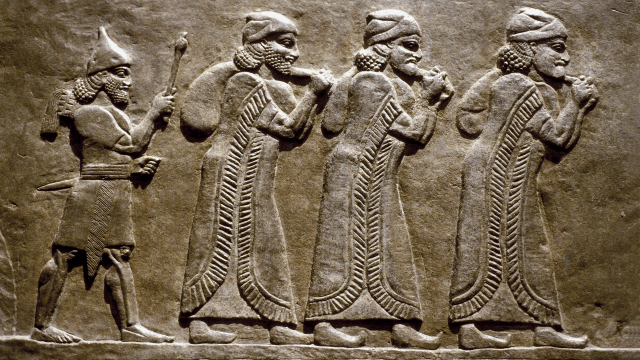
 An Assyrian solider deporting people from their land (From the Southwest Palace of Tiglath-Pileser III at Nimrud, ca. 730-727 B.C.E.; British Museum.)

The Israelites sinned against the Lord their God, who brought them out of Egypt and rescued them from the power of Pharaoh (the king of Egypt). They worshiped other gods and lived by the customs of the nations that the Lord had forced out of the Israelites’ way. They also did what their kings wanted them to do.The Israelites secretly did things against the Lord their God that weren’t right:

They built for themselves illegal places of worship in all of their cities, from the smallest watchtower to the largest fortified city.

They set up sacred stones and poles dedicated to the goddess Asherah on every high hill and under every large tree.

At all the illegal places of worship, they sacrificed in the same way as the nations that the Lord had removed from the land ahead of them.

They did evil things and made the Lord furious.

They served idols, although the Lord had said, “Never do this.”

The Lord had warned Israel and Judah through every kind of prophet and seer, “Turn from your evil ways, and obey my commands and decrees as I commanded your ancestors in all my teachings, the commands I sent to you through my servants the prophets.” But they refused to listen. They became as impossible to deal with as their ancestors who refused to trust the Lord their God. They rejected his decrees, the promise he made to their ancestors, and the warnings he had given them. They went after worthless idols and became as worthless as the idols. They behaved like the nations around them, although the Lord had commanded them not to do that. They abandoned all the commands of the Lord their God:

They made two calves out of cast metal.

They made a pole dedicated to the goddess Asherah.

They prayed to the entire army of heaven.

They worshiped Baal.

They sacrificed their sons and daughters by burning them alive.

They practiced black magic and cast evil spells.

They sold themselves by doing what the Lord considered evil, and they made him furious.

The Lord became so angry with Israel that he removed them from his sight. Only the tribe of Judah was left. Even Judah didn’t obey the commands of the Lord their God but lived according to Israel’s customs. So the Lord rejected all of Israel’s descendants, made them suffer, handed them over to those who looted their property, and finally turned away from Israel. (God’s Word Translation)

The Flight of the Prisoners, by James Tissot, 1898, depicting the Babylonian exile from Jerusalem

The prophets had warned the northern kingdom of Israel; but they did not listen, nor did they heed the prophetic utterance. Israel then stood as an example and a warning to the southern kingdom of Judah; yet they, too, refused to learn from their brother’s downfall.

And even before the kingdom was split between Israel in the north and Judah in the south, the ancient Israelites had a troubling tendency to buck the Lord’s instructions and find other more and creative ways of expressing themselves spiritually.

Every generation of people are responsible for their own spirituality and their own actions in life. We, in our contemporary time and place, need to learn the lessons of the past – for we also are not an exception in history, as if we can do whatever we want without attending to the common good of all persons and worshiping in any sort of way we want.

The trouble with the ancient worshipers of Yahweh is that they decided to pick and choose whatever commands they wanted to follow, or not. They went through continual times of idolatry and forgot about God and God’s Word to them.

To respect and revere the Lord is to obey God’s instructions. To worship Yahweh is to have an undivided allegiance to God and God’s commands. The failure to obey is really a failure of faith.

The prophets Amos, Hosea, Micah, and Isaiah specifically called out the sinful practices of the people and their negligence in upholding basic social and economic justice for everyone. They condemned violence and oppression of the poor; and expressed the divine displeasure with taking advantage of the disadvantaged.

How to treat people and live well were explicitly spelled out in the entirety of God’s Law. Yet, the leaders and the people, as a whole, decided to go another way. They kept introducing idolatrous and unhealthy forms of worship and living. And it led to their ruin.

The ancient people were continually offered grace if they would only accept it. They could return to the Lord and come back to the true worship and obedience of the God who had rescued them from trouble again and again. Turning from their unholy practices, and turning back to Yahweh, would reverse God’s impending judgment. Yet, tragically, the people did not listen.

Idolatry is a failure to trust God, and to rely instead on something else which is not able to sustain a life. Unfortunately, those who create a god according to their own liking end up becoming like the thing they worship, that is, worthless.

The tragedy of the Israelites is that they were to be God’s people, the Lord’s treasured possession, a kingdom of priests, and a holy nation which brings blessing to the earth. Instead, they traded their meaning and purpose in life to imitate everyone else around them.

Sadly, people have felt throughout history, and even we ourselves today, that there is something else, other than God, that we need in order to be happy – something more important to your heart than the Lord – whether it is human acceptance and approval, social reputation, political power and control, or financial advantage and privilege.

Idolatry creates an ignoring of the divine in our life. We might even have the chutzpah to think we can challenge God, like some small yippee pup who growls and takes on the big dog, who knows that with an effortless paw across the body, could toss the prideful pup away.

Like a mother bird who scours the land for food to sustain the babies, and brings it back to their gaping mouths, God longs to provide us with a good and beautiful life – if we will but only receive it.

Listen, my people, I’m warning you!
    If only you would listen to me, Israel.
There must be no foreign god among you.
    You must not bow down to any strange deity.
I am the Lord your God,
    who brought you up from Egypt’s land.
    Open your mouth wide—I will fill it up! (Psalm 81:8-10, CEB)

O Lord, as you gave us the greatest commandment, to love you with all our heart, soul, strength and mind, help us to love you above all else, putting you above the potential idols in our lives, including success, fame and wealth. May your benevolent kingdom come, and your moral and ethical will be done, here on this earth for this time, as it is always done in your heaven. Amen.