
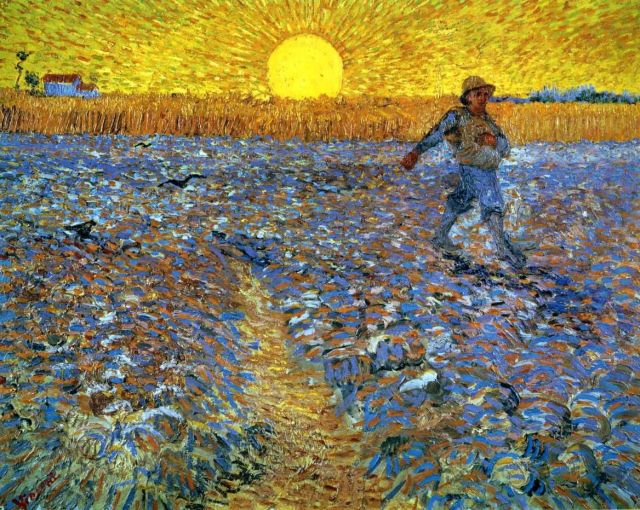
The Parable of the Sower

The Sower by Van Gogh 1881
“The Sower” by Vincent Van Gogh, 1881

“A farmer went out to sow his seed. As he was scattering the seed, some fell along the path, and the birds came and ate it up. Some fell on rocky places, where it did not have much soil. It sprang up quickly because the soil was shallow. But when the sun came up, the plants were scorched, and they withered because they had no root. Other seed fell among thorns, which grew up and choked the plants. Still other seed fell on good soil, where it produced a crop—a hundred, sixty or thirty times what was sown. Whoever has ears, let them hear.” (Matthew 13:3-9, NIV)

Introducing the Parable

I have been preaching sermons for over thirty-five years, so I have seen my share of people falling asleep in church.  The most common ways of drifting off during a sermon are, what I call, the “Snapback” in which the head dramatically snaps back from its gradual descent backward; the “Pious Nod” where it might appear the person is praying until the head either hits the pew in front of it or snaps up, as in the snapback; and, the “Cozy-Sweet” where the head goes to the side and eventually lands on its neighbor’s shoulder for a bit of a nap.

I tend to believe if you need to sleep, you need to sleep – and I find the nodding-off antics of parishioners as bringing some light-hearted levity to my life. That said, for the Christian, it is important to listen to the Word of God.  We need, first and foremost, to take a posture of listening, really hearing what Jesus has to say so that we can do the will of God.

The Parable

“Whoever has ears, let them hear,” said Jesus.  Truly hearing Jesus’ words and listening with focused attention is the key to life.  Our ears are the soil of our lives.  Ears that are attentive and devoted to listening to Jesus are good soil; ears that are distracted and inattentive and stopped up with ear wax are the bad soil.  Receptive listening to the Word of God brings a fruitful harvest of righteousness, peace, and joy in the Holy Spirit.  The Parable of the Sower (or Soils) lets us know that sowing (planting) the Word is important.   It is sown on four different soils….

  1. The seed on the path. A path is for walking, which is why the seed never takes root.  Here there is no listening. When we act without listening, our actions will be misguided.
  2. The seed on rocky soil. Here there is no deep listening.  A lack of attentive hearing results in a shallow person who perhaps relies more on Christian clichés or on his/her personality or abilities instead of the sown Word.
  3. The seed on the thorny soil. Here there is significant listening. However, there is too much listening to a cacophony of voices and not enough singular listening to the sown Word.  Listening to the wrong voices will cause an unfruitful life, so we must be careful to the kind of preaching and type of preachers we hear!
  4. The seed on good soil. A devoted listening to the Word without distraction leads to a productive, fruitful believer.

The Nature of Parables

A parable is a genre of biblical literature.  Parables are as much about concealing truth as they are conveying truth.  A person needs to give focused attention to the story to learn from it, much like a good novel conveys truth about the human condition without being preachy or outright saying the truth; or, much like a good movie that relies on character development and the power of story for its message instead of being a straightforward documentary.

Jesus neither strong-arms people into the kingdom nor puts a person in a full nelson to force them to do God’s will.  We will miss the kingdom if we are looking for a big dramatic hoo-ha of an event, because it comes as an awareness within people and works its way out. For the person who has no intention of changing, they will find Christ’s words confusing.  They might “hear” Jesus yet fail to really listen since they have their own ideas about how the kingdom ought to operate.

Yet, grace is present.  The very fact that Jesus addressed the crowd of people demonstrates he cared enough to communicate.  He could have said, “Hey, you guys, get lost, I’m just going to interact with people who really listen to me.”  Jesus, however, is full of mercy.  Instead of coming at the crowd and bursting through the front door, he came at them through the side door so that they would be able to receive the message well.

When I was a young Christian, I had a habit of puking the good news of Jesus all over people without really listening to them.  Being blunt without being attentive is not the best approach; neither is being worried about saying something offensive, so nothing is said at all.  Others cannot listen if we are either obnoxious or silent. A better approach is to ask permission to tell your story of what Jesus means to you, or what you have learned from God’s Word.
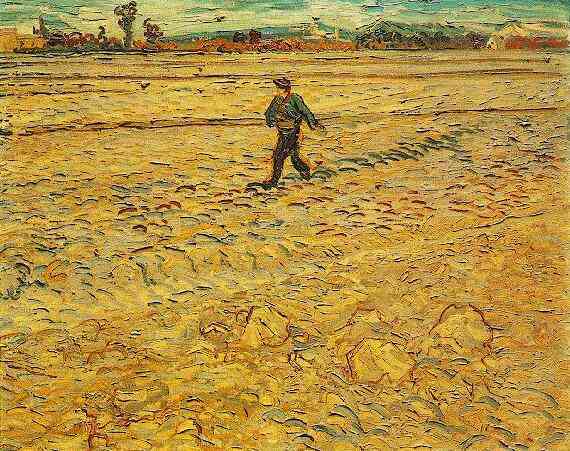
The Sower by Van Gogh 1888
“The Sower” by Vincent Van Gogh, 1888

The Parable Interpreted

“Listen then to what the parable of the sower means: When anyone hears the message about the kingdom and does not understand it, the evil one comes and snatches away what was sown in their heart. This is the seed sown along the path. The seed falling on rocky ground refers to someone who hears the word and at once receives it with joy. But since they have no root, they last only a short time. When trouble or persecution comes because of the word, they quickly fall away. The seed falling among the thorns refers to someone who hears the word, but the worries of this life and the deceitfulness of wealth choke the word, making it unfruitful. But the seed falling on good soil refers to someone who hears the word and understands it. This is the one who produces a crop, yielding a hundred, sixty or thirty times what was sown.” (Matthew 13:18-23, NIV)

The focus of the interpretation Jesus gave is the experience of the seed in a variety of soils.  The outside powers that act on the Word – devouring birds, rocks, the burning sun, choking thorn-bushes – demonstrate that the Word is central and needs to be received well:

  1. The soil on the path is the person who hears the message yet is unable to hear God’s Word because their heart is hard. The devil snatches it before any real understanding can take place.  We see that the devil is real and has ability to influence people who have listening issues.
  2. The rocky soil is the person who hears just enough to respond with joy but drops out when hard circumstances come around. “I didn’t sign up for this!” is their cry.  They needed to count the cost of discipleship before responding to the message.  This is merely a professing Christian, nothing more.  Rather than listening and internalizing the Word, there is only positive affirmation without any action or practice. So, tomorrow the message is gone and forgotten.  When difficulty comes, there are no supporting words to draw from, so the person fades away, unable to navigate life successfully.
  3. The thorny soil also hears and responds to the message. This person is also a professing Christian, nothing more.  The issue with such a person is that he/she also listens to the voices of worry and wealth.  Like some sort of spiritual attention-deficit-disorder, there is no ability to filter all the voices calling out, and so there is no growth.  The Word of God must reign supreme; there cannot be two thrones of Wealth and Word and two Masters of God and Money.
  4. The good soil is listening with the intention of understanding and putting into practice the message heard is what brings about fruit. Receiving the Word through careful listening brings about spiritual growth.  God brings the growth when we focus on the Word.  So, priority must be to listening well to the Word of God.  When a whole group does this, then it creates a greenhouse effect in which people cannot help but grow in the Lord!

Conclusion on the Parable

The simple reception of God’s Word makes a person fruitful.  The first soil did not receive the Word at all, though it listened to it; the second received it with joy but under pressure let it go; the third received it with only one hand because the other hand was busy; only the fourth soil received the seed of the Word with both hands.

Blessed is the one who does not walk in step with the wicked or stand in the way that sinners take or sit in the company of mockers, but whose delight is in the law of the Lord, and who meditates on his law day and night. That person is like a tree planted by streams of water, which yields its fruit in season and whose leaf does not wither—whatever they do prospers. (Psalm 1:1-3, NIV)
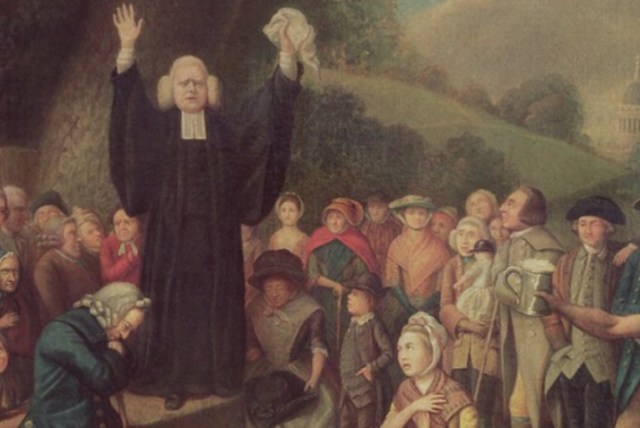
George-Whitefield
George Whitefield (1714-1770) preaching outdoors by English artist John Collet (c.1720-1780)

George Whitefield, arguably the greatest of all revivalists, addressed the topic of listening in a mid-eighteenth- century sermon based on the words of Jesus in Luke 8:18, “Take care how you hear:”

  1. Come to church out of a sincere desire to know what God has to say to you. Sermons are not for entertainment. They are to reform our hearts and teach us our duty towards God and men.
  2. Give focused attention to the things that are spoken. Listen as you would to the voice of someone you respect; the King of Kings demands even more respect! The stuff of sermons concerns eternal matters and not just the things of this world.
  3. Guard you heart against prejudice to the minister. Even when ministers urge us in the ways they themselves have trouble with, don’t refuse the urging on that account. If what they urge is biblical, receive as though Jesus were the one who spoke.
  4. Guard your heart at thinking more highly of a minister than you ought.It was the Corinthian evil that they began to prefer one preacher to another openly with terrible consequences for the body of Christ. Though one may minister to you more than another, respect both for what God does through them to the body of Christ and remember they are people just like you.
  5. Make application to your own heart of everything that is said.  Beware of that roving eye that says in a sermon, “That was meant for him” or “I sure hope she heard that!”
  6. Pray to the Lord, before, during, and after the sermon. Pray that the minister might be endued with power and boldness to declare the whole counsel of God and not be intimidated by anyone. Pray that God would apply the words to your own heart.

Whitefield concludes: “If only all who hear me this day would seriously apply their hearts to practice what has now been told them! How ministers would see Satan, like lightning, fall from heaven, and people find the Word preached sharper than a two-edged sword and mighty, through God, to the pulling down of the devil’s strongholds!”

May it be so, to the glory of God.

Psalm 119:105-112 – Light for the Journey

Your Word is a Light

Your word is a lamp to guide my feet 
    and a light for my path. 
I’ve promised it once, and I’ll promise it again: 
    I will obey your righteous regulations. 
I have suffered much, O Lord; 
    restore my life again as you promised. 
Lord, accept my offering of praise, 
    and teach me your regulations. 
My life constantly hangs in the balance, 
    but I will not stop obeying your instructions. 
The wicked have set their traps for me, 
    but I will not turn from your commandments. 
Your laws are my treasure; 
    they are my heart’s delight. 
I am determined to keep your decrees 
    to the very end. (NLT) 

Two qualities which stand out to me in these verses are the psalmist’s attitude and affection. This is a person who is determined to hold onto God’s Word because it is his heart’s delight. Yes, our attitudes and our affections are meant to be like a hand in a glove. It is our attitudes which help us to push through the pain to realize better days. And it is our affections which drive us forward, allowing us to experience joy in the present moment as we await our hope of ultimate deliverance. 

Commitments are fluid, always moving – which means they need to be continually rehearsed and refreshed. We are constantly either fulfilling our promises or reneging on them. There is really no such thing as a one-time vow. Commitments must have reinforcement from our attitudes and our affections. Otherwise, they languish on the trash heap of good intentions. This is one reason why the psalms are designed for constant use. 

It is important to have spiritually healthy habits ensconced in our lives well before any suffering and hard times roll in. If we have been nourished and supported by a daily sustenance of God’s Word, then we have both a breadth and a depth of robust theology to draw upon when the going gets rough. In addition, the sheer force of habit brings us back again and again to the treasure chest of divine instruction which informs our decisions and illuminates the treacherous road ahead. 

All the psalms are designed to reframe our own difficult situations. Even and especially when a person’s life hangs in the balance, we have the opportunity of viewing such hard and awkward circumstances through the window of the psalmist. Although circumstances change and we never quite know what to expect, God’s Word remains as our ballast and our rock. Divine love and morality are unchanging. Jesus Christ is the same yesterday, today, and forever. The Spirit is always with us, through each wave of hardship. 

Life is a continual journey, an exploration into the unknown of the future. The path is shadowy and unclear. We are unsure of what is just around the bend. Yet, God’s Word is like a never-ending flashlight helping us navigate forward. Maybe Jesus had this psalm in mind when he said:  

“I am the light of the world. Whoever follows me will never walk in darkness but will have the light of life.” (John 8:12, NRSV) 

In the Christian tradition, the Word is embodied in Jesus Christ so that he is both example and fulfillment of all God’s promises. Within today’s psalm, a sequence of four metaphors runs through these verses: my feet (light for my feet to walk in the way of God); my mouth (deliberate verbal commitment to God’s words); my hands (doing God’s will despite the circumstances); and my heart (desiring God’s decrees and commands).

With Jesus as Word and Light we have a constant companion walking alongside us for the journey; we have an intercessor who takes our wordy or malformed prayers and presents them before our heavenly Father; we use our hands by observing the Master who washed the feet of others; and, our hearts find their rest in the One who loved us and gave himself for us. 

In sum, our attitudes and affections are transformed into sustainable faith for the long journey; our hope is made sure through the promises of God; and, our love finds a resting place in the person of Jesus. Faith, hope, and love are the shoes which enable us to walk the long hard road uphill, as well as absorbing the shock as we run with abandon downhill – into the loving arms of God. 

soap

Let us come to Holy Scripture and liberally digest its life-giving message. I encourage you to find what works best for you in developing helpful spiritual habits. In reading the Bible, I often take the following approach using the acronym S.O.A.P…. 

Scripture 

  • Open your Bible and slowly, meditatively, read the portion of Scripture in your reading plan for today.
  • Write the reference of what you read in a journal along with the date.
  • As you read, ask God’s Spirit to highlight the verse(s) that speak to your life and write it in your journal.

Observation 

  • Make observations about what you just read and write them in your journal.
  • Think about: What is going on? What is the context?  Who are the people being spoken to? What is the background or setting for this verse?
  • Paraphrase and write this scripture down in your journal, in your own words.
  • What do you think God is saying to you in this scripture?

Application 

  • Personalize what you have read by asking yourself how it relates to your life right now.
  • Ask yourself how you can apply what you just read to your own life and write it in your journal.
  • Ask yourself how your life will be different or changed as a result of God speaking to you in this Scripture.

Prayer 

  • Write out a prayer to God in your journal.
  • Your prayer should relate to the verse that you highlighted. It could be asking for help, thanking God, etc. Write down what your heart desires to say to God in response to his Word.

May the words of your mouth, the meditations of your heart, the work of your hands, and the movement of your feet be to the glory of Jesus Christ. Amen. 

Psalm 29 – The Power of Words

thunderstorm church

Ascribe to the Lord, O heavenly beings,
ascribe to the Lord glory and strength.
Ascribe to the Lord the glory of his name;
worship the Lord in holy splendor.

The voice of the Lord is over the waters;
the God of glory thunders,
the Lord, over mighty waters.
The voice of the Lord is powerful;
the voice of the Lord is full of majesty.

The voice of the Lord breaks the cedars;
the Lord breaks the cedars of Lebanon.
He makes Lebanon skip like a calf,
and Sirion like a young wild ox.

The voice of the Lord flashes forth flames of fire.
The voice of the Lord shakes the wilderness;
the Lord shakes the wilderness of Kadesh.

The voice of the Lord causes the oaks to whirl,
and strips the forest bare;
and in his temple all say, “Glory!”

The Lord sits enthroned over the flood;
the Lord sits enthroned as king forever.
May the Lord give strength to his people!
May the Lord bless his people with peace! (NRSV)

I have always felt comforted during thunderstorms. Having grown up in the Midwest of America, strong thunderstorms are a given every summer. When my daughters were small children and frightened by the loud clap of thunder, I would say to them, “That’s just God letting us know he is powerful and watching over us.” Indeed, he is.

God spoke and stirred up a storm… So, they cried out to the Lord in their distress, and God brought them out safe from their desperate circumstances. God quieted the storm to a whisper; the sea’s waves were hushed. (Psalm 107:25, 29-30, CEB)

Yet, there is even more going on in today’s psalm than a reminder of God’s glory and power over all creation. God’s very voice is the source of all the power. In the beginning God created the heavens and the earth – with words. The Lord Almighty spoke the entire world into existence. God’s words are generative, that is, the speech of God creates and gives life. When God’s voice goes forth, things happen.

God said, “Let the waters under the sky come together into one place so that the dry land can appear.” And that’s what happened. (Genesis 1:9, CEB)

The way God gives is through speech. Yes, the mechanism of God’s provision for us is words. This means language is vitally important. The Lord creates, gives, sustains, and blesses his creatures through language. Out of all creation, humans are the only creatures formed in the image and likeness of God.

God said, “Now we will make humans, and they will be like us. (Genesis 1:26, CEV)

People, then, are capable of speech. What is more, we as people with the ability of language have the capacity to form generative words. We have the God-given means to give life with our speech.

“Life and death lie in the power of language” –Helen Keller

I believe we all intuitively know this is true. As we reminisce the history of our lives, we can observe events where another’s words impacted us so significantly that it was as if they gave us the gift of life. We never forget those words. We also have had times when another’s words cut us emotionally and it felt as if a part of us died. We tend to remember those as well, and they hold us back in our own life-giving speech to ourselves and others.

“The godless destroy their neighbors by their words, but the righteous are saved by their knowledge.” (Proverbs 11:9, CEB)

So, it is quite necessary for us to listen to the voice of the Lord. God’s speech does not disappoint or destroy. God’s Word is eternal life. The better we listen to God, the better we can have the generative power of words to provide life for others. It only takes a cursory look at Holy Scripture to realize that words are powerful and are to be used with great care. We are all to continually develop the craft of “wordsmithing” so that we might ascribe to the Lord the glory due his name as well as bless the world.

“As a tree gives fruit, healing words give life, but dishonest words crush the spirit.” (Proverbs 15:4, NCV)

The language we use—spoken and written words, sign language, facial expressions, bodily gestures, singing—helps us understand ourselves and lets us create relationships with others. Our words give us the power to describe our past, define our present, and dream of our future.

“Words from wise people are like water bubbling up from a deep well—the well of wisdom.” (Proverbs 18:4, ERV)

We adults may balk at the notion that words are anything more than a creative expression. Yet, as I believe is typical with most things, children are closer to the kingdom of God. They effortlessly make connections between words and reality whereas us older folks barely have an idea this even occurs. My grandson once remarked when I was talking to him about being cautious at the playground, “How am I supposed to meet new people if I can’t talk to strangers?”

“When I asked my son (5 years old) how his day was, he said it was awesome. I asked him what made it so awesome – his response was ‘because I wanted it to be.’” – Tanya Niedzwiecki (Huffington Post, November 2015)

The voice of Lord exhibits a mighty God who has the power to create and recreate with but a word. As people in God’s likeness, our words are powerful tools to be used with wisdom and care. Our speech allows us to praise God and encourage one another. Even more, the use of language enables us to speak into existence new realities for ourselves and others. May those words bring forth hope and blessing to a world in need of healing.

Mighty God, King all powerful, I am overwhelmed before such awesome majesty, and my response to your voice is reverent worship through Jesus Christ, your Son, my Lord, who lives and reigns with you and the Holy Spirit, one God, now and forever. Amen.

Psalm 19 – Living Wisely

20180302_062505

Most of life, as you well know, is lived in the mundane.  We drive the same well-worn roads to work; spend most of the time at our jobs doing routine ordinary things; repeatedly say the same things to our kids, day after day; engage in ordinary chores; and, worship in predictable ways each week.  Excitement is certainly to be had, but it is more the exception than the rule.  Yet, it is the patience, perseverance, and plodding that comes with living wisely which is the norm for realizing a thriving and flourishing spiritual life.

Psalm 19 is a celebration of God’s self-revelation.  Through both nature and law, the Lord has graciously made himself known to humanity.  What’s more, God’s moral and ethical teachings provide insight for living a good life.  This is to the benefit of the common good of all persons.

Wisdom in the Old Testament is the combination of knowledge and practice.  It is the application of God’s self-revelation to concrete situations in life.  We live wisely when we get to know the sovereign God of creation and use his revealed mores and ethos as our guide in daily experiences.

We need God’s gracious revealed law.  It’s not just for theology nerds or spiritual eggheads; God’s law is for everyone – the learned and the unlearned.  Every one of us needs the guidance and direction of God’s Holy Word, and the careful application of it to all our circumstances.  That’s wisdom.

You and I are shaped and formed as godly people as we allow God’s Word to awash us and seep into our souls.  Reading this psalm out loud slowly and contemplatively more than once is an opportunity to let our common ordinary experiences transform into divine appointments.

Self-revealing God of creation, your words are sweeter than honey and more precious than gold.  May I be humble and wise as I meditate and think about how you are the center of everything in my life; through my Lord Jesus Christ, who lives and reigns with you and the Holy Spirit; one God, now and forever.  Amen.