Get Up and Pray! (Luke 22:39-46)

The Garden of Gethsemane by He Qi

Jesus went out as usual to the Mount of Olives, and his disciples followed him. On reaching the place, he said to them, “Pray that you will not fall into temptation.” He withdrew about a stone’s throw beyond them, knelt down and prayed, “Father, if you are willing, take this cup from me; yet not my will, but yours be done.” An angel from heaven appeared to him and strengthened him. And being in anguish, he prayed more earnestly, and his sweat was like drops of blood falling to the ground.

When he rose from prayer and went back to the disciples, he found them asleep, exhausted from sorrow. “Why are you sleeping?” he asked them. “Get up and pray so that you will not fall into temptation.” (New International Version)

The prayer of Jesus and the sleeping of his disciples presents a contrast of approach when severe stress is upon us.

The Prayer of Jesus

Christ’s prayer expresses the tension all devout persons face: expressing our own wishes while seeking to submit to the Father’s wishes.

However, what is not the same, between our own prayers and the prayers of Jesus, is that we too often believe that if we are intense, wordy, and insistent enough with God, that our prayers will be answered.

While only feigning a few words about God’s will, we put our real efforts into lawyer-like presentations of why the Lord should answer our prayers in the way we want them answered.

Thus, prayer can too easily become a willful imperative that God grant our demands based in a very limited understanding of the big picture.

There is a big difference between willfulness and willingness. We must embrace the latter and eschew the former.

Jesus clearly stated exactly what he wanted: to have this terrible suffering, especially the pain about to be experienced, taken from him. Yet, he asks this with a willingness to accept the Father’s will for his life. Although an angel comes to bring comfort and strength, Christ’s request was denied. And Jesus was good with that.

We can, following the example of Jesus, unashamedly express our anguish, while at the same time, accepting God’s will for us, no matter what it may be.

Christ in Gethsemane by Michael O’Brien

It was God’s will for Jesus to suffer. And Christ not only suffered in the Garden of Gethsemane and on the cross; Jesus experienced the full range of human suffering throughout his life. He knew what it felt like to face continual adversity and hardship. 

The suffering of Christ helps us make sense of our own suffering. We can only truly be free from our stubborn expectations by embracing that which makes us suffer. 

Some suffer through the death of a loved one; some through cancer or a serious health issue; other believers right now throughout the world are suffering due to grinding poverty and la ack of food and clean water; many others suffer through violence done to them or their families.

Because of this reality, some of us may not even express our anguish to God in prayer. After all, what is a harshly worded e-mail, or trying to lose a few extra pounds, or an unexpected car repair, compared to starving children in the world? 

It’s good to keep our life situations in proper perspective, but it is also not good to tell God what he should and shouldn’t care about in this world. 

If the only things that matter and qualify as hardship and difficulty is human trafficking or the terrors of war, then you will soon find yourself plastering a smile on your face and nodding over-enthusiastically whenever someone asks you how you are doing…. Good grief…. I find chronically happy Christians to be insufferable (pun intended).

The sufferings of Christ qualified him to be a compassionate high priest, able to help us (Hebrews 2:5-18). A priest is one who stands in between the person and God, making things right with God. Christians possess a union with Jesus Christ because of his suffering, death, and resurrection. He is our champion. He stands with us in our suffering and temptations.    

The Sleep of the Disciples
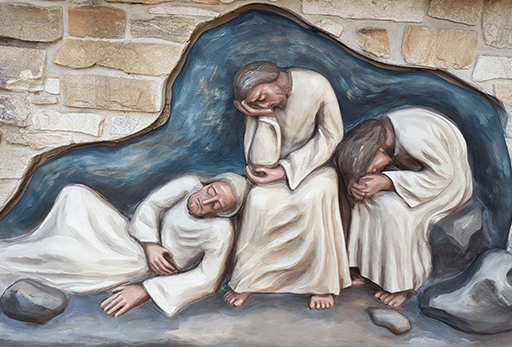
Even though their Lord told them to pray, the disciples nod-off in a stress-induced sleep. Jesus wanted them to remain awake, and he was talking of more than just physical alertness. The disciples needed to keep watch so that they didn’t fall into temptation.

Throughout his earthly ministry, Jesus had been warning them that his cross will lead to their own cross to bear. They, too, will have times of trial, so intense that it will be emotionally and spiritually overwhelming. Christ desired the disciples to follow his own example of offering anguished prayer which is thoroughly submissive to God.

So, our great task is to get up and pray!

Get up and pray so that no temptation can overtake you! (1 Corinthians 10:13)

Get up and pray so that you can endure hardship! (Hebrews 12:7)

Get up and pray for the enemies who persecute you so that you may be children of your Father in heaven! (Matthew 5:44-45)

Get up and pray so that you can encourage others and build them up in the faith! (1 Thessalonians 5:10-11)

Get up and pray so that you can be joyful in hope and patient in affliction! (Romans 12:12)

Get up and pray so that you may have peace in this world of trouble! (John 16:33)

Get up and pray so that you can submit to God and resist the devil! (James 4:7)

Get up and pray so that you will not be overcome by evil but overcome evil with good! (Romans 12:11)

Get up and pray so that you can submit to one another out of reverence for Christ! (Ephesians 5:21)

Get up and pray so that you can be the salt of the earth and the light of the world! (Matthew 5:13-16)

Get up and pray so that you can proclaim that the kingdom of God is near! (Matthew 10:7)

Get up and pray so that you can preach the Word with great patience and careful instruction! (2 Timothy 4:1-2)

Get up and pray so that you can have confidence in your leaders and submit to their authority, because they keep watch over you as those who must give an account. (Hebrews 13:17)

Get up and pray!…

Hosea 6:1-10 – “I Want Mercy, Not Sacrifice”

“Come, let us return to the Lord.
He has torn us to pieces
    but he will heal us;
he has injured us
    but he will bind up our wounds.
After two days he will revive us;
    on the third day he will restore us,
    that we may live in his presence.
Let us acknowledge the Lord;
    let us press on to acknowledge him.
As surely as the sun rises,
    he will appear;
he will come to us like the winter rains,
    like the spring rains that water the earth.”

“What can I do with you, Ephraim?
    What can I do with you, Judah?
Your love is like the morning mist,
    like the early dew that disappears.
Therefore I cut you in pieces with my prophets,
    I killed you with the words of my mouth—
    then my judgments go forth like the sun.
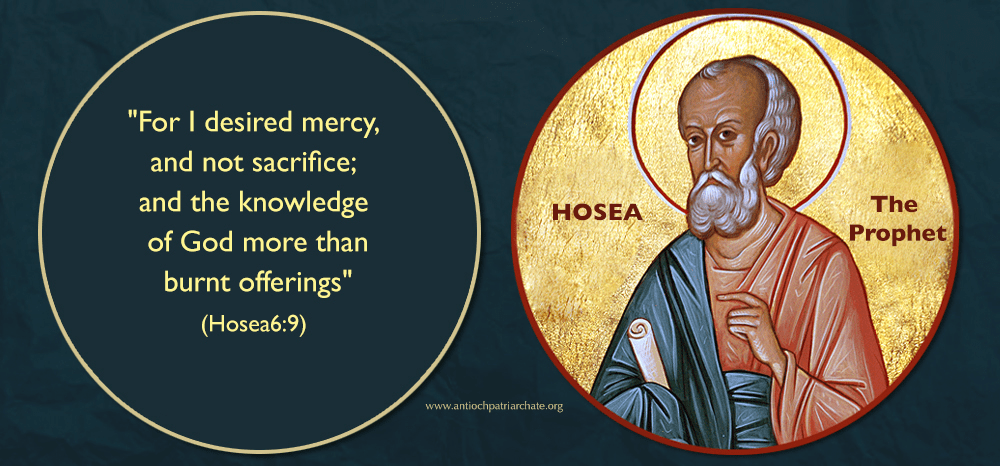
For I desire mercy, not sacrifice,
    and acknowledgment of God rather than burnt offerings.
As at Adam, they have broken the covenant;
    they were unfaithful to me there.
Gilead is a city of evildoers,
    stained with footprints of blood.
As marauders lie in ambush for a victim,
    so do bands of priests;
they murder on the road to Shechem,
    carrying out their wicked schemes.
I have seen a horrible thing in Israel:
    There Ephraim is given to prostitution,
    Israel is defiled. (New International Version)

My favorite word in all of Holy Scripture is the Hebrew word חסד (“chesed” pronounced in English “kes-ed).  It is such a rich word that no one English word can capture its depth and import. 

So, chesed is translated in various ways across English translations of the Bible as:

  • Goodness (American Standard Version)
  • Faithful love (Common English Bible)
  • Loyalty (God’s Word Translation)
  • Constant love (Good News Translation)
  • Mercy (King James Version)
  • Love that lasts (The Message)
  • Faithfulness (New English Translation)
  • Loving-kindness (New Life Version)
  • Steadfast love (New Revised Standard Version)

Chesed is God’s committed, gracious, and loving covenant loyalty to people. The Lord’s very attributes are sheer Love.

Since chesed marks the character and activity of God, the Lord very much desires people to reflect this same stance toward one another. In other words, because God is merciful and kind, we, as people created in God’s image, are to be marked with this same character in all we do. 

In today’s Old Testament lesson, God is calling and wooing wayward people to return to a life of closeness with the Lord. God demonstrated chesed by not sending the people away, like a spouse outright divorcing an unfaithful partner. Instead, the Lord is committed to loving the Israelites even when they were unlovely.

At all times, the response God wants from people is not simply to go through the motions of outward worship. Ritual practices mean little if there is no heart behind them. The Lord longs for people to demonstrate both fidelity and fealty through mercy and a steadfast love to God and neighbor.

Both our work and our worship are to be infused with divine mercy. 

God deeply desires a close relationship with humanity. The Lord is deeply grieved when people whore after other gods to meet their needs for love and belonging. Hosea’s prophecy is an impassioned plea for all persons to find their true fulfillment and enjoyment in a committed loving divine/human union, like a marriage.

In Christian readings of Hosea’s prophecy, repentance means accepting God’s chesed through Jesus Christ.

The believer is to allow the character of God to rule and reign in their heart so that love and commitment come flowing out in words, actions, thoughts, and dispositions.

Mercy, in Christianity, finds its highest expression in the person and work of Jesus.

It is no wonder, then, that Jesus lifted Hosea’s prophecy as a treasured principle of operation when asked why he deliberately made connections with “questionable” people:

As Jesus continued on from there, he saw a man named Matthew sitting at a kiosk for collecting taxes. He said to him, “Follow me,” and he got up and followed him. As Jesus sat down to eat in Matthew’s house, many tax collectors and sinners joined Jesus and his disciples at the table.

But when the Pharisees saw this, they said to his disciples, “Why does your teacher eat with tax collectors and sinners?”

When Jesus heard it, he said, “Healthy people don’t need a doctor, but sick people do. Go and learn what this means: I want mercy and not sacrifice. I didn’t come to call righteous people, but sinners.” (Matthew 9:9-13, CEB)

And when confronted about “questionable” activities, Jesus appealed to the same source of Hosea’s prophecy:

“Look! Your disciples are doing something that is not right to do on the day of rest—a holy day.”

Jesus asked them, “Haven’t you read what David did when he and his men were hungry? Haven’t you read how he went into the house of God and ate  the bread of the presence? He and his men had no right to eat those loaves. Only the priests have that right. Or haven’t you read in Moses’ Teachings that on the day of rest—a holy day, the priests in the temple do things they shouldn’t on the day of rest yet remain innocent? I can guarantee that something  greater than the temple is here. If you had known what ‘I want mercy, not sacrifices’ means, you would not have condemned innocent people. (Matthew 12:2-7, GW)

One can never go wrong with mercy and grace. If in doubt between whether to judge another or show mercy, the Christian’s choice is clear.

Grace and love reconnects the disconnected. The heart of true Christian spirituality is a deep kinship with the divine. Whenever that relation is broken or severed, it is vital to restore it. The means of doing so is not judgment; it’s mercy.

Chesed is more than a word; it is a way of life.

God wants mercy. Grace is the Lord’s divine will. So, let us today receive the forgiveness of Jesus and devote ourselves to prayer and works of love which come from a heart profoundly touched by grace. 

May the result of our return to the Lord be healing of that which has been broken, and reconciled relationships with others.

Merciful and loving God, the One who shows amazing grace, forgive us for our wanderings away from the divine life. Return us, again, to the grace of Jesus Christ our Savior so that our hearts will be renewed and aflame with love for others. In the Name of the Father, Son, and Spirit, the Great Three in One. Amen.

2 Chronicles 34:20-33 – Renew Your Faith

He [King Josiah] gave these orders to Hilkiah, Ahikam son of Shaphan, Abdon son of Micah, Shaphan the secretary and Asaiah the king’s attendant:“Go and inquire of the Lord for me and for the remnant in Israel and Judah about what is written in this book that has been found. Great is the Lord’s anger that is poured out on us because those who have gone before us have not kept the word of the Lord; they have not acted in accordance with all that is written in this book.”

Hilkiah and those the king had sent with him went to speak to the prophet Huldah, who was the wife of Shallum son of Tokhath, the son of Hasrah, keeper of the wardrobe. She lived in Jerusalem, in the New Quarter.

She said to them, “This is what the Lord, the God of Israel, says: Tell the man who sent you to me, ‘This is what the Lord says: I am going to bring disaster on this place and its people—all the curses written in the book that has been read in the presence of the king of Judah. Because they have forsaken me and burned incense to other gods and aroused my anger by all that their hands have made, my anger will be poured out on this place and will not be quenched.’ 

Tell the king of Judah, who sent you to inquire of the Lord, ‘This is what the Lord, the God of Israel, says concerning the words you heard: Because your heart was responsive and you humbled yourself before God when you heard what he spoke against this place and its people, and because you humbled yourself before me and tore your robes and wept in my presence, I have heard you, declares the Lord. Now I will gather you to your ancestors, and you will be buried in peace. Your eyes will not see all the disaster I am going to bring on this place and on those who live here.’”

So, they took her answer back to the king.

Then the king called together all the elders of Judah and Jerusalem. He went up to the temple of the Lord with the people of Judah, the inhabitants of Jerusalem, the priests and the Levites—all the people from the least to the greatest. He read in their hearing all the words of the Book of the Covenant, which had been found in the temple of the Lord. The king stood by his pillar and renewed the covenant in the presence of the Lord—to follow the Lord and keep his commands, statutes and decrees with all his heart and all his soul, and to obey the words of the covenant written in this book.

Then he had everyone in Jerusalem and Benjamin pledge themselves to it; the people of Jerusalem did this in accordance with the covenant of God, the God of their ancestors.

Josiah removed all the detestable idols from all the territory belonging to the Israelites, and he had all who were present in Israel serve the Lord their God. As long as he lived, they did not fail to follow the Lord, the God of their ancestors. (New International Version)

Sadness transformed to joy is a beautiful thing. However, joy that turns into an “Uh, oh!” is an altogether different thing.

Today’s Old Testament lesson has both sadness and joy, at the same time. God’s temple was undergoing repairs. And the Book of the Law was found. It’s sad that the Law was even lost, at all. Somewhere along the line a king, a priest, some people, they all just plain forgot about God’s Word to them. 

Yet, what’s joyful is that King Josiah had God’s Word read to him. He and his officials responded with promising to be faithful to what they heard, and to carefully follow God and God’s instructions for them as God’s people. What’s more, Josiah asked the Israelites to make that same promise.

It’s likely that you are reading this because you are a person committed to listening to God’s Word. Also, it’s likely you don’t need to go on an archaeological dig inside your own house, just to find an old dusty Bible to read. 

Maybe, however, you need to take the next step, like Josiah of old, to not only listen and obey yourself, but to ask and invite others to make the same promise.

You and I know that straightforward Bible reading often does not take place within the homes and even the churches of many confessing believers in Jesus. So, take the next step. Invite others to read with you. Ask fellow Christians to read Scripture, make observations about it, apply it to their lives, and base prayers upon it. 

Ask them to make the same promise that you have made to God: To listen to God’s Word, and then, do what it says.

This is how renewal happens.

Patient God, you continue to wait for people to read your Word and obey it. May I not simply attend to your laws in isolation from others, but freely ask others to make the same promise I have: To obey Jesus Christ, my Lord, by living and loving like him, in the power of the Holy Spirit. Amen.

Ezekiel 2:8-3:11 – Use the Head-Butt

Rufus R. Jones (1933-1993)

Son of man, listen to what I say to you. Do not join them in their rebellion. Open your mouth and eat what I give you.”

Then I looked and saw a hand reaching out to me. It held a scroll, which he unrolled. And I saw that both sides were covered with funeral songs, words of sorrow, and pronouncements of doom.

The voice said to me, “Son of man, eat what I am giving you—eat this scroll! Then go and give its message to the people of Israel.” So, I opened my mouth, and he fed me the scroll. “Fill your stomach with this,” he said. And when I ate it, it tasted as sweet as honey in my mouth.

Then he said, “Son of man, go to the people of Israel and give them my messages. I am not sending you to a foreign people whose language you cannot understand. No, I am not sending you to people with strange and difficult speech. If I did, they would listen! But the people of Israel won’t listen to you any more than they listen to me! For the whole lot of them are hard-hearted and stubborn. But look, I have made you as obstinate and hard-hearted as they are. I have made your forehead as hard as the hardest rock! So don’t be afraid of them or fear their angry looks, even though they are rebels.”

Then he added, “Son of man, let all my words sink deep into your own heart first. Listen to them carefully for yourself. Then go to your people in exile and say to them, ‘This is what the Sovereign Lord says!’ Do this whether they listen to you or not.” (New Living Translation)

When I was a kid, my brother and I watched “All-Star Wrestling” on television every Saturday. One of our favorite wrestlers was Rufus R. Jones. Like all wrestlers, he had a signature move, a lights-out-nobody-is-getting-up maneuver that always ended the match. 

Rufus’ move was the head-butt. Slamming his hard forehead into the head of his opponent always brought raucous behavior from me and my brother. Then, as the boys we were, we acted out the head-butt scene over and over. The hardest head always won…. I usually lost…. That probably explains a lot.

God gave a message to the prophet Ezekiel concerning the stubborn hearts and hard heads of the Israelites. The Lord was looking for repentance, for the people to turn their hearts and minds back to true worship and an authentic humble relationship with their God. 

The prospect of facing such a task, such an opponent, seemed daunting to Ezekiel. So, the Lord assured the prophet that his forehead would be harder than that of Rufus R. Jones. So, there is no need to be afraid of the opponent. They may be hard, but they’re no match for the rock-hard head of the prophet.

In essence, God told Ezekiel to pull-out the signature wrestling move and do the lights-out head-butt maneuver. And the promise from God that backed up Ezekiel was this: There’s absolutely no way you’re going to lose the match with the kind of head I’m giving you.

Like Ezekiel, we are to speak the Word of God with the promise of not losing. Prideful ungodly stubbornness will get us knocked-out. But conversely, gracious bold stubbornness, which determines to do the will of God, shall always win the day.

The only catch is: The Word needs to sink down deeply into our own hearts through listening well – before we can effectively speak to others.

God provides us with spiritual giftedness. Yet, that doesn’t mean we never need to develop that gift or engage in any spiritual practices to make it better. We are to use that which God gives us, no matter the response from others.

There is often a fine line between sinful obstinate stubbornness and godly persevering tenacity. We are never to use our abilities to slam people, obnoxiously and persistently, upside the head with an oversized King James Version of the Bible – in the wrongheaded notion that the Word doesn’t come back without effect.

That kind of effect, however, is harmful spiritual bruising that is devoid of grace. It’s really nothing more than an individual working out their own anger and frustration on somebody else.

Rather, we are to carefully, deliberately, consistently, and daily internalize God’s Word so that what comes out of us is helpful, not harmful. Only by a constant use of solitude and silence, in truly listening well for the voice of God, can we effect the sort of positive ministry which is needed for the present moment.

Put another way, whenever we head-butt an opponent, the grace and mercy ought to be uncompromising. It’s not our job to be the judge; our task is to communicate effectively and humbly without giving in or giving up. The message may be hard, but it should always be sweet.

Almighty and ever-living God, we pray that you would give us the Spirit of wisdom and discernment so that we may know you better and love you more. Give us an understanding heart so that we may be open in hearing your voice of grace and guidance.

Use us, your people, not to be unthinking and unfeeling tools of bludgeoning others, but to be your hands and feet – your voice and heart so that we may be a channel through which you pour out your grace to help others – may we decrease to nothing so that only Christ is seen in our lives – we ask this in the power of the Spirit and in the name of Jesus. Amen.