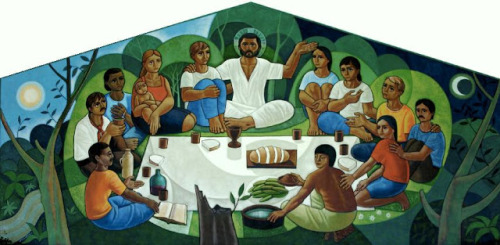
Matthew 21:28-32 – The Parable of the Two Sons

The Lord of the Parables by Argentine artist Jorge Cocco Santangelo

“What do you think? There was a man who had two sons. He went to the first and said, ‘Son, go and work today in the vineyard.’

“‘I will not,’ he answered, but later he changed his mind and went.

“Then the father went to the other son and said the same thing. He answered, ‘I will, sir,’ but he did not go.

“Which of the two did what his father wanted?”

“The first,” they answered.

Jesus said to them, “Truly, I tell you, the tax collectors and the prostitutes are entering the kingdom of God ahead of you. For John came to you to show you the way of righteousness, and you did not believe him, but the tax collectors and the prostitutes did. And even after you saw this, you did not repent and believe him. (NIV)

I once cheated on a college exam. It was a required class for which I was not much interested, so my grade was rather tenuous going into the final exam of the semester. When the professor stepped out of the classroom for a few minutes during the final, my fellow students began sharing answers. I gave in and went with the others.

I got an “A” on the exam and passed the class easily. However, I royally flunked God’s test. After a few days of misery, I went to the professor’s office and confessed what I had done. I was prepared to take a failing grade for both the exam and the class, yet I think the professor was so shocked that I would come and admit such a thing that he worked up my grade right there in front of me… I passed, but just barely.

I originally said “no” to what was right, but then said “yes” and made it right.  For those who practice repentance, there is a God of grace waiting for them. God also has no tolerance for those who profess truth with a big “yes” on the outside but are passive-aggressive on the inside and say “no,” undermining the truth by how they live. 

Today’s Gospel lesson highlights entrance into the kingdom of God – and the people entering might surprise us. Turns out, there are spiritual insiders on the outside of the kingdom, and spiritual outsiders end up as the ones who really inherit the kingdom.

Christ’s parable is a warning to all the spiritually serious: Beware, lest our insider energies be spent in correctness, conformity of belief, and cockiness rather than following Jesus.  At the same time, the parable encourages outsiders with the wonderful possibilities of a changed life. 

Christ was warning those who arrogantly assume they have the inside track by what they believe, and not by doing God’s will. It may be challenging for us to imagine how truly offensive this story was to the original hearers of the parable, so I restate it in a more contemporary form:

There was a man who was well respected in the community and had two sons. One son grew up and became a respectable member of the community, too. He was a successful businessman and gave lots of money to causes in his community, including new lights for the school football field – which was no small cost.  He only asked that appropriate and prominent recognition be given him with a plaque bearing his name on each of the light poles. 

The other son was not so successful.  He was the one in school who the teachers said, “Why can’t you be more like your brother?”  There was nothing spectacular about this son.  In fact, he lived an ‘alternate lifestyle’ and people murmured behind his back. 

One day the father said to this son: “Son, go and work at my place of business today; I am going away and need you to do some of the tedious paperwork I have gotten behind on.” “No way!” he answered, but later felt heartsick about the way he spoke to his father and decided to go and do all the grunt work his father needed done.

The father went to the well-respected son and said the same thing about needing him to do all the thankless paperwork that was piled up. That son answered, “Yes, sir, I will; anything you need I will do.”  But that son did not go. Instead, he chose to go golfing with some people whom he was trying to coy favor with.

After telling the story, Jesus asked all the upstanding faith leaders and the people listening: “Which of the two did what his father wanted?” “The first,” they answered.

Jesus said, “I tell you the truth, folks with different sexual orientations, unemployed persons on the low rung of society, and the religiously different with esoteric beliefs are entering the kingdom of God ahead of you. For you have had heard thousands of sermons about grace and the way of righteousness, yet you did not believe by putting God’s Word into practice; but the others did.  And even after you saw how God can change a person’s life from the inside-out, you yourselves did not repent and believe.

For Jesus to tell such a story was so incredibly scandalous that, frankly, it got him killed. Specifically, the scandal is this: Merely believing rightly and living as an upstanding citizen is not the way of salvation. Tax collectors and prostitutes were some of the most despised people in Christ’s time.  It was assumed they were outside of God.

Affirmation of Faith by Indian painter Jyoti Sahi, 1986

However, the proof of genuine belief is not lip service but actively obeying God when no one is looking:

My friends, what good is it to say you have faith, when you don’t do anything to show that you really do have faith? Can that kind of faith save you? If you know someone who doesn’t have any clothes or food, you shouldn’t just say, “I hope all goes well for you. I hope you will be warm and have plenty to eat.” What good is it to say this, unless you do something to help? Faith that doesn’t lead us to do good deeds is all alone and dead! Suppose someone disagrees and says, “It is possible to have faith without doing kind deeds.” I would answer, “Prove that you have faith without doing kind deeds, and I will prove that I have faith by doing them.” You surely believe there is only one God. That’s fine. Even demons believe this, and it makes them shake with fear. (James 2:14-19, CEV)

The Christian life comes down to obedience, not cheap talk. Jesus wants to bless a lost world in need of God’s love and grace.

If we have ears to listen, we can hear numerous lost souls crying in the dark. If we have eyes to see, there are people caught in addictions standing in front of us. If we have hands willing to labor, needy folks surround us who can neither help themselves nor ask for it.

Honestly, I am heartsick over the grinding loneliness of so many people; the boatloads of shame which thousands secretly carry; and the silent pain experienced by individuals everywhere. I feel this way because I genuinely believe my Lord feels the same. Jesus is looking to activate grace through his people to a world sinking in the depths of incredible human need.

Christ’s parable, however, is more than a warning; it is a story that opens the door of mercy for unlikely people seemingly far from God – people who ruined their lives by saying “no” to God. The parable is an invitation for all the screw-ups and those with little faith to come to Jesus.

There is a rather obscure Scripture reference, tucked away in the Old Testament. David was on the outside looking in. King Saul was on the inside trying to capture and kill him, even though David had done nothing wrong. Here is what happened:

David got away and escaped to the Cave of Adullam. When his brothers and others associated with his family heard where he was, they came down and joined him. Not only that, but all who were down on their luck came around—losers and vagrants and misfits of all sorts. David became their leader. There were about four hundred in all. (1 Samuel 22:1-2, MSG)

This rag-tag group of outsiders in Israel became Israel’s insiders as David eventually became king and these were the “mighty men,” the ones who helped bring Israel into prominence. 

Jesus Christ came into this world and identified himself as the Savior to the outsider when he quoted the prophet Isaiah:

Jesus went to the synagogue on the sabbath day, as was his custom. He stood up to read, and the scroll of the prophet Isaiah was given to him. He unrolled the scroll and found the place where it was written:

“The Spirit of the Lord is upon me,
    because he has anointed me
        to bring good news to the poor.
He has sent me to proclaim release to the captives
    and recovery of sight to the blind,
        to let the oppressed go free,
to proclaim the year of the Lord’s favor.”

And he rolled up the scroll, gave it back to the attendant, and sat down. The eyes of all in the synagogue were fixed on him. Then he began to say to them, “Today this scripture has been fulfilled in your hearing.” (Luke 4:16-21, NRSV)

In Christ, there are no lost causes and no persons too far on the outside to be redeemed. Therefore, now is the time to act on what we believe – to not only affirm right doctrine, but to live out that doctrine in obedience to God’s call.


Ezekiel 36:24-28 – I Will Give You A New Heart

New Heart by Ginnie Johansen Johnson

I will take you from the nations, I will gather you from all the countries, and I will bring you to your own fertile land. I will sprinkle clean water on you, and you will be cleansed of all your pollution. I will cleanse you of all your idols. I will give you a new heart and put a new spirit in you. I will remove your stony heart from your body and replace it with a living one, and I will give you my spirit so that you may walk according to my regulations and carefully observe my case laws. Then you will live in the land that I gave to your ancestors, you will be my people, and I will be your God. (CEB)

Every time I read these Old Testament verses from the prophet Ezekiel I am reminded of my time as chaplain on two cardiac intensive care units. I had several occasions to follow patients through the process of a heart transplant. I sat with them as they wondered if they would ever get a new one, as their own heart could no longer sustain the rest of their life. Would they die before receiving one? What would happen to their families?

Then, finally the day came for many (unfortunately, not all) there is a heart for them. After the incredible transplant surgery, joy abounds, knowing there is a new lease on life, a fresh experience. Through weeks or months of waiting and flirting with the Grim Reaper of death, hope is realized. Their old useless heart now replaced with a vibrant one, full of life!

However, the process is not yet over. Typically, about two or three days into possessing this new heart, a new realization comes along with it: Someone else had to die so that I could live….

He personally carried our sins
    in his body on the cross
so that we can be dead to sin
    and live for what is right.
By his wounds
    you are healed. (1 Peter 2:24, NLT)

Life comes from death. Resurrection can only happen when there is a crucifixion. Gaining a new spiritual heart has been achieved at the greatest of costs. “I will” is uttered nine times by God in five verses of Ezekiel’s prophecy. In gracious acts of determination to restore fallen people, God makes promises and has the authority and power to back them up. Our new heart is waiting to be animated by God’s Spirit so that our observance of God’s law is infused with divine might. Our consent to surgery is all that is needed.

Consider just a few of the great “I will” statements of Holy Scripture:

“I will instruct you and teach you in the way you should go; I will counsel you with my loving eye on you.” (Psalm 32:8, NIV)

“If someone trusts me, I will save them.
    I will protect my followers who call to me for help.
When my followers call to me, I will answer them.
    I will be with them when they are in trouble.
    I will rescue them and honor them.
I will give my followers a long life
    and show them my power to save.” (Psalm 91:14-16, ERV)

“I will strengthen you; I will help you; I will uphold you with my victorious right hand.” (Isaiah 41:10, NRSV)

“Call to me and I will answer you and tell you great and unsearchable things you do not know.” (Jeremiah 33:3, NIV)

“I will never leave you nor forsake you.” (Hebrews 13:5, NKJV)

May Christ make his home in your heart as you trust in him.

May your spiritual roots grow down deep into God’s love and keep you strong.

May you have the power to grasp, along with all God’s people, how wide, how long, how high, and how deep is the love of God.

May you experience the love of Christ, though it is too great to understand fully.

May you be made complete with all the fullness of life and power that comes from God.

May your new heart pump with the grace of Jesus Christ, the love of God, and the encouragement of the Spirit. Amen.

Matthew 12:46-50 – Family

En la Cena ecológica del Reino (At the Ecological Kingdom Dinner) by Spanish artist Cerezo Barredo

While Jesus was still talking to the crowd, his mother and brothers stood outside, wanting to speak to him. Someone told him, “Your mother and brothers are standing outside, wanting to speak to you.”

He replied to him, “Who is my mother, and who are my brothers?” Pointing to his disciples, he said, “Here are my mother and my brothers. For whoever does the will of my Father in heaven is my brother and sister and mother.” (NIV)

Jesus obviously did not get the memo that blood is thicker than water. When his own blood family were waiting outside for him, Jesus used the occasion to speak of what makes up a true follower of God. Christ boldly asserted that his true family is made up of people who do God’s will.  By saying this, Jesus brought the point home that the kingdom of God turns on obedience.

Rather than solely confessing belief, or appealing to a family heritage of faith, Jesus said that a genuine believer in God is one who listens to God’s words and then promptly obeys them. Therefore, a Christian is defined by allegiance to Jesus, and not by having a certain bloodline. 

Identity determines activity. For example, if I identify myself primarily as a worker at my job, my activity will show it – I will spend long hours at my labor, and will do whatever it takes to please my boss and gain promotions. If I identify myself primarily as an athlete, I will spend long hours honing my skills, and do whatever it takes to please the coach and to win. If my identity is mostly wrapped around being a husband and father, I will focus most of my attention on my family and seek to please my spouse and children in all things. 

If my identity is first and foremost as a Christian, I will always seek to please Jesus. I will then view my job as an opportunity to express the ethics of God’s kingdom, as a calling from God, and as a means for God to transform me for his glory. I will view athletics as means to glorify God, and not as an end in and of itself but as a special gift for God to teach me about the importance of community and working together. 

If my identity is clearly in Christ, I will view my kids as belonging to God and I will steward the trust of children given me by doing whatever it takes to teach and train them in the way of Jesus. I will thank God for my family and not confuse them with being God by idolizing them.

In today’s Gospel lesson, Jesus was inside a house, with his family on the outside. So, why were the family members of Jesus not inside the house sitting at his feet, taking the posture of a disciple? The disciple Matthew wanted to communicate more than physical distance between Jesus and his physical family – being “outside” was meant to convey the posture of Christ’s family as spiritually distant, skeptical of him, and indecisive about who he was and what he was up to. In fact, the disciple Mark made this spiritual and emotional distance clear:

Jesus entered a house. A crowd gathered again so that it was impossible for him and his followers even to eat. When his family heard what was happening, they came to take control of him. They were saying, “He’s out of his mind!” (Mark 3:20-21, CEB)

Christ’s earthly family were not looking for Jesus to give them warm-fuzzies and have a family group hug. They were there to tell him: “Cut it out, Jesus, because you’re acting like a nut-cake and embarrassing us all!” The kid brothers of Jesus (James and Jude) would go on to become powerful Christian preachers and each pen a New Testament letter, but that does not happen till after Jesus’ resurrection.

Ethiopian Orthodox Church depiction of Christ and his disciples

Jesus was saying that identifying only with a biological family leads to only pleasing that family. However, identifying with Jesus leads to a radical form of following God that seeks to please him instead of submitting to family practices, mores, and beliefs which are inconsistent with the kingdom of God. 

For the follower of Christ, the church is the family of God, and we are to act consistent with being in such a family.  We are to go hard after God’s will, serve one another, and adopt outsiders into our family.  The church is a family, not a restaurant.  When we go to a restaurant, we either like the food and the service, or not. If the experience was unpleasant, we might complain to the waitress and may or may not come back.  Try doing that with your mother and see where it gets you!  As a biological family, we are committed to each other. There is no complaining about mom because of dad’s wrath. Instead, we are expected to clear our plates and put them in the dishwasher, to sweep the floor and clean the table, and to work together for the benefit of the entire family.  In the same way, following Jesus means being committed to his family, the church.

Priority is to be given in doing God’s will, regardless of blood, because obedience to Christ identifies us as being in the family of God.  Our actions and the way we live points to what we honestly believe and where our commitments truly lie. 

The first step of God’s desire for us is quality focused time in sitting at Christ’s feet and listening to him because this is at the heart of all Christian discipleship. We cannot do God’s will until we have clearly heard it; and we cannot hear God’s will unless we take the time to be at the feet of Jesus. 

Both listening and doing are necessary.  Listening without engaging the world is a failure of mission; and doing without first listening leads to misguided acts and eventual burn-out. Allow Jesus to call the shots and let him instruct us so that we can act wisely and obediently. 

Jesus did not devalue blood relatives as irrelevant. Rather, Christ emphasized that our primary allegiance is to him, and not to our biological family.  The kingdom of God seeks to restore and redeem all things, including family. Both church and family are important. The relationships within each are to be nurtured.

The family of Jesus, the church, is important because Christ suffered and died for her. So, we are to be committed to the church, love the church, and serve the church because we are family. If we have a good grasp of this, we will make decisions based in what we believe God’s will is, instead of whether a relative will get upset, or not. 

Our biological families are important.  Jesus never pitted one against the other, because he wants to see families redeemed and work together as the family of God. Every Christian family can do this:

  • Appoint a time to read Scripture together and listen to Jesus and discuss it.
  • Show hospitality so that we can eat and drink our way into the kingdom of God. 

We need to persistently pray for spiritually lost family members, and those whom we are estranged from. Most families have at least a few toxic persons in their orbit. Here is how we might pray for them:

  • That God will arrange divine appointments between them and other believers who love Jesus.
  • That God will draw them to the mercy of Christ.
  • That God will hinder the devil’s schemes against them.
  • That they will understand and respond to the good news of God’s grace.

Soli Deo Gloria

1 Thessalonians 5:12-18 – Give Thanks

Now we ask you, brothers and sisters, to acknowledge those who work hard among you, who care for you in the Lord and who admonish you. Hold them in the highest regard in love because of their work. Live in peace with each other. And we urge you, brothers and sisters, warn those who are idle and disruptive, encourage the disheartened, help the weak, be patient with everyone. Make sure that nobody pays back wrong for wrong, but always strive to do what is good for each other and for everyone else.

Rejoice always, pray continually, give thanks in all circumstances; for this is God’s will for you in Christ Jesus. (NIV)

A lot of problems would resolve themselves if gratitude was a default way of life. Giving thanks in all circumstances creates peace; causes encouragement to flow freely; warns those who are busybodies; builds patience; and spreads goodness.

It can be easy to give thanks when things go our way.  It is quite another matter when circumstances are difficult, and our expectations are not realized.  The Apostle Paul’s letter to the church at Thessalonica was written to people caught between a rock and a hard place.  In fact, it was so hard that the believers focused completely on the return of the Lord. 

When times are tough, Christ’s second coming comes forth from the recesses of our minds and straightaway to the forefront of our thinking.  Gratitude is typically not a first response to trouble and hardship. Instead, we may look to escape. We long for Christ’s return as a way out of trouble.

Although we know we should be thankful, we often are not.  Envy and resentment are the twin enemies continually looking to subvert our gratitude. In our frustration of missed expectations and unwanted situations, ingratitude can easily slip into our spirits.

A life of unhappiness awaits those who are resentful of what they do not possess. Those who envy shall never be satisfied because they are always dreaming about how much better life would be without their troubles.

No matter how good we have it, someone else has it better.  To envy is to be overly future-oriented, like the Thessalonians, always thinking about how the grass is greener on the other side of the fence. And it squelches gratitude. For example, according to a study by the Templeton Foundation, gratitude has all but gone missing from the workplace.  Their research found that only 39% of people are grateful for their current employment; 74% of employees have rarely or never expressed gratitude to their bosses; and, 60% have rarely or never expressed gratitude to anyone of their fellow employees.  Workplace dissatisfaction is nearly a guarantee apart from gratitude.

If we want to live happy contented lives, then we will observe the biblical exhortation to give thanks in any kind of circumstance.  It can be a challenge to give thanks during hard times.  Yet, that might be the most important time to do it.

In her book, The Hiding Place, the late Corrie ten Boom tells about an incident that taught her the principle of giving thanks in all things. It was during World War II. Corrie and her sister, Betsy, had been harboring Jewish people in their home, so they were arrested and imprisoned at a concentration camp.  The barracks was extremely crowded and infested with fleas.

One morning they read in their tattered Bible the reminder to give thanks in all things.  Betsy said, “Corrie, we’ve got to give thanks for this barracks and even for these fleas.”  Corrie replied, “No way am I going to thank God for fleas.” But Betsy was persistent and persuasive, and they did thank God even for the fleas.  During the months that followed, they found that their barracks was left relatively free, and they could do Bible study, talk openly, and even pray in the barracks. It was their only place of refuge. Several months later they learned that the reason the guards never entered their barracks was because of those blasted fleas.

Sometimes we neither understand what God is doing nor perceive that the Lord is up to anything.  You may feel as if you are sitting still right now, yet, planet Earth is spinning around its axis at a speed of 1,000 miles per hour.  We are also hurtling through space at an average velocity of 67,108 miles per hour. Even on a day when you feel like you did not get much done, remember you traveled 1,599,793 miles through space!

That is amazing, yet we do not feel it. So, it is off our spiritual radars.  When was the last time you thanked God for keeping us in orbit? I am guessing you likely never prayed, “Lord, I wasn’t sure we’d make the full rotation today, but you did it again!” Yet, we are to learn to thank God in every circumstance, both big and small.  If we can trust God to keep our feet on the ground with a big thing like gravity, then we can have faith in any and every situation we experience.

Here are three simple ways of being intentional about gratitude

Pray with prayers of thanksgiving. 

I am a believer in using biblical prayers for ourselves rather than just saying what is always on our minds and hearts – because we might never get around to gratitude. But Scripture does. The Apostle Paul typically began every discussion with gratitude. For example, when beginning his letter to the problem filled church at Philippi, he said: 

I thank my God every time I remember you.  In all my prayers for all of you, I always pray with joy because of your partnership in the gospel from the first day until now, being confident of this, that he who began a good work in you will carry it on to completion until the day of Christ Jesus….  And this is my prayer:  that your love may abound more and more in knowledge of depth of insight, so that you may be able to discern what is best and may be pure and blameless until the day of Christ, filled with the fruit of righteousness that comes through Jesus Christ – to the glory and praise of God” (Philippians 1:3-4, 9-11, NIV).

Write your thanksgiving.

Cards, letters, emails, social media messages, and whatever other ways are available, use them to express thanksgiving to God and others. Again, Paul ended his letter to the Philippians just as he began it, with gratitude:

It was good of you to share in my troubles.  Moreover, as you Philippians know, in the early days of your acquaintance with the gospel, when I set out from Macedonia, not one church shared with me in the matter of giving and receiving, except you only; for even when I was in Thessalonica, you sent me aid again and again when I was in need” (Philippians 4:14-16, NIV).

Keep a gratitude journal.

Identifying and writing down at least three things you are thankful for everyday has healing power. Any common fool can bellyache about how bad things are and play armchair Deity about how to fix all the world’s ills.  However, it takes a wise person to find gratitude and choose to give thanks for all the good things God has done and is doing, being careful to give thanks in all circumstances for this is God’s will in Christ Jesus.

Almighty God, we give you humble thanks for all your goodness and kindness to us and to all whom you have made. We bless you for our creation, preservation, and all the blessings of this life. Above all, we are grateful for your immeasurable love in the redemption of the world by our Lord Jesus Christ, for grace and the hope of glory. Give us such an awareness of your mercies, that with truly thankful hearts we may show forth your praise, not only with our lips, but in our lives, by giving ourselves to your service, and by walking before you in holiness and righteousness all our days. We pray with thanksgiving through Jesus Christ our Lord, to whom, with you and the Holy Spirit, be honor and glory throughout all ages. Amen.

Don Moen – Give Thanks | Live Worship Sessions