Victory Over the Power of Evil (Luke 4:31-37)

He went down to Capernaum, a village in Galilee. He was teaching the people on the Sabbath. They were surprised and impressed—his teaching was so forthright, so confident, so authoritative, not the quibbling and quoting they were used to.

In the meeting place that day there was a man demonically disturbed. He screamed, “Stop! What business do you have here with us, Jesus? Nazarene! I know what you’re up to. You’re the Holy One of God and you’ve come to destroy us!”

Jesus shut him up: “Quiet! Get out of him!” The demonic spirit threw the man down in front of them all and left. The demon didn’t hurt him.

That knocked the wind out of everyone and got them whispering and wondering, “What’s going on here? Someone whose words make things happen? Someone who orders demonic spirits to get out and they go?” Jesus was the talk of the town. (The Message)

During his earthly life and ministry, Jesus was a Deliverer and a Liberator; he came to save people from their guilt and shame, and to free the world from the clutches of evil.

And so, it was inevitable that Jesus would come into conflict with the forces of darkness.

In today’s story, Jesus had a confrontation with an unclean spirit, that is, a demon who is an ally of the devil. The particular demon was not only speaking for himself, but also for his fellow band of wicked spirits.

Christ’s ministry put him in direct opposition to the hosts of Satan. The nub of the issue for the demon was whether Jesus had come for their immediate destruction. Jesus, however, wasn’t in the habit of answering questions from demons.

So, Christ rebuked the demon, told him to get out of the person he was influencing. And that is exactly what happened. The writer, Luke, pointed out that this demonstrated Christ’s authority, that it even includes the power to command unclean spirits, and out they go.

And that is how the liberating and saving ministry of Jesus began.

In the Gospel of Luke, this account of Jesus being confronted by a demon happens just after Christ’s 40 days of being tempted in the desert, even by Satan himself. So, the entire demonic realm was alert to beginning ministry of Christ. They went after Jesus right away, perhaps trying to trip him up before he could get any ministerial momentum.

Jesus was teaching on the Sabbath in the town of Capernaum. We ought not to be surprised that a demonized man was among those observing the Sabbath. The wise believer will be savvy to this reality.

Furthermore, we aren’t told who the man was or of any symptoms he may have had. Apparently, he presented himself as a normal Jewish villager. So, we ought not to think that anyone being demonized will necessarily demonstrate madness or illness of some sort.

The demon was perhaps more aware of who Jesus was than anyone else there on that Sabbath Day in Capernaum. He acknowledged Christ’s power and mission. Jesus indeed came to destroy the power and influence of evil in the world.

You believe that there is one God. Good! Even the demons believe that—and shudder.

James 2:19, NIV

Since Jesus Christ is the rightful authority over all, that means Satan and his wicked spirits are not; and they must submit to that true and real power.

Truth and doctrine are not only about objective facts and right belief. Even though our thinking is important and critical, there is more to it than that: Orthodoxy (right belief) requires orthopraxy (right actions).

A right truth that is only described is not the whole truth. In reality, a false witness and a liar may state the truth, but not entirely, withholding important information; thus, impairing any sort of right action from taking place.

Gaslighting relatives, oppressive bosses, and tyrannical rulers who tell some truth, and even support some good things, are still gaslighting and oppressing others with their narcissistic brand of leadership.

Truly, believers in and followers of Jesus can sometimes be duped into supporting evil leaders who use all sorts of unjust tactics, just because that leader tells the part of truth I want upheld.

Jesus saves; he is Savior of the world – but that is only part of the truth. We must also ask: What has Christ come to save us from? Not just our mistakes, mess-ups, and sins. Christ came to deliver us from the very power of evil that supports injustice and unrighteous behavior to begin with.

If we merely view Jesus as our personal Savior from hell after we die, then we will likely focus almost exclusively on heaven. But if we see all the freedom we need from unhealthy behaviors and unjust ways, then we view Christ as so much more than a fire insurance policy.

We need a more expansive understanding of Christ’s cross. Yes, Jesus died for our sins. Yet, he also died to conquer evil; Christ made it possible for us to become liberated from the shackles of systemic sin and structural evil, as well as personal guilt. In other words, Christ came to topple all evil, and not just human foibles.

And this was why the dark powers of Satan, and his demons, were so afraid of Jesus. They knew their time was short. There is yet another power that has a hold on us today – and that is the reality that many people no longer believe in demons and devils and dark forces.

Since we are a technically advanced people with great understanding of medical science, we now know all sorts of things which cause physical and mental illness. Ancient people did not know about human hormones and chemicals, and the impact of genetic codes on our health. They had no idea about bacteria and viruses, microbes and hygiene.

Therefore, we can jettison all this mumbo-jumbo about demons, right?… Not so much.

Even with all of our modern (and postmodern) explanations for the body and brain, we are still finding ourselves having to contend with the mystery of evil, and the malevolent suffering it causes us.

We modern folk can certainly provide a lot of insight into the cause and effect of particular symptoms a person has according to their biology. And yet, that doesn’t take away the presence of malevolent forces on this earth.

Even with all of our understanding, evil still resides within organizations, institutions, and even faith communities. The meanness and malevolence, the injustice and the ingratitude, and the profound violence (both verbal and physical) which one human being can exact on another is still here – and some would argue that it’s worse than ever.

Knowing something isn’t the same as doing it. If that were true, then education ought to deliver us from evil. Even some intelligent and objective people, who are fluent in facts and figures, still use their calculations for evil.

No matter our creeds or convictions, whether we are religious or not, all of us seem to have a collective sense that this old world of ours is profoundly broken.

All the research dollars in the world has not produced a solution to fix evil. And even if we could completely understand evil, that isn’t the same as ridding ourselves of it.

What’s more, those who put all their trust in changing things through modern means (which means without God) have been some of the worst offenders of producing wars, political tyranny, and gross injustice.

To put all of this perhaps more succinctly in the form of question: We know and understand a lot in combating disease, disaster, and death; but does all of that insight do away with the evil of it? Are things less tragic now?

I argue that is has not. Evil is still evil. Chronic pain, homelessness, poverty, injustice, and health inequities are still wreaking their evil on people.

I believe that evil really does exist, even if it has different language today than it did in the ancient world.

There is real opposition, conflict, and confrontation from evil today. The victory Christ has achieved over the forces of evil has a 2,000 year track record of helping people experience renewed lives, even when their bodies are wasting away.

In the end, the victory of Jesus Christ shall become evident to all the world. Overcoming evil doesn’t come from us, but from God. We can and we must deal with evil in this world. But we are not the Savior or the Liberator.

We need faith in the Son of God who loved us and gave himself for us. Amen.

A Mountain of Good News (Isaiah 25:6-9)

On this mountain the Lord of hosts will make for all peoples
    a feast of rich food, a feast of well-aged wines,
    of rich food filled with marrow, of well-aged wines strained clear.
And he will destroy on this mountain
    the shroud that is cast over all peoples,
    the covering that is spread over all nations;
    he will swallow up death forever.
Then the Lord God will wipe away the tears from all faces,
    and the disgrace of his people he will take away from all the earth,
    for the Lord has spoken.
It will be said on that day,
    “See, this is our God; we have waited for him, so that he might save us.
    This is the Lord for whom we have waited;
    let us be glad and rejoice in his salvation.” (New Revised Standard Version)

Mountains are a prominent and symbolic part of Holy Scripture.

Abraham sojourned to a mountain where he exhibited the pinnacle of faith in radical obedience to God’s command to sacrifice his son Isaac. (Genesis 22:1-19)

The Law was given to Moses on a mountain. (Exodus 19:1-20:17)

Elijah traveled 40 days and nights to meet God on a mountain. (1 Kings 19:11-18)

Jesus preached the most famous sermon ever on a mountain. (Matthew 5-7)

Because of such references, we routinely refer to extraordinary events as “mountaintop experiences.”

Your steadfast love, O Lord, extends to the heavens,
    your faithfulness to the clouds.
Your righteousness is like the mighty mountains;
    your judgments are like the great deep;
    you save humans and animals alike, O Lord. (Psalm 36:5-6, NRSV)

The mountain is a contrast and antithesis to the valley of death below. It signifies God’s power and reign over all earthly rulers. On the mountain we enjoy a great feast of the soul, not to mention an actual meal full of celebration. After all, food and celebration always go together in God’s kingdom.

Whenever healing and/or emancipation happen, it’s time for a celebration. To celebrate significant events, and ritualize them so we remember them, is wise and much needed.

For the Christian, Jesus is the fulfillment of all God’s good promises. In Christ, we have deliverance from guilt, shame, death, and hell. Because Jesus Christ is risen from death and has conquered the grave, our salvation is assured and made possible. And so, along with the prophet Isaiah, we proclaim the good news of peace through the crucifixion and resurrection of Christ.

How beautiful upon the mountains
    are the feet of the messenger who announces peace,
who brings good news,
    who announces salvation,
    who says to Zion, “Your God reigns.” (Isaiah 52:7, NRSV)

Celebration of the good news keeps any sort of spiritual amnesia at bay; and when future difficulties arise, because of our joy in salvation, we are able to recall the mighty acts of God and embrace hope for the future.

If we consistently practice celebration, the redemption experienced in the past is constantly fresh, like a sumptuous meal before us in an endless buffet of goodness. We can eat anytime we want.

Banquets are rightly associated with hospitality, generosity, and fellowship. Meals in the ancient Near East culture were much more than utilitarian; eating together was (and, frankly, still is in most parts of the world) a deeply spiritual event which communicates acceptance, encouragement, and love to one another.

God is the ultimate host. He throws the best parties. God ensures that there is plenty of food, fellowship, and fun. God’s joy knows no bounds. In the middle of a world beset with sadness, loss, and grief, God’s boundless generosity swallows up people’s disgrace and mourning.

At God’s Table, no one cries alone; everyone is comforted; nobody walks away hungry; and, every person is waited upon, no matter who they are or where they have come from. Indeed, there is always room at the Table.

Through Christ’s resurrection, death has been swallowed up in victory. (1 Corinthians 15:54)

Death no longer has any power to control, humiliate, or shame us into submission. Death’s threats are empty.

The Grim Reaper’s teeth have been pulled and his scythe has been broken. He is the party-pooper who is barred from entry.

There is life and abundance for all who ascend the mountain and feast with God at his Table. The invitation has gone out. The Table is spread. We need only to come.

In the joy of your Son, Jesus Christ, through his mighty resurrection and in expectation of his coming again, we offer ourselves to you, Almighty God, as holy and living sacrifices. Together with all your people everywhere and in every age, we proclaim the mystery of the faith:

Christ has died!

Christ is risen!

Christ will come again!

Send your Holy Spirit upon us, we pray, that the bread which we break and the cup which we bless may be to us a sacred communion, a holy celebration of Christ’s body, blood, and victory over death. We declare:

God has spoken!

God has acted!

God has provided!

May you gather all into your hospitable and abundant kingdom; through Jesus Christ, your Son, our Lord, who lives and reigns with you and the Holy Spirit, One benevolent God, now and forever. Amen.

Victory Celebration (Exodus 15:1-18)

The Songs of Moses and Miriam, by Laura James

Then Moses and the Israelites sang this song to the Lord:

“I will sing to the Lord, for he has triumphed gloriously;
    horse and rider he has thrown into the sea.
The Lord is my strength and my might,
    and he has become my salvation;
this is my God, and I will praise him;
    my father’s God, and I will exalt him.
The Lord is a warrior;
    the Lord is his name.

Pharaoh’s chariots and his army he cast into the sea;
    his elite officers were sunk in the Red Sea.
The floods covered them;
    they went down into the depths like a stone.
Your right hand, O Lord, glorious in power—
    your right hand, O Lord, shattered the enemy.
In the greatness of your majesty you overthrew your adversaries;
    you sent out your fury; it consumed them like stubble.
At the blast of your nostrils the waters piled up;
    the floods stood up in a heap;
    the deeps congealed in the heart of the sea.
The enemy said, ‘I will pursue; I will overtake;
    I will divide the spoil; my desire shall have its fill of them.
    I will draw my sword; my hand shall destroy them.’
You blew with your wind; the sea covered them;
    they sank like lead in the mighty waters.

Who is like you, O Lord, among the gods?
    Who is like you, majestic in holiness,
    awesome in splendor, doing wonders?
You stretched out your right hand;
    the earth swallowed them.

In your steadfast love you led the people whom you redeemed;
    you guided them by your strength to your holy abode.
The peoples heard; they trembled;
    pangs seized the inhabitants of Philistia.
Then the chiefs of Edom were dismayed;
    trembling seized the leaders of Moab;
    all the inhabitants of Canaan melted away.
Terror and dread fell upon them;
    by the might of your arm, they became still as a stone
until your people, O Lord, passed by,
    until the people whom you acquired passed by.
You brought them in and planted them on the mountain of your own possession,
    the place, O Lord, that you made your abode,
    the sanctuary, O Lord, that your hands have established.
The Lord will reign forever and ever.” (New Revised Standard Version)

The ancient Israelites were freed from four hundred years of Egyptian bondage through the miraculous work of God. Then, as they were leaving Egypt, Pharaoh had a change of heart and decided to take his army and pursue the Israelites.

Literally sandwiched between the army and the sea, yet another miracle happened: God parted the Red Sea, allowing the Israelites to pass through on dry ground; and then God closed the sea up on the pursuing army. Today’s Old Testament lesson is the people’s victory chant of deliverance.

Portrayed here is Yahweh’s incomparable power over the mighty Egyptians, and protective presence with the Israelites. God was fulfilling the divine promise to bring the people out from bondage and into the Promised Land. Nothing can stand in the way of the Lord’s purpose.

By Stushie Art

God Rescues

Throughout the Bible, deliverance and celebration go hand in hand. For the Christian, this time of year is full of celebrating the resurrection of Christ from death. Because our redemption is secured, we rejoice in the once for all sacrifice of Jesus.

God rescued us from dead-end alleys and dark dungeons. He’s set us up in the kingdom of the Son he loves so much; the Son who got us out of the pit we were in, got rid of the sins we were doomed to keep repeating. (Colossians 1:13-14, MSG)

God Protects

The Lord showed up and wondrously delivered the Israelites from certain annihilation. And God has also entered into humanity’s world and brought emancipation from sin, death, and hell through Christ’s redemptive events of cross and resurrection. We are shielded by God’s glorious grace and goodness.

Praise be to the God and Father of our Lord Jesus Christ! In his great mercy he has given us new birth into a living hope through the resurrection of Jesus Christ from the dead, and into an inheritance that can never perish, spoil or fade. This inheritance is kept in heaven for you, who through faith are shielded by God’s power until the coming of the salvation that is ready to be revealed in the last time. (1 Peter 1:3-5, NIV)

God Establishes

Deliverance is provided, and then the divine presence is with us throughout life. God doesn’t expect us to be on our own after we are saved from a calamitous situation. Grace is given for all things, not just some things. So, the Lord helps to establish us in faith and perseverance for a lifetime.

His divine power has given us everything needed for life and godliness, through the knowledge of him who called us by his own glory and excellence. Thus he has given us, through these things, his precious and very great promises, so that through them you may escape from the corruption that is in the world because of lust and may become participants of the divine nature…. Therefore I intend to keep on reminding you of these things, though you know them already and are established in the truth that has come to you. (2 Peter 1:3-4, 12, NRSV)

Our victory chant comes from God’s redemptive events. For the Christian, we are rescued from our precarious spiritual plight, protected and established by divine power, through the person and work of Jesus Christ.

“Victory in Jesus” by E.M. Bartlett, 1939

I heard an old, old story
How a Savior came from glory
How He gave His life on Calvary
To save a wretch like me
I heard about His groaning
Of His precious blood’s atoning
Then I repented of my sins
And won the victory

Oh, victory in Jesus, my Savior forever
He sought me and bought me with His redeeming blood
He loved me ‘ere I knew Him and all my love is due Him
He plunged me to victory beneath the cleansing flood

I heard about His healing
Of His cleansing power revealing
How He made the lame to walk again
And caused the blind to see
And then I cried, “Dear Jesus, come and heal my broken spirit”
And somehow Jesus came and brought to me the victory

Victory in Jesus, my Savior forever
He sought me, and He bought me with His redeeming blood
He loved me ‘ere I knew Him and all my love is due Him
He plunged me to victory beneath the cleansing flood

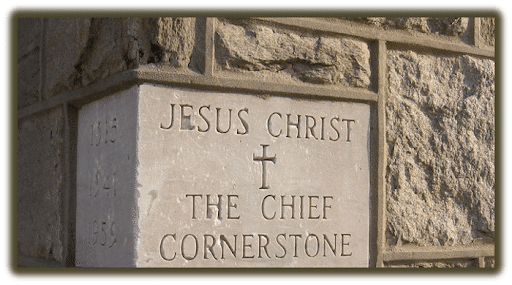
Jesus Is the Cornerstone (Psalm 118:1-2, 14-24)

Give thanks to the Lord, for he is good;
    his love endures forever.

Let Israel say:
    “His love endures forever….”

The Lord is my strength and my defense;
    he has become my salvation.

Shouts of joy and victory
    resound in the tents of the righteous:
“The Lord’s right hand has done mighty things!
    The Lord’s right hand is lifted high;
    the Lord’s right hand has done mighty things!”
I will not die but live,
    and will proclaim what the Lord has done.
The Lord has chastened me severely,
    but he has not given me over to death.
Open for me the gates of the righteous;
    I will enter and give thanks to the Lord.
This is the gate of the Lord
    through which the righteous may enter.
I will give you thanks, for you answered me;
    you have become my salvation.

The stone the builders rejected
    has become the cornerstone;
the Lord has done this,
    and it is marvelous in our eyes.
The Lord has done it this very day;
    let us rejoice today and be glad. (New International Version)

Jesus The Cornerstone, by Gloria Ssali, 2016

Indeed, today we rejoice with gladness and celebrate that Christ is risen! Christians have a firm foundation of faith that gives us strength and stability.

Everyone’s life is constructed on some sort of foundational support. If we consider a building, it’s foundation has four cornerstones. For us as people, those stones consist of the body, the mind, the emotions, and the spirit. Each of these stones is holding up the one building of our life, and so therefore, they each need our attention in order to be well maintained.

Physical

Jesus is the

Mental Spiritual

Cornerstone

Emotional

We can neither treat them as if they are different sizes (which then would never hold up the building of our life) nor as of different importance.

For example, if we get a crack in the physical stone of our life, it is insufficient to examine the mental stone and try to repair the crack through positive thinking or mindfulness. Or, if our emotional stone is damaged, it won’t get fixed by focusing on the spirit stone by only praying.

These days, a lot of people have had bad, even traumatic, religious experiences, and so they’ve jettisoned the spirit cornerstone altogether. And as their building begins to collapse, they wonder why this is all happening.

The spirit cornerstone is Jesus. We need him. We need his whole entire life – not just parts of it. Christ is not a tool that we can use and then store in the garage for next time; he’s the whole garage, and the entire hardware store. We can no more set him aside than we can set aside our lungs or our heart.

So, why do so many resist facing the cracked and damaged stones? Why resist, or even reject, Jesus? Why do so many Christians want the victory of this Resurrection Day without the hard suffering of Good Friday?

Because we are still coming to grips with what it takes to live into the victory of the Cross – yes, the Cross. There’s no new life without a death. If we want a miracle, we need to die – die to our expectations, dreams, desires, and anything we believe we need, other than Jesus.

The builders rejected the stone because it was too hard. But the reality is that you cannot build on a foundation of marshmallows. Love isn’t actually soft, but hard; it’s permanent, like solid marble; it’s not going anywhere. We need that firm base of love to construct a soul that’s worth living.

Christ’s earthly life had incredible times of miraculous healings, provisions of food and necessities, and relational connections. But that’s only part of it. There was also hardship, adversity, rejection, mockery, torture, abuse, and death. When the Apostle Paul considered it all, he said:

But whatever were gains to me I now consider loss for the sake of Christ. 

What is more, I consider everything a loss because of the surpassing worth of knowing Christ Jesus my Lord, for whose sake I have lost all things.

I consider them garbage, that I may gain Christ and be found in him, not having a righteousness of my own that comes from the law, but that which is through faith in Christ—the righteousness that comes from God on the basis of faith. 

I want to know Christ—yes, to know the power of his resurrection and participation in his sufferings, becoming like him in his death, and so, somehow, attaining to the resurrection from the dead. (Philippians 3:7-11, NIV)

Both suffering and resurrection go together for a spiritually sound life, free of cracks and damage. A new life is fresh, hopeful, and full of promise – and it’s downright hard; there is nothing easy about it. We don’t get to pick and choose which parts of Jesus we want – we must take him wholesale just as he is, the entire thing.

It’s from the person and work of Jesus Christ as our cornerstone – both his cross and resurrection – that a new building is being built into a spiritual house which is the place of hospitality for the entire world.

As you come to him, the living Stone—rejected by humans but chosen by God and precious to him—you also, like living stones, are being built into a spiritual house to be a holy priesthood, offering spiritual sacrifices acceptable to God through Jesus Christ. For in Scripture it says:

“See, I lay a stone in Zion,
    a chosen and precious cornerstone,
and the one who trusts in him
    will never be put to shame.”

Now to you who believe, this stone is precious. But to those who do not believe,

“The stone the builders rejected
    has become the cornerstone,”

and,

“A stone that causes people to stumble
    and a rock that makes them fall.”

They stumble because they disobey the message—which is also what they were destined for.

But you are a chosen people, a royal priesthood, a holy nation, God’s special possession, that you may declare the praises of him who called you out of darkness into his wonderful light. Once you were not a people, but now you are the people of God; once you had not received mercy, but now you have received mercy. (1 Peter 2:4-10, NIV)

Jesus is our cornerstone, the center of life and worship. Our priority as believers, is allowing God to build us into a community of faith that worships Jesus with lives dedicated to knowing him and making him known.

Christian worship is the expression of a relationship in which God the Father reveals himself and his love in Christ, and by his Holy Spirit gives grace, to which we respond in faith, gratitude, obedience, and love to one another and the world. 

People, at their core, exist for worship. Firmly built on Christ the cornerstone, worship becomes less about gaining truth, and more about letting truth gain us and capture us. The more we pay attention to the presence of Jesus Christ through song, prayer, Scripture, and sacrament, the more we will experience the centrality and power of God. Jesus becomes very precious to us when we align ourselves to him as the cornerstone of our faith and worship.

I urge you, brothers and sisters, in view of God’s mercy, to offer your bodies as a living sacrifice, holy and pleasing to God—this is your true and proper worship (Romans 12:1, NIV)

Jesus, as the cornerstone upon which all is supported, means that acceptable worship can happen anywhere. Everywhere can become a sanctuary and a sacred space – home, neighborhood, and marketplace – as well as church. In all these locations, Christian discipleship will prove itself.

Several years ago, a man named Matt had an aunt who had struggled for years to make ends meet. When her health started to decline, she was forced to sell her fifty acres of property to pay for health care. As an act of kindness, Matt traveled to Massachusetts and bought the land from his aunt for the appraised value of $50,000. While exploring the land to see about building a house, he discovered outcroppings of stone ledges.

Matt contracted a geologist, who surveyed the land and informed him the stone was actually Goshen stone, a type of mica used for sidewalks, patios, and landscapes. At the time, it sold for $100 a ton – and Matt had about 24 million tons on the land. The appraised value on the surface was $50,000, but experts estimated that the land was worth up to $2 billion.

Jesus is the precious cornerstone. He is much too valuable to be left in on a piece of property undiscovered. And he’s also much too needed to merely remain in a church building. He’s the cornerstone who has the resurrection power to be the foundation for all the world. So, let’s let him.

Almighty God, who through your only Son Jesus Christ overcame death and opened to us the gate of everlasting life: Grant that we, who celebrate with joy the day of the Lord’s resurrection, may be raised from the death of sin by your life-giving Spirit; through Jesus Christ our Lord, who lives and reigns with you and the Holy Spirit, one God, now and forever. Amen.