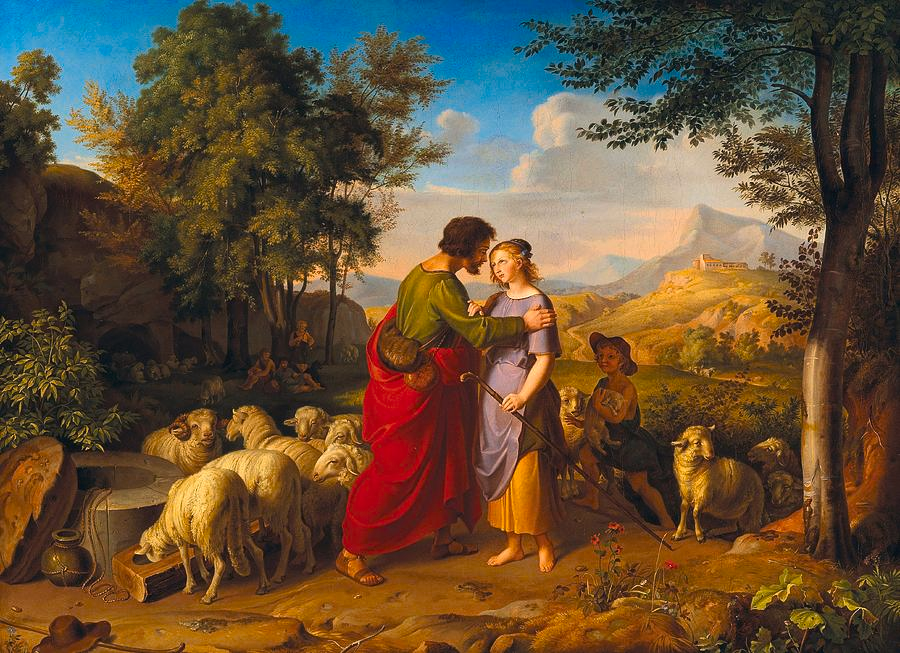
Who’s In Charge? (Romans 9:6-13)

I am not saying that the promise of God has failed; for not all the people of Israel are the people of God. Nor are all of Abraham’s descendants the children of God. God said to Abraham, “It is through Isaac that you will have the descendants I promised you.” This means that the children born in the usual way are not the children of God; instead, the children born as a result of God’s promise are regarded as the true descendants. For God’s promise was made in these words: “At the right time I will come back, and Sarah will have a son.”

And this is not all. For Rebecca’s two sons had the same father, our ancestor Isaac. But in order that the choice of one son might be completely the result of God’s own purpose, God said to her, “The older will serve the younger.” He said this before they were born, before they had done anything either good or bad; so God’s choice was based on his call, and not on anything they had done. As the scripture says, “I loved Jacob, but I hated Esau.” (Good News Translation)

My friend, I want to break this to you as gently as possible yet as straightforward as I can: Neither you nor I are in control or in charge! 

Any semblance of control we think we have is merely a delusion. Now, before you push back, its important to make the distinction between control and responsibility. We are to own our decisions and take responsibility for their outcome. The Bible describes this as “self-control.”

God’s saving kindness has appeared for the benefit of all people. It trains us to avoid ungodly lives filled with worldly desires so that we can live self-controlled, moral, and godly lives in this present world. (Titus 2:11-12, GW)

Attempting to control others is not our job – never was, isn’t now, and never will be – that’s God’s business. 

God makes choices. This was the Apostle Paul’s point to the church at Rome. The congregation was a volatile mix of Jew and Gentile. There was some bad history between them that stretched back centuries. Yet, here they were together in one church worshiping Jesus. 

Paul made a responsible choice to step into the mess between them and let each group know something important: It is neither their choice about who’s in and who’s out as God’s people, nor their choice about how someone gets in to start with. Those sorts of decisions are God’s choice. 

The Jews needed to know that Gentiles are in the kingdom because God does the work of choosing, calling, and including Gentiles just as much as Jews. 

The Gentiles needed to know that they were not replacing Jews as chosen people. The point? God chooses whomever he darn well pleases to choose, and the choice is not up to you or me.

This speaks on so many levels about how to conduct ourselves with one another in the church. The foundation of all good church dynamics is the recognition that God is the one who calls and gathers people together. That always needs to be the starting point in our relations with each other. The church is not a random collection of persons who happen to be in the same place at the same time. God puts us where we are.

He has made everything beautiful in its time. He has also set eternity in the human heart; yet no one can fathom what God has done from beginning to end. (Ecclesiastes 3:11, NIV)

The Church is a covenantal community. Believers in Jesus are receiving the blessings first promised by God’s covenant relationship with Abraham in the Old Testament that all nations would be blessed by grace through faith. God is committed to acting on their behalf through election, adoption, and redemption. The new covenant community, the Church, receives the promises of God and exists to follow Jesus Christ in all things. 

The Church is not a voluntary society, like every other human institution. Rather, the Church is the divinely called community of the redeemed whom God has joined through the Spirit to Christ. Therefore, an individual, theologically speaking, does not join a church; instead, God joins the Church to Jesus.

The Nicene Creed (325 C.E.) describes the Church with four identifying marks:

  1. The Church is one.  The unity of the Church comes from God’s covenant people being in fellowship with the Lord through Jesus in the Spirit. This unity is expressed through the bond of love and a common worship that includes the spiritually forming practices of preaching, liturgy, and sacraments.  Since believers serve a triune God of Father, Son, and Spirit who exists in unity, so Christians are to work toward maintaining their unity through the bond of peace.
  2. The Church is holy.  The Church is holy by virtue of Christ’s finished work. Therefore, the members of the Church are saints, called by God to live in holiness and participate with him in carrying out his purposes on earth. As God is holy, so believers are to be holy in all they do. Since Christians are holy through God’s justification in Christ, so the Church as saints must uphold justice in the world.
  3. The Church is catholic.  This means that God’s people are found in all parts of the world throughout all times in history, including every race, class, gender, and ethnicity. Since the Church includes all kinds of people from different cultures, these believers must work together. The Church, across all kinds of denominations, ought to minister together to the total life of all people through gospel proclamation and good works done in the Spirit.
  4. The Church is apostolic.  Apostolic means “to be sent.” The Church is not only a people who are gathered for worship and teaching; they are also sent into the world as salt and light to those who are in darkness. Where the Church goes, the rule and reign of Jesus goes with them so that the gospel is spread to all nations.

Sovereign God, you choose whomever you want to include in your kingdom. Allow me to see Jesus in each person you call and save so that I can love and encourage them in the faith which is mutually and graciously given to us all; through Christ our Lord, and the ministry of the Holy Spirit. Amen.

Divine Providence (Genesis 30:37-43)

Jacob with Laban’s flock, by Jusepe de Ribera, 1632

Then Jacob took some fresh branches from poplar, almond, and plane trees and peeled off strips of bark, making white streaks on them. Then he placed these peeled branches in the watering troughs where the flocks came to drink, for that was where they mated. And when they mated in front of the white-streaked branches, they gave birth to young that were streaked, speckled, and spotted. Jacob separated those lambs from Laban’s flock. And at mating time he turned the flock to face Laban’s animals that were streaked or black. This is how he built his own flock instead of increasing Laban’s.

Whenever the stronger females were ready to mate, Jacob would place the peeled branches in the watering troughs in front of them. Then they would mate in front of the branches. But he didn’t do this with the weaker ones, so the weaker lambs belonged to Laban, and the stronger ones were Jacob’s. As a result, Jacob became very wealthy, with large flocks of sheep and goats, female and male servants, and many camels and donkeys. (New Living Translation)

Jacob had been working for his father-in-law Laban for years. During that time, they both contested with each other in a chess match of trying to gain the upper hand. Mostly, Jacob had been outmaneuvered by Laban. But now he achieves a sort of coup de grace, a checkmate.

Having agreed between them that Jacob’s wages would be only the speckled and spotted sheep and goats, as well as every black lamb, Laban proceeded to remove all those animals from his flock and sent them off away from Jacob. This was yet another unfair practice in the chess game of his life.

Even if Jacob wanted to retaliate, he really had no means to do it – which is why Laban kept taking advantage of him. But Laban underestimated who he was playing against and dealing with.

Using an unusual method, something akin to sympathetic magic – a ritual using an object that resembles the sheep over which Jacob sought influence – he systematically grew his own flock of many strong sheep and goats. Jacob then separated these stronger animals from Laban’s flock. In doing this, Jacob became exceedingly wealthy.

It’s an incredible story, almost like achieving the modern day American dream of rags to riches in the face of adversity. Yet, behind all the success of Jacob, we as the readers know that this happens because God is working out divine promises to the family of Abraham, Isaac, and now Jacob.

The power, sovereignty, providence, and grace of God stand behind every good thing people have in this life. The Lord is the One who is not flummoxed by the impending moves in the chess game; God has the ability to rearrange the chess board, reorder the future, and make restoration possible.

Although separated by more than three millennia from the family of Jacob, we can relate to the ever-present human condition, the personal struggles of overcoming the past, and the wonderings of what will happen in the future.

In whatever way we want the future to shake-out, it ultimately is in the hands of God. We would like to live in a universally closed system where there is predictability with no trickery, posturing, manipulating, or anxiety about what’s next. Many people long for a life free from an uncertain and shadowy future.

But none of us can have the precise future we may wish for. So, some people despair that we are in a closed system in which nothing can change – that systemic evil, broken institutions, fragmented families, and wounded spirits are just the way it is.

There are lots of folks who continually feel the awkward push and pull of both hope and dread – wanting to believe that things can be better, but having a sinking sense that the other shoe is about to drop.

In truth, we do not live in a closed universal system; history is not yet finalized and the Lord has a few tricks up the divine sleeve. We actually live in an open system, where we can find both surety and hope. The future, although appearing bleak for some, shall be shaped and bent by God according to divine promises and good purposes.

And when we take the time to observe this grand open system, we begin to discern that no scheming of humanity nor any human machinations can do anything more than slightly delay the inevitable Day of the Lord. Justice will have its day, and it’s way on this earth; injustice shall not last forever.

In the meantime, we do the best we can with the resources we have, at this present moment. Today is all we have. God’s gracious provision for this day is enough. Tomorrow has enough worries of its own.

An open system says that there is a spiritual force outside of social interaction. A a closed system says there is no outside force influencing our actions and outcomes.

In a closed system, we have the illusion (and delusion) that control is possible because the number of variables remains static. People in this system long for simplicity and sameness – to be able to predict what will happen next. So, they focus on structures and processes that sustain control over organizations and people.

But in an open system, dynamics from other systems impact us, creating and expanding the number of variables. It’s a complex and fluid situation, but folks learn to focus on influence rather than control, knowing there are forces at play which impact the chessboard. That’s because ultimate control belongs to God; we, as people, are called to self-control.

Almighty God, Creator and Sustainer of all things: You uphold, direct, and govern all creatures, actions and objects, from the least to the greatest. Nothing escapes your sovereign and benevolent rule—not the most powerful institution or ruler imaginable, nor the least significant speck just biding its time. You sustain all things by your powerful word.

Help me to see your hand in my life specifically and in history worldwide. Although there is much that remains a mystery in your providence, there is much that is already revealed. Your providence reveals your infinite wisdom, power, justice, goodness, and mercy. To you be all glory and praise, through Jesus Christ our Lord, who with you and the Holy Spirit are one God, now and forever. Amen.

A Divine Appointment (Genesis 29:1-14)

Jacob and Rachel at the well, by Friedrich Wilhelm Müller (Kirchditmold 1801–1889)

Then Jacob continued on his journey and came to the land of the eastern peoples. There he saw a well in the open country, with three flocks of sheep lying near it because the flocks were watered from that well. The stone over the mouth of the well was large. When all the flocks were gathered there, the shepherds would roll the stone away from the well’s mouth and water the sheep. Then they would return the stone to its place over the mouth of the well.

Jacob asked the shepherds, “My brothers, where are you from?”

“We’re from Harran,” they replied.

He said to them, “Do you know Laban, Nahor’s grandson?”

“Yes, we know him,” they answered.

Then Jacob asked them, “Is he well?”

“Yes, he is,” they said, “and here comes his daughter Rachel with the sheep.”

“Look,” he said, “the sun is still high; it is not time for the flocks to be gathered. Water the sheep and take them back to pasture.”

“We can’t,” they replied, “until all the flocks are gathered and the stone has been rolled away from the mouth of the well. Then we will water the sheep.”

While he was still talking with them, Rachel came with her father’s sheep, for she was a shepherd. When Jacob saw Rachel daughter of his uncle Laban, and Laban’s sheep, he went over and rolled the stone away from the mouth of the well and watered his uncle’s sheep. Then Jacob kissed Rachel and began to weep aloud. He had told Rachel that he was a relative of her father and a son of Rebekah. So she ran and told her father.

As soon as Laban heard the news about Jacob, his sister’s son, he hurried to meet him. He embraced him and kissed him and brought him to his home, and there Jacob told him all these things. Then Laban said to him, “You are my own flesh and blood.” (New International Version)

Jacob meets Rachel at the well, by Paolo Fiammingo, c.1585

Jacob was a homebody. Unlike his twin brother Esau, who loved the outdoors and was often away hunting, Jacob preferred to hang around home with his mother – which is probably why Rebekah preferred him over his brother. It’s also why the two of them succeeded in a plan to deceive Isaac and steal the family blessing from Esau.

In Esau’s bitterness over not being blessed by his father, he began laying plans of his own: to kill his brother Jacob in revenge. This came to the attention of Rebekah, who then warned Jacob to flee to her family of origin in Paddan-Aram.

The boy who was attached to his mother and stayed at home, was now a man on the run, in need of a new life. Jacob was alone. One can only imagine the fear and apprehension, the grief and loneliness, of being on his own in a strange place. But God was with him. And the Lord graciously assured Jacob of the divine presence and promises.

Since God was with Jacob and was going to accomplish divine purposes through him, the Lord set up a divine appointment.

Upon arriving at a well, Jacob discovers some shepherds who know his uncle. And then, along comes Rachel with a flock of sheep. God’s providential guidance is evident in leading both Jacob and Rachel to this place and for this time.

Jacob’s mother, Rebekah, was the brother of Laban and the father of Rachel. In the lives of both Rebekah and her son Jacob, Laban ran out to greet and be involved in the divine appointments. (Genesis 24) The narratives differ, however, in that Abraham’s servant had wealth to share in bringing Isaac and Rebekah together; yet Jacob showed up without two pennies to rub together.

And whereas, on both occasions a future bride comes to a well, Rebekah and Rachel differ greatly in their betrothal times. Rebekah’s marriage was quickly arranged; Rachel’s marriage is uncertain and everything is nebulous on how things will shake out with Jacob.

The divine appointment has happened. God’s protection, presence, and guidance are with Jacob. Yet, at this point in the narrative, everything seems up in the air. Will Jacob marry Rachel? Are there going to be numerous descendants? How in the world is Jacob going to return to the land which was promised?

Though this initial foray into the unknown has had a divine stamp on it, Jacob will soon discover that there are many obstacles to negotiate before the promises of God are fulfilled.

And that is the way of us all. Sometimes things come easy and effortless. At other times, it’s a hard slog. In the scope of a life, there are extended seasons of tedious and mundane work – punctuated with times of amazement, even miracle, letting us know there is a God still watching.

You never quite know what’s around the corner of your life – whether good or bad. Yet, the real issue is trust.

The thing about divine appointments is that God is the sovereign ruler of the universe – which means that everything is in the Lord’s hands. All of life, and all events, are providentially bent for divine purposes. Both good and trouble are appointed.

If we believe the Lord is good, right, and just – all the time and that there is never a time when God is bad or capricious – then we are able to accept all circumstances as being from the hand of God. We will trust, even though we don’t know what’s coming next.

The Apostle Paul had it right by saying that “every detail in our lives of love for God is worked into something good.” (Romans 8:28, MSG)

What would your life look like by adopting this perspective God and all events you encounter?

Gracious God, you alone know what my real needs are. You love me more than I myself know how to love. Help me to see my real needs which are hidden from me. I am afraid to ask for either a cross or consolation, so I wait on you; my heart is open to you. Visit me and help me for the sake of your great mercy. Strike me and heal me, cast me down and raise me up, according to your good will. I put all my trust in you. Amen.

Clap and Shout! (Psalm 47)

Clap your hands, all you people!
    Shout joyfully to God with a joyous shout!
Because the Lord Most High is awesome,
    he is the great king of the whole world.
He subdues the nations under us,
    subdues all people beneath our feet.
He chooses our inheritance for us:
    the heights of Jacob, which he loves.

God has gone up with a joyous shout—
    the Lord with the blast of the ram’s horn.
Sing praises to God! Sing praises!
    Sing praises to our king! Sing praises
    because God is king of the whole world!
    Sing praises with a song of instruction!

God is king over the nations.
    God sits on his holy throne.
The leaders of all people are gathered
    with the people of Abraham’s God
    because the earth’s guardians belong to God;
        God is exalted beyond all. (Common English Bible)

God is King, the Supreme Sovereign over all creation and the entire universe.

In the Christian tradition specifically, Jesus is King. Christ is the One who gives shape, form, and substance to the reign of God over the earth. This is what the Lord’s ascension to heaven communicates – that Jesus sits at the right hand of God the Father, exercising a benevolent rule as the rightful monarch over all creation.

This redemptive reality of the Lord’s good reign is a cause for praise. And this is what today’s psalm is all about. We, as the subjects of God’s kingdom, are called to praise the Lord.

The psalm tells us exactly how to praise the Lord because of God’s powerful and compassionate authority: Clap your hands and shout!

For worshipers who believe acknowledgment of God is most appropriate with silence and contemplation, even a cursory reading of the psalms will inform them differently. Although it seems to me most worship experiences need more familiarity with silence, I also passionately believe they could use a whole lot more enthusiasm with clapping and shouting.

Depending upon where you fit in the spectrum of Christianity’s tradition of worship, high church or low church, very liturgical, or not, it behooves all churches to incorporate the full range of human expression to God – including both silence and shout, hands clasped reverently in prayer as well as exuberantly clapping in praise.

It’s biblical to applaud God! And it’s healthy, too – both spiritually and physically.

Whenever we fail to pause in our feelings of happiness and enjoy the moment, it’s more than a missed opportunity. Unacknowledged and unexpressed joy trains us to depress our feelings, eventually leading to depression itself. Yet, whenever we pause to outwardly demonstrate gratitude through the exuberance of shouting and clapping, it benefits everyone – God, others, and self.

Physically clapping and shouting helps keep the heart and lungs healthy, even playing a curative role with pulmonary problems. It gives relief to joint pain, gout, headaches, insomnia, and digestion. Shouting and clapping even sharpens the intellect and increases the brain’s ability. And, of course, applause is a social phenomenon which binds folks together in community.

For the psalmist, applause to the Lord is the appropriate response to God’s power and victory in the world. Since the Divine presence is everywhere – and that presence is merciful, just, and kind – we ought to take the time to acknowledge and celebrate a loving God watching over us with tender care and concern.

No matter the circumstance, God is with us. That reality alone is enough cause for exuberance and celebration. Even though evil still resides in this old fallen world, God is King, and still sits on the throne. The pastor and hymnwriter, Maltbie Davenport Babcock (1858-1901), had it right:

This is my Father’s world:
O let me ne’er forget
That though the wrong seems oft so strong,
God is the Ruler yet.
This is my Father’s world:
Why should my heart be sad?
The Lord is King: let the heavens ring!
God reigns; let earth be glad! 

It isn’t the attempt to rouse human and personal confidence which enables us to face the foulness and degradation of this world. Rather, it’s the spiritual awareness of God’s presence and power which resides around us and within us. This is the basis of our confidence, and the ground of our peace. It’s the reason for the believer’s joy, even amidst awful circumstances.

Our connection with one another as worshipers is the common acknowledgment of God’s rule and reign over all creation. And our link as followers of Jesus is the collective conviction that Christ is King, we are his subjects, and all things belong to God, including us.

Whenever we connect with this basic theology, spontaneous and joyous praise is the result. So, if we lack the joy of the Lord in our lives, the place to go is to use today’s psalm. Read it several times over, out loud. Shout the psalm! Clap while shouting the psalm! Sing the psalm aloud! Praise the risen and ascended Lord!

Just try and be morose after doing that!