Against Arrogance and Injustice (Isaiah 47:1-9)

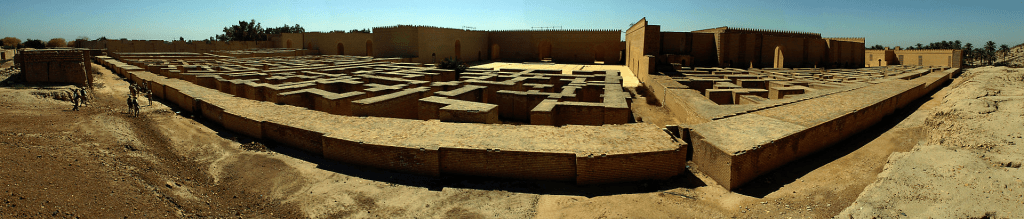
Ancient ruins of Babylon in present day Iraq

City of Babylon,
You are delicate
    and untouched,
    but that will change.
Surrender your royal power
    and sit in the dirt.
Start grinding grain!
    Take off your veil.
Strip off your fancy clothes
    and wade across rivers.
You will suffer the shame
    of going naked,
because I will take revenge,
    and no one can escape.
I am the Lord All-Powerful,
the holy God of Israel.
    I am their Savior.

Babylon, be silent!
    Sit in the dark.
No longer will nations
    accept you as their queen.
I was angry with my people.
So I let you take their land
    and bring disgrace on them.
You showed them no mercy,
but were especially cruel
    to those who were old.
You thought that you
    would be queen forever.
You didn’t care what you did;
it never entered your mind
    that you might get caught.

You think that you alone
    are all-powerful,
that you won’t be a widow
    or lose your children.
All you care about is pleasure,
    but listen to what I say.
Your magic powers and charms
    will suddenly fail,
then you will be a widow
    and lose your children. (Contemporary English Version)

The God of the Bible is not merely a local deity that the ancient Hebrews worshiped way back in history. From the biblical standpoint, God is the Lord of the universe, and the Creator of heaven and earth. Therefore, every nation on earth is accountable to the Divine Sovereign of all, the right and just Judge of the world.

Divine judgment extended to ancient Babylon. Just because they may not have worshiped and served the God of the Israelites, doesn’t mean they were off the hook for their violence and injustice.

For every nation and each person on this earth will have to give an account of their life and existence before God.

The prophet Isaiah likened Babylon to a princess who becomes a slave girl. It’s as if God is taunting her, putting her in her place; showing her who is really in charge.

Babylon had trusted in her own cleverly devised ways of manipulating reality to get what she wanted in this world. But she became helpless, stripped of her power and authority by the One who holds ultimate authority; and holds everyone accountable.

The mocking, taunting, and sarcastic nature of the Lord toward Babylon in Isaiah’s prophecy may seem out of sync with how we understand God. Yet, I invite you to remember how some great injustice of the past was done to you, or someone you care about, from someone with power and authority over you.

Allow me the liberty of reframing and retranslating today’s Old Testament lesson from the vantage of one person’s unjust victimization from another’s position of power and authority, with God exacting divine attention to such an injustice:

“Get off your high horse and sit in the dirt,
    Miss High and Mighty Babylon.
No more doing whatever the hell you want—No! Sit on the ground,
    daughter of Pride and Arrogance.
Nobody will be calling you anymore in order to get things done;
    you won’t be batting your big eyelashes and getting your way with me! So, get used to it.
Get a real job, a job where you have to do what you’ve made others do:
    Dig ditches, scrub toilets, stand at the factory line for hours on end.
You might as well get rid of your fancy clothes,
    and put on some real working gear—because the gig is up, sister.
Your true vulnerability will be on public display,
    and you will feel the criticism and manipulation that you did to others.
Now you have to contend with me. I’m intervening. And I’m taking vengeance.
    No one gets away with treating people like dirt. And if dirt is what you like, dirt is what I’m going to give you.”

Our Redeemer speaks,
    whose name is Yahweh of Armies, The Sacred One:
“Shut up and sit down in the dirt,
    Miss High and Mighty.
Because no one is ever again going to call you
    ‘Boss Lady in charge,’ or ‘Queen of the Empire.’
Believe me, I was angry with my own people,
    and was disgusted with my own children.
Which is why I let them be under your authority;
    but you didn’t show any compassion to them whatsoever.
You treated long-standing reliable people like cogs in a machine,
    and expected them to work at hard labor like they’re young men.
You arrogantly said, ‘I’m Miss High and Mighty!
    I’m here forever, and you will always serve me.’
You took no one seriously, took nothing to heart,
    never thought a wit about the consequences of your actions.
Well, Miss High and Mighty, you better start thinking!
    You’re acting as if you are the center of the universe,
saying to yourself, ‘I’m in charge. There’s nobody but me.
    I will always be in charge, I’ll never lose my authority.’
But two things are going to hit you between the eyes,
    suddenly, on the same day:
Your high position, and your company suck-ups, will be gone, a total loss,
    and your manipulative and gaslighting ways won’t help you, at all.”

Let it be known that the God of Holy Scripture hates injustice, and wants all people everywhere to extend basic human kindness and goodness to one another without prejudice or favoritism.

Individuals and even nations who selfishly grab power and control for themselves, shall have to contend with the ultimate authority in the universe. And that, my friend, is a very good thing for the righteous; and very bad thing for the selfish and arrogant.

Injustice, unfairness, and selfishness will not exist forever. Therefore, it is best for everyone to put their efforts into what lasts, what is permanent and enduring. In the end, peace and righteousness will have an unending rule and reign. Loving relationships will last. God’s justice shall endure.

So, be encouraged, in your own difficult experience and hardship. If you are the victim of another’s positional power used against you, know that the Lord sees, cares, and will do something about it.

Almighty God, who created us in your image: Grant us grace fearlessly to contend against evil and to make no peace with oppression; and, that we may reverently use our freedom, help us to employ it in the maintenance of justice in our communities and among the nations, to the glory of your holy Name; through Jesus Christ our Lord, who lives and reigns with you and the Holy Spirit, one God, now and forever. Amen.

Hold Onto Faith (Job 26:1-14)

Job, by Gonzalo Carrasco (1860-1936)

Then Job replied:

“How you have helped the powerless!
    How you have saved the arm that is feeble!
What advice you have offered to one without wisdom!
    And what great insight you have displayed!
Who has helped you utter these words?
    And whose spirit spoke from your mouth?

“The dead are in deep anguish,
    those beneath the waters and all that live in them.
The realm of the dead is naked before God;
    Destruction lies uncovered.
He spreads out the northern skies over empty space;
    he suspends the earth over nothing.
He wraps up the waters in his clouds,
    yet the clouds do not burst under their weight.
He covers the face of the full moon,
    spreading his clouds over it.
He marks out the horizon on the face of the waters
    for a boundary between light and darkness.
The pillars of the heavens quake,
    aghast at his rebuke.
By his power he churned up the sea;
    by his wisdom he cut Rahab to pieces.
By his breath the skies became fair;
    his hand pierced the gliding serpent.
And these are but the outer fringe of his works;
    how faint the whisper we hear of him!
    Who then can understand the thunder of his power?” (New International Version)

Sarcasm is a form of criticism. Criticism is a form of anger. Job was angry at his “friends.” Namely, because they had proved themselves to be not very good companions.

Job needed comfort and consolation, not hellfire sermons about his being sinful. Because, in fact, he had not sinned. His intense pain and suffering were not a punishment from God, as the prologue to the story of Job makes clear. (Job 1:1-22)

But neither Job nor his friends knew what was going on behind the scenes in the cosmic court of heaven.

Job only knew he was getting a lot of undeserved tragedy. And Job’s friends only knew that he was suffering terribly.

Job didn’t know how to interpret his situation. Job’s friends misinterpreted his situation as condemnation from the Lord.

Thus, Job became exasperated and angry. Job’s friends became the ignoramuses of ancient history.

Job was certainly no ignoramus. He knew what it meant to be right with God – which was why he was so doggone confused and confounded as to why he felt abandoned by God. Job knew his suffering wasn’t a result of unfaithfulness.

The biblical character Job came face to face with the reality that good people suffer, too.

The friends of Job kept reiterating how unworthy and sinful people are; and that Job must be especially sinful to be experiencing such trouble. And, of course, Job found this line of reasoning asinine.

The majesty of God, as Job understood it, is much greater and higher than his supposed friends could ever imagine. The dead know this better than anyone. Job himself was nearly dead, and so, he seems to see some things more clearly from his perspective of abject suffering.

Job’s observations of creation are profound reflections of God’s greatness and sovereignty in the world. His faith rested firmly with God alone, as Creator and Sustainer of the universe. So, he looked beyond the water and the clouds to heaven above.

Even in the realms we humans cannot see, God has authority and power over angelic beings. We cannot fathom the breadth and depth and extent of God’s reach and knowledge of all things. Indeed, humanity only observes a mere fraction of God’s rule and reign. And we barely know anything in comparison to God’s wisdom and knowledge.

In other words, our incredible God is so mighty and wondrous that it is incomprehensible to us.

Oh, the depth of the riches of the wisdom and knowledge of God!
    How unsearchable his judgments,
    and his paths beyond tracing out! (Romans 11:33, NIV)

God is big, to the point that only the fringes of God’s robe can fit inside the temple:

I saw the Lord, high and exalted, seated on a throne; and the train of his robe filled the temple. (Isaiah 6:1, NIV)

Although Job was flummoxed as to why God was silent and allowed suffering to happen, Job nevertheless had a majestic view of God which remained intact.

And, what’s more, Job seems to have gained an even more expansive view of God through his awful experience of suffering in both body and soul. In other words, Job got to know God better, and not for worse, because of his terrible situation.

Satan certainly meant to upend Job and cause him to renounce his faith; but God meant it all, ironically, for good.

Even though Job’s words about God appear similar to the words of his friends, they come from a very different place.

It’s one thing to talk of God’s majesty, sovereignty, and power when everything is going okay for you in your life. But it is an altogether different thing whenever your life has unraveled and distress is what you eat for breakfast.

To affirm God’s inherent power and goodness, smack in the middle of grinding hardship and ill health – and truly mean it – is the genuine article of faith.

Authentic faith is resilient and gains strength when tested and tried. Bogus faith crumbles like burnt toast when it is put through the fire.

True faith is always connected to hope and love. False faith evaporates and becomes nihilistic and hateful in the face of hellish circumstances.

Real faith perseveres through suffering, knowing that God is good, no matter what. Skin deep faith is herky-jerky, vacillating between confidence and doubt.

The only way for faith to be shown as real or fake is in the crucible of suffering. How we handle the adverse situations of life demonstrates where our faith is truly placed.

Satan’s statement to God was that Job’s faith would be shown to be a mere façade because God had blessed him with health, wealth, and family.

Satan was wrong. God was right. However, we may wonder about what Job thought of all this, once the suffering subsided.

I don’t know about Job. I can only speak for myself. I won’t list the long litany of trials and tribulations I have personally encountered in my life, and those I am facing presently. Yet, I will say that each of my experiences have taught me something important about God; and those hard experiences have changed and strengthened my faith in ways I could not have imagined.

Although I would never want to go through all of the past adversity again, I would not change a thing in my life. Because each of my experiences were formative in making me the person I am today – full of robust faith in God and confident in the Lord, no matter the circumstances.

Strengthen us, O Lord, by your grace, so that through your mighty power we may overcome all spiritual enemies, and with pure hearts serve you; through Jesus Christ our Lord, who lives and reigns with you and the Holy Spirit, one God, for ever and ever. Amen.

How To Live When Things Are Bad (Isaiah 33:10-16)

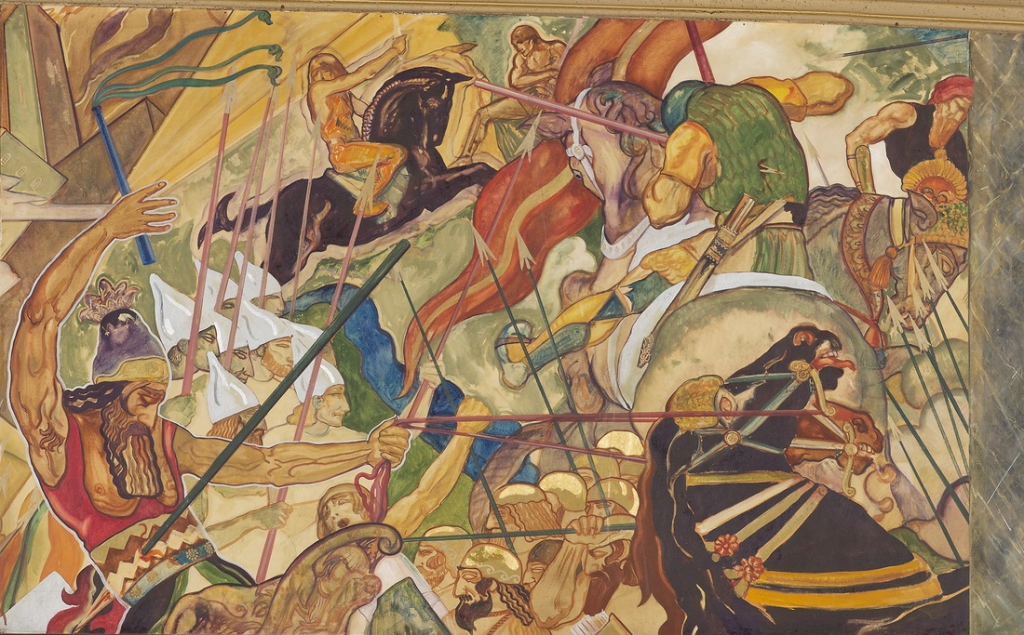
Mural depicting the wars of Israel and Judah with the surrounding nations, Wilshire Boulevard Temple, Los Angles

But the Lord says: “Now I will stand up.
    Now I will show my power and might.
You Assyrians produce nothing but dry grass and stubble.
    Your own breath will turn to fire and consume you.
Your people will be burned up completely,
    like thornbushes cut down and tossed in a fire.
Listen to what I have done, you nations far away!
    And you that are near, acknowledge my might!”

The sinners in Jerusalem shake with fear.
    Terror seizes the godless.
“Who can live with this devouring fire?” they cry.
    “Who can survive this all-consuming fire?”
Those who are honest and fair,
    who refuse to profit by fraud,
    who stay far away from bribes,
who refuse to listen to those who plot murder,
    who shut their eyes to all enticement to do wrong—
these are the ones who will dwell on high.
    The rocks of the mountains will be their fortress.
Food will be supplied to them,
    and they will have water in abundance. (New Living Translation)

The Assyrians were a nasty bunch. So were the people of Jerusalem, at the time of Isaiah’s prophecy. Maybe the folks in Judah played the comparison game and thought they were better than their foe. After all, the Assyrians were experts in war and torture.

Jerusalem was understandably terrified of the Assyrian army. And they trusted God, that is, to a degree. There’s a difference between looking to the Lord because you’re between a rock and a hard place, and placing faith in God because that is the default response of your life.

Easy for me to say. I’ve never stood on a city wall watching a powerful army surrounding me like a bunch of bullies on the playground.

Jerusalem was intimidated to the point of letting the Assyrian ruffians take their gold and silver. Well, actually, it wasn’t their gold; it was God’s. And when the army left, the city was still intact. But for how long?

It was humiliating. Being the victim of a bully always is. And because they’re bullies, it’s never enough. Like feeding the neighbor’s cat, the Assyrians end up going nowhere. They want more. In fact, they never really intended on leaving anyway. It was all a double-cross.

Judah, out of their fear and anxiety, made a bargain with the devil. A bully is a bully because they can be. Give in to them, and it only enables them to keep bullying. The Assyrians were ready for battle. It’s what they always did: fight and conquer.

It was at this point that Jerusalem finally got the clue that they’d been living with God in the background, not the foreground. They did their own thing, much like the hated and dreaded Assyrians.

So, the only recourse the people of Judah had was the mercy of their God. Yet, even though they ought to have petitioned the Lord from the get-go, at least they noticed the Lord is still there.

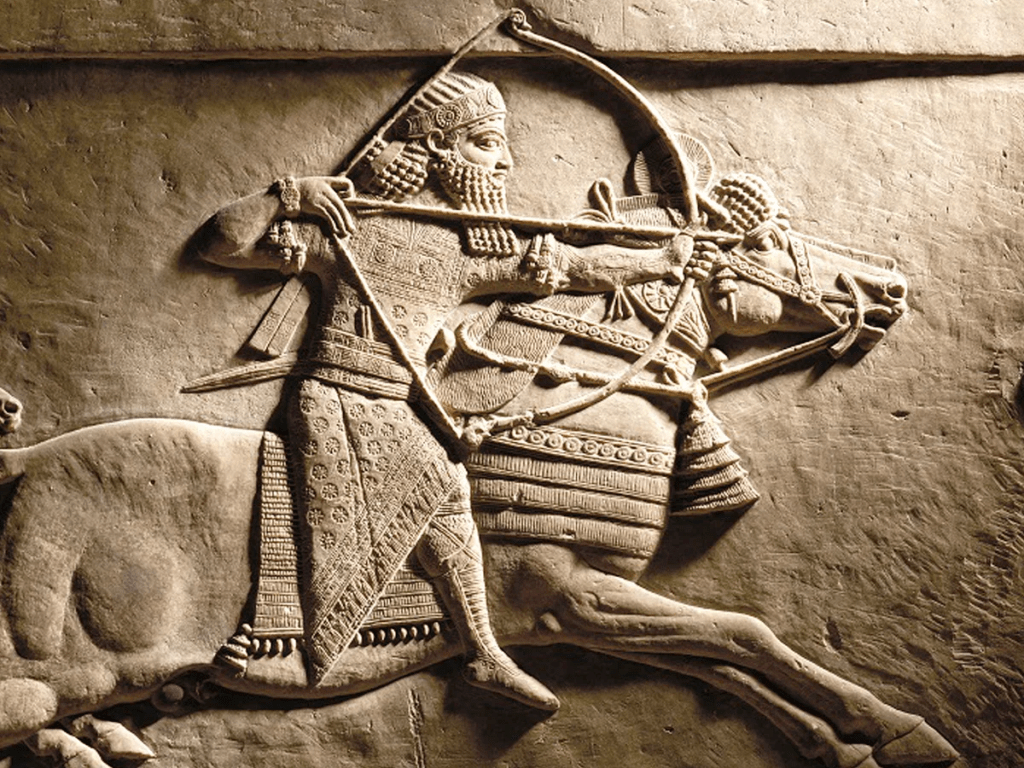
Assyrian king, British Museum

Unfortunately, most of our repentant overtures are way overdue. And yet, because of divine grace, the crazy mess we make of our lives is the very same place where a merciful God meets us.

Any sort of help is surely undeserved. It always is. The Lord, however, avoids making us grovel in our own vomit. God accepts us where we are, and not where we ought to be.

In truth, we all need to make a change, and not just the bullies. The sheer reality of God demands that we pay attention to what is right, just, and good. And the prophet Isaiah informed the people exactly how we must live in a world full of bullies and busted dreams.

We are to have an awareness of ethics and morality, a concern for humanity, and an orientation to help everyone thrive and flourish in this life.

The answer to life’s question of how to exist in this world and do more than just survive comes down to human morality:

  • Live right
  • Speak the truth
  • Despise exploitation
  • Refuse bribes
  • Reject violence
  • Avoid evil pleasures

The safe and stable way to live is to participate in the rhythms of mercy and justice that are woven into the fabric of the universe. The path to a contented and satisfying life is through goodness, not hatred.

Security and satisfaction don’t come through control of all circumstances; it comes by discerning that God has ultimate control, and that this God is good, not evil; just, not unjust; and righteous, not capricious.

According to the prophet, God will determine when the suitable time for assistance will come for us. And the Lord will deal with the ungodly according to the divine timetable, and not when we believe judgments should be rendered.

None of this is in our purview. Sometimes, talking about this sort of theology is a way of taking the focus off of our own need for an ethical and moral life. Sometimes, it is a helpful way of coming to grips with what is happening. Discernment is needed with oneself in these matters.

Trusting God means to exercise patience and perseverance, to focus on faith, to discipline ourselves in prayer, and to express confidence in hope.

We are not necessarily ruined whenever our circumstances are dire. The worse things become, the greater the display of divine power that can come.

By orienting ourselves around God and God’s strength and will, we grow in courage and develop in faith. We learn to trust in the worst of situations. We discover that the Lord knows the score of things, that God understands what’s going on.

And God laughs at the ungodly who believe they can bully the godly around. The most brilliant of military commanders is like a little toddler before the sovereign Lord of the universe. The fiery words they blow will blow back on them and consume their arrogance.

So, let us not harden our own hearts, but exercise a change of heart to let God be God, and to want for nothing but the courts of the Lord.

Let us not be like the bullies of Assyria who lived without a thought to the divine reality in front of them. Let us not become tormented, as if a fire were devouring us with inward anguish of soul, but instead:

  • Walk in right relations with others and with the Lord
  • Maintain truth and integrity in everything
  • Be free from corruption and offending others and God
  • Act with love toward your neighbor and your God
  • Refuse to accept a bribe
  • Restrain evil impulses
  • Open wide the spigot of goodness and justice

God is our refuge and strength, an ever-present help in trouble. Safety and abundance of good things is provided by the Lord. God protects. And God supplies. Rely upon God’s promises, and not the empty bellowing of others.

Be safe. Be strong. Be spiritual. We are all in this life together.

O God, my refuge and strength: In this place of unrelenting light and noise, enfold me in your holy darkness and silence, so that I may rest secure under the shadow of your wings. Amen.

Learn a Lesson from Conflict (2 Samuel 10:13-19)

David Attacks the Ammonites, by Gustave Doré, 1866

Then Joab and the troops with him advanced to fight the Arameans, and they fled before him. When the Ammonites realized that the Arameans were fleeing, they fled before Abishai and went inside the city. So Joab returned from fighting the Ammonites and came to Jerusalem.

After the Arameans saw that they had been routed by Israel, they regrouped. Hadadezer had Arameans brought from beyond the Euphrates River; they went to Helam, with Shobak the commander of Hadadezer’s army leading them.

When David was told of this, he gathered all Israel, crossed the Jordan and went to Helam. The Arameans formed their battle lines to meet David and fought against him. But they fled before Israel, and David killed seven hundred of their charioteers and forty thousand of their foot soldiers. He also struck down Shobak the commander of their army, and he died there. When all the kings who were vassals of Hadadezer saw that they had been routed by Israel, they made peace with the Israelites and became subject to them.

So the Arameans were afraid to help the Ammonites anymore. (New International Version)

Outward Conflict with Ammon

You would think that showing basic human kindness to another would always end well… Yet, not always. And King David found that out, the hard way.

David, having become king of Judah and Israel, demonstrated that his reign would be characterized by extending the sort of mercy and kindness that is characteristic of God.

Whereas David’s kindness was most often accepted, when it came to King Hanun and the Ammonites, it was misunderstood and rejected. The Ammonites humiliated King David’s sent ambassadors.

The delegation wanted to express David’s condolences to Hanun in the event of his father’s death. Then, after the Ammonites saw that King David was upset about how his ambassadors were treated, they mobilized a mercenary force of Arameans with Hadadezer leading the charge.

Both the Ammonites and the Arameans underestimated the experience and skill of the Israelite army under their commander Joab. Even though Joab was outnumbered, he conceived of a strategy that evened the odds.

All of this conflict, with preparations for battle and an escalating war, came about because a king wanted to show kindness to another. Indeed, this can be a very messed-up world that we inhabit!

The result of it all is that the Ammonites and the Arameans were soundly defeated by a smaller, yet much stronger, army with King David at the head. The Arameans became subject to Israel, and the Ammonites were left slack-jawed, not knowing what hit them.

Inner Conflict with Oneself

So, here we have David, who like all of us, is a bundle of contradictions. On the one hand, King David had his heart set on showing kindness and reflecting the heart of God in his rule and reign. And on the other hand, David is a soldier and a man of blood, who does an awful lot of killing people in his lifetime.

King David is both a paragon of moral behavior, and an example of immoral living.

He did not lift a finger against his former king who was trying to kill him; and evidenced a tender spirit through musical skill and an ability to write the psalms and songs of Israel.

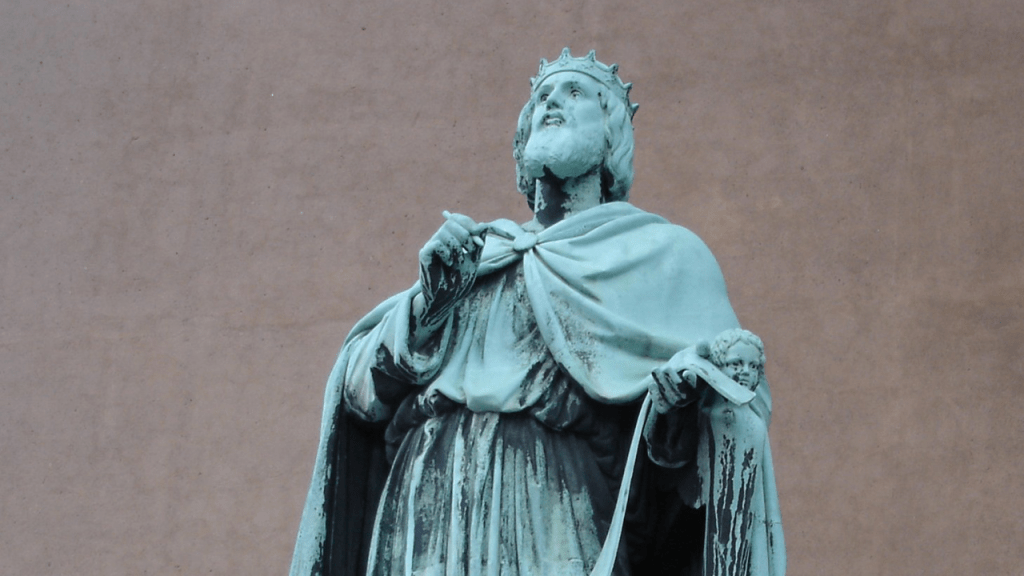
Statue of King David, Copenhagen, Denmark

Yet also, King David demonstrated for us some of the worst immorality, of which is clearly seen in the next few chapters of his story in the book of 2 Samuel. Throughout David’s adult life, he took thousands of human lives in battle.

He came to fame by beheading Goliath; made his mark in Israel by killing Philistines for King Saul; survived in the wilderness while Saul was trying to kill him by killing Amalekites; and secured Israel’s borders through an enormous amount of killing.

I won’t do to simply say that the people David killed had it coming to them, or that he did all the things he did for the sake of the nation. That sort of reductionism smacks of mental laziness and purposeful ignorance.

Coming to Grips with Conflict

At the least, it seems to me that we must accept the biblical narratives as they are, and not as we want them to be, whenever there is difficulty in understanding a story.

We have the human condition in front of us every time we read a scriptural story. Either making it all good, or all bad, just won’t do – because all of us, like David, are a bundle of contradictions and paradoxes that often don’t make sense.

It turns out that, throughout Holy Scripture, we find stories of people who are no better and no worse than we ourselves. The ancient persons, like David, are those for whom a gracious God chose to use and work through – despite either their sinning or their saintliness.

We get a glimpse of how things were and how the Lord operated through the people of the time in their own political, social, economic, and religious contexts.

God comes to us, not merely from the outside by simply mandating commands and imposing control, but enters our lives on the inside, taking us as we are and graciously working with and within us to accomplish good and just purposes on this earth.

And, as it turns out, God uses whomever God wants to use, without doing some sort of divine screening interviews to find out who the most moral candidate is available for the job.

If you are looking for a bottom line in all of this mayhem, then I believe it is this: God loves us. God is with us. And God holds us – all of us, with our maddening combinations of kindness and kookiness – to establish a truly right and benevolent world characterized by humility, gentleness, mercy, purity, and peace.

It’s a rather long and messy process of bringing in such a way of life, but God is patient and will take the centuries and even the millennia needed to accomplish it.

It’s Not All About Human Conflict

Although we are a flawed and fallible people, we are nevertheless God’s people. At the end of it all, we discover that none of this was really a story about Ammonites or Israelites or David or Joab or anyone else; it is actually a story about God – because God is both the object and subject of every biblical narrative.

And what we discover about God is that there are divine initiatives happening all the time which are meant to help us and save us from ourselves. The Lord is sovereign over all creation, and brings salvation despite what we do or don’t do.

God’s kindness – shown and expressed through our own human kindness – will eventually and always win the day.

Almighty and everlasting God, whose will it is to restore all things in your well beloved Son, the King of kings and Lord of lords: Mercifully grant that the peoples of the earth, divided and enslaved by sin, may be freed and brought together under his most gracious rule; who lives and reigns with you and the Holy Spirit, one God, now and forever. Amen.