Our Place in the World (Psalm 8)

Lord, our Lord,
    how majestic is your name in all the earth!

You have set your glory
    in the heavens.
Through the praise of children and infants
    you have established a stronghold against your enemies,
    to silence the foe and the avenger.
When I consider your heavens,
    the work of your fingers,
the moon and the stars,
    which you have set in place,
what is mankind that you are mindful of them,
    human beings that you care for them?

You have made them a little lower than the angels
    and crowned them with glory and honor.
You made them rulers over the works of your hands;
    you put everything under their feet:
all flocks and herds,
    and the animals of the wild,
the birds in the sky,
    and the fish in the sea,
    all that swim the paths of the seas.

Lord, our Lord,
    how majestic is your name in all the earth! (New International Version)

I adore the psalms. Many years ago, it was the biblical psalter which helped me come to faith. This little psalm for today is illustrative of why I was moved toward embracing a life with God. Psalm 8 grounds us by dealing with the ultimate questions of human existence:

  • Who am I?
  • Why do I exist?
  • What is the purpose of life?

The answers to those questions are supremely important because people throughout history, and now across the world, are asking what meaning their lives really have.

For example, depression is pervasive throughout the world, as well as the church. It’s a huge issue. Peeling back the layers of a person’s life, many have a deep sense of not truly belonging, and of being profoundly misunderstood by others. Many depressed persons are very aware of their own mortality and have a disconnected sense of their personal role in the world.

Put another way, some folks have lost their original purpose of being a person, that they belong to the human family in a way that makes a significant contribution to the world.

Living on such a big planet causes some people to feel small and wonder how they fit in. With such a large universe, which may at times seem cold and capricious, we may ask, along with psalmist, “What is humanity that you are mindful of them?”

That question forms the center of the psalm. Hebrew poetry is typically set up to have the front and the end of the poem point to the middle where the chief focus is found. So then, the psalmist purposely wrote this psalm so we would consider this great question of what God thinks of humanity within the scope of this immense universe.

And it is a staggeringly huge universe! To put it in perspective, if our galaxy, the Milky Way, were the size of the entire continent of North America, our solar system would fit in a coffee cup.

Even now, two Voyager spacecraft are hurtling toward the edge of the solar system at a rate of 100,000 miles per hour. For decades they have been speeding away from Earth, having now traveled billions of miles. When engineers beam a command to the spacecraft at the speed of light, it takes over half a day to arrive.

Yet this vast neighborhood of our sun—in truth, the size of a coffee cup—fits along with several hundred billion other stars and their planets in the Milky Way, one of perhaps 100 billion such galaxies in the universe. To send a light-speed message to the edge of that universe would take 15 billion years.

Out of the billions of galaxies in the universe, what is the planet Earth that God should care about it? 

Even on our planet there are billions of creatures. Yet, of all those bugs, animals, fish, and birds, God has a special relationship with us, humanity, and cares for us deeply. We know that God cares for us, according to this psalm, because he has entrusted us with the responsibility to care for creation.

We are the only creatures who have the charge to steward all that God has created. As people created in the image of God, we have a job that is befitting of a king. We are God’s vice-regents, in charge of tending and caring for all creation. This incredible job is both a duty and a delight.

God has us playing a crucial role in governing and caring for the world he created. Like a parent or grandparent patiently working with a child to teach them responsibility for all that is around them, God teaches us, and has entrusted to us, this large expansive world we live in. Literally everything in all creation is under our stewardship.

People alone have the self-awareness and perspective of the world that is needed to govern the world. Therefore, we can only find our true purpose and belonging in the stewardship of creation. Caregiving is at the heart of being a person.

The only glitch to all this, and why so many lose their way, is that the world is still living under a curse due to the original fall of humanity.

When we allow other dominions to supersede God’s dominion, then we have issues. Whenever the power of money or the significance of a position, job title, or the ability to do certain tasks is our basic identity and place of belonging, then we will likely succumb to anxiety. That’s because other dominions cannot help us find our true God-given majesty as people created in God’s image.

Living a way other than being a proper steward of the world is beneath us because we have inherent dignity as God’s vice-regents over creation.

Mother Teresa once said that there is no such thing as a small thing – only small things which are done with big love. Her sentiment perfectly captures the vision of the psalmist – that all people are crowned with glory and honor and rule with God to do all the small things of life with a love that comes from our Creator.

We continually have possibilities of engaging in good stewardship of all that God has given us. We have the chance to be attentive to all the little things of life, whether gardening, building a bird house, working with diligence and care at our jobs, or keeping our community clean and its citizens healthy and happy – it’s all important. It brings meaning to our existence as human beings.

People, like all creation, are meant for growth. Putting effort into developing our skills and honing our craft, whatever that may be, is what helps us tap into our God-given purpose for being in this big world.

So, may we continually improve what we do, no matter what it is, so that it befits us as God’s people crowned with honor. May we realize joy and contentment – knowing the majesty we share with God in his wondrous world. 

Almighty God, Creator of the heavens and the earth, words are not enough to express your awesome majesty. Our highest expressions of theology are but baby talk next to you.

Grant us awareness through your Spirit that you are here with us. May this awareness lead us to approach life carefully. The words we speak, the songs we sing, the thoughts we think, the joy and sadness we feel – may it all be pleasing to you, O Lord.

For, despite the inadequacy of our words and actions, our life and worship are addressed to you alone. May you make that life complete, whole, and full to overflowing through Jesus Christ, your Son, our Lord, who with you and the Holy Spirit lives and reigns forever.  Amen.

Do You Really Know? Probably Not (Job 38:22-38)

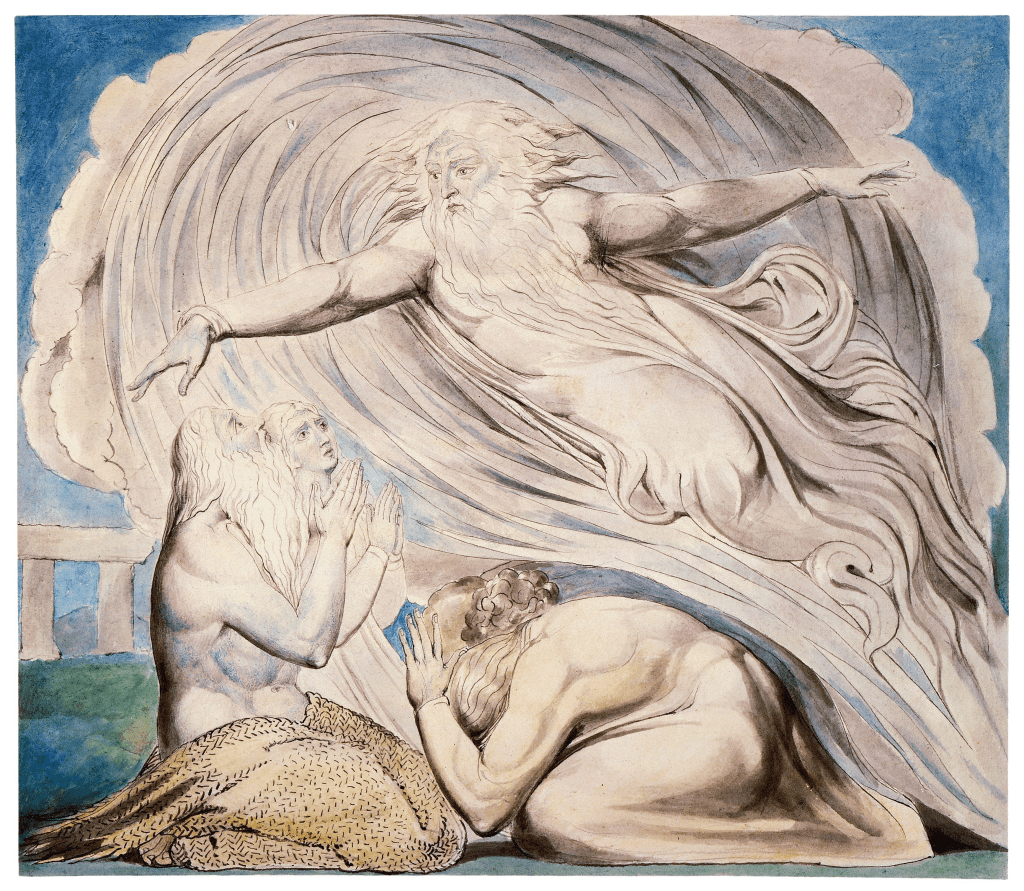
God Answers Job Out of the Whirlwind, by William Blake, 1826

“Have you entered the storehouses of the snow
    or seen the storehouses of the hail,
which I reserve for times of trouble,
    for days of war and battle?
What is the way to the place where the lightning is dispersed,
    or the place where the east winds are scattered over the earth?
Who cuts a channel for the torrents of rain,
    and a path for the thunderstorm,
to water a land where no one lives,
    an uninhabited desert,
to satisfy a desolate wasteland
    and make it sprout with grass?
Does the rain have a father?
    Who fathers the drops of dew?
From whose womb comes the ice?
    Who gives birth to the frost from the heavens
when the waters become hard as stone,
    when the surface of the deep is frozen?

“Can you bind the chains of the Pleiades?
    Can you loosen Orion’s belt?
Can you bring forth the constellations in their seasons
    or lead out the Bear with its cubs?
Do you know the laws of the heavens?
    Can you set up God’s dominion over the earth?

“Can you raise your voice to the clouds
    and cover yourself with a flood of water?
Do you send the lightning bolts on their way?
    Do they report to you, ‘Here we are’?
Who gives the ibis wisdom
    or gives the rooster understanding?
Who has the wisdom to count the clouds?
    Who can tip over the water jars of the heavens
when the dust becomes hard
    and the clods of earth stick together? (New International Version)

The older I get, and the more understanding I gain, the more I realize how little knowledge I truly possess.

When I was eighteen years old, I thought I had the world pretty much figured out. Since then, it’s all been downhill. With each passing year, my ignorance seems to grow. I suppose this all really makes some sense when talking about God’s upside-down kingdom.

There’s so much of life that is a mystery; and as we accumulate our life experiences, it seems all, not just some, of life is a mystical encounter. In other words, the more discernment I gain, I discover I know a lot less than I thought I did.

God Answers Job from the Whirlwind, by William Blake, c.1804

It seems as if the biblical character of Job found this out the hard way. If there is any person in Holy Scripture that would be wise and understanding, its him. God speaks highly of Job in the Bible.

Regarding the upcoming destruction of Jerusalem, God said, “even if these three men—Noah, Daniel and Job—were in it, they could save only themselves by their righteousness, declares the Sovereign Lord.” (Ezekiel 14:14)

Job is held up as the model of patience under suffering: “As you know, we count as blessed those who have persevered. You have heard of Job’s perseverance and have seen what the Lord finally brought about. The Lord is full of compassion and mercy.” (James 5:11)

Yet, with all of Job’s integrity, patience, and righteousness, his understanding barely moves the Richter Scale of God’s expansive knowledge.

We might be somewhat familiar with the story of Job. Being a conscientious follower of God, Job is careful to live uprightly. He acknowledges God in all things and worships him alone. Yet, suffering befell him – for no other reason than that God allowed it. Job knew fully well that there was no personal sin behind his awful ordeal of grief and grinding pain.

So, Job contended with God. For an agonizing thirty-five chapters (Job 3:1-37:24) Job questions God and respectfully takes him to task – as Job’s supposed friends questioned him and assume his guilt. Through it all God is there… silent… saying nothing.

The Desperation of Job, by William Blake, 1821

Then, just when we think God is paying no attention whatsoever, the Lord suddenly speaks.

And what is so remarkable about God’s speech is that for four chapters (Job 38:1-41:34) the Lord gives no answers. It’s all rhetorical questions. God said, “Brace yourself like a man; I will question you and you shall answer me.” (Job 38:3)

It becomes abundantly clear after just a few questions that it would be impossible for any human being to even come close to having the understanding God has. And that was the whole point.

God is God, and we are not. Our questions, however legitimate, real, and raw they are, come from a very puny perspective. Turns out, we just don’t know as much as we think we do.

To Job’s credit, he keeps his mouth shut and listens. At the end of the questioning, Job responds in the only wise way one could, after such an encounter: “Surely I spoke of things I did not understand, things too wonderful for me to know.” (Job 42:3)

None of this means that, for us, we need to face our hardships and our sufferings with a stoic keep-a-stiff-upper-lip approach. Trapped grief will inevitably come out sideways and only cause more hurt. I believe God allowed Job to express his terrible physical, emotional, and spiritual pain for chapter after chapter because he needed to.

Only when God sensed it was the proper timing did he jump in and bring the perspective Job then needed. And even after being challenged by God about his vantage point, Job still did not receive answers as to why he had to endure the awfulness of loss beyond what most of us could comprehend.

Maybe we lack being able to understand, even if God directly answered all our questions. Most likely, God protects us from knowing things that might bring irreparable damage to our human psyches. Again, this is all pure conjecture. Which leaves us with perhaps one of our greatest challenges as human beings:

We must eventually come to the place of being comfortable with mystery – and even embracing it. We simply will not have all things revealed to us that we want to know. And that’s okay.

There is yet one more comment to observe about God’s questioning of Job: God is sarcastic. Sarcasm often gets a bad rap, much like anger does, because it is so often associated with unacknowledged emotions and/or expressing our feelings in an unhelpful way.

Yet, there the sarcasm is, with the God of the universe. I take some odd comfort in knowing that God can be snarky at times – in a good way.

Anytime we try to pin God down to some tidy understandable categories, the Lord typically colors outside our human contrived lines and demonstrates to us that the divine cannot be contained in our ramshackle box.

I like it that God is playful, wild, and free to be God – even if there are times it may bug me.

God is unbound by any human knowledge, understanding, ideas, or plans. God will do what God will do. God will be who God will be. “I AM who I AM.” Now that’s a God I can put my trust in.

O Lamb of God that takes away the sins of the world, have mercy upon me.

O Lamb of God that takes away the sins of the world, have mercy upon me.

O Lamb of God that takes away the sins of the world, grant me your peace. Amen.

The Steadfast Love of God (Psalm 33:12-22)

Happy is the nation whose God is the Lord,
    the people whom he has chosen as his heritage.

The Lord looks down from heaven;
    he sees all humankind.
From where he sits enthroned he watches
    all the inhabitants of the earth—
he who fashions the hearts of them all
    and observes all their deeds.
A king is not saved by his great army;
    a warrior is not delivered by his great strength.
The war horse is a vain hope for victory,
    and by its great might, it cannot save.

Truly the eye of the Lord is on those who fear him,
    on those who hope in his steadfast love,
to deliver their soul from death
    and to keep them alive in famine.

Our soul waits for the Lord;
    he is our help and shield.
Our heart is glad in him
    because we trust in his holy name.
Let your steadfast love, O Lord, be upon us,
    even as we hope in you. (New Revised Standard Version)

God is in control of the world. I am not. Neither are you.

Although the myth of self-sufficiency and self-reliance completely permeates individualist societies, this in no way lessens the immense transcendence and sovereignty of a hugely big God.

In today’s psalm, the scene of God looking down from heaven portrays the Lord as above all, firmly in control, clearly seeing the big picture of the entire world. And yet, the Lord is also attentive to all that is happening on the earth.

Individual human creatures subscribing to a narrative of personal independence will inevitably run into the Creator God with a story as big as history itself.

Success may give us the illusion that our own strength, intelligence, and/or ingenuity has brought us the good things we possess – not God. “I worked hard for my money and I will do whatever I want with it!” and the even more crass, “It wasn’t God who put food on my table!” are just a few of the power delusions I have heard from others, as if personal accomplishments are unconnected to any other force in the universe.

What’s more, looking at individualism from the converse angle, our lack of success may cause us to pause and wonder if God is really observing all our deeds, or not. Perhaps the Lord is reclining in his La-z-God chair and watching old baseball game replays of the Angels.

More likely, we have become so expectant of satisfactory service and immediate results as consumers in a capitalist culture that we fail to discern the virtue of patience – that God is not slow in keeping divine promises as some would understand it.

The sheer fact of the matter is that we need God. And God feels no compulsion from us to be hurried along with divine purposes for humanity. Since God is the ever-present gravity in this world, the way of realizing the good life on this earth is to conform ourselves to the Lord’s purposes, and not the other way around.

When we learn to exercise the inherent gifts of hope and patience which a gracious God has fashioned in our hearts, then we begin to discover persevering trust, enduring happiness, a settled sense of gladness, and steadfast love. We awaken to the true passion of God for us. Rather than a capricious or indifferent deity, the Lord God looks upon us with endearing faithfulness.

God’s heart is forever drawn to us. Therefore, there’s no need to take every matter into our own hands, as if we are alone in the world. If we can see a vision of God high and lifted-up, observing us with a gaze of delight, then our spirits open to mercy and we find grace to help us in our time of need.

The Lord your God is in your midst—a warrior bringing victory. He will create calm with his love; he will rejoice over you with singing.

Zephaniah 3:17

God labors on our behalf. God has our back. God establishes a safe environment for us. And never forget: God delights in you. And so much so, that, this very minute, the Lord is singing songs of joy over you.

Trust and hope cannot be coerced by another or willed into being by the mind; it can only be generated through the deep conviction of God’s broad love for you and me.

The best self-help program I know of is not self-help at all – it is the self-care of opening to a loving God and allowing God’s joy and delight to fill us. God is watching us, and it is the gaze of adoration, not condemnation.

Dear God, the One who watches all, love comes from you. Anyone who loves is your child and knows you. And anyone who does not love does not know you, for God is love. Thank you for showing me love by sending your one and only Son into the world so that I might have eternal life through him. 

Precious Lord, since you loved me that much, I surely ought to love others. May you live in me and may the love of Jesus be brought to full expression in me through the power of the Spirit. Amen.

Change and Stress (Acts 27:1-12)

When it was decided that we would sail for Italy, Paul and some other prisoners were handed over to a centurion named Julius, who belonged to the Imperial Regiment. We boarded a ship from Adramyttium about to sail for ports along the coast of the province of Asia, and we put out to sea. Aristarchus, a Macedonian from Thessalonica, was with us.

The next day we landed at Sidon; and Julius, in kindness to Paul, allowed him to go to his friends so they might provide for his needs. From there we put out to sea again and passed to the lee of Cyprus because the winds were against us. When we had sailed across the open sea off the coast of Cilicia and Pamphylia, we landed at Myra in Lycia. There the centurion found an Alexandrian ship sailing for Italy and put us on board. We made slow headway for many days and had difficulty arriving off Cnidus. When the wind did not allow us to hold our course, we sailed to the lee of Crete, opposite Salmone. We moved along the coast with difficulty and came to a place called Fair Havens, near the town of Lasea.

Much time had been lost, and sailing had already become dangerous because by now it was after the Day of Atonement. So Paul warned them, “Men, I can see that our voyage is going to be disastrous and bring great loss to ship and cargo, and to our own lives also.” But the centurion, instead of listening to what Paul said, followed the advice of the pilot and of the owner of the ship. Since the harbor was unsuitable to winter in, the majority decided that we should sail on, hoping to reach Phoenix and winter there. This was a harbor in Crete, facing both southwest and northwest. (New International Version)

Change is an emotionally charged word. For some, change is longed for. Those with adverse circumstances and difficult situations may look for change, and even for a miracle to turn their life around. Others want nothing to do with change; they’ve had a bad experience with it. Their fortunes were good, until something changed. And now they’re stressed out.

The majority of us have some sort of love/hate relationship with change – which is why there are people who look askance on Christianity and raise their eyebrow in skepticism toward Christians or religious folk in general. At the heart of Christianity is change, and change can be quite threatening toward a lot of people.

The Apostle Paul perhaps knew about change better than any Christian in history. He went from resisting change with violence, to embracing change so wholeheartedly that he became a victim of other’s violence. We meet him in today’s New Testament lesson as a prisoner being shipped from Palestine to Rome.

Paul’s message, at its core, is the good news of transformation because of Christ’ crucifixion and resurrection. It’s a message of radical and joyous change, of new life. And it’s also a scandalous message which impacts the surrounding culture.

Wherever the gospel of Jesus Christ went, people responded, and it influenced society to a significant degree. Throughout the Acts of the Apostles, political authorities, religious leaders, and cultural elites felt powerful shifts in their societies. Yes, a few became Christians themselves, but most resisted the change, and in some cases, in their irritated stress response, retaliated against believers.

The message of Christianity doesn’t yield to political forces that attempt to domesticate God; and that reality put many believers in the crosshairs of those forces.

Paul’s ability to keep up his witness to Christ, even while held prisoner under powerful Roman authority, comes from a theology that God is above all earthly rule and can make a way where there seems to be no way. In other words, no matter whether human institutions, empires, and structures either acquiesce or oppose the gospel makes no difference; God is able to bend any system and authority for divine purposes.

And this is precisely why the Apostle Paul appears calm, non-anxious, and able to encourage others in the center of a storm in which everyone might lose their lives. Put simply: Paul trusted God.

Yes, we have unwanted circumstances. Yet, if we are able to entrust ourselves to a good God (which may sound trite and easy, yet is anything but that) then we find that we’re also able to have a radical acceptance of the situation we’re presently in.

Faith and trust help us to accept difficult changes and respond to stress with resilience because faith is attentive to the following:

  • Knowing change is coming. Throughout the New Testament we are told that adversity and suffering are an integral part of the Christian life. Paul wasn’t caught by surprise with a storm. In his life, he expected the difficulties to come.

You have seen me experience physical abuse and ordeals in places such as Antioch, Iconium, and Lystra. I put up with all sorts of abuse, and the Lord rescued me from it all! In fact, anyone who wants to live a holy life in Christ Jesus will be harassed. (2 Timothy 3:11-12, CEB)

  • Paying attention to the feelings of self and others. Emotions are not a necessary evil. They play a very important role in helping us come to grips with what’s happening. Paul acknowledged the emotions of everyone on the ship, as well as his own. And this became the pathway to both acceptance and encouragement.

There’s a season for everything
    and a time for every matter under the heavens

a time for crying and a time for laughing,
    a time for mourning and a time for dancing. (Ecclesiastes 3:1, 4, CEB)

  • Becoming resilient. The ability to adapt, to find ways of surviving and thriving, is buoyed by a robust faith which can see with spiritual eyes and make decisions of faith, hope, and love.

“When I was born into this world,
    I was naked and had nothing.
When I die and leave this world,
    I will be naked and have nothing.
The Lord gives,
    and the Lord takes away.
Praise the name of the Lord!” (Job 1:21, ERV)

Stress and change can be hard and overwhelming. Yet, at the same time, it can be an opportunity to put faith into practice and be a blessing to the world.

Assist us, Lord, in living hopefully into the future. In the face of change, help us to set unnecessary fears aside and to recognize our potential for creative response. Help us to develop a reasonable optimism and to guard against our own defensiveness. Be with us as we remember and celebrate former times, and keep us from unreasonable yearning for them, which takes us from the work you have set before us in our time. All this we ask in the name of your Son, our Savior, Jesus Christ. Amen.