See the Big Picture (Genesis 41:37-57)

The proposal pleased Pharaoh and all his servants. Pharaoh said to his servants, “Can we find anyone else like this, one in whom is the spirit of God?” So Pharaoh said to Joseph, “Since God has shown you all this, there is no one so discerning and wise as you. You shall be over my house, and all my people shall order themselves as you command; only with regard to the throne will I be greater than you.” And Pharaoh said to Joseph, “See, I have set you over all the land of Egypt.” 

Removing his signet ring from his hand, Pharaoh put it on Joseph’s hand; he arrayed him in garments of fine linen and put a gold chain around his neck. He had him ride in the chariot of his second-in-command, and they cried out in front of him, “Bow the knee!” Thus he set him over all the land of Egypt. 

Moreover, Pharaoh said to Joseph, “I am Pharaoh, and without your consent no one shall lift up hand or foot in all the land of Egypt.” Pharaoh gave Joseph the name Zaphenath-paneah, and he gave him Asenath daughter of Potiphera, priest of On, as his wife. Thus Joseph gained authority over the land of Egypt.

Joseph was thirty years old when he entered the service of Pharaoh king of Egypt. And Joseph went out from the presence of Pharaoh and went through all the land of Egypt. During the seven plenteous years the earth produced abundantly. He gathered up all the food of the seven years when there was plenty in the land of Egypt and stored up food in the cities; he stored up in every city the food from the fields around it. So Joseph stored up grain in such abundance—like the sand of the sea—that he stopped measuring it; it was beyond measure.

Before the years of famine came, Joseph had two sons, whom Asenath daughter of Potiphera, priest of On, bore to him. Joseph named the firstborn Manasseh, “For,” he said, “God has made me forget all my hardship and all my father’s house.” The second he named Ephraim, “For God has made me fruitful in the land of my misfortunes.”

The seven years of plenty that prevailed in the land of Egypt came to an end, and the seven years of famine began to come, just as Joseph had said. There was famine in every country, but throughout the land of Egypt there was bread. 

When all the land of Egypt was famished, the people cried to Pharaoh for bread. Pharaoh said to all the Egyptians, “Go to Joseph; what he says to you, do.” And since the famine had spread over all the land, Joseph opened all the storehouses and sold to the Egyptians, for the famine was severe in the land of Egypt. 

Moreover, all the world came to Joseph in Egypt to buy grain, because the famine became severe throughout the world. (New Revised Standard Version)

Mosaic of Joseph overseeing the gathering of grain during the seven years of plenty, c.1275 C.E., St. Mark’s Basilica, Venice, Italy

It’s easy to get lost and miss the forest for the trees; we may become too involved in the details of a problem to look at the situation as a whole. Whenever we are in the middle of hard times, it can be difficult to see the big picture of what’s really going on.

Joseph had been in a peck of trouble. He literally found himself deep in trouble by being tossed into a dark hole of a well by his jealous brothers. Then, the same brothers turned around and pulled him up, only to sell him in slavery to a caravan heading for Egypt. (Genesis 37)

While in Egypt, Joseph became the head servant in the household of Potiphar, the captain of the guard for Pharaoh. But again, trouble found Joseph, even though the guy was diligent and squeaky clean in his moral living. Mrs. Potiphar had eyes for Joseph – who did not reciprocate her advances. There’s no wrath quite like a woman’s scorn, and off to jail Joseph went. (Genesis 39)

In prison Joseph waited… and waited. It seemed as though he had been forgotten. And although he had come to be in charge of his fellow inmates because the jail keeper trusted him so much, Joseph was still in the place of bondage. (Genesis 40) So, what would you do if you were in similar circumstances?

Blame others. Bellyache. Bully your way around with a chip on your shoulder. Become bitter about the ways you’ve been shafted and the brunt of injustice. Those are things that many of us might do in the throes of one injustice after another. But not Joseph.

Holy Scripture has no record of Joseph responding with complaint nor discouragement. Joseph seemed to have a sense that there were larger forces at work behind the scenes – that God could be trusted to work out the adverse situations for divine purposes.

So, when Joseph went from the bottom slug in a prison to the top dog in Egypt, the big picture became much more clear. From age 17 to age 30, Joseph labored as the right hand servant in charge of Potiphar’s household, and then as the right hand man to the jail keeper in prison. Now, Joseph becomes the right hand to Pharaoh, the administrator over all of Egypt.

All along, the Lord was getting Joseph ready for something supremely large – life and death sort of stuff. It turns out that, with Joseph in charge, tens of thousands of lives may have been spared because of his insight, foresight, and hindsight.

Joseph had divine insight as an interpreter of dreams – a gift which he acknowledged was given to him by God. He had the foresight and wisdom to take that insight and turn it into a solid administrative plan for saving many lives from a terrible famine. And Joseph continually had the benefit of hindsight in knowing who he was and where he came from – believing that he was part of a specially called family whom the Lord had a divine hand upon.

Every experience, each event, and the myriad mundane tasks which Joseph had to endure for 13 long years were like individual bricks being mortared together into a building which would eventually house enough life-learning to accomplish a life-saving governmental administration which kept food on the table for thousands of people.

Perhaps you and I don’t always get to see what’s going on above us, what is truly being worked out to bring help and justice to the world. Yet, we can rest assure that there is a God in heaven who sees, cares, and is planning salvation for people. And we are part of that large divine plan, if we have the faith to understand there is more going on than our present circumstances and physical eyes can see.

Righteous God and Father of all: Raise up among us people who keep faith alive, hope awakened, and love abundant. Guard our daily vocations and set them apart for your good purposes. Grant us the privilege of seeing our daily work accomplish the saving and blessing of many lives. Renew us in your mercy, sanctify us with your Spirit, and redeem our time so that we may serve you and steward well our lives, through Jesus Christ our Lord. Amen.

On the Lam(b) (Genesis 31:1-21)

Jacob Flees Laban, illustration from Bible Pictures and What They Teach Us, by Charles Foster, 1897

Jacob heard that Laban’s sons were complaining, “Jacob is now a rich man, and he got everything he owns from our father.” Jacob also noticed that Laban was not as friendly as he had been before. One day the Lord said, “Jacob, go back to your relatives in the land of your ancestors, and I will be with you.”

Jacob sent for Rachel and Leah to meet him in the pasture where he kept his sheep, and he told them:

“Your father isn’t as friendly with me as he used to be, but the God my ancestors worshiped has been on my side. You know that I have worked hard for your father and that he keeps cheating me by changing my wages time after time. But God has protected me. When your father said the speckled sheep would be my wages, all of them were speckled. And when he said the spotted ones would be mine, all of them were spotted. That’s how God has taken sheep and goats from your father and given them to me.

Once, when the flocks were mating, I dreamed that all the rams were either spotted or speckled. Then God’s angel called me by name. I answered, and he said, “Notice that all the rams are either spotted or speckled. I know everything Laban is doing to you, and I am the God you worshiped at Bethel, when you poured olive oil on a rock and made a promise to me. Leave here at once and return to the land where you were born.”

Rachel and Leah said to Jacob:

There’s nothing left for us to inherit from our father. He treats us like foreigners and has even cheated us out of the bride price that should have been ours. So do whatever God tells you to do. Even the property God took from our father and gave to you really belongs to us and our children.

Then Jacob, his wives, and his children got on camels and left northern Syria for the home of his father Isaac in Canaan. Jacob took along all his flocks, herds, and other property.

Before Rachel left, she stole the household idols while Laban was out shearing his sheep.

Jacob tricked Laban the Aramean by not saying that he intended to leave. When Jacob crossed the Euphrates River and headed for the hill country of Gilead, he took with him everything he owned. (Contemporary English Version)

Moving and changing are a part of life. Change and movement are built into all creation, from the seasons of the year to our physical bodies over time. Some changes and moves we deem as good, and others, not so much. Yet, whether good or bad, any switch or shift in life can be difficult to cope with.

Whatever the circumstance, God stands behind everything, working out good and divine purposes. There are times and seasons in our lives where we can get lost in our own stories. Ultimately, however, our transitions from one place to another are really about our individual stories fitting into the larger story of God.

Whenever we are unable to see how our own story and the story of God fit together, it’s an opportunity to exercise faith and trust in God. Listening to God, and responding to God’s call to move and change, will at times be difficult, due to the uncertainty of our future.

Jacob Urges Leah and Rachel to Flee from Laban, by Pieter Symonsz Potter, 1638

In today’s Old Testament lesson, Jacob has served his father-in-law Laban for twenty years. Now, he hears the call of God to move – and that move is both good and fraught with anxiety. Jacob and his family are on the lam, literally moving their lambs and sheep and everything they own to avoid pursuit and confrontation.

The principal actor and center of the story is not Jacob, but God. The narrative is primarily about God, with Jacob as the supporting actor in the story.

God was watching over and protecting Jacob. The Lord was following through on a promise of land and descendants given to Jacob’s grandfather, Abraham – to make him into a great nation so that all people-groups on earth would be blessed. 

So then, the story of Jacob is merely one piece in the grand unfolding drama of God’s redemption. This drama would eventually and ultimately find its fulfillment in the person and work of Jesus.

Jacob had in-law issues. His relationship with his father-in-law had always been tenuous, and was morphing into trouble. Laban’s attitude had changed toward his son-in-law, probably due to Jacob’s increasing wealth, and Laban’s decreasing assets.

So, God showed up and told Jacob to return to the land of his fathers. Along with the call to make a change came a promise of God’s continued presence with Jacob. The grace given to Abraham when calling him out of Ur was renewed with more grace when calling Jacob back to the land of his father and grandfather.  It is in God’s nature to be gracious and to heap grace upon grace.

Jacob heeded call of the Lord and began laying plans to move back to Canaan. But how to tell his family about this? What are his wives going to say? After all, he’s talking about moving away with teenagers still in the tent.

With some anxiety, Jacob called his wives, Rachel and Leah, out to the fields to talk. Jacob laid out the story of himself and Laban, which he framed more as a contrasting story between God and Laban:

  • Laban’s attitude changed, whereas God’s attitude does not change. God is not fickle.
  • Laban was unreliable, reneging on promises, but God is reliable and trustworthy, keeping divine promises.
  • Laban kept changing his mind, yet God stays the same, yesterday, today, and forever.
  • Laban saw only self-interest; however God sees everyone and shows solidarity with the oppressed.

This same God is concerned for us and will not renege on promises. God is providentially working out a good  agenda and concern for this earth, and we can bank on it.

The response from Jacob and Rachel to Laban was some tricky thievery. Jacob stealthily took his family and ran away from the situation. Rachel straight up stole Laban’s household gods.

(Note: Old Testament narratives do not usually tell us whether something is bad or good but instead allows the story to unfold and speak for itself so that we can see the ethics working out). 

Jacob and Rachel had a less than stellar response to God’s grace. We do not know exactly what the household gods are, or why Rachel stole them. What we do know is that there was a bit of pagan practice mixed in with worship of the one, true God.

Our circumstances will forever be changing, and God may ask us to move and go do something somewhere else. Yet, no matter the situation, and how different our surroundings may become, God does not change, and is here with us; and, at the same time, is continually moving to accomplish good purposes.

Loving God, you have made the whole of human life in your image; each one of us shaped in love. Your goodness is ever-present within us all. Yet, there is so much evil and pain in our world; it comes at us from every direction.

Teach us how to rediscover your love within us and to use that love as a force for good. Help us to turn our hearts toward the world in hope, praying for each other and regarding each other as a treasure, so that we might be the light which darkness can never overcome, through Jesus Christ our Lord. Amen.

A Divine Appointment (Genesis 29:1-14)

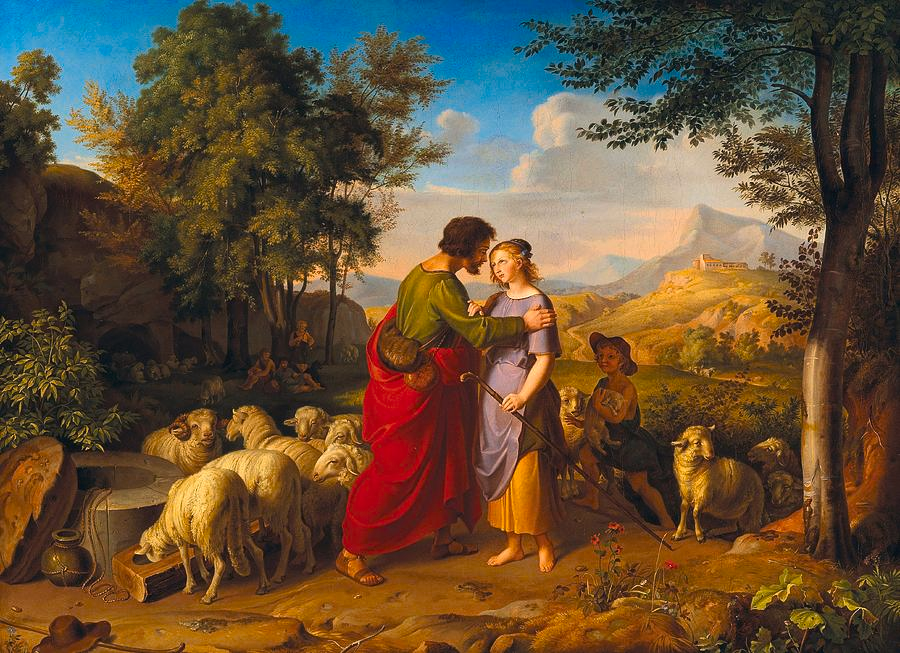
Jacob and Rachel at the well, by Friedrich Wilhelm Müller (Kirchditmold 1801–1889)

Then Jacob continued on his journey and came to the land of the eastern peoples. There he saw a well in the open country, with three flocks of sheep lying near it because the flocks were watered from that well. The stone over the mouth of the well was large. When all the flocks were gathered there, the shepherds would roll the stone away from the well’s mouth and water the sheep. Then they would return the stone to its place over the mouth of the well.

Jacob asked the shepherds, “My brothers, where are you from?”

“We’re from Harran,” they replied.

He said to them, “Do you know Laban, Nahor’s grandson?”

“Yes, we know him,” they answered.

Then Jacob asked them, “Is he well?”

“Yes, he is,” they said, “and here comes his daughter Rachel with the sheep.”

“Look,” he said, “the sun is still high; it is not time for the flocks to be gathered. Water the sheep and take them back to pasture.”

“We can’t,” they replied, “until all the flocks are gathered and the stone has been rolled away from the mouth of the well. Then we will water the sheep.”

While he was still talking with them, Rachel came with her father’s sheep, for she was a shepherd. When Jacob saw Rachel daughter of his uncle Laban, and Laban’s sheep, he went over and rolled the stone away from the mouth of the well and watered his uncle’s sheep. Then Jacob kissed Rachel and began to weep aloud. He had told Rachel that he was a relative of her father and a son of Rebekah. So she ran and told her father.

As soon as Laban heard the news about Jacob, his sister’s son, he hurried to meet him. He embraced him and kissed him and brought him to his home, and there Jacob told him all these things. Then Laban said to him, “You are my own flesh and blood.” (New International Version)

Jacob meets Rachel at the well, by Paolo Fiammingo, c.1585

Jacob was a homebody. Unlike his twin brother Esau, who loved the outdoors and was often away hunting, Jacob preferred to hang around home with his mother – which is probably why Rebekah preferred him over his brother. It’s also why the two of them succeeded in a plan to deceive Isaac and steal the family blessing from Esau.

In Esau’s bitterness over not being blessed by his father, he began laying plans of his own: to kill his brother Jacob in revenge. This came to the attention of Rebekah, who then warned Jacob to flee to her family of origin in Paddan-Aram.

The boy who was attached to his mother and stayed at home, was now a man on the run, in need of a new life. Jacob was alone. One can only imagine the fear and apprehension, the grief and loneliness, of being on his own in a strange place. But God was with him. And the Lord graciously assured Jacob of the divine presence and promises.

Since God was with Jacob and was going to accomplish divine purposes through him, the Lord set up a divine appointment.

Upon arriving at a well, Jacob discovers some shepherds who know his uncle. And then, along comes Rachel with a flock of sheep. God’s providential guidance is evident in leading both Jacob and Rachel to this place and for this time.

Jacob’s mother, Rebekah, was the brother of Laban and the father of Rachel. In the lives of both Rebekah and her son Jacob, Laban ran out to greet and be involved in the divine appointments. (Genesis 24) The narratives differ, however, in that Abraham’s servant had wealth to share in bringing Isaac and Rebekah together; yet Jacob showed up without two pennies to rub together.

And whereas, on both occasions a future bride comes to a well, Rebekah and Rachel differ greatly in their betrothal times. Rebekah’s marriage was quickly arranged; Rachel’s marriage is uncertain and everything is nebulous on how things will shake out with Jacob.

The divine appointment has happened. God’s protection, presence, and guidance are with Jacob. Yet, at this point in the narrative, everything seems up in the air. Will Jacob marry Rachel? Are there going to be numerous descendants? How in the world is Jacob going to return to the land which was promised?

Though this initial foray into the unknown has had a divine stamp on it, Jacob will soon discover that there are many obstacles to negotiate before the promises of God are fulfilled.

And that is the way of us all. Sometimes things come easy and effortless. At other times, it’s a hard slog. In the scope of a life, there are extended seasons of tedious and mundane work – punctuated with times of amazement, even miracle, letting us know there is a God still watching.

You never quite know what’s around the corner of your life – whether good or bad. Yet, the real issue is trust.

The thing about divine appointments is that God is the sovereign ruler of the universe – which means that everything is in the Lord’s hands. All of life, and all events, are providentially bent for divine purposes. Both good and trouble are appointed.

If we believe the Lord is good, right, and just – all the time and that there is never a time when God is bad or capricious – then we are able to accept all circumstances as being from the hand of God. We will trust, even though we don’t know what’s coming next.

The Apostle Paul had it right by saying that “every detail in our lives of love for God is worked into something good.” (Romans 8:28, MSG)

What would your life look like by adopting this perspective God and all events you encounter?

Gracious God, you alone know what my real needs are. You love me more than I myself know how to love. Help me to see my real needs which are hidden from me. I am afraid to ask for either a cross or consolation, so I wait on you; my heart is open to you. Visit me and help me for the sake of your great mercy. Strike me and heal me, cast me down and raise me up, according to your good will. I put all my trust in you. Amen.

Never a Dull Moment (Acts 28:1-10)

Miracle of St. Paul on the Island of Malta, by David Teniers, c.1620

Once safely on shore, we found out that the island was called Malta. The islanders showed us unusual kindness. They built a fire and welcomed us all because it was raining and cold. Paul gathered a pile of brushwood and, as he put it on the fire, a viper, driven out by the heat, fastened itself on his hand. When the islanders saw the snake hanging from his hand, they said to each other, “This man must be a murderer; for though he escaped from the sea, the goddess Justice has not allowed him to live.” But Paul shook the snake off into the fire and suffered no ill effects. The people expected him to swell up or suddenly fall dead; but after waiting a long time and seeing nothing unusual happen to him, they changed their minds and said he was a god.

There was an estate nearby that belonged to Publius, the chief official of the island. He welcomed us to his home and showed us generous hospitality for three days. His father was sick in bed, suffering from fever and dysentery. Paul went in to see him and, after prayer, placed his hands on him and healed him. When this had happened, the rest of the sick on the island came and were cured. They honored us in many ways; and when we were ready to sail, they furnished us with the supplies we needed. (New International Version)

There never seemed to be a dull moment in the life of the Apostle Paul. Throughout his life, he experienced all sorts of extreme circumstances, having survived as if he had the nine lives of a cat.

Once, when in the town of Lystra, Paul had such an impact on the people through his gift of healing, that the crowd believed he must be one of the gods; and they tried to worship him. But when Paul resisted, and a rival group from another town came along and turned the crowd, Paul was stoned and left for dead by the very people who tried to venerate him. (Acts 14:8-20)

So, it’s almost as if today’s New Testament lesson was just another day at the office for the Apostle Paul. After a suspenseful sea voyage, and then the wreck of a Roman prison ship, the drama of Paul’s life just kept going.

One minute, the people on the island in which Paul was shipwrecked were convinced that he’s a murderer, and the next minute they’re ready to assign him as a god. Nobody I’ve ever known can elicit such opposite reactions in such a short period of time – more than once. But that’s our Apostle Paul for you.

Circumstances are circumstances. But the way in which we interpret them is another thing. Take, for instance, the word “change.” For some, change is a wonderful word which brings thoughts of healing and hope. For others, change is a dirty word to be resisted, conjuring up feelings of fear and anxiety.

For one group, never-a-dull-moment is exciting and adventurous. For another group, never-a-dull-moment is nerve wracking and to be avoided at all costs.

Opposite reactions of a group of people comes from the different perspectives of change they see. It isn’t helpful to talk about who is right and who is wrong; the real trick is in how we choose to look at a thing.

I had only one grandparent when I was growing up. My Grandma was seventy-nine years old when I was born, and she lived to be ninety-seven. Even though I always knew her as an old lady, she had a lot of spunk in all ninety-five pounds of her. 

She had an old wooden cutting board in her kitchen. I’m not sure how old it was, but it was likely purchased from Methuselah’s Kitchen Outlet. It was cracked and falling apart. The board had deep furrows in it from the thousands of cuts made on it. Grandma liked her cutting board.

For Mother’s Day one year, my Dad bought her a nice brand new cutting board. And what did my Grandma do?  She put the new board in the back of her cupboard and continued using her nasty old cutting board. 

Whenever my Mom or sisters were in her house and helped her in the kitchen, they were not about to touch that old board; the thing was a bacteria trap. But Grandma didn’t care about bacteria or that it was falling apart. 

My Dad asked her why she did not use her new cutting board. She simply answered, “Oh, it’s much too nice to use.” But we all knew that was Grandma’s way of saying that she liked her nasty old cutting board, didn’t think it was all that bad, and wasn’t getting rid of it.

It seems we all have a bit of Grandma in us, bless her stubborn old heart. We like the way they do things, and really don’t see what another person sees. We don’t see that no one else has an emotional attachment to our cutting board. Sometimes we don’t realize how overwhelming and even intimidating our ways can be for someone else. 

Just imagine being in a new place with people you don’t know. Are you nervous? Does it help to have someone you know bring you and introduce you to people? Is it beneficial to have someone let you know what is happening and what is going on? 

Many years ago, I remember walking into a beautiful new church building, sitting down, and seeing a huge old pulpit that was literally falling apart. Since I’ve been around a lot of churches, I quickly discerned it was likely the old pulpit from the old church building. And, I discovered, it was. But, honestly, I had zero emotional attachment to that pulpit, and it was a distraction because it just looked like a big old ratty collar on a new puppy.

The point is thisOur view of change – whether to do it, or not, to embrace or resist – must be motivated by a solid set of values and a worthy purpose.

Paul put up with a lot, experienced a lot, and never had a dull moment. And he did it without bellyaching. That’s because he was continually focused on his ultimate purpose and values.

Our purpose, like Paul’s, is the Great Commission, to make disciples. (Matthew 28:18-20)

Our values, likewise, are the Great Commandment, to love God and neighbor. (Matthew 22:36-40)

Since our purpose is disciple-making, then we are always to make decisions based upon that standard. Since our values are loving others, then we always know how to go about our purpose.

If any faith community is helping people grow spiritually, then there is no need to change. But if a Christian community has not seen a person come to faith in Christ in the last year, that’s a significant reason to change. If a church has not seen anyone come to Christ in the last five years, then that church is eating meat prepared on a cutting board full of bacteria, and it’s making everyone sick.

Have we taken the old cutting board for granted, and just expect other people to use it if they are in our kitchen? Or do we have a vision, a motivation, and a driving desire to see all sorts of people find new life in Jesus Christ? 

If you don’t like empty seats, or the way things are, then the biblical solution is to change – specifically to change practices, speech, and daily behavior to reach others with the good news of grace. Change, or the lack thereof, for any other reason, is a bad reason to change.

Just so you know, after about a year of sitting in my Grandma’s cupboard, my Dad took out the new cutting board, put it on the kitchen counter and threw away the old board. 

It was about time. Never a dull moment with Grandma around.

Gracious God, we thank you that in love and mercy, you reached out to us. When we were dead in our sins, you sent Jesus to die in our place. Thank you that he humbled himself, even to death on a cross. And thank you that you have a heart that seeks the lost. 

Merciful Lord, please give us hearts that care for people in darkness. Teach us to care for them as you do. Thank you for including us in the mission of reaching other people for your name. Grow us to care for humanity, for the people who haven’t yet come to know and trust in you. Amen.