The Redeemed and Responsive Soul (Psalm 107:1-7, 33-37)

O give thanks to the Lord, for he is good,
    for his steadfast love endures forever.
Let the redeemed of the Lord say so,
    those he redeemed from trouble
and gathered in from the lands,
    from the east and from the west,
    from the north and from the south.

Some wandered in desert wastes,
    finding no way to an inhabited town;
hungry and thirsty,
    their soul fainted within them.
Then they cried to the Lord in their trouble,
    and he delivered them from their distress;
he led them by a straight way,
    until they reached an inhabited town…

He turns rivers into a desert,
    springs of water into thirsty ground,
a fruitful land into a salty waste,
    because of the wickedness of its inhabitants.
He turns a desert into pools of water,
    a parched land into springs of water.
And there he lets the hungry live,
    and they establish a town to live in;
they sow fields and plant vineyards
    and get a fruitful yield. (New Revised Standard Version)

The responsive spirit

A soul full of spiritual abundance responds freely and organically to God with offerings of gratitude for divine rescue and redemption.

The spiritually responsive person is at peace, content, and able to love with a sensitivity to God because they have had their needs for safety, satisfaction, and relational connection fulfilled. So, as a result, they are able to:

  • worship joyfully and praise God
  • speak words of thanksgiving
  • be attentive to self-care and personal well-being
  • use their resources wisely, feeling capable and confident of making good decisions that bless both the church and the world
  • know they are secure in the loving hands of God

The reactive spirit

Conversely, a soul that is empty from spiritual deprivation reacts predictably and robotically to others with frustration and fear.

The spiritually reactive person seems perpetually upset and in chronic emotional pain, feeling rattled and worried most of the time. They do not reflexively look to the Lord. Their needs for safety, satisfaction, and relational connection have not been met. So, as a result, they are:

  • hypervigilant, on the lookout for the bad, which they are convinced is coming
  • focused narrowly with tunnel vision, having lost sight of the big picture
  • prone to overgeneralizing their negative experiences as being the only experiences they ever have
  • searching for continual stimulation, just to seem alive and feel something
  • insecure, wanting constant validation from others because they cannot give themselves any encouragement

So, what do you do when always feeling between a rock and a hard place, experiencing racing thoughts, being anxious more than not, feeling like an abandoned town in the Old West with nothing but tumbleweed moving down the street?

A redeemed soul

In your desperation, call out to God. The Lord can:

  • get you out in the nick of time and deliver you soul from trouble so that you can be grateful for divine love
  • put your feet walking on a wonderful road of grace that leads to a good place of transformation
  • meet your needs for freedom, contentment, and loving relational networks, so that your spirit is full of right relationships, purity, mercy, and peace

You can once again, or maybe for the first time, feel like:

  • A flowing river, instead of sunbaked mud
  • A fruitful orchard, instead of dry dead tree
  • A farmer with much grain and many animals, instead of a homeless person sitting on a pile of dung
  • A person loved and valued by God, instead of a waste of space, breathing air that others could have
  • A sheep who knows the shepherd is watching over them, instead of an insect that everyone steps on

Keep in mind, that the experience of blessing, the encounter of abundance, and the feeling of peace, is not like a simple math equation – as if God were a divine genie that you happened to find and got three wishes.

Rather, the fulfilling spiritual life involves a persistent faith, confident hope, and constant love. These come from God, and are accessed through humility. The proud person will not realize a life of faith, hope, and love, because they believe they already know what is best.

The humble admit their ignorance, their failings, their shame, their guilt, and their desperation.

Approaching God with humility doesn’t mean to heap deprecation and curses on oneself. It just means to be honest with where you are spiritually, emotionally, mentally, and physically. And to cry out for help, knowing you have nothing to offer in return.

In God’s economy, the currency is grace – and not some give-and-take, I’ll-scratch-your-back-if-you-scratch-mine sort of mentality. God’s steadfast love endures forever. God’s kingdom spins on the axis of grace.

The Lord is not a reactive God but a responsive God. The Lord responded to Israel’s cry for deliverance not just with food and drink, but with a city. God did not only meet the immediate needs of the ancient Israelites, for whom the psalmist is one, along with the original recipients; the Lord took care of their larger, long term needs. 

The people needed a place where they could settle down, raise their own crops and tend their own livestock, and have a dependable means of making a living. God satisfied this, and more, by giving them a city where they could settle, be safe, secure, and content.

God can do anything, you know—far more than you could ever imagine or guess or request in your wildest dreams. God does it not by pushing us around, but by working within us, the Spirit deeply and gently providing us with our deepest and greatest needs.

Blessed heavenly Father, you have filled the world with divine beauty: Open our eyes to behold your gracious hand in everything you have done, so that, rejoicing in all your creation, we may learn to serve you with gladness; for the sake of him through whom all things were made, your Son Jesus Christ, our Lord, who with you and the Holy Spirit are one God, now and forever. Amen.

Encountering God (Exodus 19:9-25)

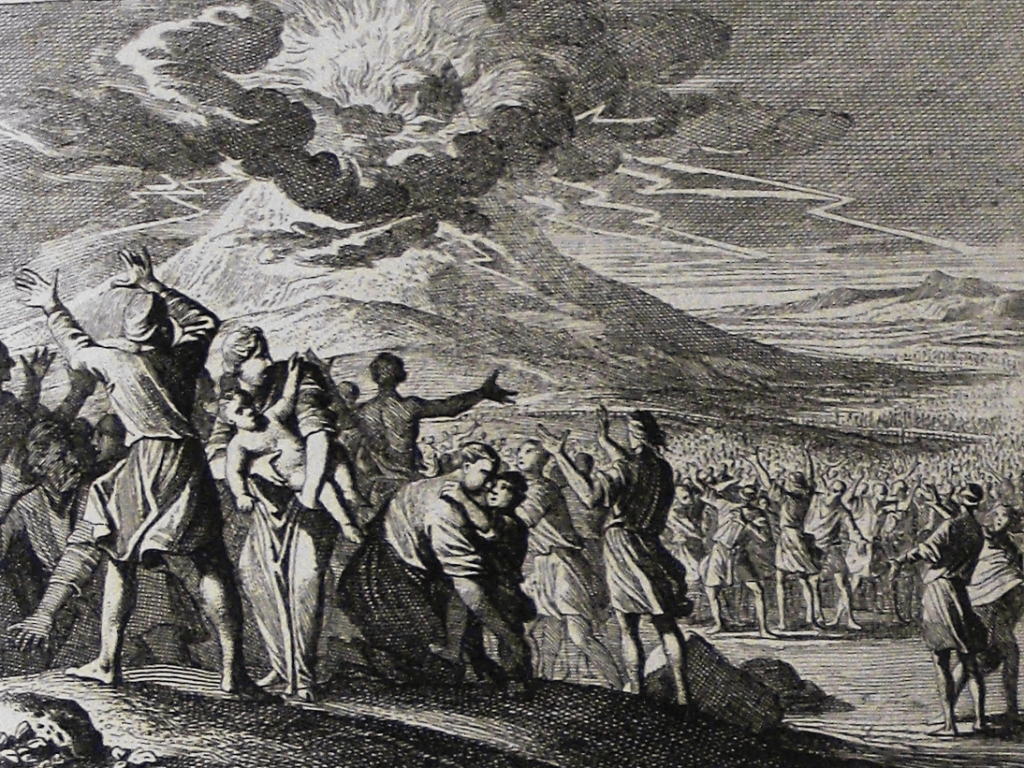
Israel at Mount Sinai, by Jan Luijken (1649–1712)

Then the Lord said to Moses, “I will come to you in a thick cloud, Moses, so the people themselves can hear me when I speak with you. Then they will always trust you.”

Moses told the Lord what the people had said. Then the Lord told Moses, “Go down and prepare the people for my arrival. Consecrate them today and tomorrow, and have them wash their clothing. Be sure they are ready on the third day, for on that day the Lord will come down on Mount Sinai as all the people watch. Mark off a boundary all around the mountain. Warn the people, ‘Be careful! Do not go up on the mountain or even touch its boundaries. Anyone who touches the mountain will certainly be put to death. No hand may touch the person or animal that crosses the boundary; instead, stone them or shoot them with arrows. They must be put to death.’ However, when the ram’s horn sounds a long blast, then the people may go up on the mountain.”

So Moses went down to the people. He consecrated them for worship, and they washed their clothes. He told them, “Get ready for the third day, and until then abstain from having sexual intercourse.”

On the morning of the third day, thunder roared and lightning flashed, and a dense cloud came down on the mountain. There was a long, loud blast from a ram’s horn, and all the people trembled. Moses led them out from the camp to meet with God, and they stood at the foot of the mountain. All of Mount Sinai was covered with smoke because the Lord had descended on it in the form of fire. The smoke billowed into the sky like smoke from a brick kiln, and the whole mountain shook violently. As the blast of the ram’s horn grew louder and louder, Moses spoke, and God thundered his reply. The Lord came down on the top of Mount Sinai and called Moses to the top of the mountain. So Moses climbed the mountain.

Then the Lord told Moses, “Go back down and warn the people not to break through the boundaries to see the Lord, or they will die. Even the priests who regularly come near to the Lord must purify themselves so that the Lord does not break out and destroy them.”

“But Lord,” Moses protested, “the people cannot come up to Mount Sinai. You already warned us. You told me, ‘Mark off a boundary all around the mountain to set it apart as holy.’”

But the Lord said, “Go down and bring Aaron back up with you. In the meantime, do not let the priests or the people break through to approach the Lord, or he will break out and destroy them.”

So Moses went down to the people and told them what the Lord had said. (New Living Translation)

Moses receives the Ten Commandments, by Caspar Luijken (1672-1708)

There’s a lot of drama surrounding today’s Old Testament story. That’s because it’s a big deal when an announcement comes that God is about to show up, speak to the people, and be with them. This is definitely not the stuff of daily mundane life.

The Mount Sinai event is one of the most remembered and talked about events in the Old Testament. This encounter establishes that the presence of the Lord is with Moses, thereby giving him authority over the people. It authenticates the leadership of Moses up to this point – in leading the people out of Egyptian slavery and to the Promised Land.

The presence of God with the people, demonstrated in Moses the leader, assures the Israelites of protection against dangers from other nations and peoples. The divine presence of the Lord will be seen preeminently in the giving of the Law. God’s very Word is encapsulated in the commands and instructions given to Moses on the mountain.

Although the scene on Mount Sinai appears dark, serious, and even scary, it nonetheless is a gift of God’s self-revelation to the people. The Law is a wonderful and gracious provision for Israel. The Lord is providing necessary guidance for living, direction in shaping successful spiritual lives, and the opportunity for obedience to a life-giving system of laws.

If the Israelites hear and obey the Lord, they will be God’s special and treasured people – a nation of priests, a people set apart to be a light for the world.

So, preparations were made for God to enter. The Lord is truly awesome and holy, and so, certain boundaries needed to be established so that the people would be safe and not overcome by such immense light and power. The mountain shakes in anticipation of the divine arrival; the shofar (ram’s horn) is heard, signaling the imminent entrance of God.

The people are assembled by Moses. God descends in the fire, which accompanies the Lord’s presence. Yahweh has come to Israel. The way is now prepared for God’s revelation to be given to Moses in Israel’s hearing. It is an awesome sight and experience.

Perhaps your own days on this earth seem very ho-hum compared to the mountain encounter of Moses and God. You may even feel as if your prayers are puny and don’t get beyond the ceiling of your house. Yet, there is always and continually an opportunity to meet with this very same God, without all the pomp and scariness.

Every single day we have the gracious and wonderful opportunity of opening the book containing a good and merciful God’s self-revelation, and reading gracious words of life to live by. We have guidance for our earthly journey; there is direction for our needy souls.

Your word is a lamp to guide my feet
    and a light for my path. (Psalm 119:105, NLT)

All Scripture is inspired by God and is useful to teach us what is true and to make us realize what is wrong in our lives. It corrects us when we are wrong and teaches us to do what is right. God uses it to prepare and equip his people to do every good work. (2 Timothy 3:16-17, NLT)

Blessed Lord, who caused all Holy Scriptures to be written for our learning: Grant us so to hear them, read, mark, learn and inwardly digest them, so that we may embrace and ever hold fast the blessed hope of everlasting life, which you have given us in our Savior Jesus Christ; who lives and reigns with you and the Holy Spirit, one God, forever and ever. Amen.

Be Careful What You Ask For (Numbers 11:18-23, 31-32)

Now tell the people, ‘Purify yourselves for tomorrow; you will have meat to eat. The Lord has heard you whining and saying that you wished you had some meat and that you were better off in Egypt. Now the Lord will give you meat, and you will have to eat it. You will have to eat it not just for one or two days, or five, or ten, or even twenty days, but for a whole month, until it comes out of your ears, until you are sick of it. This will happen because you have rejected the Lord who is here among you and have complained to him that you should never have left Egypt.’”

Moses said to the Lord, “Here I am leading 600,000 people, and you say that you will give them enough meat for a month? Could enough cattle and sheep be killed to satisfy them? Are all the fish in the sea enough for them?”

“Is there a limit to my power?” the Lord answered. “You will soon see whether what I have said will happen or not!”…

Suddenly the Lord sent a wind that brought quails from the sea, flying three feet above the ground. They settled on the camp and all around it for miles and miles in every direction. So all that day, all night, and all the next day, the people worked catching quails; no one gathered less than fifty bushels. They spread them out to dry all around the camp. (Good News Translation)

I can just imaging the dialogue around the campfire at night with some of the ancient Israelites. Out in the middle of nowhere, delivered from Egyptian slavery, but not yet to the Promised Land, they were feeling the awkward space of being in-between those two places:

“Manna, again!? Geez, are we ever going to get anything else to eat?”

“Doesn’t look like it, does it? Every single day we get up, go out on the desert, collect the manna, eat it all day, go to bed, then get up and do it all over again.”

Do you remember back in Egypt, we had garlic and leeks and stew and meat? Oh, glorious meat! Sometimes I think we were better of there. Dang it, I want meat! Don’t you want meat, too!?”

“Yeah, I’m sick of this manna. Hey, there’s Moses. Get us some meat, Moses! Did you bring us out here to bore us to death with manna!? What are you doing about it? Where are you leading us? Where’s the meat?”…

And on and on it goes, the murmuring about food and conditions in the desert.

When life is topsy-turvy and upside-down, it is so amazingly easy to grumble and complain. The ancient Israelites sometimes didn’t have water to drink. They had a limited diet of manna. They were anxious, nervous, and scared, wondering if things would get better, or not. The people were in a life-and-death sort of situation.

How would you respond?

Complaining, unlike our emotions such as fear, is a volitional response. We choose to grumble. The problem with gripes and complaints is that it sets a person down a dark path. The criticisms and grievances begin easily and are seemingly harmless, that is, at first. They are, however, anything but innocuous or innocent.

The murmuring under the breath did not stop with getting meat to eat. If we look ahead in the story of God’s people in the exodus event, the moaning and complaining quickly returned. The people became so disillusioned with their circumstances that they began longing for the “good old days” back in Egypt when they had plenty to eat and drink, forgetting about their cruel bondage in slavery. (Exodus 16:1-3)

The psychological progression continued with beginning to blame their situation on God, as if the Lord were some mean malevolent deity. From that point, it was inevitable that the people would disobey God and eventually succumb to the idolatry of the golden calf. (Exodus 32:1-8)

Despite the grand celebration of leaving Egypt and experiencing a miraculous deliverance through the Red Sea, the people quickly forgot because of their present mundane circumstance of eating manna every day.

If they were spiritually healthy, they would realize that the mighty God who saved them with incredible acts of power would care for them in a desert. Yet, for many, there was no faith to be found in a new situation they had not faced before.

Failure of faith begins neither with ignorance nor an egregious sin. It begins with grumbling and complaining. And if allowed to run amok, complaints will bear the fruit of discouragement, disobedience, and finally, a disavowal of God.

Sometimes, if you want something bad enough, God will give it to you. And you won’t like it. That’s because the heart has already been attuned to grumbling and murmuring. The heart’s hunger will never be satiated; it’s sick. And it can become so sick that a heart transplant is needed – an altogether new heart. Yet God will even help with that:

And I will give you a new heart, and I will put a new spirit in you. I will take out your stony, stubborn heart and give you a tender, responsive heart. And I will put my Spirit in you so that you will follow my decrees and be careful to obey my regulations. (Ezekiel 36:26-27, NLT)

Acceptance means practicing a conscious effort to acknowledge and honor difficult situations and emotions. Fully accepting things as they are, instead of ignoring, avoiding, or wishing the situation were different, can be a critical step in moving through a difficult experience to experiencing more meaning.

Learning to be satisfied and content begins with accepting our current reality and present circumstances. The state of our minds and our hearts will determine whether we will ever be happy or not. When we discover how to synchronize ourselves with the groove of God’s Spirit, then we shall enjoy an abundant life of contentment – no matter the situation.

May we be able to say along with the psalmist:

I will bless the Lord who guides me;
    even at night my heart instructs me.
I know the Lord is always with me.
    I will not be shaken, for he is right beside me.

No wonder my heart is glad, and I rejoice.
    My body rests in safety.
For you will not leave my soul among the dead
    or allow your holy one to rot in the grave.
You will show me the way of life,
    granting me the joy of your presence
    and the pleasures of living with you forever. (Psalm 16:7-11, NLT)

From Where Will Our Help Come? (Psalm 121)

I lift up my eyes to the hills—
    from where will my help come?
My help comes from the Lord,
    who made heaven and earth.

He will not let your foot be moved;
    he who keeps you will not slumber.
He who keeps Israel
    will neither slumber nor sleep.

The Lord is your keeper;
    the Lord is your shade at your right hand.
The sun shall not strike you by day
    nor the moon by night.

The Lord will keep you from all evil;
    he will keep your life.
The Lord will keep
    your going out and your coming in
    from this time on and forevermore. (New Revised Standard Version)

One of the rituals my family does when leaving on a long road trip is to pray. It’s in those special times of traveling, and anticipating the destination, that we can be especially cognizant of both the blessings and the dangers which may lie ahead.

When the Israelites set out together from places all over Israel to go to Jerusalem and ascend the temple mount for a special festival, they also prayed. Specifically, they prayed many of the psalms and sang them together.

One never knows what lies ahead. We trust the Lord to protect us by being our divine keeper and guardian, to help us and watch out for us. This is why today’s psalm reading is alongside the Old Testament lesson of the Passover. (Exodus 12:14-28)

In Exodus, God was readying the people for deliverance from Egypt. The ancient Israelites were about to leave the land of slavery and travel to the Promised Land. They would be vulnerable to all sorts of dangers and obstacles on their way. The people needed Yahweh’s oversight and protection on their long journey.

Will we arrive safely? Can we get where we need to go without an accident or trouble? Those are questions people ask in any age with any significant trip.

Throughout the psalms of ascent (or the pilgrimage psalms) there are some fundamental convictions about God through them all:

  1. The Lord is a mighty God, the Creator and Sustainer of the universe
  2. The Lord is a caring God, the people’s Helper and Deliverer
  3. The Lord is near, an imminent God who is close to us as our Immanuel
  4. The Lord is an attentive God, always watching and never sleeping on the job in order to guard us
  5. The Lord is far above, a transcendent God who is able watch over everything and always see us

If you think about it, life itself is one long extended pilgrimage from birth to death. Life is an earthly sojourn, continually moving about the earth from one place to the next. Even if we stay put and never move, the world itself is continually spinning on it’s axis and furthermore circling in space around the sun. In other words, no matter what we do, life is always risky.

We need the consistent and continual divine presence to go before us, with us, and after us wherever we are and wherever we go. There is a constant need for God’s watching and caring for us. What’s more, we are invited to move and participate in the Lord’s dealings in this world. The call of every Christian is Christ’s call to “follow me.”

The life of the believer is a call to a life of pilgrimage and discipleship. It is to step out in faith and live life to the full, knowing that God has your back. We need not run for the hills whenever there is trouble; we can look beyond the mountains to the God of heaven who is our divine helper.

At the end of the day, we can lay our head on the pillow to sleep with trust that the non-slumbering God keeps watch over us during the dark night hours. Unlike the gods who need to be stirred from their rest, Yahweh is never absent and always alert to whatever is happening.

In the morning, we can rise with confidence knowing that our going out and coming home again will be watched with vigilance and care from the Lord who is our keeper. Nothing escapes the God who is both far and near, able to see the big picture of our lives, as well as notice every little nuance by being up close and personal.

We exist in a day and age where God is looked upon with askance – as if the universe’s Sovereign has neither the ability nor the will to impact our daily lives and positively govern the world’s affairs. This is not the God of the Psalms – a grand Being who knows the score of everything going on, cares about the intimate details of life, and has the power to bring about a good outcome for humanity.

Even though God may at times be silent, and although the Lord rarely acts quickly, we ultimately know down deep in our soul that we matter and that Yahweh is there. The real issue is whether we will take the time and effort to connect with this incredible benevolent Being and take a walk, that is, a pilgrimage of faith and encounter God.

When all is said and done, from where will our help come? It will ultimately come from the Lord, the maker of heaven and earth.

Eternal God, in whose benevolent realm there is no weapon drawn except the sword of righteousness, and there is no strength known but the strength of love: Mightily spread abroad your gracious and powerful Spirit, so that all people everywhere may be gathered under the banner of the Prince of Peace, as children of one God and Father of all, to whom belongs dominion and glory, now and forever. Amen.