A Prayer of Confession and Contrition (Nehemiah 9:16-25)

But they—our own ancestors—acted arrogantly.
They became stubborn and wouldn’t obey your commands.
They refused to listen.
They forgot the miracles you performed for them.
They became stubborn and appointed a leader
to take them back to slavery in Egypt.
But you are a forgiving God,
one who is compassionate, merciful, patient,
and always ready to forgive.
You never abandoned them,
even when they made a metal statue of a calf for themselves
and said, ‘This is your god who took you out of Egypt.’
They committed outrageous sins.
But because of your endless compassion,
you didn’t abandon them in the desert.
The column of smoke didn’t leave them during the day,
but it led them on their way.
The column of fire didn’t leave them during the night,
but it gave them light to see the way they should go.
You gave them your good Spirit to teach them.
You didn’t keep your manna to yourself.
You gave them water to quench their thirst.
You provided for them in the desert for 40 years,
and they had everything they needed.
Their clothes didn’t wear out, and their feet didn’t swell.

You gave kingdoms and nations to the Israelites
and assigned them their boundaries.
So they took possession of the land of Sihon,
the land of the king of Heshbon,
and the land of King Og of Bashan.
You made their children as numerous as the stars in the sky.
You brought them into the land you told their parents to enter and possess.
Their children took possession of the land.
You defeated for them the Canaanites, who lived in the land.
You handed the Canaanite kings and their people over to them
to do whatever they wanted with the Canaanites.
The Israelites captured fortified cities and a rich land.
They took possession of houses filled with all sorts of good things,
cisterns, vineyards, olive trees,
and plenty of fruit trees.
So they ate and were satisfied and grew fat.
They enjoyed the vast supply of good things you gave them. (God’s Word Translation)

The Jewish people had experienced the Babylonian Captivity. The walls of Jerusalem had been torn down, and the Temple was ransacked and destroyed.

Years later, the Persians overthrew the Babylonians, and many of the Jewish captives were allowed to return to Judea. One of the returning groups was led by Nehemiah, who was a cupbearer to the king.

Nehemiah engaged in an ambitious project of rebuilding Jerusalem’s wall and securing the city. It was a large undertaking. Yet, even more daunting was restoring the Jewish people’s worship of Yahweh, and following the Torah, God’s law.

Today’s Old Testament lesson takes place in the fifth century B.C.E. Nehemiah, along with the religious leader Ezra the scribe, organized a public assembly. The people listened to the Torah being read, and were fasting, confessing, and repenting of the ways they had neglected God’s law.

A group of Levites (the priests) stood up and said a long prayer of confession. Our verses for today are a part of that extended time of confession of sin and profession of faith. The people’s past history was very much a part of their present circumstances.

The Levities emphasized that it is God’s nature to be full of faithfulness and steadfast love. So, the Lord preserved the Israelites and rescued them out of Egyptian slavery through a series of miraculous wonders.

While their ancestors were out in a desert sojourn, anticipating entry into the Promised Land, God was faithful to provide for the Israelites both physical and spiritual food – Torah and manna.

And yet, despite the incredible rescue from Egypt, and miraculously escaping through the Red Sea, the people were rebellious. Their disobedience to God in the golden calf experience prevented that generation from entering into the promised rest. (Hebrews 3:16-19)

Every generation has its “sinners,” those who seem to have a bent toward selfish behavior, and refuse to see the needs of the entire group. They only serve God if it serves their own self-centered purposes. And they stubbornly refuse to bend to anyone’s wishes, including God’s.

Unfortunately, that sin of pride and arrogance gets passed down to the next generations. It’s not only, in some ways, taught; this sort of stubbornness also appears to have a genetic component, as well. Whenever our minds and hearts are rewired with injustice toward others and disobedience toward God, that wacky wiring gets passed down to the next generations.

It is quite likely that past trauma has a lot to do with skewed minds and hearts.

Epigenetics is a scientific field which investigates how environment influences our genes. Trauma does not alter our actual DNA sequence; but it does impact how that sequence is read and utilized in our body.

When an individual experiences trauma, their body may adapt by adjusting gene expression, and some of these changes can be passed on to their children. It’s like passing on genetic notes to our progeny – which means that these notes can be rewritten (and rewired) by our own life experiences and actions.

I am not a genetic scientist, yet this may be something akin to the divine warning about generational sin, arising from a generation’s trauma experience, after being enslaved and mistreated for 400 years in Egypt. In giving the Law to Moses, God then said:

“The Lord, the Lord, the compassionate and gracious God, slow to anger, abounding in love and faithfulness, maintaining love to thousands, and forgiving wickedness, rebellion and sin. Yet he does not leave the guilty unpunished; he punishes the children and their children for the sin of the parents to the third and fourth generation.” (Exodus 34:6-7, NIV)

Whether any of us knows anything about genetics and epigenetics, or not, there yet remains the need for a prayer of confession. It is necessary to acknowledge our own sins, as well as the sins of our ancestors.

In their prayer of confession, the Levites in Nehemiah’s time acknowledged and confessed their own guilt, and the guilt of their ancestors, of being the following:

  1. Obstinate. They stubbornly presumed God would be with them, then obstinately did whatever the heck they wanted.
  2. Stubborn. They were “stiff-necked” and refused to obey God when they didn’t want to.
  3. Forgetful. Not an accidental forgetting, but a purposeful neglect to remember what God had done for the people.
  4. Idolatrous. It was the people’s impatience with waiting for Moses on Mount Sinai that led to the golden calf idol disaster. Failing to accept God’s timetable will always lead to a bevy of bad behavior.
  5. Disobedient. The most sinister form of this is obeying halfway, and believing that you have completely done your duty for God, i.e. the sin of one person, Achan, affecting the entire community. (Joshua 7:1, 10-12, 20-26)
  6. Complaining. Murmuring and grumbling is the dissatisfying attitude and speech of ingrates. When directed at God, it is a failure of faith, replaced with a belief that God is mean and/or capricious.

Confession and repentance are the remedies to both individual and communal guilt. And that is exactly what Ezra and Nehemiah organized the post-exilic Israelites to do, publicly.

Not only did they offer a prayer of confession and repentance, but they also acknowledged and believed God’s faithfulness and mercy to forgive, renew, and restore.

Indeed, God’s grace is greater than all of our sin.

The Levites were not simply offering a mechanical liturgical formula for corporate confession. They were crying out with heartfelt confession to the God they believed was listening and would respond.

As the Levites led the people in confession and repentance, they pointed to the following attributes and activities of God which they put all of their trust in:

God forgives.

He made known his ways to Moses,
    his deeds to the people of Israel:
The Lord is compassionate and gracious,
    slow to anger, abounding in love.
He will not always accuse,
    nor will he harbor his anger forever;
he does not treat us as our sins deserve
    or repay us according to our iniquities.
For as high as the heavens are above the earth,
    so great is his love for those who fear him;
as far as the east is from the west,
    so far has he removed our transgressions from us. (Psalm 103:7-12, NIV)

God guides.

He guides me along the right paths
    for his name’s sake. (Psalm 23:3, NIV)

God provides.

He has caused his wonders to be remembered;
    the Lord is gracious and compassionate.
He provides food for those who fear him;
    he remembers his covenant forever. (Psalm 111:4-5, NIV)

God sustains.

I lie down and sleep;
    I wake again, because the Lord sustains me. (Psalm 3:5, NIV)

When all is said and done, the centrality of God is humanity’s ballast. As we orient all of life around the Lord, this is what makes all the difference in coming to grips with our past, present, and future.

May it be so, to the glory of God.

Work and Family (Psalm 127)

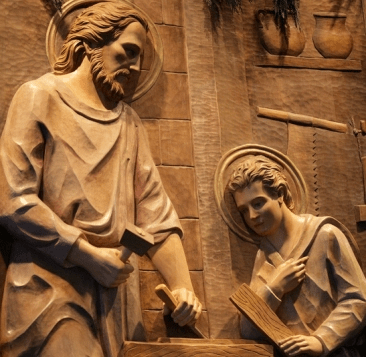
The Carpenter’s Son, Holy Cross Chapel, Houston, Texas

Unless the Lord builds the house,
    those who build it labor in vain.
Unless the Lord guards the city,
    the guard keeps watch in vain.
It is in vain that you rise up early
    and go late to rest,
eating the bread of anxious toil,
    for he gives sleep to his beloved.

Sons are indeed a heritage from the Lord,
    the fruit of the womb a reward.
Like arrows in the hand of a warrior
    are the sons of one’s youth.
Happy is the man who has
    his quiver full of them.
He shall not be put to shame
    when he speaks with his enemies in the gate. (New Revised Standard Version)

God is the Creator. We humans are creatures, created in the image and likeness of God. Therefore, we are inextricably tied to God, and quite dependent upon the Lord.

For the activities of our daily human life, we need God. When it comes to establishing a home, protecting our community, daily work, and raising children, we very much need God’s help to do all of this in a way that is successful and good.

Unless God is with us, in the center of all that we do, then our work in building a good life shall be in vain. How we go about living our lives with work and family, and who we look to as role models, makes a significant difference in the quality and effectiveness of our labor and relationships.

When my wife was growing up, her family had a prominent portrait of John Wayne in the living room above the television. That picture spoke volumes about the family ethos. They had horses and loved to ride and enjoy the outdoors. Hard work was a daily reality of life, as well as a rugged individualism that often suppressed all else in order to engage in work. 

Doing your best, striving for excellence, and learning responsibility are good things that mature people do every day. Yet, there is a fine line between hard work that provides and enriches, and lonely work that is frenetic and fueled by anxiety about the future.

The motives behind why we burn the candle at both ends are just as important to the Lord as the work itself. The psalm for today is a wake-up call for us to consider the frenetic pace of work and family life.

If we independently believe that our life is in our own hands, and we work with a worry that animates our every task, then we have lost touch with the understanding that it is God who ultimately provides us with every good thing in life. 

However, if we begin to relax and let go of our stubborn independent streak, then we work hard with the strength God gives. We let the Lord watch over us.

Trusting God in our work is connected to children being a heritage from the Lord. In the ancient world, children worked alongside their parents. Fathers and mothers did not go it alone – work was a family affair, as well as a community endeavor. 

Whenever we slip into a groove of worshiping individualism, rather than simply taking personal responsibility, then we must come back to the inter-dependence we were designed for as created human beings. 

The ethos the psalmist espoused is trust in God, reliance on others, and working together for the common good of all. 

Here are a few ways of working together and not carrying the load of work on our own:

Ask for what you want and need to accomplish the task. Whenever we don’t ask, we inevitably go the route of hustling for help through manipulation, guilt, and shaming others.

If someone says, “no,” simply ask another person or persons. Asking once just won’t do. And neither is commanding others to get things done. We have the ability to ask calmly, confidently, and compassionately. Accept the “no” which you might get, without retreating back to manipulation. This is especially needful when it comes to asking family members.

Ask God to help you in your work. Each day as I enter the hospital for which I am a Chaplain, I say a prayer, “God almighty, blessed Father, Son, and Spirit, please go before me, with me, and after me to each patient, their family members, and every team member I encounter today, with the love and compassion of Jesus Christ.”

Delegate, if possible. This is not the same thing as barking orders. Delegating is a realization that we are finite creatures with limitations of time, energy, and resources. It’s okay to share the load with others. In fact, most people are more than willing to help, if we but ask. It enables them to feel needed and important.

Be vulnerable and gracious. We all mess up our work, at times. And it’s important to own mistakes without heaping unnecessary criticism on ourselves, or others. Offering an apology, recognizing that you’ve bit off more than you can chew, and admitting your lack of energy are healthy, not sinful. Also, whenever others fall short of their responsibilities, it’s our job to handle it with grace – seeking to understand and help, rather than criticize and judge.

Working together, consulting, collaborating, and engaging in fellowship enable us to speak with those who may oppose, misunderstand, or misinterpret us. It’s also a more joyful way to live.

Sovereign God, you created all things and in you everything holds together. Preserve me with your mighty power that I may not fall into disconnection with you and others, nor be overcome by anxiety. In all I do direct me to the fulfilling of your purpose, through Jesus Christ my Lord. Amen.

Spiritual Growth (2 Peter 3:14-18)

So then, dear friends, since you are looking forward to this [a new heaven and a new earth] make every effort to be found spotless, blameless and at peace with him. Bear in mind that our Lord’s patience means salvation, just as our dear brother Paul also wrote you with the wisdom that God gave him. He writes the same way in all his letters, speaking in them of these matters. His letters contain some things that are hard to understand, which ignorant and unstable people distort, as they do the other Scriptures, to their own destruction.

Therefore, dear friends, since you have been forewarned, be on your guard so that you may not be carried away by the error of the lawless and fall from your secure position. But grow in the grace and knowledge of our Lord and Savior Jesus Christ. To him be glory both now and forever! Amen. (New International Version)

When it comes to Christianity – the Christian life and church ministry – the value and necessity of spiritual growth within individual believers and local churches is of vital importance. 

We were created by God, who made us in the divine image and likeness. That is, we were formed as spiritual people. Every one of us carries within ourselves a God-given spirit; it is a vital part of who we are.

Therefore, we must recognize that the area of our greatest value, potential, fruitfulness, and life fulfillment will be in the realm of the spiritual. 

If we deny our inherent spirituality, whether in thought or in practice, we will inevitably become confused. This then, sets us up for failure, because our basic nature is one of being spiritual persons.

Nothing is more valuable for us than spiritual growth, and the provision God has made for us to experience this growth.

There is a verse tucked away at the end of Peter’s second epistle that states for us to grow in the grace and knowledge of our Lord and Savior Jesus Christ. Grace and knowledge are important words that both point to Jesus. 

“Grace” refers to all the benefits of redemption for us through the person and work of Christ.

“Knowledge” denotes all the benefits of God’s revelation to us in Jesus Christ.

Here is a simple, yet profound, observation of the text: The word “grow” is a command; it is not optional. It’s not something to maybe think about doing when we get around to it. God insists that we spiritually grow.

God has made every provision for our spiritual growth. What’s more, we have been given the ability as a redeemed believer, and as a redeemed community, to grow spiritually. 

So then, each and every believer in Jesus Christ, as well as every local church, must face their own personal responsibility to obey this scriptural exhortation. To do otherwise is to live outside of God’s will.

Sticking with the Apostle Peter’s words, here is another verse of importance which relates to our spiritual growth: 

Like newborn babies, crave pure spiritual milk, so that by it you may grow up in your salvation. (1 Peter 2:2, NIV) 

We are to seek the Word of God with the same kind of intensity that a newly born baby will seek for food. As babies, my kids were barracudas when it came to feeding time; they took their eating seriously, and with a lot of gusto. That same desire for feeding must be present with us as Christians and churches. When the command of Peter is obeyed, and made a priority in our life, then we will grow.

Like any good thing in our lives, there are potential problems, along with the benefits. A significant downside, when pursuing spiritual growth, is that we all have a disease-like force in our lives. There exists within us a destructive tendency of lethargy and passivity toward spiritual things.

It’s rather ironic that people who confess Jesus as Lord, and are convinced about their Christianity, can be so doggone nit-picky about trivial matters which don’t really contribute much of anything to their spiritual growth.

And the trivial things only distract us from feeding upon the Word of God, and consuming the Bread of Life. We cannot – we must not – go on living like this and expect to be successful in the Christian life.

If we are going to grow spiritually, we must be about the business of speaking the truth in love – which results in us growing up into people who embody the words and ways of Jesus. (Ephesians 4:15) 

We are to have an aggressive application of the truth in our speech and our actions, which then impacts our daily faith walk with Jesus. 

The way we grow up spiritually, whether personally or corporately, is through practicing the truth of Holy Scripture – which requires reading it, learning it, and knowing it better than we know our own back door.

Our priorities, goals, and values need to reflect a solid commitment to fulfill scriptural truth in daily life. In that vein, let us ask ourselves some penetrating questions:

  • Have we humbled ourselves before God and confessed the things we have done, and the things we have left undone, when it comes to God’s revealed will?
  • Have we humbled ourselves before one another as believers, and in the church, asking for prayer?
  • Have we read the Bible on the subject of spiritual growth, and followed its teachings, so that we can know the joy and love God has for us?
  • Would we be lethargic and passive about treating a physical cancer in our lives?

God the Father and God the Son have conspired together to give believers God the Holy Spirit for our spiritual growth. The blessed Holy Trinity – the God whom Christians serve – has gifted us the Spirit, so that we might come into close fellowship with the Lord Jesus. 

Once we begin to obey the Scripture in this area of practicing biblical truth, we will experience spiritual growth and the joy of the Lord. 

However, if we allow ourselves to remain lethargic and apathetic concerning spirituality, we will not become our true selves. We must choose to make a biblical response to God, to one another, and to ourself. 

Spiritual growth is not a matter of personal willpower that can be achieved by our own efforts. Instead, we must face our spiritual condition, and seek help within the community of the redeemed, the church. Then, spiritual growth will become a reality.

Gracious heavenly Father, the God of all mercy, thank you for adding another day to my life. I dedicate both my soul and my body to serving you with a right spirit and a holy life. Strengthen me in this life, so that I may grow in grace, and in the knowledge of your Son, my Savior, Jesus Christ, who with you and the Holy Spirit are one God, now and forever. Amen.

Divine Goodness, Despite Human Ingratitude (Psalm 78:23-29)

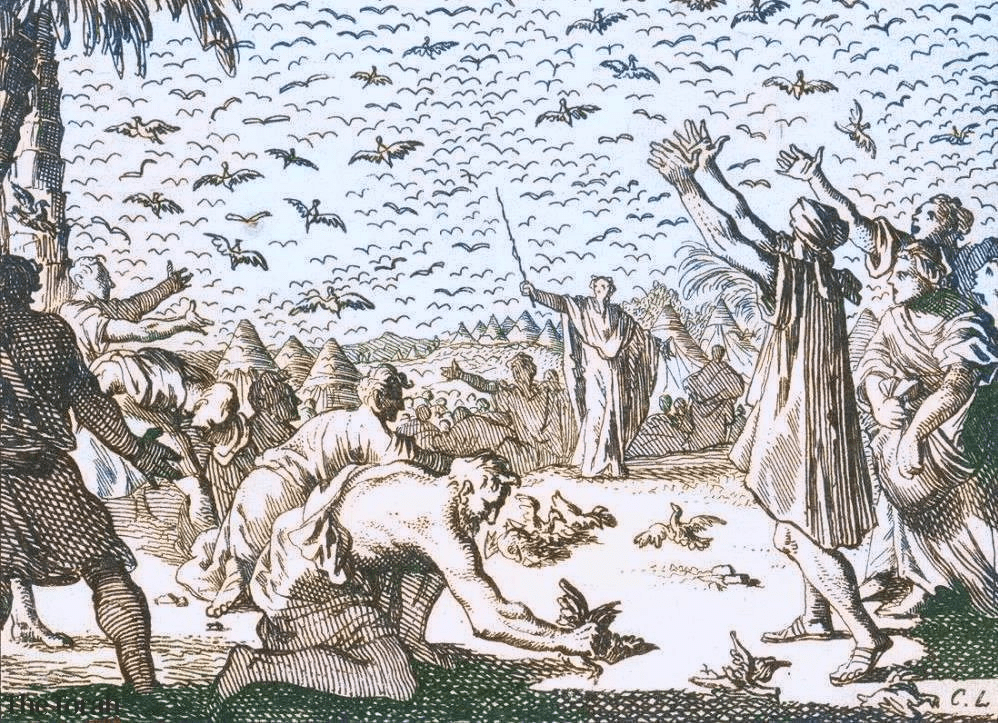
Quail in the Wilderness, by Caspar Luyken, 1698

Yet he commanded the skies above
    and opened the doors of heaven;
he rained down on them manna to eat
    and gave them the grain of heaven.
Mortals ate of the bread of angels;
    he sent them food in abundance.
He caused the east wind to blow in the heavens,
    and by his power he led out the south wind;
he rained flesh upon them like dust,
    winged birds like the sand of the seas;
he let them fall within their camp,
    all around their dwellings.
And they ate and were well filled,
    for he gave them what they craved. (New Revised Standard Version)

Today’s psalm is the second longest in the psalter (72 verses, with Psalm 119 the longest at a hefty 176 verses). Along with Psalms 105-106, Psalm 78 remembers and rehearses the history of Israel. This is a psalm which is meant for teaching and passing on important lessons.

The upshot of this psalm’s historical recollection is that the people’s ancestors were faithless; therefore, those reading the psalm now should live differently in a positive life of goodness, having observed how the past actors serve as a negative example of ingrates.

The psalmist, Asaph, viewed past events as highly informative for present circumstances. His purpose for crafting the psalm was explicit. He wanted the people:

 to put their hope in God—
        never forgetting God’s deeds,
        but keeping God’s commandments—
    and so that they won’t become like their ancestors:
    a rebellious, stubborn generation,
        a generation whose heart wasn’t set firm
        and whose spirit wasn’t faithful to God. (Psalm 78:7-8, CEB)

The verses for today’s lectionary reading have a unique place within the psalmist’s rehearsal of the past. They connect to the previous section (verses 9-22) which recounts the Lord’s angry response concerning Israel’s unbelief and rebellion.

In many ways, Psalm 78 has a consistent theme of human stubbornness, lack of faith, and wanting to do their own thing apart from God. Bucking God’s covenant code and moral law was ever-present in Israel’s history. And yet…

The Lord remained the same: Faithful and true. Furthermore, God stubbornly showed steadfast divine love and covenant loyalty to the people, despite their herky-jerky commitment and fickle faith.

Manna from heaven

Although the theme of human failure runs throughout the psalm, the dominant idea points to God’s gracious mercy, eternal faithfulness, and steadfast love. Most of all, the psalmist wanted his readers to remember the goodness and grace of God.

The people’s unbelief in no way stymied the promises of God. That’s because salvation and deliverance, faith and hope, do not originate and are not sustained by humans, but by the Lord God almighty who created heaven and earth.

Even though the people were faithless, and thus, had no trust in God’s power; nevertheless, the Lord opened the doors of heaven in order to meet the needs of people who did not deserve divine help.

The verses for today remember the story of God’s provision of manna and quail in the desert (Exodus 16). The Lord was gracious, merciful, and kind to the Israelites, despite their incessant grumbling. God responded to them because of their sheer need, and not because of any righteousness coming from them.

God not only provided food, but gave the manna in abundance, and the quail in superabundance. The contrast could not be any more glaring: Israel murmured, grumbled, complained, and demonstrated a lack of faith; God granted the Israelites a ridiculous amount of food, and evidenced steadfast faithfulness to the covenant.

The supreme goodness of God brings out, in stark relief, the incredible foolishness of Israel’s attitude. In the Exodus account, while the meat was still in their mouths, God’s anger flared because of the people’s recalcitrance.

On the surface, the divine response of judgment may appear out of sorts to the divine grace shown to Israel. Yet, the Lord cares about the holistic needs of people, and not only in giving sustenance.

God wants faithful and obedient people. The Lord desires goodness, righteousness, and justice to be the hallmark of the community.

To have your belly full and your spirit empty is an affront to God – because the Lord is good, right, and just, and does not tolerate impertinence, impudence, and impetuousness. Vice and ingratitude only makes a person an imbecile who is worthless to their fellow humanity.

Divine punishment – anywhere you find it in Holy Scripture – is meant to draw people back into relationship with God. Another way of phrasing this, is that God delivers people and grants them freedom, so that they will have no obstacles toward living a good, right, and just life.

No matter the response of God – whether it is by miraculous provision or by divine punishment – it’s always a response of grace; the Lord consistently acts from a place of compassion and commitment to doing what is best for the community.

Whereas the Israelites repeatedly cycled themselves through spirals of faith and unbelief, gratitude and grumbling, obedience and disobedience; God, however, constantly demonstrated the presence of grace and mercy, righteousness and justice, holiness and love.

The only reason the Israelites (and the entire human race, for that matter) are not wiped out is because God forgave their iniquity and did not destroy them. What’s more, the Lord didn’t even let them destroy themselves, unwittingly by their own unawareness and foolishness. (Psalm 78:36-39)

I am profoundly glad that God is the bigger person in the relationship with humanity. The Lord is continually mindful of who we are, as well as God’s own divine essence and power.

Yet he, being compassionate,
    forgave their iniquity
    and did not destroy them;
often he restrained his anger
    and did not stir up all his wrath.
He remembered that they were but flesh,
    a wind that passes and does not come again. (Psalm 78:38-39, NRSV)

As people created in the image and likeness of God, we find our highest joy and greatest fulfillment in receiving the good things from God with gratitude; and of giving goodness to others in a spirit of love – no matter what.

Gracious and almighty God: Open wide the eyes of my soul that I may see the good in all things. Grant me today a new vision of your truth. Inspire me with the spirit of joy and gladness. Make me a cup of strength to suffering souls. Amen.