Divine Providence (Genesis 30:37-43)

Jacob with Laban’s flock, by Jusepe de Ribera, 1632

Then Jacob took some fresh branches from poplar, almond, and plane trees and peeled off strips of bark, making white streaks on them. Then he placed these peeled branches in the watering troughs where the flocks came to drink, for that was where they mated. And when they mated in front of the white-streaked branches, they gave birth to young that were streaked, speckled, and spotted. Jacob separated those lambs from Laban’s flock. And at mating time he turned the flock to face Laban’s animals that were streaked or black. This is how he built his own flock instead of increasing Laban’s.

Whenever the stronger females were ready to mate, Jacob would place the peeled branches in the watering troughs in front of them. Then they would mate in front of the branches. But he didn’t do this with the weaker ones, so the weaker lambs belonged to Laban, and the stronger ones were Jacob’s. As a result, Jacob became very wealthy, with large flocks of sheep and goats, female and male servants, and many camels and donkeys. (New Living Translation)

Jacob had been working for his father-in-law Laban for years. During that time, they both contested with each other in a chess match of trying to gain the upper hand. Mostly, Jacob had been outmaneuvered by Laban. But now he achieves a sort of coup de grace, a checkmate.

Having agreed between them that Jacob’s wages would be only the speckled and spotted sheep and goats, as well as every black lamb, Laban proceeded to remove all those animals from his flock and sent them off away from Jacob. This was yet another unfair practice in the chess game of his life.

Even if Jacob wanted to retaliate, he really had no means to do it – which is why Laban kept taking advantage of him. But Laban underestimated who he was playing against and dealing with.

Using an unusual method, something akin to sympathetic magic – a ritual using an object that resembles the sheep over which Jacob sought influence – he systematically grew his own flock of many strong sheep and goats. Jacob then separated these stronger animals from Laban’s flock. In doing this, Jacob became exceedingly wealthy.

It’s an incredible story, almost like achieving the modern day American dream of rags to riches in the face of adversity. Yet, behind all the success of Jacob, we as the readers know that this happens because God is working out divine promises to the family of Abraham, Isaac, and now Jacob.

The power, sovereignty, providence, and grace of God stand behind every good thing people have in this life. The Lord is the One who is not flummoxed by the impending moves in the chess game; God has the ability to rearrange the chess board, reorder the future, and make restoration possible.

Although separated by more than three millennia from the family of Jacob, we can relate to the ever-present human condition, the personal struggles of overcoming the past, and the wonderings of what will happen in the future.

In whatever way we want the future to shake-out, it ultimately is in the hands of God. We would like to live in a universally closed system where there is predictability with no trickery, posturing, manipulating, or anxiety about what’s next. Many people long for a life free from an uncertain and shadowy future.

But none of us can have the precise future we may wish for. So, some people despair that we are in a closed system in which nothing can change – that systemic evil, broken institutions, fragmented families, and wounded spirits are just the way it is.

There are lots of folks who continually feel the awkward push and pull of both hope and dread – wanting to believe that things can be better, but having a sinking sense that the other shoe is about to drop.

In truth, we do not live in a closed universal system; history is not yet finalized and the Lord has a few tricks up the divine sleeve. We actually live in an open system, where we can find both surety and hope. The future, although appearing bleak for some, shall be shaped and bent by God according to divine promises and good purposes.

And when we take the time to observe this grand open system, we begin to discern that no scheming of humanity nor any human machinations can do anything more than slightly delay the inevitable Day of the Lord. Justice will have its day, and it’s way on this earth; injustice shall not last forever.

In the meantime, we do the best we can with the resources we have, at this present moment. Today is all we have. God’s gracious provision for this day is enough. Tomorrow has enough worries of its own.

An open system says that there is a spiritual force outside of social interaction. A a closed system says there is no outside force influencing our actions and outcomes.

In a closed system, we have the illusion (and delusion) that control is possible because the number of variables remains static. People in this system long for simplicity and sameness – to be able to predict what will happen next. So, they focus on structures and processes that sustain control over organizations and people.

But in an open system, dynamics from other systems impact us, creating and expanding the number of variables. It’s a complex and fluid situation, but folks learn to focus on influence rather than control, knowing there are forces at play which impact the chessboard. That’s because ultimate control belongs to God; we, as people, are called to self-control.

Almighty God, Creator and Sustainer of all things: You uphold, direct, and govern all creatures, actions and objects, from the least to the greatest. Nothing escapes your sovereign and benevolent rule—not the most powerful institution or ruler imaginable, nor the least significant speck just biding its time. You sustain all things by your powerful word.

Help me to see your hand in my life specifically and in history worldwide. Although there is much that remains a mystery in your providence, there is much that is already revealed. Your providence reveals your infinite wisdom, power, justice, goodness, and mercy. To you be all glory and praise, through Jesus Christ our Lord, who with you and the Holy Spirit are one God, now and forever. Amen.

Do You Really Know? Probably Not (Job 38:22-38)

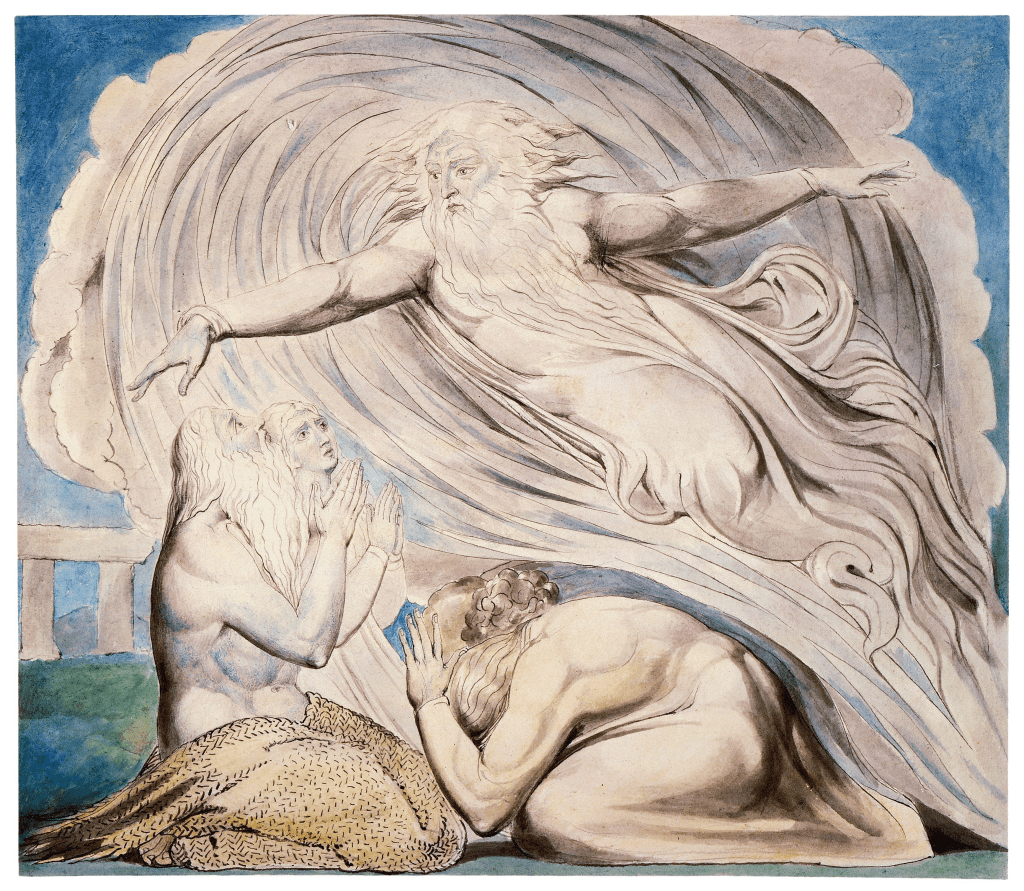
God Answers Job Out of the Whirlwind, by William Blake, 1826

“Have you entered the storehouses of the snow
    or seen the storehouses of the hail,
which I reserve for times of trouble,
    for days of war and battle?
What is the way to the place where the lightning is dispersed,
    or the place where the east winds are scattered over the earth?
Who cuts a channel for the torrents of rain,
    and a path for the thunderstorm,
to water a land where no one lives,
    an uninhabited desert,
to satisfy a desolate wasteland
    and make it sprout with grass?
Does the rain have a father?
    Who fathers the drops of dew?
From whose womb comes the ice?
    Who gives birth to the frost from the heavens
when the waters become hard as stone,
    when the surface of the deep is frozen?

“Can you bind the chains of the Pleiades?
    Can you loosen Orion’s belt?
Can you bring forth the constellations in their seasons
    or lead out the Bear with its cubs?
Do you know the laws of the heavens?
    Can you set up God’s dominion over the earth?

“Can you raise your voice to the clouds
    and cover yourself with a flood of water?
Do you send the lightning bolts on their way?
    Do they report to you, ‘Here we are’?
Who gives the ibis wisdom
    or gives the rooster understanding?
Who has the wisdom to count the clouds?
    Who can tip over the water jars of the heavens
when the dust becomes hard
    and the clods of earth stick together? (New International Version)

The older I get, and the more understanding I gain, the more I realize how little knowledge I truly possess.

When I was eighteen years old, I thought I had the world pretty much figured out. Since then, it’s all been downhill. With each passing year, my ignorance seems to grow. I suppose this all really makes some sense when talking about God’s upside-down kingdom.

There’s so much of life that is a mystery; and as we accumulate our life experiences, it seems all, not just some, of life is a mystical encounter. In other words, the more discernment I gain, I discover I know a lot less than I thought I did.

God Answers Job from the Whirlwind, by William Blake, c.1804

It seems as if the biblical character of Job found this out the hard way. If there is any person in Holy Scripture that would be wise and understanding, its him. God speaks highly of Job in the Bible.

Regarding the upcoming destruction of Jerusalem, God said, “even if these three men—Noah, Daniel and Job—were in it, they could save only themselves by their righteousness, declares the Sovereign Lord.” (Ezekiel 14:14)

Job is held up as the model of patience under suffering: “As you know, we count as blessed those who have persevered. You have heard of Job’s perseverance and have seen what the Lord finally brought about. The Lord is full of compassion and mercy.” (James 5:11)

Yet, with all of Job’s integrity, patience, and righteousness, his understanding barely moves the Richter Scale of God’s expansive knowledge.

We might be somewhat familiar with the story of Job. Being a conscientious follower of God, Job is careful to live uprightly. He acknowledges God in all things and worships him alone. Yet, suffering befell him – for no other reason than that God allowed it. Job knew fully well that there was no personal sin behind his awful ordeal of grief and grinding pain.

So, Job contended with God. For an agonizing thirty-five chapters (Job 3:1-37:24) Job questions God and respectfully takes him to task – as Job’s supposed friends questioned him and assume his guilt. Through it all God is there… silent… saying nothing.

The Desperation of Job, by William Blake, 1821

Then, just when we think God is paying no attention whatsoever, the Lord suddenly speaks.

And what is so remarkable about God’s speech is that for four chapters (Job 38:1-41:34) the Lord gives no answers. It’s all rhetorical questions. God said, “Brace yourself like a man; I will question you and you shall answer me.” (Job 38:3)

It becomes abundantly clear after just a few questions that it would be impossible for any human being to even come close to having the understanding God has. And that was the whole point.

God is God, and we are not. Our questions, however legitimate, real, and raw they are, come from a very puny perspective. Turns out, we just don’t know as much as we think we do.

To Job’s credit, he keeps his mouth shut and listens. At the end of the questioning, Job responds in the only wise way one could, after such an encounter: “Surely I spoke of things I did not understand, things too wonderful for me to know.” (Job 42:3)

None of this means that, for us, we need to face our hardships and our sufferings with a stoic keep-a-stiff-upper-lip approach. Trapped grief will inevitably come out sideways and only cause more hurt. I believe God allowed Job to express his terrible physical, emotional, and spiritual pain for chapter after chapter because he needed to.

Only when God sensed it was the proper timing did he jump in and bring the perspective Job then needed. And even after being challenged by God about his vantage point, Job still did not receive answers as to why he had to endure the awfulness of loss beyond what most of us could comprehend.

Maybe we lack being able to understand, even if God directly answered all our questions. Most likely, God protects us from knowing things that might bring irreparable damage to our human psyches. Again, this is all pure conjecture. Which leaves us with perhaps one of our greatest challenges as human beings:

We must eventually come to the place of being comfortable with mystery – and even embracing it. We simply will not have all things revealed to us that we want to know. And that’s okay.

There is yet one more comment to observe about God’s questioning of Job: God is sarcastic. Sarcasm often gets a bad rap, much like anger does, because it is so often associated with unacknowledged emotions and/or expressing our feelings in an unhelpful way.

Yet, there the sarcasm is, with the God of the universe. I take some odd comfort in knowing that God can be snarky at times – in a good way.

Anytime we try to pin God down to some tidy understandable categories, the Lord typically colors outside our human contrived lines and demonstrates to us that the divine cannot be contained in our ramshackle box.

I like it that God is playful, wild, and free to be God – even if there are times it may bug me.

God is unbound by any human knowledge, understanding, ideas, or plans. God will do what God will do. God will be who God will be. “I AM who I AM.” Now that’s a God I can put my trust in.

O Lamb of God that takes away the sins of the world, have mercy upon me.

O Lamb of God that takes away the sins of the world, have mercy upon me.

O Lamb of God that takes away the sins of the world, grant me your peace. Amen.

Proverbs 30:1-10 – Live Wisely and without Envy

These are the solemn words of Agur son of Jakeh:

    “God is not with me, God is not with me,
    and I am helpless.
I am more like an animal than a human being;
    I do not have the sense we humans should have.
I have never learned any wisdom,
    and I know nothing at all about God.
Have any ever mastered heavenly knowledge?
    Have any ever caught the wind in their hands?
    Or wrapped up water in a piece of cloth?
    Or fixed the boundaries of the earth?
Who are they, if you know? Who are their children?

“God keeps every promise he makes. He is like a shield for all who seek his protection. If you claim that he said something that he never said, he will reprimand you and show that you are a liar.”

I ask you, God, to let me have two things before I die: keep me from lying and let me be neither rich nor poor. So, give me only as much food as I need. If I have more, I might say that I do not need you. But if I am poor, I might steal and bring disgrace on my God.

Never criticize servants to their master. You will be cursed and suffer for it. (Good News Translation)

These are the raw expressions of a man who has awareness of his own envious nature. He realizes his profound lack of wisdom. The man, Agur, discerns how helpless and pathetic he really is, apart from wise living.

The wise person knows that a heart at peace gives life to the body, but envy rots the bones. Possessing too much or too little tends to awaken the eye of envy within us. Agur wants to avoid thinking that people, even God, owes him. He is concerned he might slip into the disposition of what the Lord and others can do for him, rather than vice versa.

“The secret of success is that it is not the absence of failure, but the absence of envy.”

Herodotus

Today, envy manifests itself in moving-on to another church, or friendship, or marriage, or job when perceived needs and wants are not met. Certainly, ties need to be severed in the case of abusive treatment. Yet, when we simply do not like something, and aspire to more and more hoarding of emotional and spiritual resources, there is little to no awareness of the shadowy places in our hearts.

Perhaps, through the difficulty, the Lord was attempting to reveal something important to us or working to bring about positive transformation. However, we bailed from the situation too quickly, not wanting to deal with the pain or inconvenience of it all. And, all the while, our real motivations remain hidden and unaddressed.

It is necessary to see envy for what it is – not just a common predilection everyone has – but a malady of believing I deserve things no one is giving me. It’s the age old endemic problem, much like Adam and Eve’s original sin, of grabbing a forbidden fruit in the belief G-d is not providing everything I need. And we then cannot, or will not, see all the vast resources and blessings already possessed.

Gratitude is a spiritual practice, when engrafted into a daily spiritual walk, provides a strong antidote to keeping envy at bay. Instead of wondering why G-d is not blessing my life and work in ways I think it should happen, perhaps we ought to identify and count the blessings we already possess and enjoy. 

Some of the greatest joys around us are the simple pleasures of everyday life – holding and sipping a hot cup of coffee; a quick kiss good-bye to my spouse on the way out the door; the opportunity to curl up with a good book on a rainy day; these and many more are blessings given to us by a heavenly Father who cares for us deeply.

“Gratitude turns what we have into enough.”

Aesop

It might be a good thing to spend some intentional time saying and/or writing out many of the blessings currently existing in your life. 

For example, rather than wishing a loved one would not have to endure disease or surgery and envying healthy people, rejoice that he/she is with you, that you enjoy one another’s love and companionship, whether it is in times of health or in seasons of illness.

And instead of envying the rich or worrying about becoming poor, give thanks for this current place in your life. Simple thanksgiving to G-d for every meal, each possession obtained, and even all things lost forever, fortifies the spirit for resilience over the long haul of life.

Much of our life on this earth comes down to mystery. We simply do not know, and are not privy, to the myriad ways G-d is working in the world. We may never know why we must face and deal with our particular and personal pains, disappointments, and sorrows.

So, when we pray, much like Agur, it might be wise to ask for continual help with never-ending problems, rather than constantly praying for deliverance from unwanted situations. It is best we pray as Jesus taught us saying, “Give us this day our daily bread.” (Matthew 6:11)

“I’ve learned by now to be quite content whatever my circumstances. I’m just as happy with little as with much, with much as with little. I’ve found the recipe for being happy whether full or hungry, hands full or hands empty. Whatever I have, wherever I am, I can make it through anything in the One who makes me who I am.”

The Apostle Paul (Philippians 4:11-13, MSG)

Wise persons know the frailty of their own hearts. Prayer, for them, is an organic practice arising from vulnerable and forthright discussions with G-d about doubt and disbelief. Indeed, people come to know the Lord not through speculating or imposing their own personality on G-d but by daily calling upon the Divine Being for practical help at the neediest points of life.

Blessed Lord, take me to the place where I am saved from my pride and arrogance and humility takes center stage, where I’m lifting up clean hands and a pure heart to you. Take me to the place where I’m no longer looking at the mountains I face but looking down upon them, where I can clearly see, and my decisions are flooded with your light, truth and justice. I bend my knee and receive your truth. I open my ears to receive your counsel. I open my heart to receive your eternal wisdom. Amen.

Psalm 73:21-28 – God Is Near

When my thoughts were bitter
    and my feelings were hurt,
I was as stupid as an animal;
    I did not understand you.
Yet I always stay close to you,
    and you hold me by the hand.
You guide me with your instruction
    and at the end you will receive me with honor.
What else do I have in heaven but you?
    Since I have you, what else could I want on earth?
My mind and my body may grow weak,
    but God is my strength;
    he is all I ever need.

Those who abandon you will certainly perish;
    you will destroy those who are unfaithful to you.
But as for me, how wonderful to be near God,
    to find protection with the Sovereign Lord
    and to proclaim all that he has done! (Good News Translation)

Sometimes we put our foot in our mouth. We know how it feels saying rash words that we later regret. And we also know what it feels like to get dumped on by another who has some choice words for us.

The psalmist, Asaph, records an encounter with God. Asaph was upset. He gave God a piece of his mind. Then later, after reflecting on the experience, Asaph admitted that his soul was embittered and let his base nature take over.

The human brain is a complicated organ. We process information in different parts of the brain. The neo-cortex (the rational part of the brain) allows us to engage in logical analysis and complex decision making. 

Another part, the limbic system (sometimes referred to as the “reptilian brain”) processes information very quickly, largely by instinct. When we become scared, surprised, upset, or angry, adrenaline gets pumped into our limbic system so that we can quickly react to the perceived threat, danger, or injustice.

Having our brains flooded with adrenaline when there is real danger is necessary. There are life-threatening circumstances in which we need that quick response. Yet, if our brains remain on high alert and are continually fearful and upset, even when there is no real problem, we don’t calm down, and the result is less than stellar behavior. 

So, what is the answer to this situation? Asaph said God holds his right hand and guides him with wise counsel. Being near to God brings the brain chemistry to appropriate levels so that we can relax and trust.

God is with us always in the person of the Holy Spirit. There is never a time, place, or situation where God is absent. As we learn to rely on God’s presence, and remind ourselves of it on a daily basis, we can restore more rational thoughts to our lives. We can live knowing God is in control and continually vigilant to watch over us.

Gracious God, I have no one in my life like you. My flesh and my heart may fail, my brain might become overwhelmed with irrational fears, but you are my strength and the Rock of my salvation. Thank you for your continual provision and help each day through Jesus Christ, my Lord. Amen.