Let Go (Exodus 11:1-10)

Now the Lord had said to Moses, “I will bring one more plague on Pharaoh and on Egypt. After that, he will let you go from here, and when he does, he will drive you out completely. Tell the people that men and women alike are to ask their neighbors for articles of silver and gold.” (The Lord made the Egyptians favorably disposed toward the people, and Moses himself was highly regarded in Egypt by Pharaoh’s officials and by the people.)

So Moses said, “This is what the Lord says: ‘About midnight I will go throughout Egypt. Every firstborn son in Egypt will die, from the firstborn son of Pharaoh, who sits on the throne, to the firstborn son of the female slave, who is at her hand mill, and all the firstborn of the cattle as well. There will be loud wailing throughout Egypt—worse than there has ever been or ever will be again. But among the Israelites not a dog will bark at any person or animal.’ Then you will know that the Lord makes a distinction between Egypt and Israel. All these officials of yours will come to me, bowing down before me and saying, ‘Go, you and all the people who follow you!’ After that I will leave.” Then Moses, hot with anger, left Pharaoh.

The Lord had said to Moses, “Pharaoh will refuse to listen to you—so that my wonders may be multiplied in Egypt.” Moses and Aaron performed all these wonders before Pharaoh, but the Lord hardened Pharaoh’s heart, and he would not let the Israelites go out of his country. (New International Version)

It takes a lot for the status quo to die, to let go of something that has been relied on for centuries. In the case of ancient Egypt, it took the deaths of every Egyptian first born son.

The Israelites had been slaves in Egypt for 400 years. The vast Egyptian Empire was literally built on the backs of Jews. After so long, their cry about being in bondage was heard by God – who sent Moses to deliver them. But Pharaoh, the King of Egypt, was not about to let go of this large labor force.

So, a series of 10 plagues came upon the Egyptians from God. Today’s Old Testament lesson is the tenth and final plague – the one most devastating to Egypt. Although Pharaoh was determined to keep the Israelites in bondage, not even mighty Egypt could keep it’s grip on the people when God was determined to free them and bring them to the Promised Land.

God graciously informed Moses that this was the final plague. After nine others, and hearing Pharaoh say he would let the people go multiple times, it must have been a relief to hear that this would not keep going any longer.

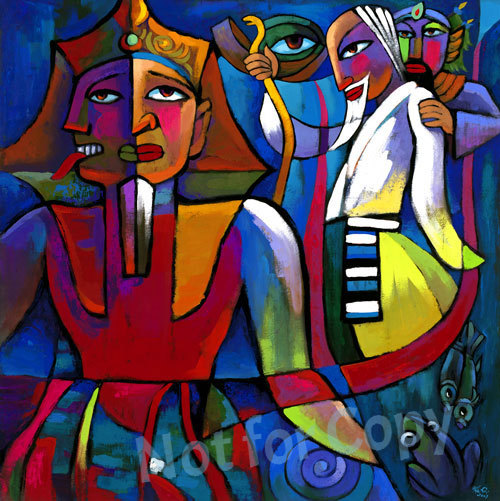
Moses and Aaron debating with Pharaoh, by He Qi

What’s more, the Lord added that not only would Pharaoh finally change and not hinder the people from leaving, but also that they should ask the Egyptians for what they needed when going. Indeed, the people of Egypt became so eager to have the Israelites away from them that they would give them anything to get them out.

The Israelites had worked hard and labored intensely for hundreds of years without any compensation. Now, they would leave the world of slavery and receive the riches of Egypt from which they were defrauded. Whereas Pharaoh’s heart became exceedingly hard, the Egyptians hearts became disposed to give – even though it was to be rid of the Israelites once and for all.

And so, God would deliver the Jews from their bondage and enrich them with many needed possessions, as if they were carrying away plunder from an enemy. The Lord both frees and empowers; God delivers from one situation and enables for another. When God closes a door, then another door is opened.

Indeed, the first will be last, and the last shall be first. In God’s upside-down kingdom, the oppressors eventually become the oppressed, and the poor become rich.

With this last and final plague, there would be no next generation to rise up and take back the Israelites into slavery again. A distinction was made between the first born of the Egyptians and the Israelites. Only the Egyptians experienced the awful deaths of so many.

After four centuries of keeping the Jews enslaved, maybe the Egyptians thought it would always be this way. Perhaps they even believed what they were doing was perfectly acceptable and right. So, when Moses comes along, speaking on behalf of God to Pharaoh, the great king of the empire thought things will not change; the Israelites ought to always be in subservience to Egyptians.

Why is it so hard to let go? Why do people keep holding on, even when it costs them nearly everything?

Whenever we cannot envision a different world or an alternative to what we are currently experiencing, then we hold on – even if it hurts to keep grasping it. Just because there was no divine judgment in hundreds of years, does not mean that God was okay with the situation in ancient Egypt. So, when the Egyptians experienced the judgment, it was absolutely devastating.

If ever we need to control other people in order to realize or maintain our own happiness or contentment, then we are in a very unhealthy place and need immediate help – before the providence of God steps in and pries that control from your clenched fists.

Conversely, if we have been in a place of oppression for a long time, it will not last forever. God sees the injustice. And God hears the cries which are uttered to heaven. A time is coming when all things will be made right.

Also, there are various sorts of traumas that people have endured. Sometimes, people don’t want to talk about any of it, and never do. But eventually, it overwhelms them. Without help, they will be in bondage. None of us can change on our own. We need others. Not everyone is going to harm us or shame us. There are people that God is ready to use in order to extend hope, healing, wholeness, and help. We should let them in, and keep the slave masters out.

Gracious and merciful God, help us to overcome the menace of evil in this world, and to be a part of freeing those weighed down with sinful oppression to realize a future of health and hope.

From famine and war, deliver us.

From hatred and from the demeaning of the dignity of others, deliver us.

From every kind of injustice in the life of society, both national and international, deliver us.

From the loss of awareness of good and evil, deliver us.

Accept our cry on behalf of the sufferings of all humanity, and of entire societies of people.

Empower us by your Spirit to resist evil in all its insidious manifestations.

May the saving grace and the redemption of Jesus put a stop to cruel bondage everywhere; and may hope be kindled in every heart. Amen.

See the Big Picture (Genesis 41:37-57)

The proposal pleased Pharaoh and all his servants. Pharaoh said to his servants, “Can we find anyone else like this, one in whom is the spirit of God?” So Pharaoh said to Joseph, “Since God has shown you all this, there is no one so discerning and wise as you. You shall be over my house, and all my people shall order themselves as you command; only with regard to the throne will I be greater than you.” And Pharaoh said to Joseph, “See, I have set you over all the land of Egypt.” 

Removing his signet ring from his hand, Pharaoh put it on Joseph’s hand; he arrayed him in garments of fine linen and put a gold chain around his neck. He had him ride in the chariot of his second-in-command, and they cried out in front of him, “Bow the knee!” Thus he set him over all the land of Egypt. 

Moreover, Pharaoh said to Joseph, “I am Pharaoh, and without your consent no one shall lift up hand or foot in all the land of Egypt.” Pharaoh gave Joseph the name Zaphenath-paneah, and he gave him Asenath daughter of Potiphera, priest of On, as his wife. Thus Joseph gained authority over the land of Egypt.

Joseph was thirty years old when he entered the service of Pharaoh king of Egypt. And Joseph went out from the presence of Pharaoh and went through all the land of Egypt. During the seven plenteous years the earth produced abundantly. He gathered up all the food of the seven years when there was plenty in the land of Egypt and stored up food in the cities; he stored up in every city the food from the fields around it. So Joseph stored up grain in such abundance—like the sand of the sea—that he stopped measuring it; it was beyond measure.

Before the years of famine came, Joseph had two sons, whom Asenath daughter of Potiphera, priest of On, bore to him. Joseph named the firstborn Manasseh, “For,” he said, “God has made me forget all my hardship and all my father’s house.” The second he named Ephraim, “For God has made me fruitful in the land of my misfortunes.”

The seven years of plenty that prevailed in the land of Egypt came to an end, and the seven years of famine began to come, just as Joseph had said. There was famine in every country, but throughout the land of Egypt there was bread. 

When all the land of Egypt was famished, the people cried to Pharaoh for bread. Pharaoh said to all the Egyptians, “Go to Joseph; what he says to you, do.” And since the famine had spread over all the land, Joseph opened all the storehouses and sold to the Egyptians, for the famine was severe in the land of Egypt. 

Moreover, all the world came to Joseph in Egypt to buy grain, because the famine became severe throughout the world. (New Revised Standard Version)

Mosaic of Joseph overseeing the gathering of grain during the seven years of plenty, c.1275 C.E., St. Mark’s Basilica, Venice, Italy

It’s easy to get lost and miss the forest for the trees; we may become too involved in the details of a problem to look at the situation as a whole. Whenever we are in the middle of hard times, it can be difficult to see the big picture of what’s really going on.

Joseph had been in a peck of trouble. He literally found himself deep in trouble by being tossed into a dark hole of a well by his jealous brothers. Then, the same brothers turned around and pulled him up, only to sell him in slavery to a caravan heading for Egypt. (Genesis 37)

While in Egypt, Joseph became the head servant in the household of Potiphar, the captain of the guard for Pharaoh. But again, trouble found Joseph, even though the guy was diligent and squeaky clean in his moral living. Mrs. Potiphar had eyes for Joseph – who did not reciprocate her advances. There’s no wrath quite like a woman’s scorn, and off to jail Joseph went. (Genesis 39)

In prison Joseph waited… and waited. It seemed as though he had been forgotten. And although he had come to be in charge of his fellow inmates because the jail keeper trusted him so much, Joseph was still in the place of bondage. (Genesis 40) So, what would you do if you were in similar circumstances?

Blame others. Bellyache. Bully your way around with a chip on your shoulder. Become bitter about the ways you’ve been shafted and the brunt of injustice. Those are things that many of us might do in the throes of one injustice after another. But not Joseph.

Holy Scripture has no record of Joseph responding with complaint nor discouragement. Joseph seemed to have a sense that there were larger forces at work behind the scenes – that God could be trusted to work out the adverse situations for divine purposes.

So, when Joseph went from the bottom slug in a prison to the top dog in Egypt, the big picture became much more clear. From age 17 to age 30, Joseph labored as the right hand servant in charge of Potiphar’s household, and then as the right hand man to the jail keeper in prison. Now, Joseph becomes the right hand to Pharaoh, the administrator over all of Egypt.

All along, the Lord was getting Joseph ready for something supremely large – life and death sort of stuff. It turns out that, with Joseph in charge, tens of thousands of lives may have been spared because of his insight, foresight, and hindsight.

Joseph had divine insight as an interpreter of dreams – a gift which he acknowledged was given to him by God. He had the foresight and wisdom to take that insight and turn it into a solid administrative plan for saving many lives from a terrible famine. And Joseph continually had the benefit of hindsight in knowing who he was and where he came from – believing that he was part of a specially called family whom the Lord had a divine hand upon.

Every experience, each event, and the myriad mundane tasks which Joseph had to endure for 13 long years were like individual bricks being mortared together into a building which would eventually house enough life-learning to accomplish a life-saving governmental administration which kept food on the table for thousands of people.

Perhaps you and I don’t always get to see what’s going on above us, what is truly being worked out to bring help and justice to the world. Yet, we can rest assure that there is a God in heaven who sees, cares, and is planning salvation for people. And we are part of that large divine plan, if we have the faith to understand there is more going on than our present circumstances and physical eyes can see.

Righteous God and Father of all: Raise up among us people who keep faith alive, hope awakened, and love abundant. Guard our daily vocations and set them apart for your good purposes. Grant us the privilege of seeing our daily work accomplish the saving and blessing of many lives. Renew us in your mercy, sanctify us with your Spirit, and redeem our time so that we may serve you and steward well our lives, through Jesus Christ our Lord. Amen.

On the Lam(b) (Genesis 31:1-21)

Jacob Flees Laban, illustration from Bible Pictures and What They Teach Us, by Charles Foster, 1897

Jacob heard that Laban’s sons were complaining, “Jacob is now a rich man, and he got everything he owns from our father.” Jacob also noticed that Laban was not as friendly as he had been before. One day the Lord said, “Jacob, go back to your relatives in the land of your ancestors, and I will be with you.”

Jacob sent for Rachel and Leah to meet him in the pasture where he kept his sheep, and he told them:

“Your father isn’t as friendly with me as he used to be, but the God my ancestors worshiped has been on my side. You know that I have worked hard for your father and that he keeps cheating me by changing my wages time after time. But God has protected me. When your father said the speckled sheep would be my wages, all of them were speckled. And when he said the spotted ones would be mine, all of them were spotted. That’s how God has taken sheep and goats from your father and given them to me.

Once, when the flocks were mating, I dreamed that all the rams were either spotted or speckled. Then God’s angel called me by name. I answered, and he said, “Notice that all the rams are either spotted or speckled. I know everything Laban is doing to you, and I am the God you worshiped at Bethel, when you poured olive oil on a rock and made a promise to me. Leave here at once and return to the land where you were born.”

Rachel and Leah said to Jacob:

There’s nothing left for us to inherit from our father. He treats us like foreigners and has even cheated us out of the bride price that should have been ours. So do whatever God tells you to do. Even the property God took from our father and gave to you really belongs to us and our children.

Then Jacob, his wives, and his children got on camels and left northern Syria for the home of his father Isaac in Canaan. Jacob took along all his flocks, herds, and other property.

Before Rachel left, she stole the household idols while Laban was out shearing his sheep.

Jacob tricked Laban the Aramean by not saying that he intended to leave. When Jacob crossed the Euphrates River and headed for the hill country of Gilead, he took with him everything he owned. (Contemporary English Version)

Moving and changing are a part of life. Change and movement are built into all creation, from the seasons of the year to our physical bodies over time. Some changes and moves we deem as good, and others, not so much. Yet, whether good or bad, any switch or shift in life can be difficult to cope with.

Whatever the circumstance, God stands behind everything, working out good and divine purposes. There are times and seasons in our lives where we can get lost in our own stories. Ultimately, however, our transitions from one place to another are really about our individual stories fitting into the larger story of God.

Whenever we are unable to see how our own story and the story of God fit together, it’s an opportunity to exercise faith and trust in God. Listening to God, and responding to God’s call to move and change, will at times be difficult, due to the uncertainty of our future.

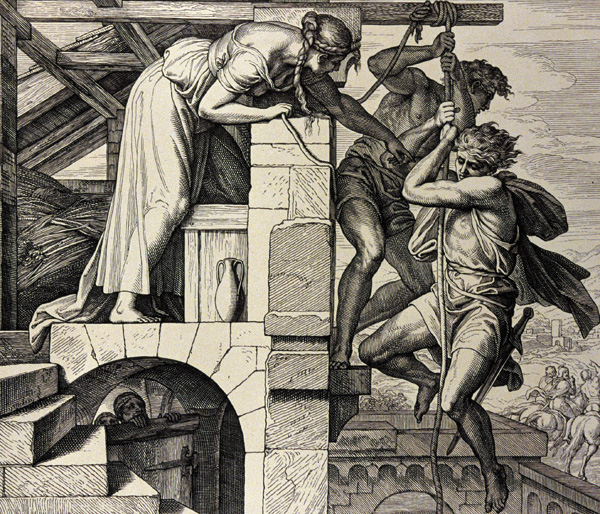
Jacob Urges Leah and Rachel to Flee from Laban, by Pieter Symonsz Potter, 1638

In today’s Old Testament lesson, Jacob has served his father-in-law Laban for twenty years. Now, he hears the call of God to move – and that move is both good and fraught with anxiety. Jacob and his family are on the lam, literally moving their lambs and sheep and everything they own to avoid pursuit and confrontation.

The principal actor and center of the story is not Jacob, but God. The narrative is primarily about God, with Jacob as the supporting actor in the story.

God was watching over and protecting Jacob. The Lord was following through on a promise of land and descendants given to Jacob’s grandfather, Abraham – to make him into a great nation so that all people-groups on earth would be blessed. 

So then, the story of Jacob is merely one piece in the grand unfolding drama of God’s redemption. This drama would eventually and ultimately find its fulfillment in the person and work of Jesus.

Jacob had in-law issues. His relationship with his father-in-law had always been tenuous, and was morphing into trouble. Laban’s attitude had changed toward his son-in-law, probably due to Jacob’s increasing wealth, and Laban’s decreasing assets.

So, God showed up and told Jacob to return to the land of his fathers. Along with the call to make a change came a promise of God’s continued presence with Jacob. The grace given to Abraham when calling him out of Ur was renewed with more grace when calling Jacob back to the land of his father and grandfather.  It is in God’s nature to be gracious and to heap grace upon grace.

Jacob heeded call of the Lord and began laying plans to move back to Canaan. But how to tell his family about this? What are his wives going to say? After all, he’s talking about moving away with teenagers still in the tent.

With some anxiety, Jacob called his wives, Rachel and Leah, out to the fields to talk. Jacob laid out the story of himself and Laban, which he framed more as a contrasting story between God and Laban:

  • Laban’s attitude changed, whereas God’s attitude does not change. God is not fickle.
  • Laban was unreliable, reneging on promises, but God is reliable and trustworthy, keeping divine promises.
  • Laban kept changing his mind, yet God stays the same, yesterday, today, and forever.
  • Laban saw only self-interest; however God sees everyone and shows solidarity with the oppressed.

This same God is concerned for us and will not renege on promises. God is providentially working out a good  agenda and concern for this earth, and we can bank on it.

The response from Jacob and Rachel to Laban was some tricky thievery. Jacob stealthily took his family and ran away from the situation. Rachel straight up stole Laban’s household gods.

(Note: Old Testament narratives do not usually tell us whether something is bad or good but instead allows the story to unfold and speak for itself so that we can see the ethics working out). 

Jacob and Rachel had a less than stellar response to God’s grace. We do not know exactly what the household gods are, or why Rachel stole them. What we do know is that there was a bit of pagan practice mixed in with worship of the one, true God.

Our circumstances will forever be changing, and God may ask us to move and go do something somewhere else. Yet, no matter the situation, and how different our surroundings may become, God does not change, and is here with us; and, at the same time, is continually moving to accomplish good purposes.

Loving God, you have made the whole of human life in your image; each one of us shaped in love. Your goodness is ever-present within us all. Yet, there is so much evil and pain in our world; it comes at us from every direction.

Teach us how to rediscover your love within us and to use that love as a force for good. Help us to turn our hearts toward the world in hope, praying for each other and regarding each other as a treasure, so that we might be the light which darkness can never overcome, through Jesus Christ our Lord. Amen.

Who’s In Charge? (Romans 9:6-13)

I am not saying that the promise of God has failed; for not all the people of Israel are the people of God. Nor are all of Abraham’s descendants the children of God. God said to Abraham, “It is through Isaac that you will have the descendants I promised you.” This means that the children born in the usual way are not the children of God; instead, the children born as a result of God’s promise are regarded as the true descendants. For God’s promise was made in these words: “At the right time I will come back, and Sarah will have a son.”

And this is not all. For Rebecca’s two sons had the same father, our ancestor Isaac. But in order that the choice of one son might be completely the result of God’s own purpose, God said to her, “The older will serve the younger.” He said this before they were born, before they had done anything either good or bad; so God’s choice was based on his call, and not on anything they had done. As the scripture says, “I loved Jacob, but I hated Esau.” (Good News Translation)

My friend, I want to break this to you as gently as possible yet as straightforward as I can: Neither you nor I are in control or in charge! 

Any semblance of control we think we have is merely a delusion. Now, before you push back, its important to make the distinction between control and responsibility. We are to own our decisions and take responsibility for their outcome. The Bible describes this as “self-control.”

God’s saving kindness has appeared for the benefit of all people. It trains us to avoid ungodly lives filled with worldly desires so that we can live self-controlled, moral, and godly lives in this present world. (Titus 2:11-12, GW)

Attempting to control others is not our job – never was, isn’t now, and never will be – that’s God’s business. 

God makes choices. This was the Apostle Paul’s point to the church at Rome. The congregation was a volatile mix of Jew and Gentile. There was some bad history between them that stretched back centuries. Yet, here they were together in one church worshiping Jesus. 

Paul made a responsible choice to step into the mess between them and let each group know something important: It is neither their choice about who’s in and who’s out as God’s people, nor their choice about how someone gets in to start with. Those sorts of decisions are God’s choice. 

The Jews needed to know that Gentiles are in the kingdom because God does the work of choosing, calling, and including Gentiles just as much as Jews. 

The Gentiles needed to know that they were not replacing Jews as chosen people. The point? God chooses whomever he darn well pleases to choose, and the choice is not up to you or me.

This speaks on so many levels about how to conduct ourselves with one another in the church. The foundation of all good church dynamics is the recognition that God is the one who calls and gathers people together. That always needs to be the starting point in our relations with each other. The church is not a random collection of persons who happen to be in the same place at the same time. God puts us where we are.

He has made everything beautiful in its time. He has also set eternity in the human heart; yet no one can fathom what God has done from beginning to end. (Ecclesiastes 3:11, NIV)

The Church is a covenantal community. Believers in Jesus are receiving the blessings first promised by God’s covenant relationship with Abraham in the Old Testament that all nations would be blessed by grace through faith. God is committed to acting on their behalf through election, adoption, and redemption. The new covenant community, the Church, receives the promises of God and exists to follow Jesus Christ in all things. 

The Church is not a voluntary society, like every other human institution. Rather, the Church is the divinely called community of the redeemed whom God has joined through the Spirit to Christ. Therefore, an individual, theologically speaking, does not join a church; instead, God joins the Church to Jesus.

The Nicene Creed (325 C.E.) describes the Church with four identifying marks:

  1. The Church is one.  The unity of the Church comes from God’s covenant people being in fellowship with the Lord through Jesus in the Spirit. This unity is expressed through the bond of love and a common worship that includes the spiritually forming practices of preaching, liturgy, and sacraments.  Since believers serve a triune God of Father, Son, and Spirit who exists in unity, so Christians are to work toward maintaining their unity through the bond of peace.
  2. The Church is holy.  The Church is holy by virtue of Christ’s finished work. Therefore, the members of the Church are saints, called by God to live in holiness and participate with him in carrying out his purposes on earth. As God is holy, so believers are to be holy in all they do. Since Christians are holy through God’s justification in Christ, so the Church as saints must uphold justice in the world.
  3. The Church is catholic.  This means that God’s people are found in all parts of the world throughout all times in history, including every race, class, gender, and ethnicity. Since the Church includes all kinds of people from different cultures, these believers must work together. The Church, across all kinds of denominations, ought to minister together to the total life of all people through gospel proclamation and good works done in the Spirit.
  4. The Church is apostolic.  Apostolic means “to be sent.” The Church is not only a people who are gathered for worship and teaching; they are also sent into the world as salt and light to those who are in darkness. Where the Church goes, the rule and reign of Jesus goes with them so that the gospel is spread to all nations.

Sovereign God, you choose whomever you want to include in your kingdom. Allow me to see Jesus in each person you call and save so that I can love and encourage them in the faith which is mutually and graciously given to us all; through Christ our Lord, and the ministry of the Holy Spirit. Amen.