God’s Glory Is Everywhere (Psalm 19)

The heavens declare the glory of God,
and the sky displays what his hands have made.
One day tells a story to the next.
One night shares knowledge with the next
without talking,
without words,
without their voices being heard.
Yet, their sound has gone out into the entire world,
their message to the ends of the earth.
He has set up a tent in the heavens for the sun,
which comes out of its chamber like a bridegroom.
Like a champion, it is eager to run its course.
It rises from one end of the heavens.
It circles around to the other.
Nothing is hidden from its heat.

The teachings of the Lord are perfect.
They renew the soul.
The testimony of the Lord is dependable.
It makes gullible people wise.
The instructions of the Lord are correct.
They make the heart rejoice.
The command of the Lord is radiant.
It makes the eyes shine.
The fear of the Lord is pure.
It endures forever.
The decisions of the Lord are true.
They are completely fair.
They are more desirable than gold, even the finest gold.
They are sweeter than honey, even the drippings from a honeycomb.
As your servant I am warned by them.
There is a great reward in following them.

Who can notice every mistake?
Forgive my hidden faults.
Keep me from sinning.
Do not let anyone gain control over me.
Then I will be blameless,
and I will be free from any great offense.

May the words from my mouth and the thoughts from my heart
be acceptable to you, O Lord, my rock and my defender. (God’s Word Translation)

Today’s psalm is a celebration of God’s self-revelation. Through both nature and law, the Lord has graciously made the divine life known to humanity. What’s more, God’s moral and ethical teachings provide insight for living a good life. All of this is for the common good of everyone.

The vision of the psalm is of a personal God, not an abstract deity who is aloof from creation. Through both land and law, there is the Lord of life, desiring humanity to know the divinity which infuses it all and has people’s best interests continually at the forefront of providence and goodwill.

The created world witnesses to God. Creation manifests the glory of its Creator. Each creature and every created thing have the capacity to acknowledge and declare their Originator. That which has no mouth can speak. Those with no vocal cords have a voice. We can hear them, that is, if our ears are open to listen.

The creation is not God. Yet the created world and order knows the Lord so intimately that it sometimes seems as if the sun, the trees, the mountains, and the meadows are divine. The divine stamp is there, testifying with mysterious unspoken words to a glorious God who desires to be known.

So, the Lord graciously gave us law. God’s righteous and good law flows seamlessly from God’s good character. Law is the divine medium for humanity, a guide for human life toward thriving and flourishing on God’s good earth.

We were put on this planet with instructions on how to get along on it. It is when we throw out the rulebook and improvise that we tend to get into all kinds of trouble.

Yet, even when we go our own way and dig our own grave, and end up falling into it, God is there. Grace is available for the asking, redeeming the wayward life.

Deliverance is a real possibility, to set us aright again, and restore us to our full luster as people created in the image of God. Law and land converge to guide us into grateful living, into the wisdom of dealing rightly in all things.

Wisdom in the Old Testament is the combination of knowledge and practice. It is the application of God’s self-revelation to concrete situations in life. We live wisely when we get to know the sovereign God of creation and use the Lord’s revealed mores and ethos as our guide in daily experiences.

We need God’s gracious revealed law. It’s not just for theology nerds or spiritual eggheads; God’s law is for everyone – the learned and the unlearned. Every one of us needs the guidance and direction of God’s Holy Word, and the careful application of it to all our circumstances. That’s wisdom.

You and I are shaped and formed as godly people as we allow God’s Word to awash us and seep into our souls.  Reading this psalm out loud slowly and contemplatively more than once is an opportunity to let our common ordinary experiences transform into divine appointments.

God’s glory is everywhere. We just need the deep spirituality given to us to help us see divine glory in all the myriad ways it comes to us every day.

Clean the slate, God, so we can start the day fresh! Keep me from stupid and idiotic sins, from thinking I can take over your work. Then I can start each day sun-washed, scrubbed clean of sin’s awful grime. Let me not be found in the dominion of darkness but bask in the glorious light of your glory. Accept both my words and my life when I place them on the morning altar, O God, my Rock, my Deliverer, my Redeemer, my All. Amen.

The Trouble Is Turned (Esther 7:1-10)

The Coronation of Queen Esther, from the 1617 Scroll of Esther, Ferrara, Italy.

So the king and Haman came to have dinner with Queen Esther. On the second day, while they were drinking wine, the king asked Esther, “What is your request, Queen Esther? It will be granted to you. And what would you like? Even if it is up to half of the kingdom, it will be granted.”

Then Queen Esther answered, “If I have found favor with you, Your Majesty, and if it pleases you, Your Majesty, spare my life. That is my request. And spare the life of my people. That is what I ask for. You see, we—my people and I—have been sold so that we can be wiped out, killed, and destroyed. If our men and women had only been sold as slaves, I would have kept silent because the enemy is not worth troubling you about, Your Majesty.”

Then King Xerxes interrupted Queen Esther and said, “Who is this person? Where is the person who has dared to do this?”

Esther answered, “Our vicious enemy is this wicked man Haman!” Then Haman became panic-stricken in the presence of the king and queen.

The king was furious as he got up from dinner and went into the palace garden. But Haman stayed to beg Queen Esther for his life, because he saw that the king had a terrible end in mind for him. When the king returned from the palace garden to the palace dining room, Haman was falling on the couch where Esther was lying. The king thought, “Is he even going to rape the queen while I’m in the palace?” Then the king passed sentence on him, and servants covered Haman’s face.

Harbona, one of the eunuchs present with the king, said, “What a coincidence! The 75-foot pole Haman made for Mordecai, who spoke up for the well-being of the king, is still standing at Haman’s house.”

The king responded, “Hang him on it!” So servants hung Haman’s dead body on the very pole he had prepared for Mordecai. Then the king got over his raging anger. (God’s Word Translation)

“Let nothing disturb you, let nothing frighten you. All things are passing away: God never changes. Patience obtains all things. Whoever has God lacks nothing; God alone suffices.”

Saint Teresa of Ávila (1515-1582)

I sometimes half-jokingly say to people that it’s important for me to keep busy so that I stay out of trouble. The truth is, however, that I tend to find myself in trouble a lot – whether I’m busy, or not. The same could be said for the Jewish people.

If you are anything like me, you have experienced, on more than one occasion, of feeling like you are in a circumstance that’s like quicksand. It’s as if you are stuck with no way out. Queen Esther found herself in such a situation. Through no fault of her own, she was thrust upon the stage of being the intercessor between life and death, salvation and elimination. 

The wicked Haman, a high official to the king of Persia, had it out for the Jews. So, he orchestrated a devious plan to do away with them once and for all – even building a gallows on his own property in the anticipation of hanging one of them on it. That’s how much the guy hated Jews.

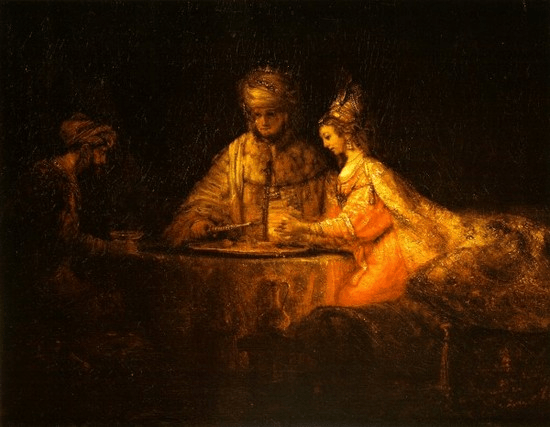
The King, Haman, and Esther, by Rembrandt van Rijn, 1660

But God, who is always awake and alert to whatever is happening in this world, had their backs. Even though the book of Esther does not once pronounce the name of God, the Lord’s influence and divine sovereignty are evident throughout the entirety of the story. 

God seems to specialize in hard cases, and in people who keep getting into trouble, despite their good intentions. And through providential means, the Lord inevitably gains the glory, and God’s people are wonderfully saved from circumstances well beyond their ability to save themselves.

Esther, a Jewish girl who became part of the king’s harem, and then the king’s wife and queen, humbly and prayerfully entered the king’s presence on behalf of her people, the Jews. Even though she was exalted to such a status, there was still the very real possibility that taking such an initiative would get Esther into deep trouble.

Yet, because of divine providence superintending the whole affair, the tables were turned, with the Jews being joyously delivered; and Haman literally finding himself at the end of his rope, on his own gallows. 

Prayer, sensitivity to God, and the humility to listen, undergirded Esther’s decision and courage to step out and act on behalf of her people. 

Especially when it comes to trouble, prayer is not optional equipment for the believer, but absolutely essential to facing each and every difficult situation. That’s because it is God, not us, nor any of our skill or ingenuity, that ultimately brings deliverance. 

Saving ourselves from impossible situations and dire circumstances is way above our pay grade; only God can bring true deliverance – the kind that genuinely changes people so that divine purposes are accomplished.

Our discouraging situations, hard cases, difficult people problems, and vexing trouble – whatever the situation – God has your back, and delights to answer our desperate pleas for help and deliverance. 

Like me, you may find yourself in trouble. But you can also find yourself with all the power of heaven behind you; and with an answer to your prayer that is beyond what you can even think or imagine.

Loving God, your Son Jesus Christ came that we might have life and have it abundantly. We humbly ask that you pour out your blessing upon our nation. Where there is illness, bring your healing touch; where there is fear, strengthen us with the knowledge of your presence; where there is uncertainty, build us up in faith; where there is dishonesty, lead us into truth; where there is discord, may we know the harmony of your love. This we are to bold to pray through Jesus Christ our Lord, who with you and the Holy Spirit are one God, now and forever. Amen.

God Will Make a Way (Exodus 2:1-10)

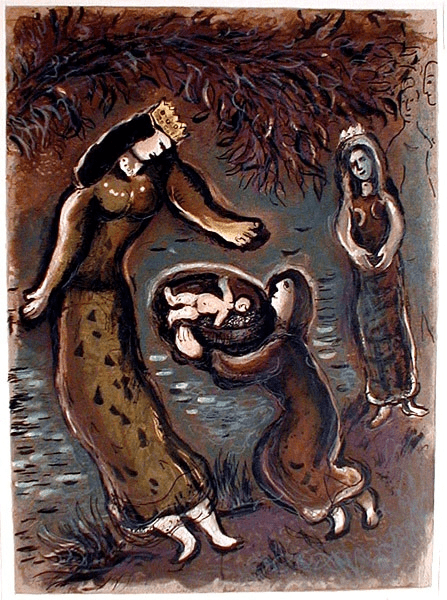
Moses is saved from the water by Pharaoh’s daughter, by Marc Chagall, 1966

Now a man from Levi’s household married a Levite woman. The woman became pregnant and gave birth to a son. She saw that the baby was healthy and beautiful, so she hid him for three months. When she couldn’t hide him any longer, she took a reed basket and sealed it up with black tar. She put the child in the basket and set the basket among the reeds at the riverbank. The baby’s older sister stood watch nearby to see what would happen to him.

Pharaoh’s daughter came down to bathe in the river, while her women servants walked along beside the river. She saw the basket among the reeds, and she sent one of her servants to bring it to her. When she opened it, she saw the child. The boy was crying, and she felt sorry for him. She said, “This must be one of the Hebrews’ children.”

Then the baby’s sister said to Pharaoh’s daughter, “Would you like me to go and find one of the Hebrew women to nurse the child for you?”

Pharaoh’s daughter agreed, “Yes, do that.” So the girl went and called the child’s mother. Pharaoh’s daughter said to her, “Take this child and nurse it for me, and I’ll pay you for your work.” So the woman took the child and nursed it. After the child had grown up, she brought him back to Pharaoh’s daughter, who adopted him as her son. She named him Moses, “because,” she said, “I pulled him out of the water.” (Common English Bible)

A new Pharaoh was enthroned in Egypt. Enough time had gone by that the legacy of Joseph as the administrator in saving many Egyptian people was lost. So, because the Israelites had grown to such large numbers, Pharaoh was afraid.

The politics of fear typically results in somebody getting oppressed. Indeed, fear became the driving force to a series of escalating oppressive policies initiated by Pharaoh, even to the point of planned infanticide. The Jewish midwives were instructed toward this end.

But the midwives did not fear the Egyptian Pharaoh. Instead they had a healthy fear of God (Exodus 1:17, 21). With such rightly ordered fear, the Jewish midwives defied the order of Pharaoh and openly disobeyed the royal command to murder Hebrew boys.

Here then, we have the setting for a special Hebrew baby to be born named Moses. He is the healthy child of two devout Levites. And although God’s name is not referenced in the verses for today, we can nonetheless see the providence and protection of the Lord within the narrative.

Through a complex chain of events, both the birth mother and the royal daughter care for this baby, protecting his life, with a divine provision for the needs of the infant Moses. Most stories in the Old Testament have contrasting characters within them, and today’s is no exception.

Pharaoh was the ruler over all of Egypt, and yet, he feared a loss of power and the status quo because of the Israelites – even though he reigned during a time of political peace, with hegemony reaching into the Middle East. As Pharaoh’s paranoid fear rose, so did God’s response of divine sovereignty over him, by providing protection against his diabolical intentions.

In contrast to Pharaoh, a powerless and non-descript Hebrew couple were married, conceived and bore a family of a daughter and two sons – Moses being the youngest. They had nothing, yet everything; whereas Pharaoh had everything, yet nothing. Thriving and flourishing has to do with a lot more than wealth and material resources.

Maternal care is powerful. And it finds a way to win the day and not only save a baby, but also to ensure that the baby grows, lives, and thrives. No royal edict can defeat the resilient strength of maternal compassion.

Despite Pharaoh’s increasing oppression, the compassion of several women ends up raising the very one who will lead the Israelites into liberation from this oppression.

With the Lord, a way will be found where there is no way. God + nothing = everything.

For us today, there is often a tendency to look back on the good old days when God did great things, and to look ahead when the Lord will return and make all things new and right. Yet we too often neglect to be mindful and live in the present moment, and know the God who is present with us right now.

We may remember the awesome deeds that God once did; and rejoice in biblical stories which demonstrate the Lord’s power, provision, and protection. We may look forward to the fulfillment of God’s promises in the person of Jesus when he returns, and gain hope from that.

Now, in this present evil age, and in this messed up world, we also have the God of the present tense. God will make a way, in this present time, where there seems to be no way. God is doing something new and amazing for us today.

And that way will be clear enough for us to know – and incredible enough for us to not predict or imagine. For God’s watch-care and deliverance can (and does) take many forms. When the Lord fulfills divine plans, it sometimes comes in the most creative and incredible way possible, so that we will have no doubt where it came from.

“God Will Make a Way” by Don Moen

God will make a way, Where there seems to be no way
He works in ways we cannot see, He will make a way for me
He will be my guide, Hold me closely to His side
With love and strength, For each new day
He will make a way He will make a way

By a roadway in the wilderness, He’ll lead me
And rivers in the desert will I see
Heaven and earth will fade
But His Word will still remain
He will do something new today

Consider Rahab (Joshua 2:15-24)

Rahab the harlot helps the Israelite spies escape from Jericho

So she [Rahab] let them [the Israelite spies] down by a rope through the window, for the house she lived in was part of the city wall [of Jericho]. She said to them, “Go to the hills so the pursuers will not find you. Hide yourselves there three days until they return, and then go on your way.”

Now the men had said to her, “This oath you made us swear will not be binding on us unless, when we enter the land, you have tied this scarlet cord in the window through which you let us down, and unless you have brought your father and mother, your brothers and all your family into your house. If any of them go outside your house into the street, their blood will be on their own heads; we will not be responsible. As for those who are in the house with you, their blood will be on our head if a hand is laid on them. But if you tell what we are doing, we will be released from the oath you made us swear.”

“Agreed,” she replied. “Let it be as you say.”

So she sent them away, and they departed. And she tied the scarlet cord in the window.

When they left, they went into the hills and stayed there three days, until the pursuers had searched all along the road and returned without finding them. Then the two men started back. They went down out of the hills, forded the river and came to Joshua son of Nun and told him everything that had happened to them. They said to Joshua, “The Lord has surely given the whole land into our hands; all the people are melting in fear because of us.” (New International Version)

A drama unfolded as the Israelites began entering and taking the Promised Land. Joshua, their leader, secretly sent two men as spies to look over the land and check out the prominent city of Jericho. The spies left and ended up in the house of a harlot named Rahab. They hid there because it had been found out they were in the city.

Rahab was able to divert and send away the pursuers who were looking for the spies, telling them that the men left, and that they should leave and go catch them. But she had actually hid them on the roof of her house.

Rahab took the spies into her home because she realized and affirmed that God was giving the land to the Israelites. Everyone in the city had heard the stories of how the Lord brought them out of Egyptian slavery and into the land of Canaan. In an insightful and beautiful confession of faith, Rahab told them:

“I know that God has given you the land. We’re all afraid. Everyone in the country feels hopeless. We heard how God dried up the waters of the Red Sea before you when you left Egypt, and what he did to the two Amorite kings east of the Jordan, Sihon and Og, whom you put under a holy curse and destroyed. We heard it and our hearts sank. We all had the wind knocked out of us. And all because of you, you and God, your God, God of the heavens above and God of the earth below.” (Joshua 2:8-11, MSG)

The men promised to show Rahab and her family mercy when they came to take the city, just as she had shown them grace in the face of trouble. So, today’s Old Testament lesson picks up the story from that point, as she sends the spies safely on their way.

That Rahab, a prostitute, is the heroine of the story is no accident or anomaly. Her profession of faith is central to the drama. She was living in the city wall, which is reflective of her status as being on the margins of society. And having strange men in her home would not have been weird in her neighborhood. It also made it rather easy to get the spies out of the city when trouble was brewing.

Most importantly, however, Rahab – the ultimate outsider in society – becomes the consummate insider. It is astonishing that a Gentile woman of disrepute has a story about her, and even told from her perspective – and not from the point of view of an Israelite man.

Rahab’s bold assertion of faith is both sincere and linked to God’s promise that the Israelites would take the land. Rahab is Exhibit A of the kind of person that inherits the kingdom of God. Rahab’s faith, not her works or reputation, is what spared her life and spared her from judgment.

Please ponder and consider that truth for a bit. Sit with it if you must – the reality that Rahab was judged neither by the spies nor God.

In far too many quarters of the Christian (and broadly religious world) judgment instead of mercy is levied to persons like Rahab. If there is anyone who should have a non-judgmental presence toward “sinners” it is Christians. And, if there is any institution which ought to consistently, both personally and through policy, display unflagging grace and forsake judgment, it is the Church.

Yet, unfortunately, as many have experienced, the Church has often fallen short of the glory of God’s grace in Christ by condemning people of ill repute. Perhaps we all need to rethink what faith truly is: not a checklist of doctrinal beliefs to sign-off on but a confident and bold action based solidly in the promises of God.

Knowing what those promises are, and living our lives appropriately in consideration of them, is the kind of faith that pleases God. Those who attempt to be judge, jury, and executioner need not apply as followers of God.

Genuine righteousness is never earned; it is given by the compassionate grace of God. So, lay hold of God’s promise of grace and mercy with gusto! Let the gracious God, who is full of steadfast love, affect the way we live our lives. Believe with a bold biblical belief that God always does what God has decreed and proclaimed to do.

Lord God, the gracious, almighty, and Holy One of all: I may have not always lived my life well, yet I trust you today that you can and will deliver me from all my troubles because you are with me. May your Holy Spirit give me the gift of faith to believe in such a way that forever impacts how I live my life in service to you and for the common good of all persons – no matter who they are. Amen.