Real vs. Delusional (2 Kings 22:29-40, 51-53)

So the king of Israel and Jehoshaphat king of Judah went up to Ramoth Gilead. The king of Israel said to Jehoshaphat, “I will enter the battle in disguise, but you wear your royal robes.” So the king of Israel disguised himself and went into battle.

Now the king of Aram had ordered his thirty-two chariot commanders, “Do not fight with anyone, small or great, except the king of Israel.” When the chariot commanders saw Jehoshaphat, they thought, “Surely this is the king of Israel.” So they turned to attack him, but when Jehoshaphat cried out, the chariot commanders saw that he was not the king of Israel and stopped pursuing him.

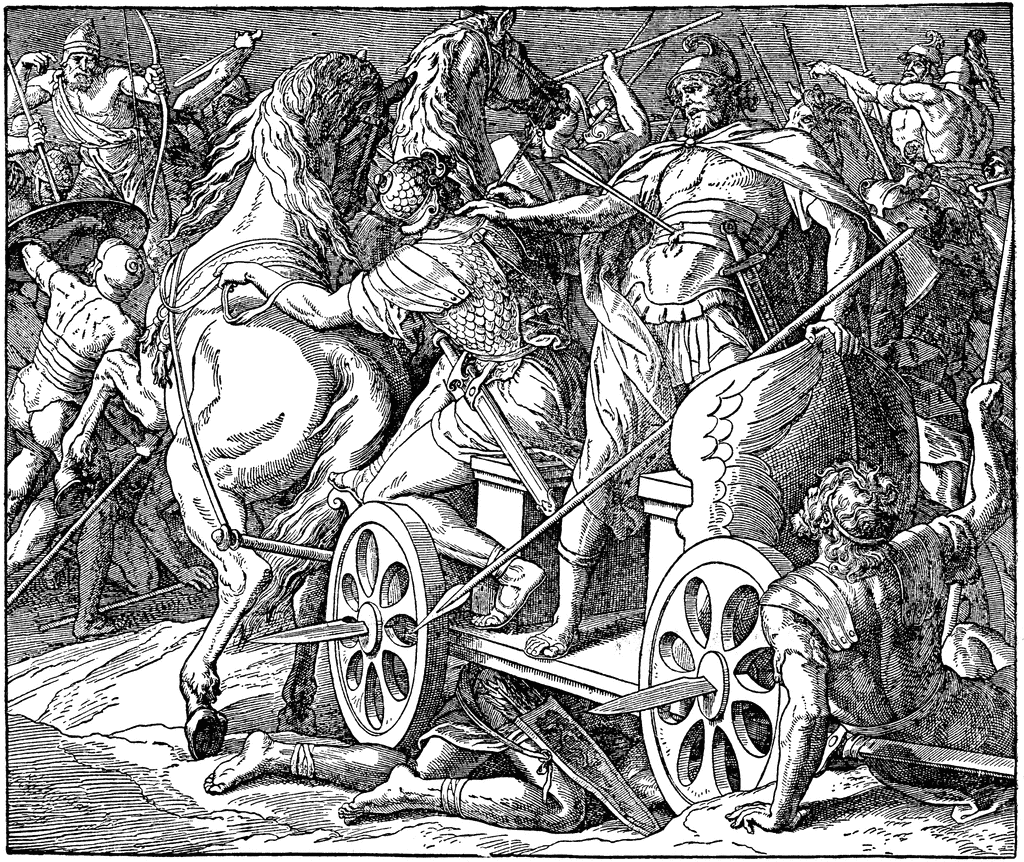
But someone drew his bow at random and hit the king of Israel between the sections of his armor. The king told his chariot driver, “Wheel around and get me out of the fighting. I’ve been wounded.” All day long the battle raged, and the king was propped up in his chariot facing the Arameans. The blood from his wound ran onto the floor of the chariot, and that evening he died. As the sun was setting, a cry spread through the army: “Every man to his town. Every man to his land!”

So the king died and was brought to Samaria, and they buried him there. They washed the chariot at a pool in Samaria (where the prostitutes bathed), and the dogs licked up his blood, as the word of the Lord had declared.

As for the other events of Ahab’s reign, including all he did, the palace he built and adorned with ivory, and the cities he fortified, are they not written in the book of the annals of the kings of Israel? Ahab rested with his ancestors. And Ahaziah his son succeeded him as king….

Ahaziah son of Ahab became king of Israel in Samaria in the seventeenth year of Jehoshaphat king of Judah, and he reigned over Israel two years. He did evil in the eyes of the Lord, because he followed the ways of his father and mother and of Jeroboam son of Nebat, who caused Israel to sin. He served and worshiped Baal and aroused the anger of the Lord, the God of Israel, just as his father had done. (New International Version)

The Death of Ahab, by Julius Schnoor von Carolsfeld (1794-1872)

Whenever someone ignores or tries to get around reality, we call such a person “delusional.” It seems that the more power and authority a person possesses, the easier it is to delude themselves into thinking they can manipulate events in their favor. They then tend to listen only to what they want to hear.

King Ahab of Israel was delusional. He, like so many kings before and after him, was focused on the externals of personal power, accumulating more wealth, and exploring alternative religions. It all led to a twisted view of reality, as well as a prophetic demise.

Identifying so much with externalities, to the detriment of the internalities, is the ultimate bogus approach to life. It never ends well. Instead of exploring the image of God within himself and others, ensuring justice for all his subjects, and using his power to provide for the common good of all Israel, King Ahab went the spiritually and emotionally insecure route of listening to the wrong people.

Insecure and delusional people only listen to what is positive; and they eschew any negatives in their life. This is why the biblical prophets throughout Old Testament history typically found themselves at loggerheads, in prison, or at the end of a spear from those in power.

Ahab feigned wanting to hear what is true, but when hearing any negative aspects, he wrongly believed he could get around reality through his earthly authority and personal ingenuity. But he couldn’t. No one can outdo the stronger unseen forces in this world. (1 Kings 22:1-28)

So, Ahab laid a delusional plan to disguise himself as an ordinary soldier in battle. But although he chose to go against prophetic truth, there was no way to ignore the reality of it.

The providence and purposes of God prevail in any and all circumstances – no matter what they are. Today’s story highlights a seemingly random arrow from an enemy solider, hitting Ahab in the precise spot which could penetrate his armor.

The king was wounded and had to leave the battle. Yet, Ahab stuck to his delusional world, having his men prop him up in his chariot so that he could watch events unfolding in front of him.

Even in his powerlessness, King Ahab could not bring himself to believe that things could be different than he planned. He died at the end of the day, still stuck in his delusional and insecure world.

The editor of the Book of Kings summarized Ahab’s reign by mentioning impressive external improvements to his palace and fortified cities. Yet, these are mere incidentals. The real – and not delusional – assessment of the king’s life is that he was a religious apostate and a moral reprobate.

In the end, Ahab was nothing more than a weak and insecure individual who compromised God’s ethical law and sought to control events for his own misguided purposes. He followed Yahweh only if it aligned with his own plans.

Furthermore, it’s sad that Ahab’s approach to life, and his behavior toward others, was reflective of the Israelite nation as a whole (2 Kings 17:7-17). His own death eerily foreshadowed the death of Israel.

In our own era of incompetent leadership, morally inferior leaders, and delusional administrations, it behooves every concerned and pious believer to pray for all those in authority.

This side of heaven, there will always be cultural and societal pressures to conform to external pride, wealth, and success. But this is not the believer’s call, to take it’s cues from worldly power. Our focus is on consistently and patiently doing what is good, right, and just – accepting the unseen real over the seen delusion.

Rather than trying to continually manipulate events for our own shortsighted purposes, we must persevere in spurring-on one another to love and good deeds (Hebrews 10:24). For only together, as the one people of God, can we resist and subvert the machinations of delusional leaders.

O Lord God, Ruler of all, and whose glory exists in all the world: We commend nations and their leaders to Your divine providence, so that we may dwell secure in Your peace.

Grant to everyone in authority everywhere the wisdom and strength to know and do Your will. Fill them with the love of truth and justice; and make them mindful of their calling to serve all people with respect and reverence; through Jesus Christ our Lord, who lives and reigns with You and the Holy Spirit, one God, world without end. Amen.

Divine Providence (Esther 1:1-20)

The Refusal of Vashti, by Gustave Doré (1832-1883)

These events happened in the days of King Xerxes, who reigned over 127 provinces stretching from India to Ethiopia. At that time Xerxes ruled his empire from his royal throne at the fortress of Susa. In the third year of his reign, he gave a banquet for all his nobles and officials. He invited all the military officers of Persia and Media as well as the princes and nobles of the provinces. The celebration lasted 180 days—a tremendous display of the opulent wealth of his empire and the pomp and splendor of his majesty.

When it was all over, the king gave a banquet for all the people, from the greatest to the least, who were in the fortress of Susa. It lasted for seven days and was held in the courtyard of the palace garden. The courtyard was beautifully decorated with white cotton curtains and blue hangings, which were fastened with white linen cords and purple ribbons to silver rings embedded in marble pillars. Gold and silver couches stood on a mosaic pavement of porphyry, marble, mother-of-pearl, and other costly stones.

Drinks were served in gold goblets of many designs, and there was an abundance of royal wine, reflecting the king’s generosity. By edict of the king, no limits were placed on the drinking, for the king had instructed all his palace officials to serve each man as much as he wanted.

At the same time, Queen Vashti gave a banquet for the women in the royal palace of King Xerxes.

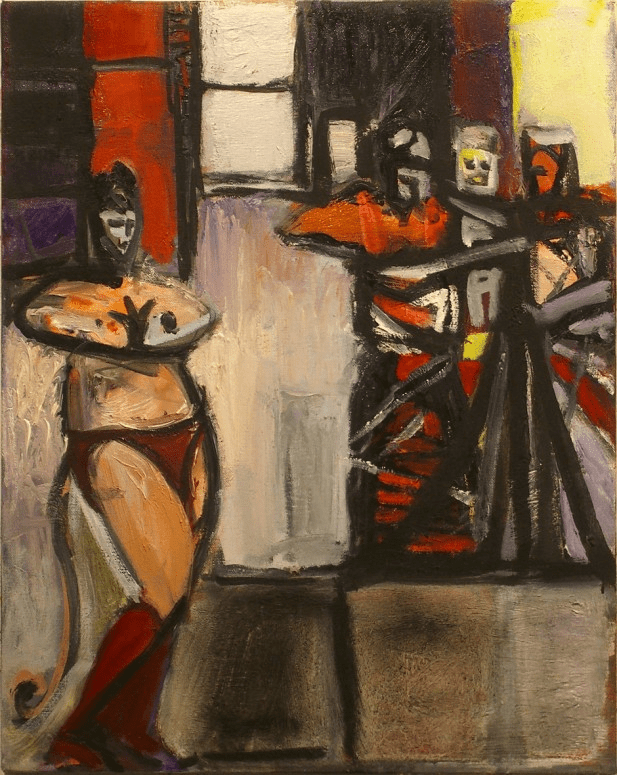
On the seventh day of the feast, when King Xerxes was in high spirits because of the wine, he told the seven eunuchs who attended him—Mehuman, Biztha, Harbona, Bigtha, Abagtha, Zethar, and Carcas—to bring Queen Vashti to him with the royal crown on her head. He wanted the nobles and all the other men to gaze on her beauty, for she was a very beautiful woman. But when they conveyed the king’s order to Queen Vashti, she refused to come. This made the king furious, and he burned with anger.

He immediately consulted with his wise advisers, who knew all the Persian laws and customs, for he always asked their advice. The names of these men were Carshena, Shethar, Admatha, Tarshish, Meres, Marsena, and Memucan—seven nobles of Persia and Media. They met with the king regularly and held the highest positions in the empire.

“What must be done to Queen Vashti?” the king demanded. “What penalty does the law provide for a queen who refuses to obey the king’s orders, properly sent through his eunuchs?”

Memucan answered the king and his nobles, “Queen Vashti has wronged not only the king but also every noble and citizen throughout your empire. Women everywhere will begin to despise their husbands when they learn that Queen Vashti has refused to appear before the king. Before this day is out, the wives of all the king’s nobles throughout Persia and Media will hear what the queen did and will start treating their husbands the same way. There will be no end to their contempt and anger.

“So if it please the king, we suggest that you issue a written decree, a law of the Persians and Medes that cannot be revoked. It should order that Queen Vashti be forever banished from the presence of King Xerxes, and that the king should choose another queen more worthy than she. When this decree is published throughout the king’s vast empire, husbands everywhere, whatever their rank, will receive proper respect from their wives!”

The king and his nobles thought this made good sense, so he followed Memucan’s counsel. (New Living Translation)

Vashti Refuses, by Richard McBee

The Jews were living in exile. The Babylonian Empire had taken Jerusalem, destroyed the temple, and exiled many of the people to Babylon. Later, the Medes and Persians conquered Babylon and ruled over a vast area of many different peoples.

The story of Esther begins with the story of King Xerxes and Queen Vashti. They were the most powerful people in the world, at that time. This meant that Vashti had more power and authority than any woman on earth, at that time.

Although most women had few rights, Vashti was not one of them. However, when it came to the king, the queen was most definitely second fiddle.

Today, we can understand Vashti’s response to Xerxes. But back then, it was unthinkable. It wasn’t only Xerxes who ruled the land; misogyny did, as well.

Queen Vashti appears in the story as a strong-willed independent woman of power. While the king and queen were each having their respective parties, things started to go sideways.

No limits on the bar meant unlimited drinking. A drunk King Xerxes had one of those moments that seemed logical to the inebriated mind, but was actually nonsensical. He insisted that his queen stop her celebration, leave her guests, get all gussied up in her royal accoutrements, and parade around for a bunch of drunk guys to gawk at.

As readers of the story, we can tell this is not going to have a good ending for Vashti. She was in an impossible situation. She could submit and face humiliation, or worse. So, the queen chose not to abide by the king’s order.

Little did Vashti know that she was paving the way for a new queen to ascend to the side of King Xerxes. The extreme action of Xerxes attempting to use his queen then turned into another action of consulting his advisors and deposing the queen. Vashti was banned from the court, and the kingdom.

Hence, events were set in motion to find a new queen. As the story unfolds, Esther is a young Jewish woman living in this forced diaspora of the Persian Empire. Little did she know that Vashti’s fall was the beginning of her own rise.

“So the last will be first, and the first will be last.”

Jesus (Matthew 20:16)

Although the story of Esther never mentions the word “God,” we see an incredible Providence guiding events through the biblical book of Esther. Young Esther found favor with the king, became queen, and risked her life to save the Jewish people from destruction.

Esther’s story is the Jewish story – a tale of others pronouncing pogroms upon them and attempting to rid themselves of these others who live strangely and differently. But a champion arises; one who bring deliverance.

The Jewish story is one of resilience as a people throughout the millennia. Rather than ignoring, or worse, persecuting Jews, we can observe how they have had to deal with the enduring issues of perseverance through suffering; preserving their identity; and ensuring their survival in the middle of social and cultural pressures.

We also see that just because one is in the courts of power and is not one of the peoples who is persecuted, does not necessarily mean that there is an exemption from harm. Vashti was a powerful woman, but her power didn’t last.

In the end, Vashti was treated more like an oppressed Jew than a privileged Gentile; and Esther would move from powerless to powerful.

And from a Christian perspective, we can see Jesus as the Savior who puts himself at risk to save the world from sin, death, and hell.

And let us run with perseverance the race marked out for us, fixing our eyes on Jesus, the pioneer and perfecter of faith. (Hebrews 12:1b-2a, NIV)

We can, as well, observe that God is not fazed by any big earthly political power. The Lord sees all, knows all, and has the authority to do something about injustice and accomplishing just purposes on this earth.

O God, your never-failing providence sets in order all things both in heaven and earth: Put away from us, we entreat you, all hurtful things, and give us those things which are profitable for us; through Jesus Christ our Lord, who lives and reigns with you and the Holy Spirit, one God, for ever and ever. Amen.

Avoid an Ambush (Acts 23:12-35)

The next morning some Jews formed a conspiracy and bound themselves with an oath not to eat or drink until they had killed Paul. More than forty men were involved in this plot. They went to the chief priests and the elders and said, “We have taken a solemn oath not to eat anything until we have killed Paul. Now then, you and the Sanhedrin petition the commander to bring him before you on the pretext of wanting more accurate information about his case. We are ready to kill him before he gets here.”

But when the son of Paul’s sister heard of this plot, he went into the barracks and told Paul.

Then Paul called one of the centurions and said, “Take this young man to the commander; he has something to tell him.” So he took him to the commander.

The centurion said, “Paul, the prisoner, sent for me and asked me to bring this young man to you because he has something to tell you.”

The commander took the young man by the hand, drew him aside and asked, “What is it you want to tell me?”

He said: “Some Jews have agreed to ask you to bring Paul before the Sanhedrin tomorrow on the pretext of wanting more accurate information about him. Don’t give in to them, because more than forty of them are waiting in ambush for him. They have taken an oath not to eat or drink until they have killed him. They are ready now, waiting for your consent to their request.”

The commander dismissed the young man with this warning: “Don’t tell anyone that you have reported this to me.”

Then he called two of his centurions and ordered them, “Get ready a detachment of two hundred soldiers, seventy horsemen and two hundred spearmen[a] to go to Caesarea at nine tonight. Provide horses for Paul so that he may be taken safely to Governor Felix.”

He wrote a letter as follows:

Claudius Lysias,

To His Excellency, Governor Felix:

Greetings.

This man was seized by the Jews and they were about to kill him, but I came with my troops and rescued him, for I had learned that he is a Roman citizen. I wanted to know why they were accusing him, so I brought him to their Sanhedrin. I found that the accusation had to do with questions about their law, but there was no charge against him that deserved death or imprisonment. When I was informed of a plot to be carried out against the man, I sent him to you at once. I also ordered his accusers to present to you their case against him.

So the soldiers, carrying out their orders, took Paul with them during the night and brought him as far as Antipatris. The next day they let the cavalry go on with him, while they returned to the barracks. When the cavalry arrived in Caesarea, they delivered the letter to the governor and handed Paul over to him. The governor read the letter and asked what province he was from. Learning that he was from Cilicia, he said, “I will hear your case when your accusers get here.” Then he ordered that Paul be kept under guard in Herod’s palace. (New International Version)

An “ambush” is a sudden and unexpected attack from a concealed position. In the Apostle Paul’s case, there were those looking to ambush in order to kill him.

Some Jerusalem Jews were determined to be rid of Paul. They demonstrated their commitment by taking a solemn oath to not eat or drink until they killed the Apostle – which has always made me wonder, when I read this story, if the plotters starved to death, or not, when the ambush was foiled.

In retrospect, I hope the would-be assassins saw how stupid it is – in more ways than one – to make an oath of killing someone.

Maybe even more nonsensical is that the oath-takers presented their plan to the Sadducees (the Jewish chief priests and elders) who endorsed the whole thing, signed-off on it, and actually participated in it.

I’ll just make the historical observation that the Sadducees no longer exist today; and they haven’t since the destruction of the Temple in 70 C.E. I grew up with an old rural folk saying that essentially said, “Dumb dogs die young.”

In the end, the nefarious plan of the Jerusalem Jews was foiled by Paul’s nephew. The young lad caught onto the conspiracy, reported it to Uncle Paul, and then to the Roman authorities.

The Roman commander lost no time in providing an impressive display of security in transporting Paul to Ceasarea. There, the Roman official Felix received him, along with a letter from the commander.

Once in Ceasarea, Felix promised Paul a fair hearing when his accusers arrived. In the meantime, Paul was kept under house arrest. The planned ambush was thus averted, and Paul was securely in Roman custody.

Unfortunately, there are people in this world who twist even their own religious ethics in order to justify violence – going so far as to ambush an innocent person to prevent an unwanted agenda (in this case, the Christian faith) from making inroads into society.

It will not do for any of us to believe that we are immune from trouble in the form of an ambush – whether the ambush is a literal physical one, or mental, emotional, or spiritual.

Gaslighting is a sinister form of mental ambush; a group bullying and threatening an individual is a horrible emotional ambush; and I personally have been the victim of, or diverted, many a spiritual ambush from disgruntled parishioners over the years who wanted my ministry finished.

Yet, many of our emotional ambushes are much more subtle. We might not realize, until later, that we’ve been had by one. Many times the ambush is couched in language of flattery, such as:

  • “We’re depending on you.”
  • “You’re the only one who can do this.”
  • “You did such a good job last time.”
  • “I’m counting on you.”

Or the statements can be more blunt:

  • “Don’t mess this up. A lot is riding on you.”
  • “If you don’t do it, everyone will be disappointed; everything will go to hell.”
  • “You’ve done it before. You have to do it again.”
  • “Don’t make me look bad, or else.”

Please remember the following whenever you find yourself in the crosshairs of an ambush:

  1. You are under no obligation to do whatever another person says.
  2. Take a deep breath and respond from the core of your being instead of from your fear and anxiety.
  3. There are 7 billion people on this earth. Everything doesn’t depend on you.
  4. You have the freedom to say, “No,” without having to explain why or justify it.
  5. Call a spade a spade. If you walk into an ambush, call it for what it is, and report it to the proper persons. It’s really okay to do that.

The more we can connect with what is of most value to us, the greater we can make decisions we’re able to live with, even in the moment.

What’s more, it’s possible to prepare ahead of time for a potential ambush, simply through consistent daily growth in wisdom and knowledge.

Be safe. Be strong. Be spiritual. We are all in this life together.