Exodus 3:16-25 – A Great Reversal

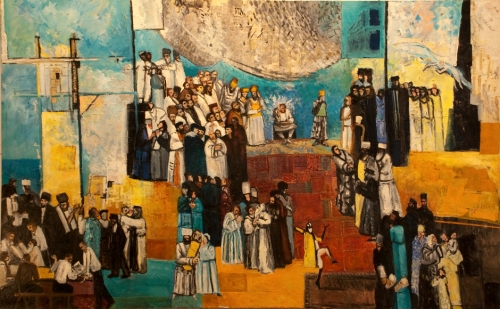
Moses and the Children of Israel by Richard McBee
“Moses and the Children of Israel” by Richard McBee

“Go, assemble the elders of Israel and say to them, ‘The Lord, the God of your fathers—the God of Abraham, Isaac and Jacob—appeared to me and said: I have watched over you and have seen what has been done to you in Egypt. And I have promised to bring you up out of your misery in Egypt into the land of the Canaanites, Hittites, Amorites, Perizzites, Hivites and Jebusites—a land flowing with milk and honey.’ 

“The elders of Israel will listen to you. Then you and the elders are to go to the king of Egypt and say to him, ‘The Lord, the God of the Hebrews, has met with us. Let us take a three-day journey into the wilderness to offer sacrifices to the Lord our God.’ But I know that the king of Egypt will not let you go unless a mighty hand compels him. So, I will stretch out my hand and strike the Egyptians with all the wonders that I will perform among them. After that, he will let you go. 

“And I will make the Egyptians favorably disposed toward this people, so that when you leave you will not go empty-handed. Every woman is to ask her neighbor and any woman living in her house for articles of silver and gold and for clothing, which you will put on your sons and daughters. And so, you will plunder the Egyptians.” (NIV) 

Moses spent forty years in the back side of the desert tending sheep. The first forty years were lived in the most powerful place on earth at the time, Egypt. Although Moses had a privileged position, he forsook his place to be in solidarity with the enslaved Israelites. With a skewed sense of timing and method, he slew a cruel Egyptian, and was forced to flee into the desert. 

The time eventually became ripe, and God was on the move. At eighty years old, God called Moses out of the desert and back to Egypt. The deliverance was going to be accomplished according to God’s designs and purposes, and not from the impetuous actions of a younger Moses. God knew exactly what he was doing and put Moses on a course which would strike at the heart of imperial Egypt and bring freedom to millions of slaves. 

Today’s story is laced thick with divine promises. After all, it is the promises of God which give people hope and a future. Referring to himself as the God of Abraham, Isaac, and Jacob, the Lord connects the generations-long covenant promise to the Israelites and reminded them they are not forgotten. God’s covenant has neither disappeared nor changed; it still exists. While the Jews were languishing in slavery, God was not aloof but watching – carefully inspecting, caring, and paying close attention. 

The inheritance of the Promised Land was coming, and it would be realized. God affirmed the covenant, knowing the plans he has for them – plans to give them abundance and joy. And God knew full well that dislodging the Israelites from Egypt would take some work, since Pharaoh relied so heavily on slave labor to support his massive imperial state. 

You, like me, have likely noticed that God tends to move rather slow by our standards. We might question and wonder about so much injustice going unabated for so long. Yet, that is our perspective of things, not God’s. Whereas we often have our own self-interest at mind, the Lord has the concern of an entire world. God is patient and long-suffering, providing full opportunity for both individual and national repentance. The Lord is on the lookout for people to amend their errant ways and return to their true purpose for living. He only judges at the proper time. 

And when that time comes, look out! Nothing can stand in the way of God’s good plans for the earth. The ancient Egyptians had built an empire on the backs of slavery, and everything went into supporting the power and wealth of the state. God was not okay with this situation. As he had done many times before, the Lord would thoroughly dismantle and destroy the powerful system of oppression. God is the expert at flip-flopping the status of people – the slaves become free, and the free are bound; the hated become favored, and those who enjoyed all the perks of power and privilege become the despised. 

Embracing God’s upside-down kingdom means advocating for justice, righteousness, and holiness for all people, not just a select few whom I like. Jesus, over 1,500 years after Moses and the exodus from Egypt, had this to say: 

“Those who are last now will someday be first, and those who are first now will someday be last.” (Matthew 20:16, NCV) 

“Blessed are you who are poor, 
    for yours is the kingdom of God. 
“Blessed are you who are hungry now, 
    for you will be filled. 
“Blessed are you who weep now, 
    for you will laugh. 

“Blessed are you when people hate you, and when they exclude you, revile you, and defame you on account of the Son of Man. Rejoice in that day and leap for joy, for surely your reward is great in heaven; for that is what their ancestors did to the prophets. 

“But woe to you who are rich, 
    for you have received your consolation. 
“Woe to you who are full now, 
    for you will be hungry. 
“Woe to you who are laughing now, 
    for you will mourn and weep. 

“Woe to you when all speak well of you, for that is what their ancestors did to the false prophets. (Luke 6:20-26, NRSV) 

And the Apostle Paul said to the Church: 

“For our present troubles are small and won’t last very long. Yet they produce for us a glory that vastly outweighs them and will last forever!” (2 Corinthians 4:17, NLT) 

The New Testament references are not meant to sanitize or put a positive spin on the very real suffering that so many people have endured both past and present. It is, however, meant to lift-up the reality that we have a sure and certain hope. Our trust in the promises and presence of God will eventually be realized and gives shape to how we live today in persistent prayers with patience and perseverance. 

So, may the Lord of all creation bless and protect you. May the Lord show you mercy and kindness in your affliction. And, may the Lord be good to you and give you peace. Amen. 

Psalm 17:1-7, 15 – Hear My Prayer!

Lament

Lord, hear my prayer for justice.
I am calling loudly to you.
I am being honest in what I say,
so please listen to my prayer.
You will make the right decision,
because you can see the truth.
You were with me all night
and looked deep into my heart.
You questioned me and found that
I did not say or do anything wrong.
Unlike most people, I have obeyed your commands,
so I have never been like those who are cruel and evil.
I have followed your way.
My feet never left your path.
Every time I call to you, God, you answer me.
So listen to me now, and hear what I say.
Show your amazing kindness
and rescue those who depend on you.
Use your great power
and protect them from their enemies.

I have done only what is right, so I will see your face….
And seeing you, I will be fully satisfied. (ERV)

This is one of David’s personal psalms of lament.  It is a prayer forged during a time of severe adversity with enemies who sought to snuff-out his life.  The psalm is a plea uttered with the hope that God would indeed vindicate him and subdue those who wanted to harm him.  It is a lament that wickedness exists and often gets its way; and, it is grief over the constant threats that swirled around David.

It was David’s prayer that with all the heartless and arrogant violence continually in his life that God would keep him as the apple of his eye and hide him in the shadow of his wings. Indeed, perhaps no better prayer could be said in those times when there are people who make untrue accusations and only wish harm to be done to you, that God would be gracious, merciful, and kind through rescuing us from both bodily harm and spiritual abuse.  It is in the times when angry simpletons spew their worst that we need to confidently know that God watches over his people with affection and cares for them as a mother hen protects her chicks.

You and I are precious to God.  We can and ought to run to him when there is trouble and feel no shame in loudly crying for fairness and justice.  The Lord is a benevolent God showing firm commitment to those who seek truth, loving actions, and merciful words.  When going through a difficult time in which another or others accuse you of wrongdoing and you know you are innocent, the proper prescription is to pray this very psalm repeatedly at night before bed.  For we all know that sleep can be elusive and hard to come by in such circumstances.  Perhaps, along with David, you will be able to say: I have done what is right. I will see your face. I will be fully satisfied.

Arise, Lord God Almighty!  Deliver my soul from the wicked and subdue them!  I seek refuge in you, O Savior; show me your steadfast love as I cry out to you for justice.  Incline your ear to hear me, and answer when I call through the name of Jesus Christ in the power of the Holy Spirit.  Amen.

Genesis 31:22-42 – On the Run

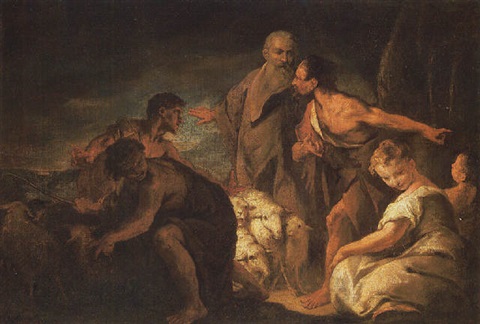
Jacob and Laban by Nicola Grassi
Jacob and Laban by Italian painter Nicola Grassi (1682-1748)

On the third day Laban was told that Jacob had fled. Taking his relatives with him, he pursued Jacob for seven days and caught up with him in the hill country of Gilead. Then God came to Laban the Aramean in a dream at night and said to him, “Be careful not to say anything to Jacob, either good or bad.”

Jacob had pitched his tent in the hill country of Gilead when Laban overtook him, and Laban and his relatives camped there too. Then Laban said to Jacob, “What have you done? You’ve deceived me, and you’ve carried off my daughters like captives in war. Why did you run off secretly and deceive me? Why didn’t you tell me, so I could send you away with joy and singing to the music of timbrel and harp? You didn’t even let me kiss my grandchildren and daughters goodbye. You have done a foolish thing. I have the power to harm you; but last night the God of your father said to me, ‘Be careful not to say anything to Jacob, either good or bad.’ Now you have gone off because you longed to return to your father’s household. But why did you steal my gods?”

Jacob answered Laban, “I was afraid, because I thought you would take your daughters away from me by force. But if you find anyone who has your gods, that person shall not live. In the presence of our relatives, see for yourself whether there is anything of yours here with me; and if so, take it.” Now Jacob did not know that Rachel had stolen the gods.

So, Laban went into Jacob’s tent and into Leah’s tent and into the tent of the two female servants, but he found nothing. After he came out of Leah’s tent, he entered Rachel’s tent. Now Rachel had taken the household gods and put them inside her camel’s saddle and was sitting on them. Laban searched through everything in the tent but found nothing.

Rachel said to her father, “Don’t be angry, my lord, that I cannot stand up in your presence; I’m having my period.” So, he searched but could not find the household gods.

Jacob was angry and took Laban to task. “What is my crime?” he asked Laban. “How have I wronged you that you hunt me down? Now that you have searched through all my goods, what have you found that belongs to your household? Put it here in front of your relatives and mine and let them judge between the two of us.

“I have been with you for twenty years now. Your sheep and goats have not miscarried, nor have I eaten rams from your flocks. I did not bring you animals torn by wild beasts; I bore the loss myself. And you demanded payment from me for whatever was stolen by day or night. This was my situation: The heat consumed me in the daytime and the cold at night, and sleep fled from my eyes. It was like this for the twenty years I was in your household. I worked for you fourteen years for your two daughters and six years for your flocks, and you changed my wages ten times. If the God of my father, the God of Abraham, and the Fear of Isaac, had not been with me, you would surely have sent me away empty-handed. But God has seen my hardship and the toil of my hands, and last night he rebuked you.” (NIV)

Jacob’s in-law issues did not magically disappear when he sneaked out of town with his entire family. I am glad God is faithful and acts on our behalf even when we are fearful with little faith. Far too often we do the right thing in the wrong way. It is far too easy to run away from people we don’t like. Yet, it is rarely so simple. Sometimes we plain need divine intervention to deal with people in our lives.

To Jacob’s credit, he obeyed God and headed back to the land of Canaan. However, he did it in a deceitful way which avoided confrontation. Out of fear of facing his father-in-law Laban and the worry of what might happen, Jacob got out of Dodge. It seems Jacob’s wife Rachel also acted out of fear by taking her father’s idols. Fear can cause us to have some skewed ideas and do some stupid things which get us in trouble.

“According to most studies, people’s number one fear is public speaking. Number two is death. Death is number two. Does that sound right? This means to the average person, if you go to a funeral, you’re better off in the casket than doing the eulogy.” –Jerry Seinfeld

Laban found out what was going on with Jacob and was anything but a happy camper. He went after the upstart Jacob with gusto and finally caught up to him. Despite having the power and ability to deal severely with Jacob, Laban backs off because Jacob finally found his voice and took his father-in-law to task. Embedded in Jacob’s rehearsal of their relationship is the God who intervened and took care of Jacob when Laban didn’t.

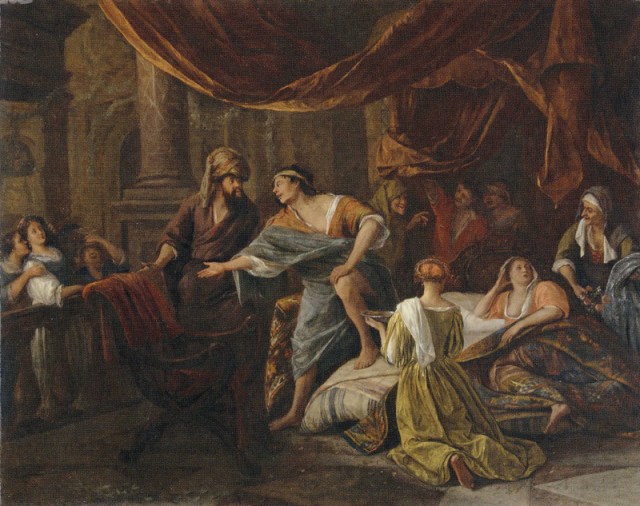
Jacob Confront Laban by Jan Steen, 1669
Jacob Confronts Laban by Dutch painter Jan Steen, 1669

The lengthy dialogue between Jacob and Laban was a power struggle: Laban wanted to keep the status quo authority as family head over Jacob’s family; but Jacob asserted himself as having his own distinct household.  In the end, they ended-up on equal footing because of God’s intervention.  Whereas Laban had his own intentions for Jacob and his family, God had other plans.  It was God who enriched Jacob with a wealth of flocks and herds, even as he was being oppressed and intimidated by Laban.

The same God, who was with Jacob, is with you and me:

  • God is with us through difficulty, oppression, and injustice.

Now, it is commendable if, because of one’s understanding of God, someone should endure pain through suffering unjustly. But what praise comes from enduring patiently when you have sinned and are beaten for it? But if you endure steadfastly when you’ve done good and suffer for it, this is commendable before God. (1 Peter 2:19-20, CEB)

  • God does not give up on his people. We Christians are often living contradictions, like Jacob, who acknowledge God and give him glory but at the same time act out of fear and insecurity. Out of the compost of human sin, the sovereign God accomplishes his will.

Christ died for us when we were unable to help ourselves. We were living against God, but at just the right time Christ died for us… while we were still sinners, and by this God showed how much he loves us. (Romans 5:6, 8, ERV)

  • God cares both about what we do, and about why and how we do it. Ethics is the difference between morality and legality; and, between what I ought to do, and what is required of me. Jacob did what was demanded of him by God; yet, he did it out of fear along with unwise methods.

Anything that is not done in faith is sin. (Romans 14:23b, GW)

  • God’s intervention is needed. Without divine help, we are hopelessly lost. Furthermore, we continue to need God so we can deal with the unpredictable attempts of others to control us and push us into a mold outside of trusting in God.

Give all your worries to God because he cares about you. (1 Peter 5:7, NCV)

  • God instills confidence in us. After twenty hard years of service, Jacob returned to the land of Canaan prosperous and more confident in God than ever. Jacob’s trials with Laban gave him a growing sense of dependence on God. Jacob struggled, suffered, and endured – and came out the stronger for it.

You know that when your faith is tested, your endurance has a chance to grow. So, let it grow, for when your endurance is fully developed, you will be perfect and complete, needing nothing. (James 1:3-4, NRSV)

God loves us enough to not always give us an easy out because he is concerned for our walk of faith and our education in grace. So, may you discover the intervening God and exercise trust through those times when others give you a hard time.

God, grant me the serenity to accept the things I cannot change, the courage to change the things I can, and the wisdom to know the difference. Living one day at a time, enjoying one moment at a time; accepting hardship as a pathway to peace; taking, as Jesus did, this sinful world as it is, not as I would have it; trusting that You will make all things right if I surrender to Your will; so that I may be reasonably happy in this life and supremely happy with You forever in the next. Amen.  –The Serenity Prayer by Reinhold Niebuhr, 1951

Isaiah 25:1-5 – Against Violence

“Violence brings only temporary victories; violence, by creating many more social problems than it solves, never brings permanent peace”. —Martin Luther King, Jr.

AgainstViolence

Lord, you are my God.
I honor you and praise you,
because you have done amazing things.
You have always done what you said you would do;
you have done what you planned long ago.
You have made the city a pile of rocks
and have destroyed her walls.
The city our enemies built with strong walls is gone;
it will never be built again.
People from powerful nations will honor you;
cruel people from strong cities will fear you.
You protect the poor;
you protect the helpless when they are in danger.
You are like a shelter from storms,
like shade that protects them from the heat.
The cruel people attack
like a rainstorm beating against the wall,
like the heat in the desert.
But you, God, stop their violent attack.
As a cloud cools a hot day,
you silence the songs of those who have no mercy. (NCV)

These wonderful words of celebration were uttered not in a time of peace and plenty but in an era of hardship and loss. It seems the Jewish people have always faced a plethora of others who would rather see them wiped off the face of the map than existing with their own customs and religion. It was in one of those times of experiencing problems from Gentiles that this poem was crafted. It is precisely in the adverse times that we need to flee to the open arms of God and enjoy the divine embrace of security. In the sixteenth century, John Calvin reflected on these verses:

“When our minds are perplexed by a variety of uneasy thoughts on account of numerous distresses and afflictions which happen daily, we ought immediately to resort to God, and rely on his providence; for even the smallest calamities will overwhelm us, if we do not betake ourselves to him.”

God Almighty is the One who intervenes on behalf of the poor and helpless. The Lord God is the divine Protector who hears the voice of those overwhelmed with a crushing load of hard circumstances. The great “I AM” is the ultimate refuge and shelter for the vulnerable who possess no resources of their own. There is no bully, whether in the form of a person, an institution, or a government which can stand against the God who bends his ear to listen on behalf of the forgotten and the faint-hearted. Brutality and arrogance might touch our lives, yet it is the Lord to whom all those who exploit others must give an account. The violent, using cruelty and ruthlessness, shall not survive under the shadow of the Almighty God.

The poor and the needy may have no apparent chance against abusive persons and systems of the world. However, no power on earth can take on the Ruler and Sustainer of all creation and expect to have their way. God is the defender of the powerless. He specializes in tearing down the walls of oppression and lifting-up those in need of mercy.

So, then, I shall be explicit about the ancient and almighty God and our present circumstances:

  • Pandemic is a ruthless enemy which knows no pity from both rich and poor, the healthy and unhealthy; and, God is a merciful Deliverer who transcends all disease.
  • Poverty is a cruel master which is never satisfied; and, God is benevolent, bringing both spiritual and material satisfaction to life.
  • Patience is a virtue exemplified and amplified through the divine who desires to see all persons realize new life; and, impatience is a vice of the arrogant who demand their needs be met immediately without any regard to the common good of all.
  • Peace is a harmonious and wholehearted life gifted by God, even despite the surrounding storms of hardship; and, pride is the stance of the privileged who either cannot or will not see those who are underprivileged, and, so, they live in a constant state of unrest and disunity.

Wherever you find people speaking of their individual rights without emphasizing their communal responsibilities, there you will find a situation ripe for God to destroy the walls built by the selfish in order to create a safe place for the afflicted.

The Lord will silence the songs of the unmerciful; and, shall allow the shouts of the ones crying out for mercy to be heard. And he will do it in his own good time and grace.

Lord Jesus Christ, we thank you that through your death on the cross you disarmed the powers of evil. Help us, we pray you, to enter your resurrection victory and to stand in your authority against all evil. Send forth your light and your truth. Bring to light the deeds of darkness and let plans of violence be revealed. Through the power of Holy Spirit, almighty God, disarm every evil power and influence in your good world; and, bring loving connection where there is hatred and cruelty. Amen.