Remember Your Baptism (Matthew 3:13-17)

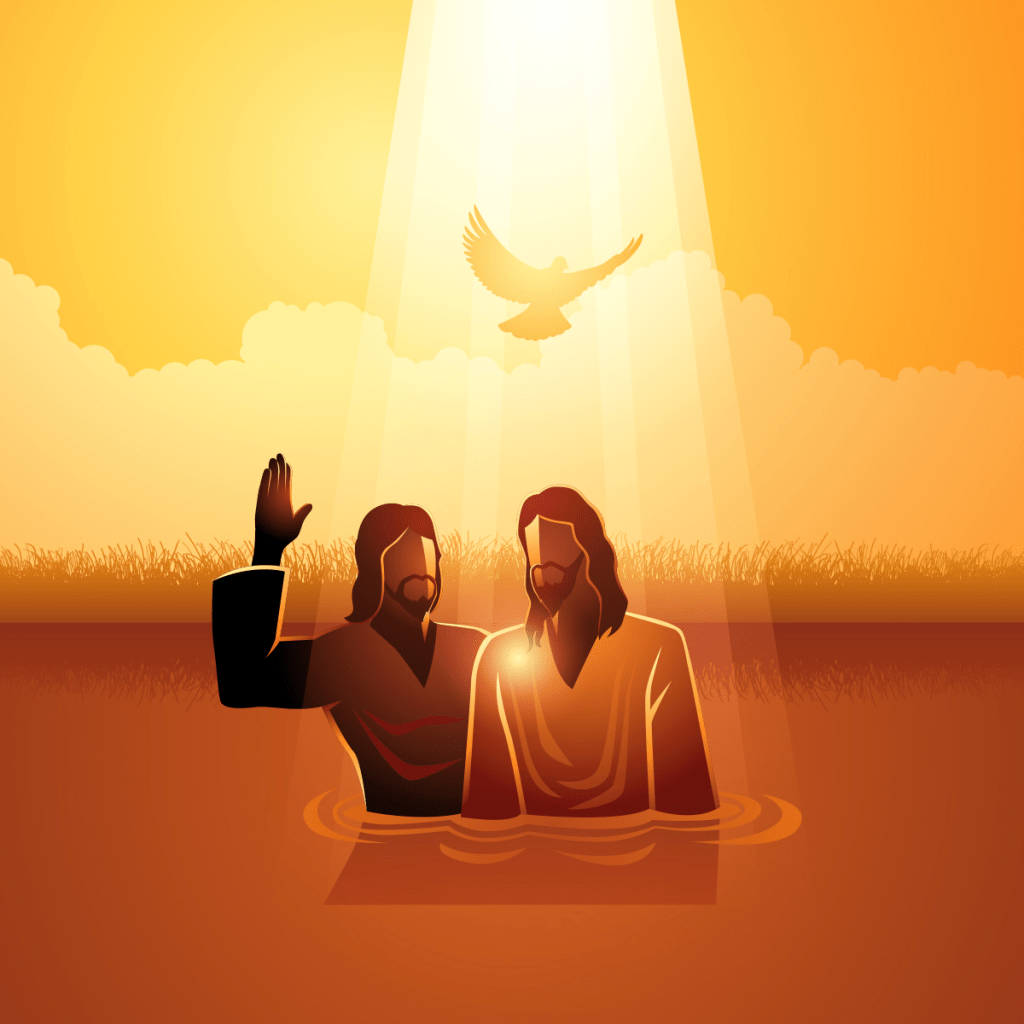
John baptizing Jesus with the Holy Spirit’s affirmation

Then Jesus came from Galilee to the Jordan to be baptized by John. But John tried to deter him, saying, “I need to be baptized by you, and do you come to me?”

Jesus replied, “Let it be so now; it is proper for us to do this to fulfill all righteousness.” Then John consented.

As soon as Jesus was baptized, he went up out of the water. At that moment heaven was opened, and he saw the Spirit of God descending like a dove and alighting on him. And a voice from heaven said, “This is my Son, whom I love; with him I am well pleased.” (New International Version)

Baptism is important. Remembering is important. Put together, remembering our baptism is highly important. Here’s why….

Baptism is important to Jesus

Baptism is the distinguishing mark or symbol of being a Christian. 

The New Testament actually knows nothing of an unbaptized Christian. That’s because the practice is tied to our identity as believers. Our baptisms are based in the baptism of the Lord who, in his Great Commission, told us to baptize in the name of the Father, Son, and Spirit (who were all present at Christ’s baptism). 

The absence of baptism is like a bride without a wedding ring; a football player not wearing a uniform; a motorcycle gang without tattoos; or like an Iowa farmer without a Pioneer seed corn hat!

Baptism is the outward sign that we belong to God. It is the distinguishing symbol that we have been adopted by God and will receive all the promises of salvation in Christ.

Christ’s baptism fulfilled all righteousness through identification with repentant people

John the Baptist was understandably hesitant to baptize Jesus; he knew Jesus had no need of repentance. Although Jesus had no sin to confess, his baptism is a powerful symbol of his humility. It anticipates his ministry to people who recognize their need for God. 

It was necessary for Jesus to be baptized in order to communicate solidarity with people who are coming to God. “Righteousness” means having a right relationship with both God and other people. By being baptized, Jesus is proclaiming that a renewed and right relationship with God will become a reality through himself. Baptism is the sign that we belong to God and that our righteousness is tied to our union with Jesus.

It was important for Jesus to identify with sinners; it is important for us, as well. We remember our baptism – that we belong to God – by identifying with “sinners.” Here are 7 ways of doing it:

  1. Practicing hospitality (love of strangers)
  2. Using our spiritual gifts of speaking and serving on their behalf
  3. Getting to know people very different from ourselves
  4. Meeting people on their turf (not just ours)
  5. Showing respect and upholding dignity
  6. Asking thoughtful and caring questions
  7. Listening with focused attention

It isn’t what we “do” for people that’s as important as affirming our shared humanity with them; thus leading folks to the ultimate person who can address the needs of their heart:  Jesus.

Christ’s baptism fulfilled all righteousness through the affirmation of witnesses

Before Jesus began his ministry, it was necessary to receive validation of what he was about to teach and do. In ancient Judaism, one of the protections guaranteeing that Scripture would be taught according to the way of God, was through an ordination, of sorts. In order for a new rabbi to become a new rabbi, he needed the laying on of hands from two other rabbis who had authority to do so. 

That’s why Christ’s baptism is important. John the Baptist was a powerful teacher and prophet who was recognized by the people as such. John publicly said he wasn’t worthy to carry Jesus’s sandals, that Jesus is the Lamb of God that takes away the sin of the world. So, a baptism by John validated Jesus and inaugurated his ministry. 

Baptism of Christ by Dave Zelenka

A second voice – another witness from heaven – affirmed Jesus: “This is my Son, the one I love. I am very pleased with him.” And then, the Holy Spirit, in the form of a dove, came upon Jesus. This further affirmed that Jesus would save people, not through arm-twisting and great shows of power, but through humility and gentleness.

Baptism was Christ’s first recorded act as an adult. In some ways, it was his first miracle – the miracle of humility in identifying with sinners.

Remember your baptism

Baptism is a sign and seal of God’s grace. Just as Christ’s baptism focused all the promises of God in salvation as being fulfilled in one person, so in our baptism we claim all the promises of God as found in Jesus. Water symbolizes new life, God identifying with us – Immanuel, God with us.

In baptism, God promises and seals to us our union with Jesus so that identity is not found in my past and my profession of faith, but in Christ’s past of bringing redemption to us.  Baptism does not so much express faith as call one to a life of faith and sets us apart as belonging to God.

Baptism is a visible declaration of an invisible reality: union with Christ. Just as circumcision was the outward visible sign of the old covenant, so baptism is the sign of the new covenant in Christ – available to both male and female – thus opening the way for women to participate fully in the ministry of the gospel.

In particular, infant baptism confirms that salvation is not initiated by us, but by God. It affirms that one is betrothed to God. As a child, then an adult, grows into the faith, it is our task to remember our baptism, to be reminded that God’s mark is upon us, that we belong to the Lord. 

God has set us apart to be a holy people, given to Jesus to live as he did. We must never forget that baptism is God’s identifying mark upon us; that our union and solidarity with Jesus is affirmed through this practice.

We are not solitary Christians; we belong Christ and to one another. Baptism is the initiation rite that takes a lifetime to complete. Therefore, we must struggle together in working out our salvation.

Because of our union with Jesus Christ, we must remember:

  • I do not belong to the world. So, I will not live selfishly, only seeking my own comfort agenda. Instead, I will give and serve others from a pure and humble heart.
  • I do not belong to sin. So, I will not give myself over to shameful words or actions, to bullying or manipulating people, to throwing fits and pity parties to get my way, nor using my tongue to speak gossip, slander, or suck-up to others. Instead, I will use my speech wisely, building up others through thoughtful and heartfelt encouragement.
  • I do not belong to the devil. So, I will not seek his agenda of lying, cheating, stealing, and being bitter. 

I belong to Jesus, so therefore:

  • I will uphold biblical justice by championing the cause of the fatherless and the widow, the poor and the needy, the least and the lost among us.
  • I will love others with all the grace God gives me.
  • I will forgive others because Christ has forgiven me.
  • I will consider others better than myself by embracing the humility of Christ.
  • I will hunger and thirst for righteousness.
  • I will seek peace and pursue it.
  • I will, give myself to my Lord and Savior Jesus Christ my Savior and Lord – completely and thoroughly, unabashedly and unreservedly.
  • I will live into my baptism and remember it always because I belong to Jesus!

Be Courageous (Joshua 1:1-9)

After the death of Moses the servant of the Lord, the Lord spoke to Joshua son of Nun, Moses’s assistant, saying: 

“My servant Moses is dead. Now proceed to cross the Jordan, you and all this people, into the land that I am giving to them, to the Israelites. Every place that the sole of your foot will tread upon I have given to you, as I promised to Moses. From the wilderness and the Lebanon as far as the great river, the River Euphrates, all the land of the Hittites, to the Great Sea in the west shall be your territory. 

No one shall be able to stand against you all the days of your life. As I was with Moses, so I will be with you; I will not fail you or forsake you. 

Be strong and courageous, for you shall lead this people to possess the land that I swore to their ancestors to give them. Only be strong and very courageous, being careful to act in accordance with all the law that my servant Moses commanded you; do not turn from it to the right hand or to the left, so that you may be successful wherever you go. 

This book of the law shall not depart out of your mouth; you shall meditate on it day and night, so that you may be careful to act in accordance with all that is written in it. For then you shall make your way prosperous, and then you shall be successful. I hereby command you: Be strong and courageous; do not be frightened or dismayed, for the Lord your God is with you wherever you go.” (New Revised Standard Version)

Freedom came to the ancient Israelites; they were delivered from their cruel Egyptian bondage. Then, they wandered through the desert for forty years; and, after the death of their leader Moses, were poised to enter the Promised Land. 

However, it was going to be no cakewalk. There were pagan peoples entrenched in the land. It would be a huge feat to conquer their territory. Joshua, the young aide-de-camp of Moses, now leader of the people, would be the one to go before them in battle. Understandably, Joshua was likely nervous, maybe even downright scared. 

So, the Lord came to Joshua. God told him to be strong and courageous, to not be afraid to claim the divine promise of the land. 

The path to success for Joshua – as well as all God’s people – is not by the physical sword but by the sword of the Lord, the Word of God. 

The Lord was plainspoken about the need to intimately know the Law given to the people and to continually meditate upon it. Being careful to do everything written within it, Joshua would find both the courage and the wisdom to lead the people to victory.

It still remains true for all God’s people that faithful knowledge, sage wisdom, and careful adherence to Holy Scripture comes through meditation upon its contents. 

There is a great need amongst believers to continually ruminate on God’s Word. We live on a broken planet, filled with all sorts of adversity, hardship, difficulty, and challenge to living a committed spiritual life. And so,

we may sometimes wonder how to address and deal with it all; our problems might seem as large as taking the Promised Land. 

The place to begin is by going to the Word of God – not so much in an anxious, hasty, or impatient question-and-answer sort of way which looks for a quick response; but instead, in a slow, deliberate, contemplative way. 

Lasting and genuine spirituality, as well as a sense of settled success, comes not only through acknowledging the importance and integrity of Scripture; one must know it’s contents, and allow it’s wisdom to saturate the soul through consistent and continual meditation.

Scripture memorization is a discipline worth pursuing. Having large chunks of the Holy Bible in our minds and hearts helps us in the crucible of challenging situations and adverse circumstances. 

What’s more, when doing the everyday pedantic and tedious work, we can engage our minds in the practice of contemplation on those verses we have committed to memory. Meditation on God’s Word is a necessary practice if we want to have success in living a genuinely well-rounded life.

Courage and meditation are a package deal. Bravery and contemplation are meant to be wed together. One rarely comes without the other – which means the realization of our good dreams, for both us and the world, needs the practice of Scripture meditation.

God Almighty, my delight is in your law, and on it I meditate day and night. (Psalm 1:2)

O how I love your law! It is my meditation, my food and drink, all day, every day. (Psalm 119:97)

I will meditate on your precepts and honor your ways in all I do and say. (Psalm 119:15)

I am determined to lift my hands to your commandments, which I love; and I will meditate on your statutes. (Psalm 119:48)

I look forward to the wee hours of the night because it provides me the space and the quiet to meditate on your word. (Psalm 119:148)

In fact, I meditate on all your doings through both day and night; I ponder and consider the works of your hands. (Psalm 143:5)

Amen.

Sensing the Divine (Exodus 3:1-5)

The Burning Bush by Yoram Raanan

Now Moses was tending the flock of Jethro his father-in-law, the priest of Midian, and he led the flock to the far side of the wilderness and came to Horeb, the mountain of God. There the angel of the Lord appeared to him in flames of fire from within a bush. Moses saw that though the bush was on fire it did not burn up. So Moses thought, “I will go over and see this strange sight—why the bush does not burn up.”

When the Lord saw that he had gone over to look, God called to him from within the bush, “Moses! Moses!”

And Moses said, “Here I am.”

“Do not come any closer,” God said. “Take off your sandals, for the place where you are standing is holy ground.” (New International Version)

The burning bush is one of those iconic objects and stories in Holy Scripture. Moses had an experience which changed his life, as well as the lives of all the Israelites then and now.

Having spent the first forty years of his life as a darling in the Egyptian court; and then the next forty years far from that life on the backside of the desert with a bunch of sheep; it’s an understatement to say that Moses did not expect or ever envision encountering God in a burning bush. The impossible has no possibility… Or does it?…

The experience of the burning bush fired the five senses of Moses:

  • See. There was the paradoxical sight of seeing fire in a bush that isn’t burning up.
  • Smell. All around there were the smells of sheep, the outdoors, and perhaps, even the lack of smelling burnt wood.
  • Hear. Listening to the voice and call of God from within the bush.
  • Taste. Spiritually and emotionally savoring God’s attentive justice toward the people.
  • Touch. Removing his sandals to feel the grounding of sacred space.

The story also comments on the senses of God, as well. Even though God is Spirit and is worshiped as such, God is alive with divine sensations:

  • See. Observing the approach of Moses, and the misery of the Israelites.
  • Smell. The stench of injustice wafting into God’s nostrils, bringing a strong divine reaction.
  • Hear. Listening to the cries of suffering and oppression amongst the people.
  • Taste. Anticipating the savor of showing mercy, justice, and righteousness.
  • Touch. A profound and holistic touching of Moses so that both he and the Israelites would never be the same again.

Through it all, the close identification between God and the people is expressed. The Lord feels the humiliation and pain of the Israelites – and vows to uproot them from the Egyptian factory farm of slavery and plant them firmly into rich Promised Land soil.

And what God promises to do, God has the authority and power to make good on.

Although experiencing all of this unbelievable sensory encounter, Moses knew it to be an impossible task in freeing so many Israelites from such a powerful Egyptian juggernaut.

After all, the people had their senses aflame, as well; and not in a good way:

  • See. The sight of family being worked to the bone; and cruelly treated.
  • Smell. The constant smell of bricks baking, mixed with the ever-present smell of death.
  • Hear. Listening day after day to the groans of people, just trying to survive under awful conditions.
  • Taste. Every day tasting the desert dust.
  • Touch. Overstimulated with handling tools to the point of hard callouses and dry, cracked, bloody hands.

Hundreds of years of backbreaking bondage to a national force so mighty that nothing can be done about it be broken…. Ah, but God specializes in systems of oppression and miserable people.

It is the Lord’s abilities which conquer the mightiest of foes and can extend mercy to the lowest and the least powerful. The entire Israelite situation was ripe for divine intervention and supernatural wonders to occur.

God will make a way where there seems to be no way. God works in ways which transcend our senses.

  • See. We are blind, but God gives us the gift of sight.
  • Smell. Our nostrils have become accustomed to the smell of death, but God’s aroma of life awakens us to new hope.
  • Hear. We are deaf, but God opens our ears with the sound of justice.
  • Taste. Our taste buds are shot with the gruel of poverty, but God causes our tongues to dance with the zest of mercy.
  • Touch. Our nerve endings are raw from cruel bondage, but God touches us with freedom.

You already intuitively know deep in your spirit that the impossible is possible with God. It’s never a question of God’s ability, but of God’s timing.

God is able and works the impossible in its proper time so that justice and mercy will have their full effect.

God of the impossible: I believe. Help me in my unbelief.

God of mercy: I receive. Help me in my denial.

God of justice: I accept. Help me in my rejection.

God of all time: I endure. Help me in my impatience.

God of All: I submit. Help me in my rebellion.

God of power and of might: I trust. Help me in my distrust.

God of our Lord Jesus Christ: I follow. Help me in my wandering.

God of the nations: Yes, you know that I love you. Yes, Lord, you know I love you. Lord, you know all things, and you know that I love you. So, yes, I will answer your call to go. Help me in my sending. Amen.

Promise and Pilgrimage (Genesis 12:1-7)

The Lord said to Abram,

“Leave your land,
your relatives,
and your father’s home.
Go to the land that I will show you.
I will make you a great nation,
I will bless you.
I will make your name great,
and you will be a blessing.
I will bless those who bless you,
and whoever curses you, I will curse.
Through you every family on earth will be blessed.”

So Abram left, as the Lord had told him, and Lot went with him. Abram was 75 years old when he left Haran. Abram set out for Canaan. He took along his wife Sarai, his nephew Lot, and all the possessions they had accumulated and the servants they had acquired in Haran.

They arrived in Canaan, and Abram traveled through the land to the oak tree belonging to Moreh at Shechem. At that time the Canaanites were in the land. Then the Lord appeared to Abram and said, “I’m going to give this land to your descendants.” So he built an altar there to the Lord, who had appeared to him. (God’s Word Translation)

Abram (later having a name change to “Abraham”) knew quite a lot about new beginnings.

It isn’t every day that the Lord comes along and completely upends a person’s life. Abram had lived his entire life in the same city, Ur, in Chaldea (present day Iraq). By all accounts, Abram was completely fine living where he was living. He had neither the ambition nor need to leave his home city.

The Lord, however, had other plans for Abram. And they were radical plans. This was no rearranging of the furniture; it was a wholesale life-altering change. Ur was an important cosmopolitan city, a trade center, located at a pivotal point where the Tigris and Euphrates Rivers run into the Persian Gulf. Thus, Ur was a wealthy city, the citizens enjoying a level of comfort unknown in other parts of Mesopotamia.

Actor Eddie Albert as the out of place city lawyer trying to make it in the country on “Green Acres” which aired on CBS from 1965-1971

So, Abram being called to move from the city and go to some unknown place in the west would be something like growing up in Manhattan, New York and being called by God to head for Brewster, Nebraska – which is pretty much in the middle of nothing. It makes “Green Acres” look like a night out at the opera.

The Lord’s First Promise to Abram

It wasn’t all unknown change; there was a promise attached to the call. Having every family on earth blessed through you is a really big promise. There was a lot riding on Abram’s response.

Perhaps there was some pushback on Abram’s end of things. But we don’t have any record of it if it even happened. Instead, we get a simple statement telling us that he left, just as the Lord told him to do.

Lest we think Abram had some incredible relationship with the Lord before this call came, we need to think again:

“This is what the Lord God of Israel says: Long ago your ancestors, Terah and his sons Abraham and Nahor, lived on the other side of the Euphrates River and served other gods. But I took your ancestor Abraham from the other side of the Euphrates River. I led him through all of Canaan and gave him many descendants.” (Joshua 24:2-3, GW)

The One true God wasn’t even on Abram’s radar. He was merrily serving the pagan gods of Sumer, seemingly without a care in the world. It wasn’t as if Abram was bored watching old reruns of “Green Acres” and wishing for a change. And it sure wasn’t because he was attuned to knowing anything about Yahweh.

Whatever went down between Abram and the Lord was likely so compelling that Abram left willingly and without any pushback.

The Lord’s Second Promise to Abram

To travel from Ur of the Chaldees to the land of Canaan is an approximate distance of 800 miles. That’s slow going when you’re traveling in a caravan by donkey and camel. It took a while to get to the land that the Lord had in mind for Abram.

Once there, God gave Abram another promise: The land that he reached will be his home, the new land, the Promised Land. It would be yet another 500+ years before Abram’s descendants took full possession of that land and the promise realized.

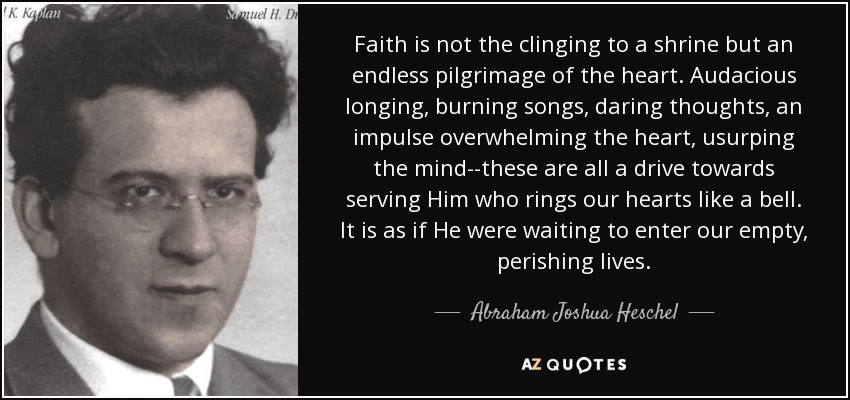
Abram had a lot of time to consider and reflect on the Lord’s calling and promises. And that is precisely why pilgrimage is so very important. Yes, the destination is significant; yet it is the journey itself that really matters.

Pilgrimage

Those who put their strength in you are truly happy;
    pilgrimage is in their hearts. (Psalm 84:5, CEB)

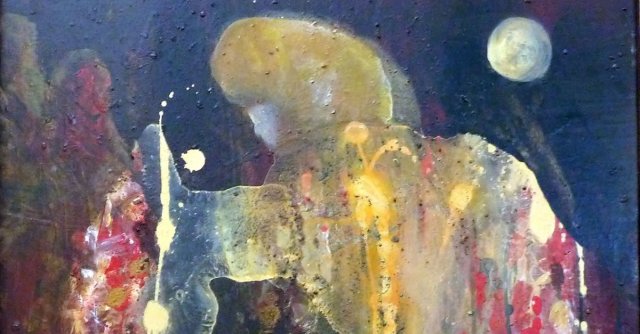
Abram journeys into the unknown by Yoram Raanan

The way of pilgrimage is for all, like Abram, who walk in faith and patience, awaiting the fulfillment of God’s promises.

By faith Abraham obeyed when he was called to go out to the place which he would receive as an inheritance. And he went out, not knowing where he was going. 

By faith he dwelt in the land of promise as in a foreign country… for he waited for the city which has foundations, whose builder and maker is God…. Therefore from one man, and him as good as dead, were born as many as the stars of the sky — innumerable as the sand which is by the seashore.

These all died in faith, not having received the promises, but having seen them afar off were assured of them, embraced them and confessed that they were strangers and pilgrims on the earth. 

For those who say such things declare plainly that they seek a homeland. And truly if they had called to mind that country from which they had come out, they would have had opportunity to return. But now they desire a better, that is, a heavenly country. Therefore God is not ashamed to be called their God, for He has prepared a city for them. (Hebrews 11:8-16, NKJV)

Each day, we have the opportunity to be pilgrims, walking by faith, exercising patient hope, persevering in love for one’s fellow humanity.

Just because we live in a microwave society which values speed and customer service above all else, doesn’t mean our religion has to follow suit. The best things in life are slow in coming; they require a great deal of blood, sweat, and tears.

Go ahead and enjoy an episode or two of “Green Acres;” just remember to listen when the Lord calls and go to make disciples of all nations.

All-powerful God, you always show mercy toward those who you love, and you are never far away for those who seek you. Be with your servants on this pilgrimage and guide their way in accord with your will. Amen.