A Word of Faith (Genesis 15:1-20)

After this, the word of the Lord came to Abram in a vision:

“Do not be afraid, Abram.
    I am your shield,
    your very great reward.”

But Abram said, “Sovereign Lord, what can you give me since I remain childless and the one who will inherit my estate is Eliezer of Damascus?” And Abram said, “You have given me no children; so a servant in my household will be my heir.”

Then the word of the Lord came to him: “This man will not be your heir, but a son who is your own flesh and blood will be your heir.” He took him outside and said, “Look up at the sky and count the stars—if indeed you can count them.” Then he said to him, “So shall your offspring be.”

Abram believed the Lord, and he credited it to him as righteousness.

He also said to him, “I am the Lord, who brought you out of Ur of the Chaldeans to give you this land to take possession of it.”

But Abram said, “Sovereign Lord, how can I know that I will gain possession of it?”

So the Lord said to him, “Bring me a heifer, a goat and a ram, each three years old, along with a dove and a young pigeon.”

Abram brought all these to him, cut them in two and arranged the halves opposite each other; the birds, however, he did not cut them in half. Then birds of prey came down on the carcasses, but Abram drove them away.

As the sun was setting, Abram fell into a deep sleep, and a thick and dreadful darkness came over him. Then the Lord said to him, “Know for certain that for four hundred years your descendants will be strangers in a country not their own and that they will be enslaved and mistreated there. But I will punish the nation they serve as slaves, and afterward they will come out with great possessions. You, however, will go to your ancestors in peace and be buried at a good old age. In the fourth generation your descendants will come back here, for the sin of the Amorites has not yet reached its full measure.”

When the sun had set and darkness had fallen, a smoking firepot with a blazing torch appeared and passed between the pieces. On that day the Lord made a covenant with Abram and said, “To your descendants I give this land, from the Wadi of Egypt to the great river, the Euphrates—the land of the Kenites, Kenizzites, Kadmonites, Hittites, Perizzites, Rephaites, (New International Version)

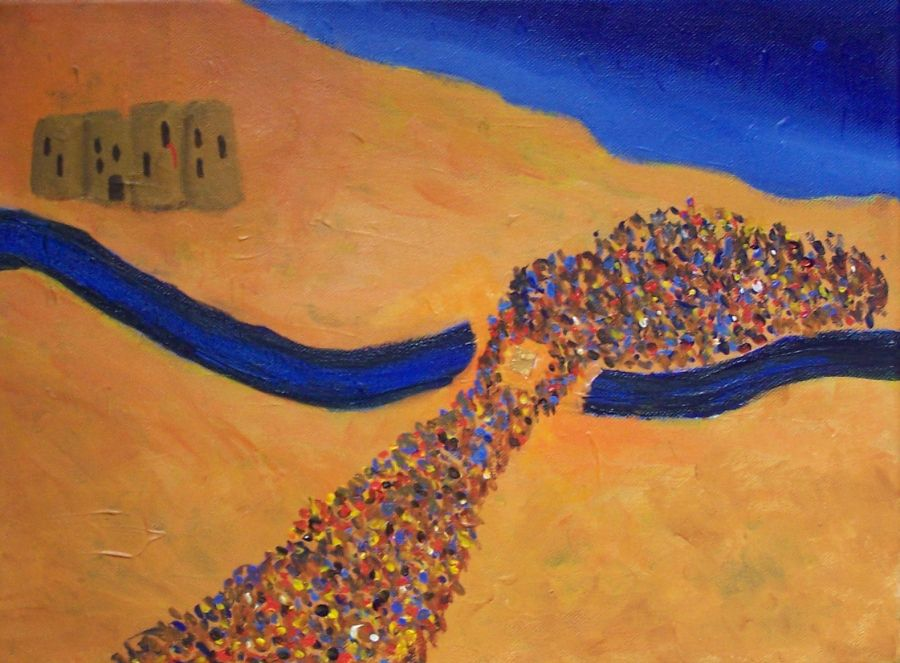
Abrahamic Covenant II, by Wayne Forte, 2007

A Word about Abram and Sarai

We meet Abram and Sarai (later to be known as Abraham and Sarah) as a non-descript couple from a place called Ur of the Chaldees, a few chapters earlier in the opening biblical book of Genesis. It’s noted that Sarai is barren, or childless. (Genesis 11:30)

The Lord decided to choose a people for God’s own name, a singular people to become a kingdom of priest and a holy nation. The idea was that God would bless all the other nations through this one nation.

So, in what becomes something of a divine pattern, God chooses a most unlikely couple (old and childless) to become father and mother of this new nation to bless all other nations on earth. The Lord called them from their country of origin to leave and go to a new place. (Genesis 12:1-3)

Lo and behold, Abram and Sarai did just that. They left all they ever knew and journeyed to the new land, believing the promise of God, even though it didn’t make much sense. And there, they waited for a child, who would become the first of their many descendants, the child of promise.

And they waited. Time passed. They made a few sojourns into Egypt and back. But still no child. More time went by. Abram and Sarai were old when they came to the new land. Now, they’re really old! And still, no child. Then, finally, the Lord broke the silence.

The Word of the Lord

God’s initial words after all this time were, “Don’t be afraid.” We discover that anytime we hear that phrase spoken by the Lord, something good is about to happen. In fact, it’s great news.

But Abram seems discouraged, even with a fresh heart-to-heart with God. He and Sarai are still without a child. Instead of joy over God’s speech, Abram laments the ache of childlessness. Even though, by this time, Abram was wealthy, prosperous, and of good reputation, he feels the sting of a promise yet unfulfilled. God has still not granted him progeny for blessing the world.

A Word of Lament

Lament is, at its core, a complaint – an expression of grief in losing something or someone, or as in Abram’s case, of never having that something or someone to begin with.

It’s actually important for us to essentially make our problems into God’s problems. To tell God about our deepest hurts and unmet hopes is to implicate God in those hurts and hopes. It is to involve God in our disappointment.

In lament, we cry out to God in the belief that the Lord can and will respond to our painful cries and our deep desires. We believe God has the power and ability to respond. To complain to God is to have faith that God is faithful to divine promises—in spite of any nonsensical present circumstances.

Concerning matters about which God has made a promise, to complain is to remind the Lord of those unmet promises. In his lament, Abram was implying that God had not kept the promise, and had not yet proven faithful.

A Word of Response

Far from feeling perturbed that Abram laments instead of rejoices, God, in fact, responds by doubling-down on the original promise. Not only will there be a child, but that child’s descendants will be too many to even begin counting.

The Lord invited Abram to move his head from looking down at the bare ground to looking up at the magnificent stars. And in gazing upon the heavens, listening to the God whom he serves, Abram believed the Lord. And it was this faith which was credited to him as righteousness.

God is okay with being implicated in our problems. In fact, God welcomes it. Our deep grief, and our prayerful complaints, are a way of speaking which reminds God that God has promised to be faithful to divine promises. God doesn’t at all mind being held accountable to promises made.

Then, the Lord further responds by making a tangible expression of the intangible promise by means of a special sacrifice. God instructed Abram to involve some animal sacrifices and arrange them a certain way. When the sun had gone down and it was dark, a smoking fire pot and a flaming torch passed between the arranged pieces of the sacrifice.

A Covenant Word

On that day, through a ritual observance, God made a covenant with Abram.

To make a covenant in the ancient world, animals were cut in half, and then the persons making the covenantal commitment walked down the middle between the animals.

In Abram’s ritual, however, it was the Lord—in the form of a smoking pot and a flaming torch—who passed down the middle and thus was the one making the promise.

The symbolism of the covenant ritual is this: The one making the promise passes between dead animals as a ritual promise that, if they should be unfaithful to the terms of the covenant, they are to be cut in half just as the sacrificed animal.

In other words, when the Lord passed between the cleaved goat, sheep, ram and birds, God was pledging complete commitment to Abram.

A New Covenant Word

In Christianity, the gospel is a free promise by God that requires the death of God. The promise of God to Abram, Christians believe, ultimately led to the very death of the Son of God, Jesus.

In order to be faithful to the divine promise, to Abraham and Sarah and their descendants, and to David, God took on human flesh, walked between the pieces, and died so that we might have life.

Therefore, the promise comes by faith, so that it may be by grace and may be guaranteed to all Abraham’s offspring—not only to those who are of the law but also to those who have the faith of Abraham. He is the father of us all. As it is written: “I have made you a father of many nations.” He is our father in the sight of God, in whom he believed—the God who gives life to the dead and calls into being things that were not. (Romans 4:16-17, NIV)

Amen.

Trust the Promises (Joshua 3:1-17)

Crossing the Jordan River, by Yoram Raanan

Early in the morning Joshua and all the Israelites set out from Shittim and went to the Jordan, where they camped before crossing over. After three days the officers went throughout the camp, giving orders to the people: “When you see the ark of the covenant of the Lord your God, and the Levitical priests carrying it, you are to move out from your positions and follow it. Then you will know which way to go, since you have never been this way before. But keep a distance of about two thousand cubits between you and the ark; do not go near it.”

Joshua told the people, “Consecrate yourselves, for tomorrow the Lord will do amazing things among you.”

Joshua said to the priests, “Take up the ark of the covenant and pass on ahead of the people.” So they took it up and went ahead of them.

And the Lord said to Joshua, “Today I will begin to exalt you in the eyes of all Israel, so they may know that I am with you as I was with Moses. Tell the priests who carry the ark of the covenant: ‘When you reach the edge of the Jordan’s waters, go and stand in the river.’”

Joshua said to the Israelites, “Come here and listen to the words of the Lord your God. This is how you will know that the living God is among you and that he will certainly drive out before you the Canaanites, Hittites, Hivites, Perizzites, Girgashites, Amorites and Jebusites. See, the ark of the covenant of the Lord of all the earth will go into the Jordan ahead of you. Now then, choose twelve men from the tribes of Israel, one from each tribe. And as soon as the priests who carry the ark of the Lord—the Lord of all the earth—set foot in the Jordan, its waters flowing downstream will be cut off and stand up in a heap.”

So when the people broke camp to cross the Jordan, the priests carrying the ark of the covenant went ahead of them. Now the Jordan is at flood stage all during harvest. Yet as soon as the priests who carried the ark reached the Jordan and their feet touched the water’s edge, the water from upstream stopped flowing. It piled up in a heap a great distance away, at a town called Adam in the vicinity of Zarethan, while the water flowing down to the Sea of the Arabah (that is, the Dead Sea) was completely cut off. So the people crossed over opposite Jericho. The priests who carried the ark of the covenant of the Lord stopped in the middle of the Jordan and stood on dry ground, while all Israel passed by until the whole nation had completed the crossing on dry ground. (New International Version)

400 years of Egyptian slavery. Then deliverance from bondage. Another 40 years of wandering around the desert. It might have seemed to the ancient Israelites that getting to the Promised Land would never happen.

How can we know God is with us? Will divine promises really hold up? Can I keep trusting in the Lord, even though it is taking so darned long to get where I need to be?

Through yet another miracle of the parting of the waters and walking on dry land to get to the other side, Joshua and people of Israel (and us) are given a visual, tactile, experiential way of trusting God. By this indelible encounter, the people will know that the living God is among them, and without fail, the Lord will drive out all obstacles and opposition to entering and taking the land.

All the dramatic events that occurred were for the sake of the people, so that they would know that God is with them and will give them victory. To heighten the experience, the Jordan River was at flood stage at the time of the crossing. If you have ever been on the bank of a raging river, you know how significant a miracle this really was to behold. 

Today, we may not have the experience of seeing a rushing river stop and crossing over on dry ground; yet we have these stories that bear witness to the truth that God is among us, that God will do what was promised, and that God will give us victory.

Know that the victory came after a long liminal period of moving from one reality to another. A “liminal space” (an intermediate position characterized by transition, a place where things are either coming or going) is where the Israelites had to hang out for a very long time. Now, the promises were about to be realized.

Miracles and wonders and victories are neither easy nor cheap. They come as a result of significantly hard movements from the past into the future. In other words, our present experiences can be quite adverse and difficult. If we lose where we’ve come from, and where we’re going, we may too easily lose heart or become afraid and simply give up all hope.

That’s why God gives divine promises, so that we will be sustained with God’s words until the promised time is realized. It’s our job to encourage one another and remind each other of those promises; they are meant to buoy up our flagging spirits when things get rough.

So, keep looking and praying for that miracle. Just understand that you may need to persevere in faith, patience, and holiness for a while before it happens.

Blessed and holy God, continue the good work begun in me, so that I may increase daily in wholeness, integrity, and strength. I rejoice in your goodness and think and do that which pleases you, through Jesus Christ our Redeemer. Amen.

Mercy Will Happen (Isaiah 60:17-22)

I will exchange your bronze for gold,
    your iron for silver,
your wood for bronze,
    and your stones for iron.
I will make peace your leader
    and righteousness your ruler.
Violence will disappear from your land;
    the desolation and destruction of war will end.
Salvation will surround you like city walls,
    and praise will be on the lips of all who enter there.

“No longer will you need the sun to shine by day,
    nor the moon to give its light by night,
for the Lord your God will be your everlasting light,
    and your God will be your glory.
Your sun will never set;
    your moon will not go down.
For the Lord will be your everlasting light.
    Your days of mourning will come to an end.
All your people will be righteous.
    They will possess their land forever,
for I will plant them there with my own hands
    in order to bring myself glory.
The smallest family will become a thousand people,
    and the tiniest group will become a mighty nation.
    At the right time, I, the Lord, will make it happen.” (New Living Translation)

The people of ancient times typically had a love/hate relationship with prophets. After all, the Lord’s messengers gave verbal punches to the gut with bad news of judgment. But they also were bearers of good news, as well. They were able to hold both judgment and grace together.

It is good to always keep in mind that, despite human foibles, grace exists and is the grand operating force in God’s big world. Good news turns to great news when there is a realization that judgment is deserved, yet it won’t have the last word.

God’s grace prevails in the end. God has a tenacious resolve to work out good for people, not ill. Although the Lord dispenses judgment, sometimes with a firm hand, there is an unflagging commitment to divine love which shines through the darkest of times.

God expertly knows how to make a reversal in people’s situations from hopeless despair to incredible fortune (and vice versa). The Lord truly has plans of goodness and well-being for humanity. Humiliation and powerlessness will give way to exaltation and empowerment. Peace will eventually overcome both the human heart and human institutions.

Deliverance from the ills which plague both body and soul comes from the God who specializes in penetrating the blackest darkness with overwhelming light – and it’s more than personal well-being. Isaiah’s prophecy communicates a cosmic vision of peace which thoroughly works its way in all the shadowy places of the world. It’s a vision of a new world and new life.

Because of God’s merciful action in a broken and bruised world, we can make some bold and hopeful theological claims for God’s people:

  • God’s good grace and steadfast love are the superior forces in the church and the world. Because grace and love are pure gifts from the Lord, they are not dependent upon whether we deserve them, or not. The sheer fact that we need them is what prompts God to give generously and unsparingly. A new heaven and new earth are coming. Sin and death are not permanent.

Then I saw a new heaven and a new earth; for the first heaven and the first earth had passed away. (Revelation 21:1, NRSV)

  • God is the center of every good thing that was, is, and is coming. God’s world runs on God’s providence and power, and not on human agency. God is in control. All the Lord’s good promises shall not fail but will be realized. For the Christian, those promises are ultimately fulfilled in the person and work of Jesus Christ. When circumstances are at their worst, faith is at its best.

In everything we have won more than a victory because of Christ who loves us. I am sure that nothing can separate us from God’s love—not life or death, not angels or spirits, not the present or the future, and not powers above or powers below. Nothing in all creation can separate us from God’s love for us in Christ Jesus our Lord! (Romans 8:37-39, CEV)

  • God’s promises extend well beyond the “spiritual” to all of life. God’s peace will work its way into the fabric of the whole world, not only individual hearts. God’s benevolent kingdom and ethical will shall be done on earth as it is always done in heaven. Just as every human institution and all creation have been profoundly touched by sin, so everything will be touched by grace and renewed. Our prayers are to encompass this grand scope of God’s renewing vision for the world.

May your Kingdom come soon. May your will be done on earth, as it is in heaven. (Matthew 6:11, NLT)

God’s plans are more than good and gracious; they are cosmic in their scope and include an expansive realm of peace which is so incredible that the Lord’s glory will overwhelm all darkness and shall shine forever.

Human sin might seem as though it is so pervasive as to win the day, yet it will not always be this way. God’s light will penetrate, overcome, and dispel guilt, shame, and disobedience. And it has already begun…

Almighty God give us a new vision of you, of your love, of your grace and power; and then, give us a new vision of what you would have us do as your people, and an awareness that in the strength of your Spirit we can do it to your glory, through Jesus Christ our Lord. Amen.

Take the Long View (Genesis 49:1-2, 8-13, 21-26)

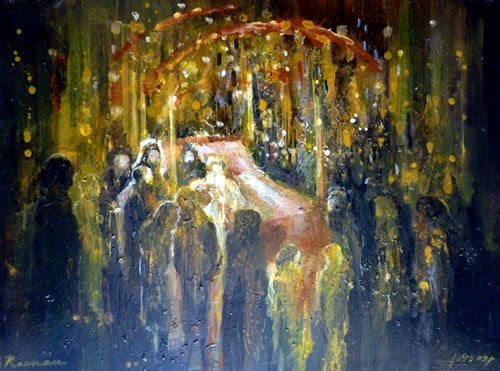
Jacob blesses his sons on his deathbed by Yoram Raanan

Jacob called his sons together and said:

My sons, I am Jacob,
    your father Israel.
Come, gather around,
    as I tell your future….

Judah, you will be praised
    by your brothers;
they will bow down to you,
    as you defeat your enemies.
My son, you are a lion
    ready to eat your victim!
You are terribly fierce;
    no one will bother you.
You will have power and rule
until nations obey you
    and come bringing gifts.
You will tie your donkey
    to a choice grapevine
and wash your clothes
    in wine from those grapes.
Your eyes are darker than wine,
    your teeth whiter than milk.

Zebulun, you will settle
    along the seashore
and provide safe harbors
    as far north as Sidon….

Naphtali, you are a wild deer
    with lovely fawns.

Joseph, you are a fruitful vine
growing near a stream
    and climbing a wall.
Enemies attacked with arrows,
    refusing to show mercy.
But you stood your ground,
    swiftly shooting back
with the help of Jacob’s God,
    the All-Powerful One—
his name is the Shepherd,
    Israel’s mighty rock.
25 Your help came from the God
your father worshiped,
    from God All-Powerful.
God will bless you with rain
    and streams from the earth;
he will bless you
    with many descendants.
My son, the blessings I give
are better than the promise
    of ancient mountains
    or eternal hills.
Joseph, I pray these blessings
    will come to you,
because you are the leader
    of your brothers. (Contemporary English Version)

Where does confidence come from?

The theme of confidence works its way through the patriarch Jacob’s deathbed prophecies and blessings – a resolute conviction in the promises of God – that the Lord will accomplish exactly what was promised.

Jacob expressed the hope and sure belief that God would bring the Israelites out of Egypt and into the land of Canaan as their inheritance – and, ultimately to the City of God, the eternal inheritance.

The Christian will find much in the blessing of Judah concerning the promises surrounding the coming of Christ. Mentioning the implements of “staff” and “scepter” are symbols of authority. And the reference to a donkey communicated a ruler was coming, as donkeys were the preferred mounts of royalty in ancient times.

What’s more, the washing of garments in wine, and eyes darker than wine, are allusions to the future blessing and abundance that will occur through the tribe of Judah. In fact, the first miracle of Jesus was turning water into wine – a deliberate attempt by the Apostle John to connect Jesus with Old Testament messianic prophecies of abundance and blessing. (John 2:1-12)

It’s important to adopt a long view of life. We must keep in mind that it took eighteen centuries for Jacob’s prophecy of Judah to occur. This long view is what gives us our confidence in life and provides the patience and perseverance we need for the here and now.

Seeing the big picture of God’s work in this world is necessary, because if we do not, we will likely become discouraged with the circumstances we face right now.

The reason Jacob makes it into the great Hall of Faith in the New Testament book of Hebrews is not because he was squeaky clean and perfect in how he lived his life; it was because he took the long view, the big picture, and saw that God was going to fulfill divine promises to Israel:

By an act of faith, Jacob on his deathbed blessed each of Joseph’s sons in turn, blessing them with God’s blessing, not his own—as he bowed worshipfully upon his staff. (Hebrews 11:21, MSG)

Furthermore, when we string the following three verses together across both Old and New Testaments of the Bible, we see the long view of God’s purposes:

It is true that you planned to do something bad to me. But really, God was planning good things. God’s plan was to use me to save the lives of many people. And that is what happened. (Genesis 50:20, ERV)

For I know the plans I have for you,” declares the Lord, “plans to prosper you and not to harm you, plans to give you hope and a future. (Jeremiah 29:11, NIV)       

And we know that all things work together for good to those who love God, to those who are the called according to his purpose. (Romans 8:28, NKJV)

In the Christian faith tradition, all of God’s promises come together and are fulfilled in the person and work of Jesus.

Christ is our salvation, our inheritance, and our hope. To give our lives to following Jesus in complete trust of faith is both our challenge and our privilege.

May we live by faith, and not by fear. And may we have patience and persevere through the most challenging of situations because we have adopted the long view of understanding the God is bringing all divine promises to fruition, all in good time.

Our confidence comes from the Lord.

Be present, O merciful God, and protect us through anxious times, so that we who are wearied by the changes of this life may rest in your eternal steadiness. Keep watch, dear God, with those who work, or watch, or weep this night, and give your angels charge over those who sleep. Tend the sick, Lord Christ; give rest to the weary, bless the dying, soothe the suffering, pity the afflicted, shield the joyous; and all for your love’s sake. Amen.