Fear vs. Faith (Numbers 13:1-2, 17-33; 14:1-9)

The Spies Return with Discordant Views, by Yoram Raanan

The Lord said to Moses, “Send some men to explore the land of Canaan, which I am giving to the Israelites. From each ancestral tribe send one of its leaders”…

When Moses sent them to explore Canaan, he said, “Go up through the Negev and on into the hill country. See what the land is like and whether the people who live there are strong or weak, few or many. What kind of land do they live in? Is it good or bad? What kind of towns do they live in? Are they unwalled or fortified? How is the soil? Is it fertile or poor? Are there trees in it or not? Do your best to bring back some of the fruit of the land.” (It was the season for the first ripe grapes.)

So they went up and explored the land from the Desert of Zin as far as Rehob, toward Lebo Hamath. They went up through the Negev and came to Hebron, where Ahiman, Sheshai and Talmai, the descendants of Anak, lived. (Hebron had been built seven years before Zoan in Egypt.) 

When they reached the Valley of Eshkol, they cut off a branch bearing a single cluster of grapes. Two of them carried it on a pole between them, along with some pomegranates and figs. That place was called the Valley of Eshkol because of the cluster of grapes the Israelites cut off there. At the end of forty days they returned from exploring the land.

They came back to Moses and Aaron and the whole Israelite community at Kadesh in the Desert of Paran. There they reported to them and to the whole assembly and showed them the fruit of the land. They gave Moses this account:

“We went into the land to which you sent us, and it does flow with milk and honey! Here is its fruit. But the people who live there are powerful, and the cities are fortified and very large. We even saw descendants of Anak there. The Amalekites live in the Negev; the Hittites, Jebusites and Amorites live in the hill country; and the Canaanites live near the sea and along the Jordan.”

Then Caleb silenced the people before Moses and said, “We should go up and take possession of the land, for we can certainly do it.”

But the men who had gone up with him said, “We can’t attack those people; they are stronger than we are.” And they spread among the Israelites a bad report about the land they had explored. They said, “The land we explored devours those living in it. All the people we saw there are of great size. We saw the Nephilim there (the descendants of Anak come from the Nephilim). We seemed like grasshoppers in our own eyes, and we looked the same to them.”

That night all the members of the community raised their voices and wept aloud. All the Israelites grumbled against Moses and Aaron, and the whole assembly said to them:

“If only we had died in Egypt! Or in this wilderness! Why is the Lord bringing us to this land only to let us fall by the sword? Our wives and children will be taken as plunder. Wouldn’t it be better for us to go back to Egypt?” And they said to each other, “We should choose a leader and go back to Egypt.”

Then Moses and Aaron fell face down in front of the whole Israelite assembly gathered there. Joshua son of Nun and Caleb son of Jephunneh, who were among those who had explored the land, tore their clothes and said to the entire Israelite assembly:

“The land we passed through and explored is exceedingly good. If the Lord is pleased with us, he will lead us into that land, a land flowing with milk and honey, and will give it to us. Only do not rebel against the Lord. And do not be afraid of the people of the land, because we will devour them. Their protection is gone, but the Lord is with us. Do not be afraid of them.” (New International Version)

“Pessimism has done infinitely more harm than atheism.”

Pierre Teilhard de Chardin

Fear can be debilitating. At its core, we fear either what we don’t know, or believe to be bad. For example, if I am convinced that my boss does not have my best interests at mind, then I will likely be afraid and hold back.

The majority of the ancient Israelites were paralyzed by fear because of the anxiety and fearfulness of those who came back from spying out the Promised Land. They had a low view of God. Yet Caleb, and only a few others, acknowledged that God is good for divine promises, and so, trusted the Lord completely in confidence, not fear.

If we view God as being angry all the time, then we will not use the incredible gifts given to us for fear of messing up and bringing divine wrath upon us. We will be plagued with uncertainty and only see giants in the land who we cannot begin to deal with.

Yet, if we commit ourselves to knowing God through seeking the divine will and trusting in divine promises, then we understand that God is gracious and generous, always having our backs. We live by faith, not by sight, and discern that giants in the land are really nothing more than gnats.

Fear is maybe the devil’s greatest tool to prevent God’s people from being productive and responsible in serving the church and the world. Beneath that fear are powerful feelings of inferiority, inadequacy, and a low view of self – which is really born of a low view of God. Being afraid wastes what impact a person could have for God, and waters-down life so that it’s ineffective.

Enjoy the Lord, and he will give what your heart asks.

Psalm 37:4, CEB

We are to enjoy the gracious and generous God; and in our enjoyment, the Lord places within us godly dreams that are a delight for God to fulfill. Our enjoyment of the Lord gives us the security and confidence to act upon those godly desires and wed them to divine promises from Holy Scripture.   

But put fear in the mix, and it dilutes and destroys everything. It makes you do nothing. And the fear is a result of not knowing the Lord, of not seeking God’s mind or will.

God had a grand vision and a big dream for the Israelites to enter the Promised Land. But ten of the twelve spies who came back after checking out the land were paralyzed by fear, feeling like grasshoppers next to the people in the land. 

Caleb and Joshua, however, had a different view of taking the land because they had a different view of God. They didn’t see giants – they saw a gracious and generous God who could easily take care of whoever might be in the land, and they wanted to act on the faith they had in a mighty and merciful God. 

The God of the other spies wasn’t big enough to handle the giants. Their low view of themselves as grasshoppers betrayed their low view of God.

“We wrap a lot of our fears in morbidly sanctified self-belittling.  We piously cover this self-despising and call it consecration and self-crucifixion.”

David Seamands

Too many people feel good about feeling bad – and then use those feelings to make spiritual excuses for not exploring what God promises, expects, commands, and dreams for them. 

It is high time for us to get into the world with our witness in a far greater way because we serve a God who sees giants as gnats; and we will, too, if we have a high view of God.

Yet, holding us back, is fear of criticism, of taking a risk, of going outside of the way we’ve always done it, and of what others may think or say. 

If you once dreamed something and you think your dream is dead because you destroyed it by your sins or bad habits, you are wrong. Dreams are destroyed by fear, by being tricked into thinking that we are nothing but grasshoppers and God doesn’t care, and so we do nothing.

Unfortunately, it appears the most common way of coping with feelings of fear, insecurity, and inferiority is by withdrawing from other people – because you cannot give yourself fully to your family, church, neighborhood, vocation, and the world without a healthy robust view of and relationship with God. 

Give God a chance to work in and through your life. May you step up and step out because you have a God behind you that is gracious and generous. Amen.

Family Drama (Genesis 29:15-28)

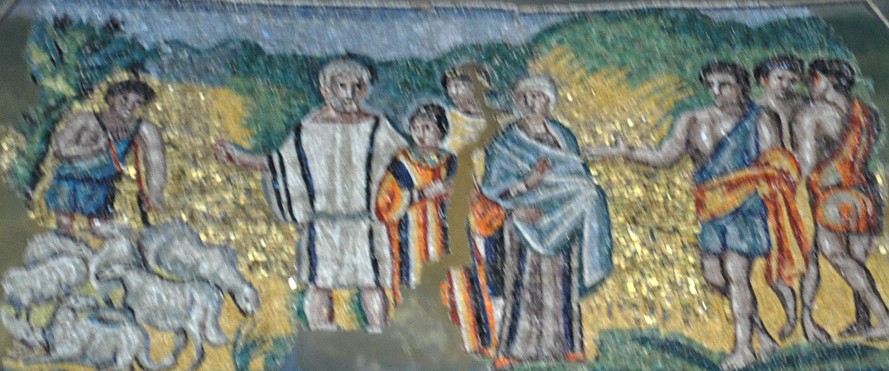
Jacob works to gain Rachel’s hand, 5th century mosaic, Basilica of Santa Maria Maggiore, Rome

Laban said to him [Jacob] “Just because you are a relative of mine, should you work for me for nothing? Tell me what your wages should be.”

Now Laban had two daughters; the name of the older was Leah, and the name of the younger was Rachel. Leah had weak eyes, but Rachel had a lovely figure and was beautiful. Jacob was in love with Rachel and said, “I’ll work for you seven years in return for your younger daughter Rachel.”

Laban said, “It’s better that I give her to you than to some other man. Stay here with me.” So Jacob served seven years to get Rachel, but they seemed like only a few days to him because of his love for her.

Then Jacob said to Laban, “Give me my wife. My time is completed, and I want to make love to her.”

So Laban brought together all the people of the place and gave a feast. But when evening came, he took his daughter Leah and brought her to Jacob, and Jacob made love to her. And Laban gave his servant Zilpah to his daughter as her attendant.

When morning came, there was Leah! So Jacob said to Laban, “What is this you have done to me? I served you for Rachel, didn’t I? Why have you deceived me?”

Laban replied, “It is not our custom here to give the younger daughter in marriage before the older one. Finish this daughter’s bridal week; then we will give you the younger one also, in return for another seven years of work.”

And Jacob did so. He finished the week with Leah, and then Laban gave him his daughter Rachel to be his wife. (New International Version)

There’s no drama quite like family drama. Love and hate, unity and inequality, privileged and powerless, gender and patriarchy, altruism and selfishness, all combine for a strange brew we call “family.” It seems you can’t live with them, or without them.

In a love story for the ages, the lonely Jacob meets the lovely Rachel. It was a divine appointment, and quite literally, a match made in heaven. (Genesis 29:1-14)

Although the romance appears to lead to a happy and better days, it is anything but. The family dynamics are at play, and it leads to plenty of dysfunctional stuff. Just as Jacob the deceiver successfully wrangled a blessing away from his brother for himself, Rachel’s father Laban did his own bit of deception.

Having promised Rachel to Jacob, the elder daughter Leah replaces her sister and is found in the marriage bed in the morning after the wedding. Oy! It was Laban’s doing. He had Jacob over a barrel.

The whole situation ended up creating an unhealthy competition between the two sisters for the affection of their husband. So much for living happily ever after.

A lot of this story exposes the gap between the ancient biblical world and our own contemporary cultural context. The patriarchal and tribal society within the book of Genesis assumes that marriage is first and foremost an alliance between men involving the exchange of women. This is anything but a commitment between individuals intending to share their lives together. Laban and Jacob work out the marriage price of seven years of labor without any consultation of the bride(s)-to-be.

What’s more, polygamy seems a given. We get no objections to multiple women being married to one man. And this is typically how Old Testament narratives work – they give us the story, without moral comment, and let that story speak for itself about the ethics involved. The consequences to the decisions and actions are meant to demonstrate the morality or immorality of it all.

There remains, however, a tender love story inside all the drama. Despite all the deceit and masculine posturing for position, Jacob was madly in love with Rachel and would do anything for her – including working fourteen years in unjust conditions.

As in most family affairs, all of this is terribly complicated. Jacob’s singular love for Rachel, and Laban’s finagling, strands the older sister Leah in a loveless marriage. Even with God’s enablement of giving Leah many children, the tragedy of the family drama continued. Rachel envied her elder sister’s fertility, as she herself desperately tried to conceive. It’s all a quite convoluted way to realizing the blessing of God to Abraham’s descendants.

The casual introduction of servant women in this narrative raises all sorts of issues concerning social class, slave and domestic labor, and reproductive rights – not to mention such realities as sexual trafficking and abuse with which we still wrestle in the twenty-first century.

Despite the distance between the ancient world and our own, we have a lot in common with people of the past. We are far from perfect. Families are messy and often broken. We hurt each other intentionally and unintentionally. We act in our own best interest and against the greater good of others. We forget to ask those with less power about decisions that impact their lives.

To look in on this family reality show in Genesis is to look straight into human brokenness. And yet, through all of Jacob’s family drama, God’s purposes were advanced. Jacob had been promised he would have a multitude of descendants, and it was through the unloved Leah and her servant Zilpah that eight of the twelve tribes of Israel trace their descent.

Even the deceitfulness of Laban and Jacob cannot stand in the way of God’s purposes. Human sin may delay the realization of God’s promises, but our human foibles shall never overrule the sovereignty and providence of God’s good plans for humanity.

God of compassion, whose Son Jesus Christ, the child of Mary, shared the life of a home in Nazareth, and on the cross drew the whole human family to himself: Have mercy on us all, especially on our families of origin and all the various family situations we find ourselves within.

Strengthen us in our daily living, so that in joy and in sorrow we may know the power of your presence to bind together and to heal, through Jesus Christ our Lord, the power of the Holy Spirit. Amen.

A Solemn Pledge of Hope (Hebrews 6:13-20)

When God gave Abraham his promise, he swore by himself since he couldn’t swear by anyone greater. He said, “I will certainly bless you and multiply your descendants.” So Abraham obtained the promise by showing patience. People pledge by something greater than themselves. A solemn pledge guarantees what they say and shuts down any argument.When God wanted to further demonstrate to the heirs of the promise that his purpose doesn’t change, he guaranteed it with a solemn pledge. So these are two things that don’t change, because it’s impossible for God to lie.

He did this so that we, who have taken refuge in him, can be encouraged to grasp the hope that is lying in front of us. This hope, which is a safe and secure anchor for our whole being, enters the sanctuary behind the curtain. That’s where Jesus went in advance and entered for us, since he became a high priest according to the order of Melchizedek. (Common English Bible)

“We must accept finite disappointment, but never lose infinite hope.”

Martin Luther King, Jr.

Humanity needs hope. We all require a confident expectation that things will be different or better. Hope is what our ancestors in the faith possessed in abundance.

How did Abraham receive what was promised by God?

Abraham latched onto hope. He believed God’s promise of having a place to belong. His faith caused him to make a major move from the city where he had always lived. What’s more, Abraham understood that the promises of God don’t end in this life. He looked forward to being a permanent resident in the eternal city.

By faith Abraham obeyed when he was called to go out to a place that he was going to receive as an inheritance. He went out without knowing where he was going. By faith he lived in the land he had been promised as a stranger. He lived in tents along with Isaac and Jacob, who were coheirs of the same promise. He was looking forward to a city that has foundations, whose architect and builder is God. (Hebrews 11:8-10, CEB)

Why did God make a solemn pledge, a sacred oath, to Abraham?

The Lord wanted to reinforce Abraham’s faith and encourage him. God desired to convincingly show that divine promises are sure.

The Lord spoke to Abram in a vision and said to him, “Do not be afraid, Abram, for I will protect you, and your reward will be great.” But Abram replied, “O Sovereign Lord, what good are all your blessings when I don’t even have a son?…. You have given me no descendants of my own, so one of my servants will be my heir.”

Then the Lord said to him, “No, your servant will not be your heir, for you will have a son of your own who will be your heir.” Then the Lord took Abram outside and said to him, “Look up into the sky and count the stars if you can. That’s how many descendants you will have!” And Abram believed the Lord, and the Lord counted him as righteous because of his faith. (Genesis 15:1-6, NLT)

What are two things that do not change?

God’s promise and God’s solemn pledge. God promised Abraham:

“I will make you into a great nation,
    and I will bless you;
I will make your name great,
    and you will be a blessing.
I will bless those who bless you,
    and whoever curses you I will curse;
and all peoples on earth
    will be blessed through you.”(Genesis 12:2-3, NIV)

God confirmed the promise with a sacred oath:

“I swear by myself, declares the Lord, that because you have done this and have not withheld your son, your only son, I will surely bless you and make your descendants as numerous as the stars in the sky and as the sand on the seashore. Your descendants will take possession of the cities of their enemies, and through your offspring all nations on earth will be blessed, because you have obeyed me.” (Genesis 22:16-18, NIV)

Is there a way to be motivated and encouraged in the Christian life?

Yes. Hope in God’s promises. Confidence that our efforts to live for Christ are being seen. Knowledge that our labor in the Lord is not in vain.

To remain encouraged, and to keep persevering in faith and hope, we need one another. So, it is important to maintain significant relationships with other believers so that we will not lose our spiritual vitality and become discouraged. The author of Hebrews stated:

We should keep on encouraging each other to be thoughtful and to do helpful things. Some people have gotten out of the habit of meeting for worship, but we must not do that. We should keep on encouraging each other, especially since you know that the day of the Lord’s coming is getting closer. (Hebrews 10:24-25, CEV)

Faith and patience, fueled by an unshakable hope, has always been the way believers have lived their lives. For the Christian, we have a promised inheritance. And that promise is focused on the person and work of Christ – because all of God’s good promises are fulfilled in Jesus.

Our energy, resources, time, and work are finite. Yet God is infinite. God has always been and always will be. And Jesus is the same yesterday, today, and forever. As we tether ourselves to these unchangeable realities, we have a sure foundation of hope in which to build a solid life of confidence.

God of hope, in these times of change, unite us and encourage us with your promise and oath. Help us overcome our fears and enable us to build a future in which all may prosper and share, through Jesus Christ our Lord. Amen.

A Divine Appointment (Genesis 29:1-14)

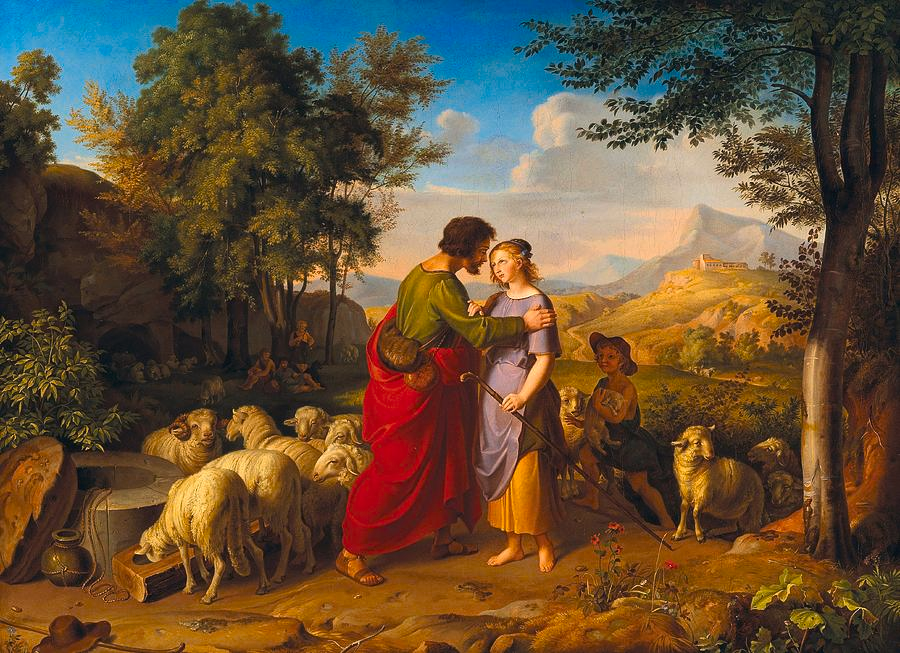
Jacob and Rachel at the well, by Friedrich Wilhelm Müller (Kirchditmold 1801–1889)

Then Jacob continued on his journey and came to the land of the eastern peoples. There he saw a well in the open country, with three flocks of sheep lying near it because the flocks were watered from that well. The stone over the mouth of the well was large. When all the flocks were gathered there, the shepherds would roll the stone away from the well’s mouth and water the sheep. Then they would return the stone to its place over the mouth of the well.

Jacob asked the shepherds, “My brothers, where are you from?”

“We’re from Harran,” they replied.

He said to them, “Do you know Laban, Nahor’s grandson?”

“Yes, we know him,” they answered.

Then Jacob asked them, “Is he well?”

“Yes, he is,” they said, “and here comes his daughter Rachel with the sheep.”

“Look,” he said, “the sun is still high; it is not time for the flocks to be gathered. Water the sheep and take them back to pasture.”

“We can’t,” they replied, “until all the flocks are gathered and the stone has been rolled away from the mouth of the well. Then we will water the sheep.”

While he was still talking with them, Rachel came with her father’s sheep, for she was a shepherd. When Jacob saw Rachel daughter of his uncle Laban, and Laban’s sheep, he went over and rolled the stone away from the mouth of the well and watered his uncle’s sheep. Then Jacob kissed Rachel and began to weep aloud. He had told Rachel that he was a relative of her father and a son of Rebekah. So she ran and told her father.

As soon as Laban heard the news about Jacob, his sister’s son, he hurried to meet him. He embraced him and kissed him and brought him to his home, and there Jacob told him all these things. Then Laban said to him, “You are my own flesh and blood.” (New International Version)

Jacob meets Rachel at the well, by Paolo Fiammingo, c.1585

Jacob was a homebody. Unlike his twin brother Esau, who loved the outdoors and was often away hunting, Jacob preferred to hang around home with his mother – which is probably why Rebekah preferred him over his brother. It’s also why the two of them succeeded in a plan to deceive Isaac and steal the family blessing from Esau.

In Esau’s bitterness over not being blessed by his father, he began laying plans of his own: to kill his brother Jacob in revenge. This came to the attention of Rebekah, who then warned Jacob to flee to her family of origin in Paddan-Aram.

The boy who was attached to his mother and stayed at home, was now a man on the run, in need of a new life. Jacob was alone. One can only imagine the fear and apprehension, the grief and loneliness, of being on his own in a strange place. But God was with him. And the Lord graciously assured Jacob of the divine presence and promises.

Since God was with Jacob and was going to accomplish divine purposes through him, the Lord set up a divine appointment.

Upon arriving at a well, Jacob discovers some shepherds who know his uncle. And then, along comes Rachel with a flock of sheep. God’s providential guidance is evident in leading both Jacob and Rachel to this place and for this time.

Jacob’s mother, Rebekah, was the brother of Laban and the father of Rachel. In the lives of both Rebekah and her son Jacob, Laban ran out to greet and be involved in the divine appointments. (Genesis 24) The narratives differ, however, in that Abraham’s servant had wealth to share in bringing Isaac and Rebekah together; yet Jacob showed up without two pennies to rub together.

And whereas, on both occasions a future bride comes to a well, Rebekah and Rachel differ greatly in their betrothal times. Rebekah’s marriage was quickly arranged; Rachel’s marriage is uncertain and everything is nebulous on how things will shake out with Jacob.

The divine appointment has happened. God’s protection, presence, and guidance are with Jacob. Yet, at this point in the narrative, everything seems up in the air. Will Jacob marry Rachel? Are there going to be numerous descendants? How in the world is Jacob going to return to the land which was promised?

Though this initial foray into the unknown has had a divine stamp on it, Jacob will soon discover that there are many obstacles to negotiate before the promises of God are fulfilled.

And that is the way of us all. Sometimes things come easy and effortless. At other times, it’s a hard slog. In the scope of a life, there are extended seasons of tedious and mundane work – punctuated with times of amazement, even miracle, letting us know there is a God still watching.

You never quite know what’s around the corner of your life – whether good or bad. Yet, the real issue is trust.

The thing about divine appointments is that God is the sovereign ruler of the universe – which means that everything is in the Lord’s hands. All of life, and all events, are providentially bent for divine purposes. Both good and trouble are appointed.

If we believe the Lord is good, right, and just – all the time and that there is never a time when God is bad or capricious – then we are able to accept all circumstances as being from the hand of God. We will trust, even though we don’t know what’s coming next.

The Apostle Paul had it right by saying that “every detail in our lives of love for God is worked into something good.” (Romans 8:28, MSG)

What would your life look like by adopting this perspective God and all events you encounter?

Gracious God, you alone know what my real needs are. You love me more than I myself know how to love. Help me to see my real needs which are hidden from me. I am afraid to ask for either a cross or consolation, so I wait on you; my heart is open to you. Visit me and help me for the sake of your great mercy. Strike me and heal me, cast me down and raise me up, according to your good will. I put all my trust in you. Amen.