Exodus 5:10-23 – More Bricks, Less Straw “Why, God!?”

A brick making scene from an ancient the ancient Egyptian tomb of Rekhmire, c.1400 B.C.E.

So, the slave drivers and foremen went out and told the people: “This is what Pharaoh says: I will not provide any more straw for you. Go and get it yourselves. Find it wherever you can. But you must produce just as many bricks as before!” So, the people scattered throughout the land of Egypt in search of stubble to use as straw.

Meanwhile, the Egyptian slave drivers continued to push hard. “Meet your daily quota of bricks, just as you did when we provided you with straw!” they demanded. Then they whipped the Israelite foremen they had put in charge of the work crews. “Why haven’t you met your quotas either yesterday or today?” they demanded.

So the Israelite foremen went to Pharaoh and pleaded with him. “Please don’t treat your servants like this,” they begged. “We are given no straw, but the slave drivers still demand, ‘Make bricks!’ We are being beaten, but it isn’t our fault! Your own people are to blame!”

But Pharaoh shouted, “You’re just lazy! Lazy! That’s why you’re saying, ‘Let us go and offer sacrifices to the Lord.’ Now get back to work! No straw will be given to you, but you must still produce the full quota of bricks.”

The Israelite foremen could see that they were in serious trouble when they were told, “You must not reduce the number of bricks you make each day.” As they left Pharaoh’s court, they confronted Moses and Aaron, who were waiting outside for them. The foremen said to them, “May the Lord judge and punish you for making us stink before Pharaoh and his officials. You have put a sword into their hands, an excuse to kill us!”

Then Moses went back to the Lord and protested, “Why have you brought all this trouble on your own people, Lord? Why did you send me? Ever since I came to Pharaoh as your spokesman, he has been even more brutal to your people. And you have done nothing to rescue them!” (New Living Translation)

It was God – Yahweh, the great I AM – who called to Moses from the burning bush. It was God who told Moses to go to Egypt because of the groaning of the Israelites in their slavery. It was also God who promised Moses that Divine help would deliver the people from their awful bondage. 

But the promised vision of release and rescue from captivity ran into the harsh buzz-saw of reality. 

Moses did exactly what God told him to do. He was completely attentive and obedient to God’s revealed will. And the result? Pharaoh forced the Israelite slaves to make bricks without being supplied with the straw to do it. Now, the people’s situation is even worse than it was before Moses showed up on the scene. What’s up with that!?

Since we know the end to the story, we understand where all of this is going. However, when we put ourselves in the sandals of Moses, it’s anything but clear about what was happening.

“Confusion is a sign of intelligence; only fools are crystal clear.”

Haresh Sippy

None of us gets off this planet without facing some hard things. We may even face those difficulties when we’re just trying to do the right thing. We’re simply trying to help, do our best, obey God, and then we get in trouble. In those situations, we can empathize with Moses getting testy with God and expressing his complaint.

The God of the universe is big enough to handle our protests in the midst of trouble – even when those complaints are directly pointed toward him. God gets it.

There is an appropriate place for us to freely express our abject disbelief, our painful wonderings, and our outright anger toward God. We won’t get a lightning bolt from heaven if we ask and cry out, “Why, God? What the **** are you doing!?”

There have been many times in my life when I questioned whether I was really sent by God to be in a certain place or to do a certain thing. I seriously wondered whether I really heard God, or not. Maybe it was my own voice in my head. Perhaps it was an emotional decision. 

The incongruence between what we believe and how things are actually turning out can be maddening.

But there is something we must all realize: Just because things go from bad to worse does not necessarily mean God isn’t in the thing. 

We are not always, even usually, privy to the mind of God in the big picture of what the Lord is doing. 

In the middle of trouble, we might think God is not at work, not paying attention, or slow to act. Yet, God knows exactly what’s going on and what the plan is. Sometimes, we need to discern and know that things will get worse before they will get better – and that God has not abandoned us.

Wise God, I trust you that you know what you are doing, even though I don’t see what in the world is going on. Help me to see all things from your perspective so that I might have the wisdom to move forward in faith and patience. I’m out on a limb for you! Please don’t let it break! Amen.

Revelation 21:1-7 – Making Everything New

Making All Things New by James Janknegt

Then I saw a new heaven and a new earth; for the first heaven and the first earth had passed away, and the sea was no more. And I saw the holy city, the new Jerusalem, coming down out of heaven from God, prepared as a bride adorned for her husband. And I heard a loud voice from the throne saying,

“See, the home of God is among mortals.
He will dwell with them;
they will be his peoples,
and God himself will be with them;
he will wipe every tear from their eyes.
Death will be no more;
mourning and crying and pain will be no more,
for the first things have passed away.”

And the one who was seated on the throne said, “See, I am making all things new.” Also, he said, “Write this, for these words are trustworthy and true.” Then he said to me, “It is done! I am the Alpha and the Omega, the beginning and the end. To the thirsty I will give water as a gift from the spring of the water of life. Those who conquer will inherit these things, and I will be their God and they will be my children. (New Revised Standard Version)

The world as we now know it will someday pass away. 

We have a future hope – and it will literally be heaven on earth.

God will descend to dwell with us, and, so, will bring us to humanity’s original design God in the Garden – an unhindered relationship between God and people in which we are no longer dogged by a sinful nature, a sinful world system, and all the temptations a sinful devil uses to exploit for malevolent purposes. 

Tears, death, sorrow and pain will be a thing of the past. Our struggle with sin will be over.

The Apostle John’s revelation to the early church was a very encouraging message. The believers faced all kinds of trouble and persecution due to their commitment to Christ. To know that these problems are temporary, and that Christ’s changes are permanent, was a great comfort and boon to their faith.

One of the problems we experience in this present age is our chronic impatience. We want what we want, and we want it now! 

Throughout history God’s people have looked ahead in hope for the ultimate fulfillment of divine promises. John did not really give a brand new revelation to the church but upheld and anticipated, for Christians, what was true for Israel.   

“Look! I am creating new heavens and a new earth,
    and no one will even think about the old ones anymore.
Be glad; rejoice forever in my creation!
    And look! I will create Jerusalem as a place of happiness.
    Her people will be a source of joy.
I will rejoice over Jerusalem
    and delight in my people.
And the sound of weeping and crying
    will be heard in it no more.” (Isaiah 65:17-19, NLT)
     

In Christ’s first advent, God’s people believed all these promises would be fully and finally realized. But, like a young couple in their engagement period, the promises of God were initiated but not yet realized or consummated. 

People throughout the centuries have struggled with patience, wondering if all this talk of renewal, restoration, and revival would ever happen.

“Where is this ‘coming’ he promised? Ever since our ancestors died, everything goes on as it has since the beginning of creation….”  But do not forget this one thing, dear friends: With the Lord a day is like a thousand years, and a thousand years are like a day. The Lord is not slow in keeping his promise, as some understand slowness. Instead, he is patient with you, not wanting anyone to perish, but everyone to come to repentance. (2 Peter 3:4, 8-9, NIV)

God is even now in the process of moving history to its final stage. Can we be patient, letting God work until that final day comes? 

We live in an amazing time. Although the earth is a big place, we can traverse it by plane in less than two days. It used to be that a ship going across the Atlantic Ocean took three months from Europe to America. Now, we fly across the ocean in a matter of hours. Yet, we freak out whenever we have to be to the airport two hours before a flight and grump about standing in a twenty minute line to board a plane.

It used to be that communication moved at the same pace as a ship. Knowing about a significant event that happened in Europe took months to find out. Now we can know what kind of bread some Frenchman ate for breakfast almost instantly after he eats it because he posted it on social media. Yet, we complain about waiting a few extra seconds for something to load on our computers or smartphones, as if the world were about to end. 

Well, actually, the world is about to end.

Until that day comes, we are not to spend our remaining time trying to figure out exactly the day and hour of Christ’s second advent. We properly anticipate Jesus coming again when we let God change our hearts and lives, our neighborhoods and workplaces, our families and churches, to be like Christ.

God is presently preparing for Christ’s return by doing away with the old to make room for the new. With every changed life, there is the reminder that God is not slow in keeping promises but is active in transforming lives for good.

If anyone belongs to Christ, there is a new creation. The old things have gone; everything is made new!

2 Corinthians 5:17, NCV

The New Testament book of Revelation helps us break our fixation with the past and holding onto the ways we have always done things. We are reminded of God’s capacity and action for renewal. We can walk, right now, in newness of life. 

So, what do we do? Keep on sinning so God can keep on forgiving? I should hope not! If we’ve left the country where sin is sovereign, how can we still live in our old house there? Or didn’t you realize we packed up and left there for good? That is what happened in baptism. When we went under the water, we left the old country of sin behind; when we came up out of the water, we entered into the new country of grace—a new life in a new land!

That’s what baptism into the life of Jesus means. When we are lowered into the water, it is like the burial of Jesus; when we are raised up out of the water, it is like the resurrection of Jesus. Each of us is raised into a light-filled world by our Father so that we can see where we’re going in our new grace-sovereign country. (Romans 6:1-5, MSG)

To overcome impatience and embrace perseverance, we need a better perspective.

In the fall of 1991, a car driven by a drunk driver jumped its lane and smashed headfirst into a minivan driven by a man named Jerry Sittser. Sittser and three of his children survived, but Sittser’s wife, four-year-old child, and mother died in the crash.

In his book, A Grace Revealed, Sittser shares the following interaction some months after the accident with his son, David, who was one of the children who survived:

“Do you think Mom sees us right now?” he suddenly asked.

I paused to ponder. “I don’t know, David. I think maybe she does see us. Why do you ask?”

“I don’t see how she could, Dad. I thought Heaven was full of happiness. How could she bear to see us so sad?”

Could Lynda, my wife, witness our pain in Heaven? How could that be possible? How could she bear it?

“I think she does see us,” I finally said. “But she sees the whole story, including how it all turns out, which is beautiful to her. It’s going to be a good story, David.”

When all is stripped from our lives, and the world as we know it is done away with, what are we left with? 

We are left with God. And a participation with Christ in the renewal of all things. We do that through alleviating and doing away with the evils and troubles of this world. Whenever we seek to eradicate things like global poverty and sex-trafficking; help others come to grips with the evil of this world; change old devilish ways of living; or come alongside others in their trouble; then, God is using us to make everything new.

The end is coming.

But it’s not yet here. 

What’s here right now is God patiently bringing salvation to all kinds of people. 

So, let’s allow God to be God. And let’s allow the Lord to use us in proclaiming the good news that all things are being made new.

Amen.

2 Samuel 7:18-29 – A Model Prayer

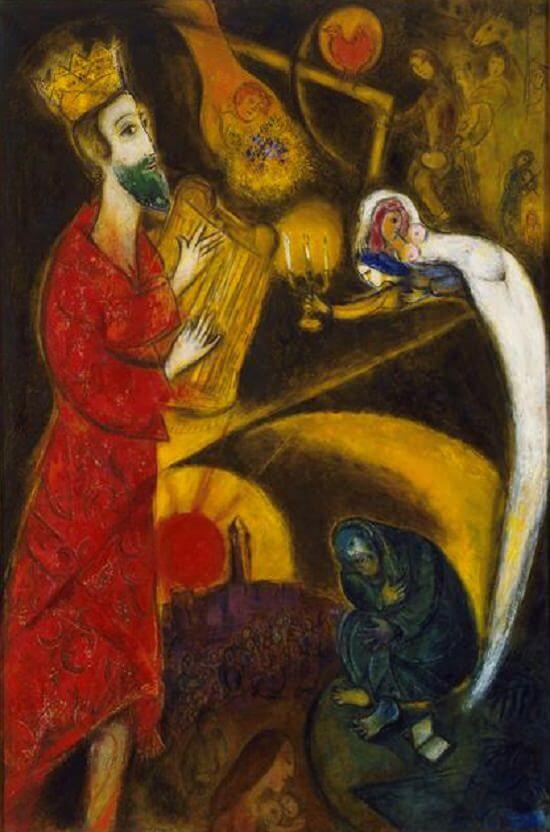
King David by Marc Chagall, 1962

Then King David went in and sat before the Lord, and he said:

“Who am I, Sovereign Lord, and what is my family, that you have brought me this far? And as if this were not enough in your sight, Sovereign Lord, you have also spoken about the future of the house of your servant—and this decree, Sovereign Lord, is for a mere human!

“What more can David say to you? For you know your servant, Sovereign Lord. For the sake of your word and according to your will, you have done this great thing and made it known to your servant.

“How great you are, Sovereign Lord! There is no one like you, and there is no God but you, as we have heard with our own ears. And who is like your people Israel—the one nation on earth that God went out to redeem as a people for himself, and to make a name for himself, and to perform great and awesome wonders by driving out nations and their gods from before your people, whom you redeemed from Egypt? You have established your people Israel as your very own forever, and you, Lord, have become their God.

“And now, Lord God, keep forever the promise you have made concerning your servant and his house. Do as you promised, so that your name will be great forever. Then people will say, ‘The Lord Almighty is God over Israel!’ And the house of your servant David will be established in your sight.

“Lord Almighty, God of Israel, you have revealed this to your servant, saying, ‘I will build a house for you.’ So, your servant has found courage to pray this prayer to you. Sovereign Lord, you are God! Your covenant is trustworthy, and you have promised these good things to your servant. Now be pleased to bless the house of your servant, that it may continue forever in your sight; for you, Sovereign Lord, have spoken, and with your blessing the house of your servant will be blessed forever.” (New International Version)

“The whole reason why we pray is to be united into the vision and contemplation of God to whom we pray.”

Julian of Norwich (1343-1416)

Perhaps you wish you had a better prayer life. To pray, as with most things in life, requires both motivation and how to do it. So, it’s appropriate to find answers about prayer by observing the biblical models of prayer contained in Holy Scripture.

Today’s Old Testament lesson is King David’s prayer in response to God’s revelation to him about fulfilling covenant promises. Looking at David’s prayer, there is a three-fold division which models for us a good way to approach God.

The Present: Gratitude for God’s Grace

David began his prayer with an attitude, posture, and words of humility, recognizing and affirming the relationship between himself and God. Although David is the king over all Israel and Judah, he repeatedly refers to himself as a servant (10 times).

God didn’t have to communicate anything to David about the future. Yet, the Lord graciously made known that it would be through David’s descendants that all of God’s good promises will be fulfilled. And David is overwhelmed with such gracious words. It comes tumbling out of him in a heartfelt prayer of gratitude and thanksgiving.

It is good for us to think about the spiritual blessings we have received from God. Not only can prayers of thanksgiving be uttered at any time to the Lord, but we can also write our gratitude in a journal as a prayer offering to God.

It’s also good to be specific about the circumstances and the praises. In the future, whenever there are discouraging situations, we can look back to what we wrote and remember the ways in which God showed up and encouraged us with very great and precious promises.

The Past: Praise for God’s Actions

David affirms there is no one and no god which can compare to Yahweh, the great I Am. It is the Lord God almighty who displayed divine power and presence in redeeming the Israelites out of Egyptian slavery and into the Promised Land.

Any greatness which arises from humans is the direct result of God’s greatness. Apart from God, there is no distinctive way of living. God’s presence makes all the difference:

Then Moses said to him [Yahweh], “If your Presence does not go with us, do not send us up from here. How will anyone know that you are pleased with me and with your people unless you go with us? What else will distinguish me and your people from all the other people on the face of the earth?” (Exodus 33:15-16, NIV)

The Lord specializes in bending hopeless situations to divine purposes, transforming people to new life, and turning systemic evil on its head so that the humble, meek, and penitent will be first, not last.

The Future: Prayer for God to Fulfill Divine Promises

King David already knew God’s promises to the Israelites. Now, however, David understands how he personally fits into the Lord’s plan.

Courage arises whenever God’s people know God’s promises and then discern how to fit into God’s plan. Confident assurance and settled peace cannot simply be ginned-up through positive thinking; bold faith needs a foundation of truth – a rock solid base which cannot be moved and is always there.

King David found his ultimate motivation in life in God’s revelation. His basis of prayer was God’s Word. Biblical prayers, like David’s, are there for us to model our own prayers.

Accept, O Lord, our thanks and praise for all that you have done for us. We thank you for the splendor of the whole creation, for the beauty of this world, for the wonder of life, and for the mystery of love. We thank you for the blessing of family and friends, and for the loving care which surrounds us on every side. We thank you for setting us at tasks that demand our best efforts, and for leading us to accomplishments that satisfy and delight us. We thank you also for those disappointments and failures that lead us to acknowledge our dependence on you alone.

Above all, we thank you for your Son Jesus Christ; for the truth of his Word and the example of his life; for his steadfast obedience, by which he overcame temptation; for his dying, through which he conquered death; and for his rising to life again, in which we are raised to the life of your kingdom. Grant us the gift of your Spirit, that we may know Christ and make him known; and through him, at all times and in all places, may give thanks to you in all things. Amen.

Nehemiah 9:26-31 – Judgment and Grace

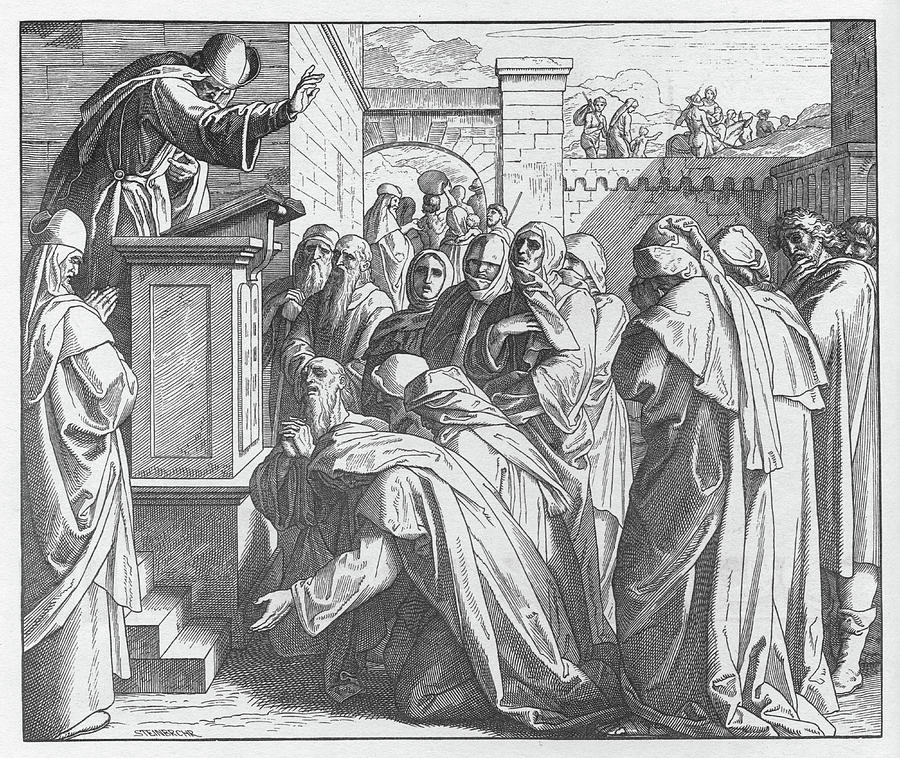
“Repentance of the People” by German painter Julius Schnoor von Carolsfeld (1794-1872)

But despite all this [God’s blessings] they were disobedient and rebelled against you. They turned their backs on your Law, they killed your prophets who warned them to return to you, and they committed terrible blasphemies. So, you handed them over to their enemies, who made them suffer. But in their time of trouble, they cried to you, and you heard them from heaven. In your great mercy, you sent them liberators who rescued them from their enemies.

But as soon as they were at peace, your people again committed evil in your sight, and once more you let their enemies conquer them. Yet whenever your people turned and cried to you again for help, you listened once more from heaven. In your wonderful mercy, you rescued them many times!

You warned them to return to your Law, but they became proud and obstinate and disobeyed your commands. They did not follow your regulations, by which people will find life if only they obey. They stubbornly turned their backs on you and refused to listen. In your love, you were patient with them for many years. You sent your Spirit, who warned them through the prophets. But still, they wouldn’t listen! So once again you allowed the peoples of the land to conquer them. But in your great mercy, you did not destroy them completely or abandon them forever. What a gracious and merciful God you are! (New Living Translation)

Much of the Old Testament is a rhythmic pattern of God’s judgment and grace. The storyline often goes something like this: 

God makes promises and gives commands. 

People get stubborn, refuse to listen, and disobey. 

God responds with judgment. 

People cry out in their distress.

God gives grace and fulfills divine promises. 

People enjoy, then get stubborn again…. 

The promise of God always involves judgment and grace. Proclaiming only a message of judgment without grace brings despair, death, and hell; there is no hope. Speaking only of grace apart from judgment is oxymoronic – it doesn’t exist because there is no need for grace if there is no judgment; grace is an undeserved mercy given freely by God in the face of our stubborn obstinate selves.

Nehemiah chapter nine is a beautiful prayer of confession. Having heard the Word of God proclaimed, the people released their obstinacy; they realized exile occurred because of their own stubborn refusal to listen to God. So, they repented. 

“Fallen man is not simply an imperfect creature who needs improvement: he is a rebel who must lay down his arms.”

C.S. Lewis

The ancient Jewish people acknowledged their checkered past of ignoring God’s prophets, and they bellied-up and took ownership of their past choices. And God was faithful. Even though the city of Jerusalem had been overtaken and the people sent into exile, God brought them back and the broken wall was rebuilt.

It’s never too late to turn from a past filled with poor decisions, broken relationships, and spiritual disobedience. The time of confession is available, and the time is now. God’s grace always overwhelms our dubious past. 

The appropriate response to today’s Old Testament lesson is to spend some time in confession to God. This chapter, along with Nehemiah chapter one, are good places to begin with understanding just what to say to God. 

For the Christian, confession ought always to conclude with accepting the grace available to us in Christ. 

Today is a new day and a new Christian Year. Let it be a life with the love of Jesus implanted in your heart. As we enter the Advent season, allow that love of Christ to gestate within your soul. Anticipate the birth. Look forward to the Nativity. Long for Christmas and the inbreaking of God to this earth.

Holy Lord, in this time of Advent, we confess we often are distracted by the season’s busyness, by the stress of commitment, and even by putting our own traditions ahead of the true meaning of Christmas. We confess we also often prefer being sentimental to being sacrificial.

Forgive us for all the times we have missed seeing You in our midst, for all the times we have doubted Your presence, and for all the times we have failed to hold the holidays as holy days. Pour peace into our lives and let us be bearers of Your peace to others. Remind us that this is a season of waiting and preparation for the greatest Gift of all. In the holy Name of our Savior, Jesus, we pray. Amen.