Seen by God (Genesis 16:7-15)

The angel of the Lord found Hagar near a spring in the desert; it was the spring that is beside the road to Shur. And he said, “Hagar, slave of Sarai, where have you come from, and where are you going?”

“I’m running away from my mistress Sarai,” she answered.

Then the angel of the Lord told her, “Go back to your mistress and submit to her.” The angel added, “I will increase your descendants so much that they will be too numerous to count.”

The angel of the Lord also said to her:

“You are now pregnant
    and you will give birth to a son.
You shall name him Ishmael,
    for the Lord has heard of your misery.
He will be a wild donkey of a man;
    his hand will be against everyone
    and everyone’s hand against him,
and he will live in hostility
    toward all his brothers.”

She gave this name to the Lord who spoke to her: “You are the God who sees me,” for she said, “I have now seen the One who sees me.” That is why the well was called Beer Lahai Roi; it is still there, between Kadesh and Bered.

So Hagar bore Abram a son, and Abram gave the name Ishmael to the son she had borne. (New International Version)

I’m blind as a bat without my glasses. They’re the first thing I put on when waking in the morning, and the last thing I take off before retiring at night. Without them I can’t distinguish anything very well, at all. I cannot see others unless they are inches from my face.

As bad as it would be if I didn’t have my glasses, it would be even worse if you were not seen by anyone. I believe that one of the great tragedies of modern Western civilization is that we can live among so many other people, yet not be seen by so many of them. The loneliness of not being seen is a terrible situation.

Hagar certainly felt that way. Perhaps even worse, she felt that God didn’t see her. It was as if God lost his glasses somewhere. 

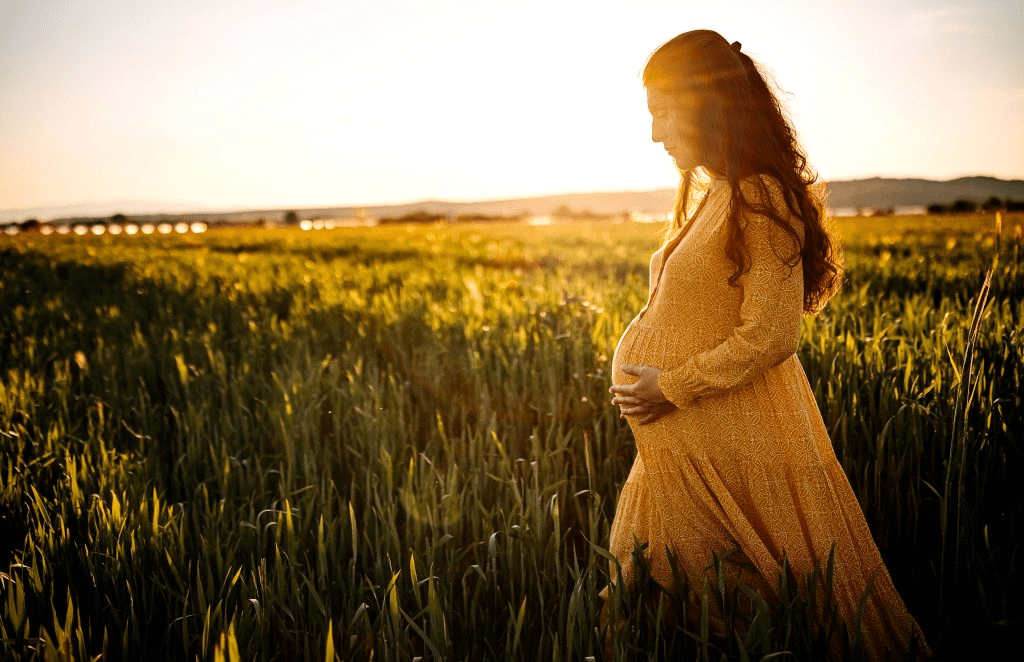
Because a slave, Hagar’s body was not her own. Through a bunch of decisions out her control, she became pregnant with Abraham’s son. It was messy and complicated. Dysfunction was all around. A very pregnant Hagar ran away.

Having been abused by her mistress, we can feel Hagar’s despair… but there was someone watching, someone seeing the desperation on the face of a pregnant slave: God. 

The Lord saw everything – all the craziness, all the mistreatment – and stepped-in and acted on behalf of Hagar and her unborn son.

As a result, Hagar began to call God, “The God Who Sees Me.” She never again had to wonder or doubt whether she was seen. 

You might feel today that God doesn’t see your pain, is aloof and distant from your hurt, and is blind to your deep wounds. But God sees… all of it. The Lord may not be working on the same timetable as you and me, but nevertheless, you are seen with divine eyes.

You “see,” there is someone watching who specializes in hard cases. The Lord came alongside Hagar and spoke a promise to her that she could hold onto in her time of trouble. It was a promise way beyond what she could have dreamed of, far above her station in life.

Hagar gave a name to God. “El Roi” means “the God who sees.” At a low point in Hagar’s life when it seemed she was an unseen nobody, God showed up and let her know different.

I’m sure there have been times in your life, just like there have been situations in my life, where you wonder if anybody sees you, including God. You feel that if you stepped off the earth today, nobody would even notice or care.

Conversely, to be seen brings wonder, joy, and awe into life. To know the God who sees you is to be transported into the garden of paradise, enjoying divine presence and fellowship.

You are not alone. The Lord knows your every move. God watches because God loves and adores you. The almighty Lord is not a god who is aloof and distant. The One true God looks upon you and me with the kind of affection that a new parent has standing over the crib of their infant child. It’s a look of care, protection, joy, pride, and compassion.

One of the most fundamental theological statements we could say about God is: The Lord sees each individual person, and the Lord of all creation cares for each one.

Yes, terrible tragedies and gut-wrenching evil exist in this twisted mixed-up world. And God has anger and wrath, and is not okay with all the injustice throughout the earth. Yet, God’s wrath exists because of God’s love. The Lord will do something about it, and will do it in the proper time.

God is working out good purposes and plans. God will judge the living and the dead. The Lord has not forgotten you. God sees you, created in the divine image and likeness, and will act on your behalf.

Blessed are you, Sovereign God of all, to you be praise and glory forever. In your tender compassion the dawn from on high is breaking upon us to dispel the lingering shadows of night. As we look for your coming among us, open our eyes to behold your presence. Strengthen our hands to do your will, so that the world may rejoice and give you praise. Blessed be you, God almighty. Amen.


Encouragement for Today (1 Thessalonians 4:13-18)

Brothers and sisters, we do not want you to be uninformed about those who sleep in death, so that you do not grieve like the rest of mankind, who have no hope. 

For we believe that Jesus died and rose again, and so we believe that God will bring with Jesus those who have fallen asleep in him. According to the Lord’s word, we tell you that we who are still alive, who are left until the coming of the Lord, will certainly not precede those who have fallen asleep. 

For the Lord himself will come down from heaven, with a loud command, with the voice of the archangel and with the trumpet call of God, and the dead in Christ will rise first. After that, we who are still alive and are left will be caught up together with them in the clouds to meet the Lord in the air. And so we will be with the Lord forever. Therefore encourage one another with these words. (New International Version)

Everyone needs encouragement. Everybody wants some good news in their lives. People must not only have food, drink, clothing, and shelter, but also words that they can live by – words that can sustain them and help to make ends meet for their daily lives.

The Thessalonian Christians needed some good words of encouragement. They believed the Lord Jesus was coming soon. Any day now, at any time, Christ will return and take us to be with him forever. And yet, day after day, there was nothing but the anticipation, along with the expectations that weren’t realized.

On top of it all, some of the believing brothers and sisters died. So, what happens to them when they die? Will they somehow be excluded from enjoying Christ’s return? And, by the way, are we missing out on something here? Did Jesus come, and we somehow missed it?

The believers in the Thessalonian Church were left with concerns – not only for those who had died, but for those who were still alive. Perhaps somebody, even themselves, were being excluded from the gracious visitation of God. They were curious, but most of all confused.

Hope needed to be clarified for the Christians. A confident expectation would help sustain them in this life. They can keep laboring in the Lord with faith, have hope for the future, and realize love in both this life and in the life to come.

Christ will descend from the clouds with a cry of command, the sound of a trumpet, and lift the faithful into heaven. In other words, for those people who were living in the Roman Empire, Christ will arrive with the fanfare and pageantry of any Roman Emperor. Peace and security are here – not from Ceasar – but from a Sovereign who is greater than any earthly ruler.

I realize that many believers today see this vision of the coming Christ as a literal description. Maybe it is, and maybe it isn’t. But whatever it is, the Apostle Paul intended to assure the Thessalonian faithful that the promises of God were backed up by a power even greater than that of Rome.

Furthermore, true peace, security, and hope are not found in the Pax Romana of Rome, but in the gracious rule and reign of God. Christ is the Lord; Ceasar is not. The Thessalonians, therefore, were encouraged to let God be the source of their peace. For the One who calls you is faithful.

The encouragement we need is really not so different from what the Thessalonians needed to hear. Two thousand years later, like them, we continue to look for signs that assure us that God has not forgotten us; that we will not be left behind; and that we will not be separated from those who have already died.

As world problems continue, and as time marches on, we may grow weary. We might then place more hope and confidence in the power of a national government that offers us peace and security, as we patiently wait for God. Like the Thessalonians, all we really need is the assurance that God’s power and God’s promise is real.

We might not see Christ coming down from the sky today, or even next week, or next year. But we can still embrace the hope we need in order to get by every single day.

Although an apocalypse is coming, it is actually in the little things of life that helps sustain us till then. An encouraging and timely word from a friend; praying with a fellow believer; giving thanks to God for all things; and living with an awareness of the spiritual throughout the world all these things strengthen us and enable us to see God at work.

Through a consistent walk with God, day after day, the power and presence of God becomes real to us – maybe just as real as a dramatic scene of Christ coming down from the clouds – and offers us hope to face each new day with courage and compassion for a world in desperate need of salvation.

Almighty and all-sufficient God, give me strength to live another day.

Let me not be a coward in difficult circumstances, or to turn tail and run in the face of hard responsibilities.

Help me not lose faith in other people.

Keep my heart tender and wise, in spite of others’ ingratitude, treachery, or meanness.

Preserve me from minding the little stings of life, or of giving them to others.

May my heart be pure; and may I live honestly and fearlessly, so that no outward failure can dishearten me or take away the joy of inward integrity.

Open wide the eyes of my soul that I may see good in all things.

Grant me today some new vision of your truth.

Inspire me with a spirit of joy and gladness.

Make me the cup of strength to suffering souls.

I ask all of this in the name of my Deliverer, Lord, and Friend, Jesus Christ. Amen.

Consider Rahab (Joshua 2:15-24)

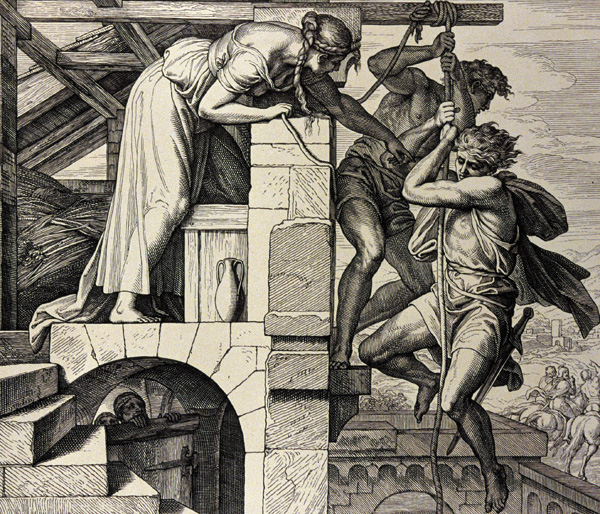
Rahab the harlot helps the Israelite spies escape from Jericho

So she [Rahab] let them [the Israelite spies] down by a rope through the window, for the house she lived in was part of the city wall [of Jericho]. She said to them, “Go to the hills so the pursuers will not find you. Hide yourselves there three days until they return, and then go on your way.”

Now the men had said to her, “This oath you made us swear will not be binding on us unless, when we enter the land, you have tied this scarlet cord in the window through which you let us down, and unless you have brought your father and mother, your brothers and all your family into your house. If any of them go outside your house into the street, their blood will be on their own heads; we will not be responsible. As for those who are in the house with you, their blood will be on our head if a hand is laid on them. But if you tell what we are doing, we will be released from the oath you made us swear.”

“Agreed,” she replied. “Let it be as you say.”

So she sent them away, and they departed. And she tied the scarlet cord in the window.

When they left, they went into the hills and stayed there three days, until the pursuers had searched all along the road and returned without finding them. Then the two men started back. They went down out of the hills, forded the river and came to Joshua son of Nun and told him everything that had happened to them. They said to Joshua, “The Lord has surely given the whole land into our hands; all the people are melting in fear because of us.” (New International Version)

A drama unfolded as the Israelites began entering and taking the Promised Land. Joshua, their leader, secretly sent two men as spies to look over the land and check out the prominent city of Jericho. The spies left and ended up in the house of a harlot named Rahab. They hid there because it had been found out they were in the city.

Rahab was able to divert and send away the pursuers who were looking for the spies, telling them that the men left, and that they should leave and go catch them. But she had actually hid them on the roof of her house.

Rahab took the spies into her home because she realized and affirmed that God was giving the land to the Israelites. Everyone in the city had heard the stories of how the Lord brought them out of Egyptian slavery and into the land of Canaan. In an insightful and beautiful confession of faith, Rahab told them:

“I know that God has given you the land. We’re all afraid. Everyone in the country feels hopeless. We heard how God dried up the waters of the Red Sea before you when you left Egypt, and what he did to the two Amorite kings east of the Jordan, Sihon and Og, whom you put under a holy curse and destroyed. We heard it and our hearts sank. We all had the wind knocked out of us. And all because of you, you and God, your God, God of the heavens above and God of the earth below.” (Joshua 2:8-11, MSG)

The men promised to show Rahab and her family mercy when they came to take the city, just as she had shown them grace in the face of trouble. So, today’s Old Testament lesson picks up the story from that point, as she sends the spies safely on their way.

That Rahab, a prostitute, is the heroine of the story is no accident or anomaly. Her profession of faith is central to the drama. She was living in the city wall, which is reflective of her status as being on the margins of society. And having strange men in her home would not have been weird in her neighborhood. It also made it rather easy to get the spies out of the city when trouble was brewing.

Most importantly, however, Rahab – the ultimate outsider in society – becomes the consummate insider. It is astonishing that a Gentile woman of disrepute has a story about her, and even told from her perspective – and not from the point of view of an Israelite man.

Rahab’s bold assertion of faith is both sincere and linked to God’s promise that the Israelites would take the land. Rahab is Exhibit A of the kind of person that inherits the kingdom of God. Rahab’s faith, not her works or reputation, is what spared her life and spared her from judgment.

Please ponder and consider that truth for a bit. Sit with it if you must – the reality that Rahab was judged neither by the spies nor God.

In far too many quarters of the Christian (and broadly religious world) judgment instead of mercy is levied to persons like Rahab. If there is anyone who should have a non-judgmental presence toward “sinners” it is Christians. And, if there is any institution which ought to consistently, both personally and through policy, display unflagging grace and forsake judgment, it is the Church.

Yet, unfortunately, as many have experienced, the Church has often fallen short of the glory of God’s grace in Christ by condemning people of ill repute. Perhaps we all need to rethink what faith truly is: not a checklist of doctrinal beliefs to sign-off on but a confident and bold action based solidly in the promises of God.

Knowing what those promises are, and living our lives appropriately in consideration of them, is the kind of faith that pleases God. Those who attempt to be judge, jury, and executioner need not apply as followers of God.

Genuine righteousness is never earned; it is given by the compassionate grace of God. So, lay hold of God’s promise of grace and mercy with gusto! Let the gracious God, who is full of steadfast love, affect the way we live our lives. Believe with a bold biblical belief that God always does what God has decreed and proclaimed to do.

Lord God, the gracious, almighty, and Holy One of all: I may have not always lived my life well, yet I trust you today that you can and will deliver me from all my troubles because you are with me. May your Holy Spirit give me the gift of faith to believe in such a way that forever impacts how I live my life in service to you and for the common good of all persons – no matter who they are. Amen.

Use Your Freedom For Good (Exodus 33:1-6)

Then the Lord said to Moses, “You and the people you brought out of Egypt must leave this place. Go to the land I promised to Abraham, Isaac, and Jacob with an oath, saying, ‘I will give it to your descendants.’ I will send a Messenger ahead of you, and I will force out the Canaanites, Amorites, Hittites, Perizzites, Hivites, and Jebusites. Go to that land flowing with milk and honey. But I will not be with you, because you are impossible to deal with, and I would destroy you on the way.”

When the people heard this bad news, they acted as if someone had died. No one wore any jewelry. The Lord had said to Moses, “Tell the Israelites, ‘You are impossible to deal with. If I were with you, I might destroy you at any time. Now take off your jewelry, and I’ll decide what to do with you.’” After they left Mount Horeb, the Israelites no longer wore their jewelry. (God’s Word Translation)

It took little time for the covenant between God and the Israelites to be violated. The relationship between the Lord and the people was meant to be cemented through a special covenant in which Yahweh makes promises to them and gives them instructions and commandments; and the Israelites pledge their fealty and promise to obey.

But the people quickly reneged on the relationship. While Moses was up on Mount Sinai, receiving the Law from God, the Israelite grumbles and complaints came to full flower. They went their own way and made a calf idol out of gold.

So, the Lord’s judgment broke out amongst them. The Levites, to their credit, rallied around Moses and the Lord, and took out the rabble rousers in the camp. What’s more, God sent a plague that killed many.

In the aftermath of the rebellion against Moses and the Lord, God ordered the people to leave Mount Sinai – the place where everyone was to have a positive experience of Yahweh’s presence. God’s anger and wrath were so aroused that it became impossible for the divine presence to go with the people. Only Moses, as God’s emissary, would be able to guide the Israelites so that they are not completely eradicated.

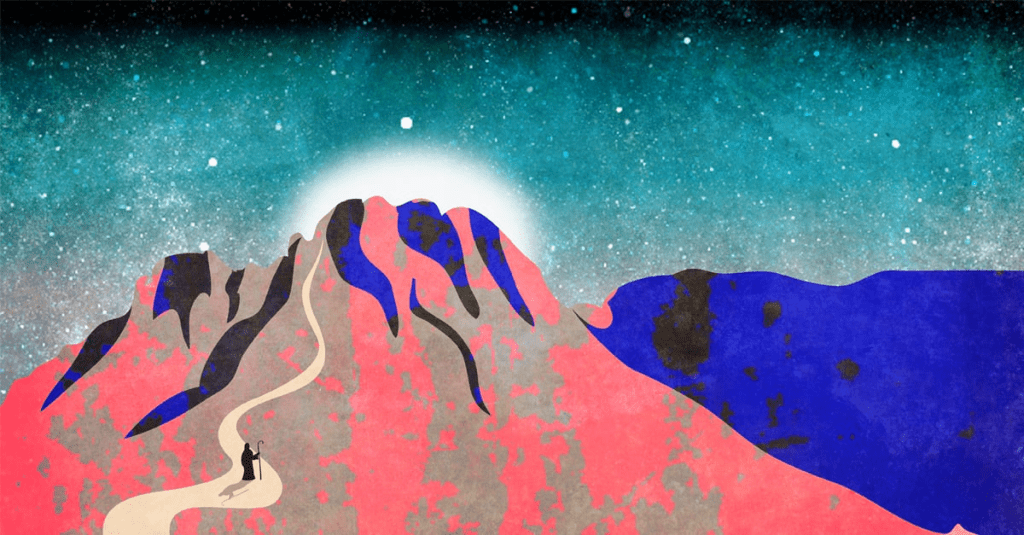
Mount Sinai, by Sefira Lightstone

Yet, even after all the bad attitudes, rebellious actions, and an idolatrous spirit among the Israelites, Yahweh will still keep the divine promise to Abraham, Isaac, and Jacob to deliver them and bring them to the Promised Land.

Today’s story has the feel of a chastened child sitting in the corner, having to think about what they just did to raise the ire of the parent. The Israelites moved from Sinai in a somber mood, realizing more clearly than ever how much their lives are tied and linked to God’s divine presence.

At God’s command, the people removed their jewelry and took off their party clothes from the celebration that got them into so much trouble. It began to sink in, that the Lord departed from them because of their great sin. They started to realize, albeit too late, that they really screwed up their relationship with God.

The Israelites didn’t know how good they had it with the divine pillar of cloud by day and fire by night to lead them – and how much they actually depended on the God-given manna for their sustenance and existence.

It’s all too typical for us humans that we fail to realize what we have, until it’s gone. The ancient Israelites were freed from a cruel slavery in Egypt. They clearly did not handle their freedom well, at all. Perhaps the people were so used to being in bondage that, when they go their freedom, they just adopted a different sort of slavery – to their sinful passions.

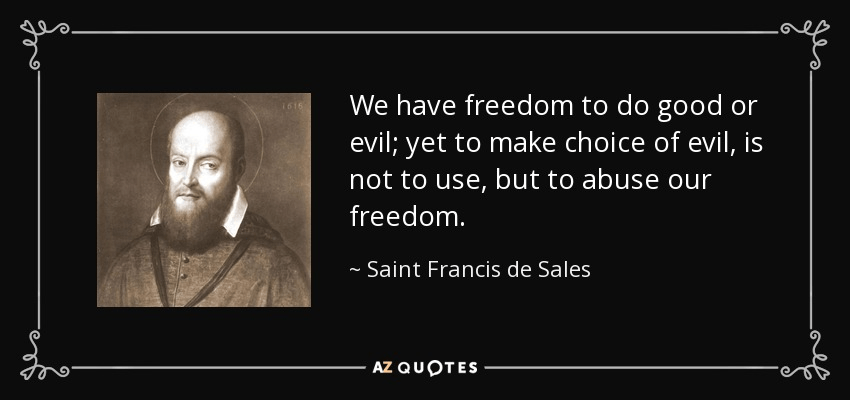
Let’s handle our freedom with some responsibility and accountability, so that we do not go down the same rebellious path as the ancient people of God. You and I are free to choose what we do, what we think, and how we spend our time. It’s easy to blame outside forces when circumstances are hard; and to grumble whenever we don’t like something.

Freedom is a spiritual discipline; we must learn how to intentionally practice it and use it for good. The following are four areas to purposefully work on with our freedom by making good choices:

Choose your words carefully. What comes out of your own mouth is up to you. Let those words reflect who you truly are; and let your speech impact others around you for good, and not evil.

Choose your attitude with some self-awareness. With awareness comes choices. For example, if we are not aware of our own anger, it will eventually come out sideways on another person. Our sullen attitude and jaded perspective will color our relational interactions. But if we are aware of our emotions, we can choose to effectively work through them, and then decide what sort of attitude we’re going to have.

Choose your actions before you do them. Seemingly insignificant choices turn into small actions. The small actions become habits. And habits shape character and create a life. We make choices every day about what we’ll do and not do. In every sort of situation we have choices to act, such as: Will I let go, or will I try and control others? Will I walk, or drive? Will I spend, or save? Shall I prepare, or procrastinate? Be fit, or be fat? Talk or listen?… and a thousand other choices of action.

Choose your beliefs with care. Our beliefs and our faith determines how we act and behave. If we believe in a good God who has our best interests at heart, we will freely trust such a God. But if we believe God to be a capricious Being who is aloof from my concerns, then we will make choices to watch out for number one and view others with suspect.

If you are behaving in ways that aren’t working for you, examine what belief is causing that behavior. Then decide whether that’s a belief you really need to have, or not, then change it, if necessary.

Every choice we make, contributes to the person we want to become, and sets us on the path to where we want to be in life. Maybe if the ancient Israelites had more awareness of this, they might have chosen very differently.

Gracious God, grant me clarity and awareness to make wise decisions. Enlighten my heart and mind, as I seek to follow your divine guidance. In the face of uncertainty, give me the courage to trust your promises. Help me embrace the path set before me, with a spirit of love and grace. Amen.