If the Lord hadn’t been for us—
let Israel now repeat!—
if the Lord hadn’t been for us,
when those people attacked us
then they would have swallowed us up whole
with their rage burning against us!
Then the waters would have drowned us;
the torrent would have come over our necks;
then the raging waters would have come over our necks!
Bless the Lord
because he didn’t hand us over
like food for our enemies’ teeth!
We escaped like a bird from the hunters’ trap;
the trap was broken so we escaped!
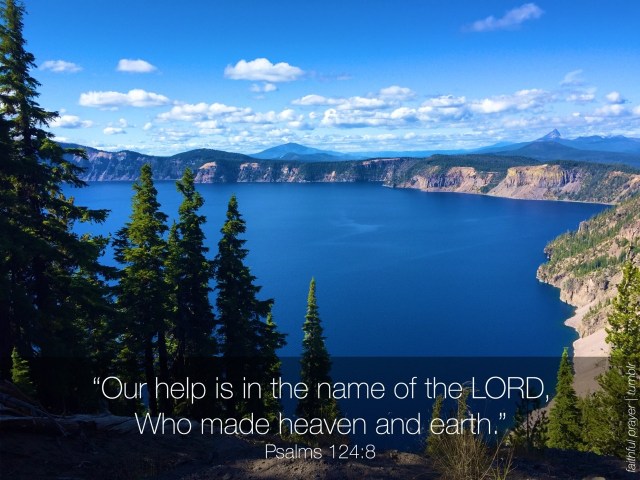
Our help is in the name of the Lord,
the maker of heaven and earth. (CEB)
“Our help is in the name of the Lord who made heaven and earth.” These are the words for which I begin nearly every worship service in church. It is a call to worship the God who is above all and sees all – and can do something about the adversity and trouble we face in the world. When confronted with a new day, our attention needs some direction in the positive way of acknowledging God.
Our ultimate help is in the Lord. Our fears about the future, our insecurities of what will happen, and our anxieties about all the upcoming stuff we must face can be transformed with the biblical perspective of acknowledging our need for God. The Lord is our most prescient support. That virtual meeting you have been dreading; that conversation you have been avoiding; or, that deadline that has been looming over your head; these and all situations can only find their proper perspective in light of the God who helps.
I am a believer in making daily affirmations of faith in God. That is, affirming the truth about God, even if I don’t feel like it, each and every day so that some solid robust theology is at the forefront of my mind, and the attributes of God sink firmly into my heart. For faith does not simply come because of signing off on a checklist of beliefs. Rather, faith arises as a response to the recognition that God is good – all the time – and that he helps those who look to him.
There are a lot of things we do not know: what will happen tomorrow; how a situation will shake out in the end; whether a relationship will flower or wither; and, a million other things which can weigh down our hearts with anxiety. However, there is one sure truth we can count on right now and for every minute into the future: God is with us. God’s ever-present help remains the constant ballast in a sea of changing circumstances.
Indeed, “If God is on our side, can anyone be against us?… I am sure that nothing can separate us from God’s love—not life or death, not angels or spirits, not the present or the future, and not powers above or powers below. Nothing in all creation can separate us from God’s love for us in Christ Jesus our Lord!” (Romans 8:31, 38-39, CEV)
Creator God, you are the ever-present One who provides everything I need for life and godliness. I need your help today and everyday so that I can confidently do your will. I stand with full assurance of faith because I serve the Lord Jesus, who is benevolent and always does what is right and just. Amen.
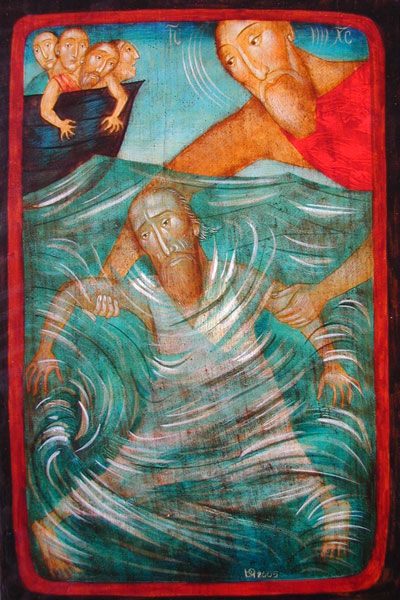
The Sinking of the Apostle Peter by Julia Stankova, 2006
The New Testament Gospels of Matthew, Mark, Luke, and John allow us to see Jesus for who he really is: The Son of God, the true King of the universe who seeks to reconcile people to God through his life, miracles, and teaching. The Gospels also allow us to see the disciples of Jesus for who they really are: A rag-tag bunch who express both belief and doubt, and experience both faith and failure.
The reality of the Christian life is that it is often a herky-jerky three-steps-forward and two-steps-backward kind of experience. An expectation that we will “succeed” and have everything go well every time we try something by stepping out in faith is way out of step with how things work in both this world and in the kingdom of God. It would be a bit like a basketball player expecting to make every free throw attempt – and if they cannot do it, they refuse to even try.
Doubt and failure are important experiences for the believer in Jesus Christ. Without failure, there is no Christian life. Never failing means we have not tried – we are still in the boat, having never left the safety of established routines and responded to God’s command to come, leave your comfort zone, and enter the scary world of kingdom living.
Our failures may sometimes, like the disciple Peter, be colossal belly-flops. Yet, the story of Peter getting out of the boat and walking on the water and becoming overcome with the waves is just as much or more about Jesus (Matthew 14:22-33). Christ extended grace to Peter and helped him, even in his failure of faith. Therefore, our failures do not need to define us. Jesus is Lord over the water, the storms, and of everything – including our own hardship and trouble.
Yes, there are a lot of scary things in life. Learning to ride a bike is scary. Driving for the first time on an icy road is scary. Getting married and having kids is scary. Admitting an addiction or unethical behavior is scary. Sharing the innermost thoughts with a friend is scary. It is scary just to be in this world. It can even be scary to be at church! It is all scary because we might fail, and the failure, we reason and worry about, might crush us.
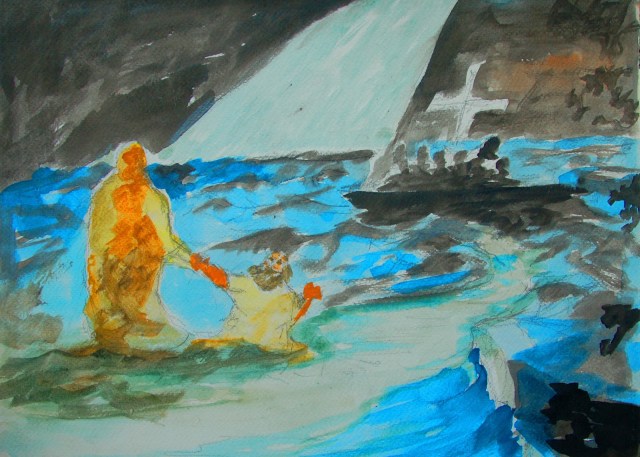
However, the fear of failure need not control our lives because grace overcomes everything. We all find ourselves, at times, caught midway between faith and doubt. Yet, to know this situation is to experience grace. If the worst scenario you worry about in your head would actually come to pass, it will still never change the reality that God loves you! And it will not stop Jesus from extending his hand to you in a life-saving grip of grace.
Jesus Saving Peter by Bertram Poole, 2012
Fear only melts away when we keep our eyes on Jesus. Christ is the polestar whom we must center our lives, instead of focusing on the waves around us. The truth sets us free, so, take note of the following truths about Jesus that will help us overcome the fear of failure and embrace a life of faith.
Jesus is a person of prayer (Matthew 14:22-24).
Jesus, the Son of God, was deeply dependent on his heavenly Father. His life exhibited the necessities of simple prayer and obedience. If Jesus found the need for solitude and prayer in his life and ministry, how much more to we need it!?
Jesus made the disciples get into the boat and go out on the lake. As Lord of the elements, he knew very well they were about to face a storm. Sure enough, the storm clouds gathered, and the boat got thrown around by the waves. Even though the disciples were doing God’s will by going out on the lake, they were not spared from the adversity. In fact, Jesus wanted them to experience the storm because it is through the storm that we really learn faith.
Faith is a muscle which requires continual use. Through stressful and vigorous exercise, there is a breaking down of muscle tissue and tearing of muscle fibers which leaves the body in need of rest and recuperation. It is through this process of healing that the muscles grow and are strengthened. Muscles which do not experience this type of stress become useless and eventually atrophy. Show me a person of great faith, and I’ll show you a person who has gone through a boat load of adversity and hurt, having allowed Jesus to grace them with healing.
There is no shame in either being hurt and/or admitting failure. Where there is shame, our instinct is to run away much like our ancestors Adam and Eve. We can try and hide from the shame, but we will end up hiding ourselves from the grace that could be ours through the Body of Christ. Grace is free, not cheap – it is accessed by the humility of confession.
Jesus is present with us, bringing an end to fear (Matthew 14:25-27).
Although on the middle of a lake during a storm, Jesus was still present with the disciples. Adverse weather was no problem for Jesus – he just walked on the water to be with them. Even though the disciples had just seen and participated in the miracle of Jesus feeding the five thousand, they were not looking for another miracle. Maybe that is why they did not recognize Jesus and were afraid when they saw him.
The disciples’ expectations of Jesus were far too low! Sometimes when we are afraid, we fail to see Jesus, even when he is right in front of our faces. We just do not expect him to be there. When the disciples cried out in fear, Jesus responded. I used to work at a factory where I trained people in their jobs. When the training was finished, I had the trainees evaluate our time together. The top response I received from most of them is that it was my presence that helped them to learn their job – the ability to fail time and time again. And having me there to rescue them when things got overwhelming eventually built faith that they could do it on their own.
Jesus wants those who follow him to imitate him (Matthew 14:28-31).
Jesus walked on water. Jesus invited Peter to walk on water. We are to do what Jesus did. Notice that Peter is not chided by Jesus for getting out of the boat but for doubting that he could continue in the miracle that was happening. Jesus wants more than a regurgitation or parroting of his teaching; he wants us to exercise that learning through actual deeds of faith. Once the command of Jesus was given to “come” then walking on water became nothing more than a matter of trust. Christianity is more than a set of doctrines to believe; it is a powerful reality to be live into.
“Christianity has not been tried and found wanting. It has been found difficult and left untried.” –G.K. Chesterton
We understandably get nervous when a crazy Jesus and an unpredictable Holy Spirit call us to get out of the friendly confines of the boat. After all, we might fail. However, it is in such times we bank on the Word of God and the promises of God.
The Apostle James said that if we find ourselves lacking wisdom to deal with the unpredictable and unknowable that we are to ask God who gives generously to all without finding fault and will be given to them (James 1:5).
Peter responded to his sinking situation by crying out to Jesus, “Lord, save me!” Jesus immediately reached out and saved Peter from his own doubt and lack of faith. Jesus called Peter a “little-faith.” Many people have lived too long with the notion that God is some stern angry deity who is constantly displeased with his sinful people, and that only through perfection will he ever be happy with us. The truth is that Jesus wants us to imitate him; and, when we fail, he is there to pick us up.
Jesus has the authority to settle the storm when he is good and ready to do it (Matthew 14:32).
Jesus is the King of the universe and the Sovereign of the world. He will bring the crisis to an end according to his own good pleasure and in his own good timing. Rather than spending all our emotional capital by worrying or conniving to get out of a situation, we need to trust God and keep our eyes on Jesus. Our job is trust; God’s job is everything else.
Jesus’ power led the disciples to acknowledge who he is (Matthew 14:33).
Worship happens when we see Jesus as he really is, the Son of God. Flat, dull, boring worship comes from flat, dull, boring Christians who are unable to see the power of Jesus in their lives. And the way we know the power of God is when we are in a situation which requires God’s strength to deliver us. Grasping Jesus as the Son of God is more than a verbal confession of faith; it is being able to trust him, like getting out of a boat in the middle of a lake.
We are to live by faith in the Son of God who loved us and gave himself for us (Galatians 2:20). It does not require much faith to pray that Aunt Mable’s bunions will feel better. It only requires a little faith to give a dollar when you have ten dollars. It takes no faith to discuss the weather and steer clear of hard conversations.
However, it does require faith to pray for a miraculous healing every day without giving up for a little boy who is racked by epilepsy, and trust God to spare his life. It does require faith to write a check for $100 to someone in need when you have exactly $100 in your checking account, and you must trust God to provide for you own necessities. It does require faith to deviate from the routine schedule to have a difficult discussion about race. It does require faith to act on Christ’s teachings. It does require faith to live as though the mission of God in this world is the most important thing we could ever do.
It would be nice for me say that if you live by faith in the Son of God that you will never fail, but that would be lying. The only way of not failing is not living life, and not exercising faith. It would be great if we could pray and act without ever doubting, yet the only way to avoid doubt is to not believe.
So, may we embrace the life that is truly life by stepping out of the boat. May Jesus define our lives instead of letting failure define us. May we accept the grace that is ours in Jesus Christ our Lord.
Lord, hear my prayer for justice.
I am calling loudly to you.
I am being honest in what I say,
so please listen to my prayer.
You will make the right decision,
because you can see the truth.
You were with me all night
and looked deep into my heart.
You questioned me and found that
I did not say or do anything wrong.
Unlike most people, I have obeyed your commands,
so I have never been like those who are cruel and evil.
I have followed your way.
My feet never left your path.
Every time I call to you, God, you answer me.
So listen to me now, and hear what I say.
Show your amazing kindness
and rescue those who depend on you.
Use your great power
and protect them from their enemies.
I have done only what is right, so I will see your face….
And seeing you, I will be fully satisfied. (ERV)
This is one of David’s personal psalms of lament. It is a prayer forged during a time of severe adversity with enemies who sought to snuff-out his life. The psalm is a plea uttered with the hope that God would indeed vindicate him and subdue those who wanted to harm him. It is a lament that wickedness exists and often gets its way; and, it is grief over the constant threats that swirled around David.
It was David’s prayer that with all the heartless and arrogant violence continually in his life that God would keep him as the apple of his eye and hide him in the shadow of his wings. Indeed, perhaps no better prayer could be said in those times when there are people who make untrue accusations and only wish harm to be done to you, that God would be gracious, merciful, and kind through rescuing us from both bodily harm and spiritual abuse. It is in the times when angry simpletons spew their worst that we need to confidently know that God watches over his people with affection and cares for them as a mother hen protects her chicks.
You and I are precious to God. We can and ought to run to him when there is trouble and feel no shame in loudly crying for fairness and justice. The Lord is a benevolent God showing firm commitment to those who seek truth, loving actions, and merciful words. When going through a difficult time in which another or others accuse you of wrongdoing and you know you are innocent, the proper prescription is to pray this very psalm repeatedly at night before bed. For we all know that sleep can be elusive and hard to come by in such circumstances. Perhaps, along with David, you will be able to say: I have done what is right. I will see your face. I will be fully satisfied.
Arise, Lord God Almighty! Deliver my soul from the wicked and subdue them! I seek refuge in you, O Savior; show me your steadfast love as I cry out to you for justice. Incline your ear to hear me, and answer when I call through the name of Jesus Christ in the power of the Holy Spirit. Amen.
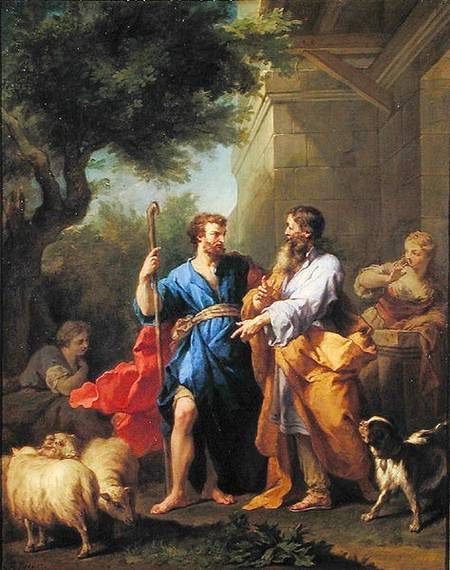
Jacob and Laban by French artist Jean Restout (1692-1768)
Jacob heard that Laban’s sons were saying, “Jacob has taken everything our father owned and has gained all this wealth from what belonged to our father.” And Jacob noticed that Laban’s attitude toward him was not what it had been.
Then the Lord said to Jacob, “Go back to the land of your fathers and to your relatives, and I will be with you.”
So, Jacob sent word to Rachel and Leah to come out to the fields where his flocks were. He said to them, “I see that your father’s attitude toward me is not what it was before, but the God of my father has been with me. You know that I have worked for your father with all my strength, yet your father has cheated me by changing my wages ten times. However, God has not allowed him to harm me. If he said, ‘The speckled ones will be your wages,’ then all the flocks gave birth to speckled young; and if he said, ‘The streaked ones will be your wages,’ then all the flocks bore streaked young. So, God has taken away your father’s livestock and has given them to me.
“In breeding season, I once had a dream in which I looked up and saw that the male goats mating with the flock were streaked, speckled or spotted. The angel of God said to me in the dream, ‘Jacob.’ I answered, ‘Here I am.’ And he said, ‘Look up and see that all the male goats mating with the flock are streaked, speckled, or spotted, for I have seen all that Laban has been doing to you. I am the God of Bethel, where you anointed a pillar and where you made a vow to me. Now leave this land at once and go back to your native land.’”
Then Rachel and Leah replied, “Do we still have any share in the inheritance of our father’s estate? Does he not regard us as foreigners? Not only has he sold us, but he has used up what was paid for us. Surely all the wealth that God took away from our father belongs to us and our children. So do whatever God has told you.”
Then Jacob put his children and his wives on camels, and he drove all his livestock ahead of him, along with all the goods he had accumulated in Paddan Aram, to go to his father Isaac in the land of Canaan.
When Laban had gone to shear his sheep, Rachel stole her father’s household gods. Moreover, Jacob deceived Laban the Aramean by not telling him he was running away. So, he fled with all he had, crossed the Euphrates River, and headed for the hill country of Gilead. (NIV)
Moving and changing are inevitable. Change and movement are built into all creation, from the seasons of the year to our physical bodies. Some changes and moves we deem as good, and others, not so much. Yet, whether good or bad, any switch or shift in life can be difficult to cope with.
Whatever the circumstance, God stands behind everything, working out his purposes. There are times and seasons in our lives in which we can get lost in our own stories. Ultimately, however, our transitions from one place to another are much more about our individual stories fitting into the larger story of God. Whenever we are unable to see how our own story and the story of God fit together, it is an opportunity to exercise our faith and trust God. Listening to God and responding to his call to move and change will at times be difficult due to the uncertainty of our future.
In today’s Old Testament lesson, Jacob has served his father-in-law Laban for twenty years. Now, he hears the call of God to move. The principal actor and center of the story is not Jacob, but God. The primary point of the narrative is a revelation of who God is, with Jacob as the supporting actor in the story. God was watching over and protecting Jacob. The Lord was following through on his promise given to Jacob’s grandfather, Abraham, to go to the land he would show him – to make Abraham into a great nation so that all people-groups on earth would be blessed through him. So, this story of Jacob is one piece in the unfolding drama of God’s redemption which would ultimately find its fulfillment in the person and work of Jesus.
Jacob had in-law issues. His relationship with his father-in-law was morphing into trouble. Laban’s attitude had changed toward his son-in-law, probably due to Jacob’s increasing wealth, and Laban’s decreasing assets. So, God showed up and told Jacob to return to the land of his fathers. Along with the call to make a change came a promise of God’s continued presence with Jacob. The grace given to Abraham when calling him out of Ur was renewed with more grace when calling Jacob back to the land of his father and grandfather. It is in God’s nature to be gracious and to heap grace upon grace.
Jacob Fleeing Laban by Italian painter Filippo Lauri (1623-1694)
Jacob heeded call of the Lord and began laying plans to move back to Canaan. But how to tell his family about this? What are his wives going to say? After all, he is talking about moving away with kids and teenagers still in the tent. So, with some anxiety, Jacob called his wives, Rachel and Leah, out to the fields to talk. Jacob laid out the story of himself and Laban, which he framed more as a contrasting story between God and Laban:
Laban’s attitude changed – God’s attitude does not change. God is not fickle.
Laban was unreliable, reneging on promises – God is reliable and trustworthy, keeping his promises.
Laban kept changing his mind – God stays the same, yesterday, today, and forever.
Laban saw only self-interest – God sees everyone and shows solidarity with the oppressed.
This same God is concerned for us and will not renege on his promises. God is providentially working out his agenda and concern for this earth, and we can bank on it.
The response from Jacob and Rachel to Laban was some tricky thievery. Jacob stealthily took his family and ran away from the situation. Rachel straight up stole Laban’s household gods. (Note: Old Testament narratives do not usually tell us whether something is bad or good but instead lets the story unfold and speak for itself so that we can see the ethics working itself out). Jacob and Rachel had a less than stellar response to God’s grace. We do not know exactly what the household gods are, or why Rachel stole them. What we do know is that there was a bit of pagan practice mixed in with worship of the one, true God.
God wants to be our everything – the faithful, gracious, and present God – because God is good all the time. Our circumstances will forever be changing, and God may ask us to move and go do something somewhere else. Yet, no matter the situation and how different our surroundings may become, God does not change, and he is here with us; and, at the same time, is continually moving to accomplish his purposes.
Loving God, you have made the whole of human life in your image; each one of us shaped in love. Your goodness is ever-present within us all. Yet, there is so much evil and pain in our world; it comes at us from every direction. Teach us how to rediscover your love within us and to use that love as a force for good. Help us to turn our hearts toward the world in hope, praying for each other and regarding each other as a treasure. Join us all together in prayer so that we might be the light which darkness can never overcome, through Jesus Christ our Lord. Amen.








 Rev. Tim Ehrhardt